SUBSCRIBE TO OUR FREE NEWSLETTER
Daily news & progressive opinion—funded by the people, not the corporations—delivered straight to your inbox.
5
#000000
#FFFFFF
To donate by check, phone, or other method, see our More Ways to Give page.
Daily news & progressive opinion—funded by the people, not the corporations—delivered straight to your inbox.
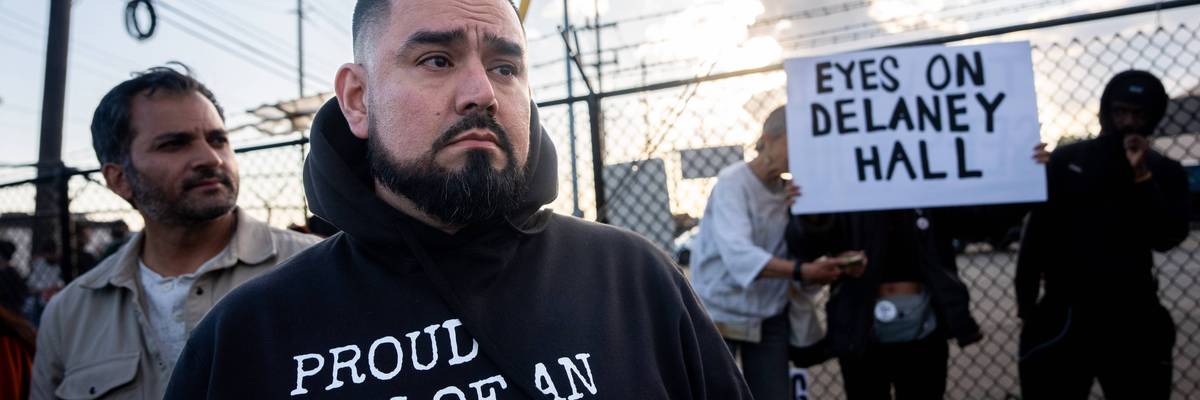
Protesters stand behind barricades near the Delaney Hall Immigration Detention Center in Newark, where Immigration and Customs Enforcement is housing detained immigrants on June 1, 2026 in Newark, New Jersey.
These new guidelines are a gift for private prison companies. By lowering standards across the board, they empower them to more thoroughly exploit detainees without fear of legal ramifications.
On June 15, Immigration and Customs Enforcement released new rules governing immigration jails intended to “streamline requirements” and “reduce the burden on our detention operators.”
The Washington Post reported on Tuesday that during the revision process, The GEO Group, one of the biggest private prison firms in the country, requested that ICE make changes that would benefit its businesses and court cases.
The GEO Group has significant ties with the Trump administration. It was a major donor to President Donald Trump’s 2025 inaugural fund and Trump-aligned super PAC. In 2025, they spent more than $3.6 million on lobbying expenditures. Perhaps most importantly two of Trump’s top immigration officials—Border Czar Tom Homan and Acting Director of ICE David Venturella—were previously employed by them.
In a statement, ICE claimed it “consulted with a variety of stakeholders, including facility operators responsible for implementing the standards,” and “considered that input” during the revision process. The end result, however, is a series of policies that overwhelmingly benefit private prisons.
Detention centers have always been inhumane institutions by design. Under Trump, they are becoming even worse.
This includes: first, clarifying that detainees “are not considered facility and/or government employees and are not entitled to wages or benefits.” This effectively eliminates a prior rule that stipulated that detainees “shall receive monetary compensation of not less than $1.00 per day for work completed.”
That change alone is a major win for private prisons. The GEO Group has faced multiple lawsuits for violating minimum wage laws. In 2023, the Washington Supreme Court ordered the company to pay $17.3 million to hundreds of detainees in back pay.
By designating detainees as non-employees, ICE is providing private prisons with the legal excuse needed to engage in even more egregious wage theft.
Second, the new guidelines specify that detention centers do not “have a right of refusal for any ICE detainee that ICE decides to detain.” As such, they will likely be forced to admit people who are severely ill or injured, regardless of whether they are able to provide appropriate medical care.
A related rule change notes that “in cases where a detainee has medical or mental health needs that exceed the capabilities of the facility, the facility shall notify ICE and request a transfer.” This process may take days—time that a detainee with a life-threatening condition may not have. To date, at least 50 people have died in ICE detention since the start of Trump’s mass deportation campaign in January 2025.
Notably, last year, the Department of Homeland Security (DHS) funneled $10 billion through the Navy to accelerate the construction of new detention centers that could house as many as 10,000 people each. Under the Navy’s terms, contractors building and staffing those new facilities do not have a “right of refusal and shall take all referrals from ICE as applicable.” ICE’s new guidelines expand that “right of refusal” to existing immigration centers.
This sets a dangerous precedent at a time when more US citizens are being swept up in ICE’s immigration raids. This includes people like Dulce Consuelo Diaz Moralez, a US-born citizen, who was wrongfully imprisoned by ICE for 25 days late last year. Denying detention centers a “right of refusal” will likely protect them from any lawsuits resulting from US citizens arrested and held by ICE.
Third, detention centers are permitted to use “machine learning-based translation or generative AI” for “non-critical communication (i.e., those of moderate importance, urgency, or significance) or during informal interactions with detainees.” This includes “reviewing and responding to a detainee’s non-English grievance or other request related to basic issues/concerns within detention.”
As Dr. Homer Venters, an expert on correctional healthcare, remarks, such grievances often include “very urgent or even emergent information such as when a patient has been denied lifesaving care.”
Many detainees have reported that guards routinely ignore their pleas for medical care and assistance. In May 2026 at The GEO Group-operated Delaney Hall, one detainee, Elder Guerra, suffered a seizure after falling and hitting the back of his head. It was only after detainees begged that guards finally called an ambulance for him. According to his relative, Guerra’s condition continues to worsen.
Substituting human translators with AI provides guards with a built-in excuse for their lack of responsiveness. Going forward, they can simply claim that the translation tool failed to communicate the urgency of their request, which led to inaction on their part.
After all, such tools are far from infallible. For instance, volunteers with Respond Crisis Translation, an organization that offers human translation and interpretation services for migrants and refugees, described a case where a woman seeking asylum due to domestic abuse used the phrase “mi jefe” to describe her father—a common colloquialism in her country. The AI tool translated the phrase literally as “my boss,” and her application was denied.
The basic problem is that machine learning algorithms are trained on datasets consisting of whatever is most represented in digital sources. While there are over 7,000 languages and dialects spoken worldwide, the vast majority of digital content is written in English, French, German, Spanish, Mandarin, and Russian. This limitation means that AI tools will be far more prone to error when it comes to translating idioms from underrepresented parts of the world as well as underrepresented languages, such as Wolof or Hausa.
Given that the new guidelines do not require any form of human oversight for AI translations, if the AI makes a mistake (and it will), that error may never be corrected. What’s more, if that error has serious consequences for a detainee, it’s unclear who, if anyone, would be held responsible.
ICE claims that it is constantly reevaluating its detention centers “to ensure we are providing the best care to illegal aliens in our custody.” And yet, while there have been hunger and labor strikes at three The GEO Group-operated immigration jails within the last three months, none of the new guidelines address those systematic failures.
This is not surprising, however. Since Trump retook office, DHS has eliminated and restricted oversight, while also rescinding regulations meant to hold detention operators responsible for their mistreatment of detainees. On June 4, ICE announced it will no longer investigate or report the deaths of those who have been recently released from their custody. This move is meant to absolve ICE of responsibility for the deaths of people like Daphy Michel. A medical examiner said Michel, a Haitian asylum-seeker, was “suffering from untreated severe mental health issues and a significant language barrier.” Despite this, ICE agents released her 25 miles away from Pittsburgh in the middle of winter without a coat or any regard for how she would get home. She died of hypothermia three days later.
Neither DHS, The GEO Group, nor any private prison firm care whatsoever about the health and well-being of detainees. On June 8, The GEO Group filed a lawsuit against Colorado challenging a new law that requires them to always have medical and mental health professionals available at their detention facilities. It is currently being sued by the state of New Jersey for refusing to allow its Department of Health to conduct a full inspection of Delaney Hall.
These new guidelines are a gift for private prison companies. By lowering standards across the board, ICE is empowering them to more thoroughly exploit detainees without fear of legal ramifications.
Detention centers have always been inhumane institutions by design. Under Trump, they are becoming even worse. There is only one viable solution here: abolish detention centers; abolish ICE.
Dear Common Dreams reader, It’s been nearly 30 years since I co-founded Common Dreams with my late wife, Lina Newhouser. We had the radical notion that journalism should serve the public good, not corporate profits. It was clear to us from the outset what it would take to build such a project. No paid advertisements. No corporate sponsors. No millionaire publisher telling us what to think or do. Many people said we wouldn't last a year, but we proved those doubters wrong. Together with a tremendous team of journalists and dedicated staff, we built an independent media outlet free from the constraints of profits and corporate control. Our mission has always been simple: To inform. To inspire. To ignite change for the common good. Building Common Dreams was not easy. Our survival was never guaranteed. When you take on the most powerful forces—Wall Street greed, fossil fuel industry destruction, Big Tech lobbyists, and uber-rich oligarchs who have spent billions upon billions rigging the economy and democracy in their favor—the only bulwark you have is supporters who believe in your work. But here’s the urgent message from me today. It's never been this bad out there. And it's never been this hard to keep us going. At the very moment Common Dreams is most needed, the threats we face are intensifying. We need your support now more than ever. We don't accept corporate advertising and never will. We don't have a paywall because we don't think people should be blocked from critical news based on their ability to pay. Everything we do is funded by the donations of readers like you. When everyone does the little they can afford, we are strong. But if that support retreats or dries up, so do we. Will you donate now to make sure Common Dreams not only survives but thrives? —Craig Brown, Co-founder |
On June 15, Immigration and Customs Enforcement released new rules governing immigration jails intended to “streamline requirements” and “reduce the burden on our detention operators.”
The Washington Post reported on Tuesday that during the revision process, The GEO Group, one of the biggest private prison firms in the country, requested that ICE make changes that would benefit its businesses and court cases.
The GEO Group has significant ties with the Trump administration. It was a major donor to President Donald Trump’s 2025 inaugural fund and Trump-aligned super PAC. In 2025, they spent more than $3.6 million on lobbying expenditures. Perhaps most importantly two of Trump’s top immigration officials—Border Czar Tom Homan and Acting Director of ICE David Venturella—were previously employed by them.
In a statement, ICE claimed it “consulted with a variety of stakeholders, including facility operators responsible for implementing the standards,” and “considered that input” during the revision process. The end result, however, is a series of policies that overwhelmingly benefit private prisons.
Detention centers have always been inhumane institutions by design. Under Trump, they are becoming even worse.
This includes: first, clarifying that detainees “are not considered facility and/or government employees and are not entitled to wages or benefits.” This effectively eliminates a prior rule that stipulated that detainees “shall receive monetary compensation of not less than $1.00 per day for work completed.”
That change alone is a major win for private prisons. The GEO Group has faced multiple lawsuits for violating minimum wage laws. In 2023, the Washington Supreme Court ordered the company to pay $17.3 million to hundreds of detainees in back pay.
By designating detainees as non-employees, ICE is providing private prisons with the legal excuse needed to engage in even more egregious wage theft.
Second, the new guidelines specify that detention centers do not “have a right of refusal for any ICE detainee that ICE decides to detain.” As such, they will likely be forced to admit people who are severely ill or injured, regardless of whether they are able to provide appropriate medical care.
A related rule change notes that “in cases where a detainee has medical or mental health needs that exceed the capabilities of the facility, the facility shall notify ICE and request a transfer.” This process may take days—time that a detainee with a life-threatening condition may not have. To date, at least 50 people have died in ICE detention since the start of Trump’s mass deportation campaign in January 2025.
Notably, last year, the Department of Homeland Security (DHS) funneled $10 billion through the Navy to accelerate the construction of new detention centers that could house as many as 10,000 people each. Under the Navy’s terms, contractors building and staffing those new facilities do not have a “right of refusal and shall take all referrals from ICE as applicable.” ICE’s new guidelines expand that “right of refusal” to existing immigration centers.
This sets a dangerous precedent at a time when more US citizens are being swept up in ICE’s immigration raids. This includes people like Dulce Consuelo Diaz Moralez, a US-born citizen, who was wrongfully imprisoned by ICE for 25 days late last year. Denying detention centers a “right of refusal” will likely protect them from any lawsuits resulting from US citizens arrested and held by ICE.
Third, detention centers are permitted to use “machine learning-based translation or generative AI” for “non-critical communication (i.e., those of moderate importance, urgency, or significance) or during informal interactions with detainees.” This includes “reviewing and responding to a detainee’s non-English grievance or other request related to basic issues/concerns within detention.”
As Dr. Homer Venters, an expert on correctional healthcare, remarks, such grievances often include “very urgent or even emergent information such as when a patient has been denied lifesaving care.”
Many detainees have reported that guards routinely ignore their pleas for medical care and assistance. In May 2026 at The GEO Group-operated Delaney Hall, one detainee, Elder Guerra, suffered a seizure after falling and hitting the back of his head. It was only after detainees begged that guards finally called an ambulance for him. According to his relative, Guerra’s condition continues to worsen.
Substituting human translators with AI provides guards with a built-in excuse for their lack of responsiveness. Going forward, they can simply claim that the translation tool failed to communicate the urgency of their request, which led to inaction on their part.
After all, such tools are far from infallible. For instance, volunteers with Respond Crisis Translation, an organization that offers human translation and interpretation services for migrants and refugees, described a case where a woman seeking asylum due to domestic abuse used the phrase “mi jefe” to describe her father—a common colloquialism in her country. The AI tool translated the phrase literally as “my boss,” and her application was denied.
The basic problem is that machine learning algorithms are trained on datasets consisting of whatever is most represented in digital sources. While there are over 7,000 languages and dialects spoken worldwide, the vast majority of digital content is written in English, French, German, Spanish, Mandarin, and Russian. This limitation means that AI tools will be far more prone to error when it comes to translating idioms from underrepresented parts of the world as well as underrepresented languages, such as Wolof or Hausa.
Given that the new guidelines do not require any form of human oversight for AI translations, if the AI makes a mistake (and it will), that error may never be corrected. What’s more, if that error has serious consequences for a detainee, it’s unclear who, if anyone, would be held responsible.
ICE claims that it is constantly reevaluating its detention centers “to ensure we are providing the best care to illegal aliens in our custody.” And yet, while there have been hunger and labor strikes at three The GEO Group-operated immigration jails within the last three months, none of the new guidelines address those systematic failures.
This is not surprising, however. Since Trump retook office, DHS has eliminated and restricted oversight, while also rescinding regulations meant to hold detention operators responsible for their mistreatment of detainees. On June 4, ICE announced it will no longer investigate or report the deaths of those who have been recently released from their custody. This move is meant to absolve ICE of responsibility for the deaths of people like Daphy Michel. A medical examiner said Michel, a Haitian asylum-seeker, was “suffering from untreated severe mental health issues and a significant language barrier.” Despite this, ICE agents released her 25 miles away from Pittsburgh in the middle of winter without a coat or any regard for how she would get home. She died of hypothermia three days later.
Neither DHS, The GEO Group, nor any private prison firm care whatsoever about the health and well-being of detainees. On June 8, The GEO Group filed a lawsuit against Colorado challenging a new law that requires them to always have medical and mental health professionals available at their detention facilities. It is currently being sued by the state of New Jersey for refusing to allow its Department of Health to conduct a full inspection of Delaney Hall.
These new guidelines are a gift for private prison companies. By lowering standards across the board, ICE is empowering them to more thoroughly exploit detainees without fear of legal ramifications.
Detention centers have always been inhumane institutions by design. Under Trump, they are becoming even worse. There is only one viable solution here: abolish detention centers; abolish ICE.
On June 15, Immigration and Customs Enforcement released new rules governing immigration jails intended to “streamline requirements” and “reduce the burden on our detention operators.”
The Washington Post reported on Tuesday that during the revision process, The GEO Group, one of the biggest private prison firms in the country, requested that ICE make changes that would benefit its businesses and court cases.
The GEO Group has significant ties with the Trump administration. It was a major donor to President Donald Trump’s 2025 inaugural fund and Trump-aligned super PAC. In 2025, they spent more than $3.6 million on lobbying expenditures. Perhaps most importantly two of Trump’s top immigration officials—Border Czar Tom Homan and Acting Director of ICE David Venturella—were previously employed by them.
In a statement, ICE claimed it “consulted with a variety of stakeholders, including facility operators responsible for implementing the standards,” and “considered that input” during the revision process. The end result, however, is a series of policies that overwhelmingly benefit private prisons.
Detention centers have always been inhumane institutions by design. Under Trump, they are becoming even worse.
This includes: first, clarifying that detainees “are not considered facility and/or government employees and are not entitled to wages or benefits.” This effectively eliminates a prior rule that stipulated that detainees “shall receive monetary compensation of not less than $1.00 per day for work completed.”
That change alone is a major win for private prisons. The GEO Group has faced multiple lawsuits for violating minimum wage laws. In 2023, the Washington Supreme Court ordered the company to pay $17.3 million to hundreds of detainees in back pay.
By designating detainees as non-employees, ICE is providing private prisons with the legal excuse needed to engage in even more egregious wage theft.
Second, the new guidelines specify that detention centers do not “have a right of refusal for any ICE detainee that ICE decides to detain.” As such, they will likely be forced to admit people who are severely ill or injured, regardless of whether they are able to provide appropriate medical care.
A related rule change notes that “in cases where a detainee has medical or mental health needs that exceed the capabilities of the facility, the facility shall notify ICE and request a transfer.” This process may take days—time that a detainee with a life-threatening condition may not have. To date, at least 50 people have died in ICE detention since the start of Trump’s mass deportation campaign in January 2025.
Notably, last year, the Department of Homeland Security (DHS) funneled $10 billion through the Navy to accelerate the construction of new detention centers that could house as many as 10,000 people each. Under the Navy’s terms, contractors building and staffing those new facilities do not have a “right of refusal and shall take all referrals from ICE as applicable.” ICE’s new guidelines expand that “right of refusal” to existing immigration centers.
This sets a dangerous precedent at a time when more US citizens are being swept up in ICE’s immigration raids. This includes people like Dulce Consuelo Diaz Moralez, a US-born citizen, who was wrongfully imprisoned by ICE for 25 days late last year. Denying detention centers a “right of refusal” will likely protect them from any lawsuits resulting from US citizens arrested and held by ICE.
Third, detention centers are permitted to use “machine learning-based translation or generative AI” for “non-critical communication (i.e., those of moderate importance, urgency, or significance) or during informal interactions with detainees.” This includes “reviewing and responding to a detainee’s non-English grievance or other request related to basic issues/concerns within detention.”
As Dr. Homer Venters, an expert on correctional healthcare, remarks, such grievances often include “very urgent or even emergent information such as when a patient has been denied lifesaving care.”
Many detainees have reported that guards routinely ignore their pleas for medical care and assistance. In May 2026 at The GEO Group-operated Delaney Hall, one detainee, Elder Guerra, suffered a seizure after falling and hitting the back of his head. It was only after detainees begged that guards finally called an ambulance for him. According to his relative, Guerra’s condition continues to worsen.
Substituting human translators with AI provides guards with a built-in excuse for their lack of responsiveness. Going forward, they can simply claim that the translation tool failed to communicate the urgency of their request, which led to inaction on their part.
After all, such tools are far from infallible. For instance, volunteers with Respond Crisis Translation, an organization that offers human translation and interpretation services for migrants and refugees, described a case where a woman seeking asylum due to domestic abuse used the phrase “mi jefe” to describe her father—a common colloquialism in her country. The AI tool translated the phrase literally as “my boss,” and her application was denied.
The basic problem is that machine learning algorithms are trained on datasets consisting of whatever is most represented in digital sources. While there are over 7,000 languages and dialects spoken worldwide, the vast majority of digital content is written in English, French, German, Spanish, Mandarin, and Russian. This limitation means that AI tools will be far more prone to error when it comes to translating idioms from underrepresented parts of the world as well as underrepresented languages, such as Wolof or Hausa.
Given that the new guidelines do not require any form of human oversight for AI translations, if the AI makes a mistake (and it will), that error may never be corrected. What’s more, if that error has serious consequences for a detainee, it’s unclear who, if anyone, would be held responsible.
ICE claims that it is constantly reevaluating its detention centers “to ensure we are providing the best care to illegal aliens in our custody.” And yet, while there have been hunger and labor strikes at three The GEO Group-operated immigration jails within the last three months, none of the new guidelines address those systematic failures.
This is not surprising, however. Since Trump retook office, DHS has eliminated and restricted oversight, while also rescinding regulations meant to hold detention operators responsible for their mistreatment of detainees. On June 4, ICE announced it will no longer investigate or report the deaths of those who have been recently released from their custody. This move is meant to absolve ICE of responsibility for the deaths of people like Daphy Michel. A medical examiner said Michel, a Haitian asylum-seeker, was “suffering from untreated severe mental health issues and a significant language barrier.” Despite this, ICE agents released her 25 miles away from Pittsburgh in the middle of winter without a coat or any regard for how she would get home. She died of hypothermia three days later.
Neither DHS, The GEO Group, nor any private prison firm care whatsoever about the health and well-being of detainees. On June 8, The GEO Group filed a lawsuit against Colorado challenging a new law that requires them to always have medical and mental health professionals available at their detention facilities. It is currently being sued by the state of New Jersey for refusing to allow its Department of Health to conduct a full inspection of Delaney Hall.
These new guidelines are a gift for private prison companies. By lowering standards across the board, ICE is empowering them to more thoroughly exploit detainees without fear of legal ramifications.
Detention centers have always been inhumane institutions by design. Under Trump, they are becoming even worse. There is only one viable solution here: abolish detention centers; abolish ICE.