5
#000000
#FFFFFF
To donate by check, phone, or other method, see our More Ways to Give page.
Daily news & progressive opinion—funded by the people, not the corporations—delivered straight to your inbox.
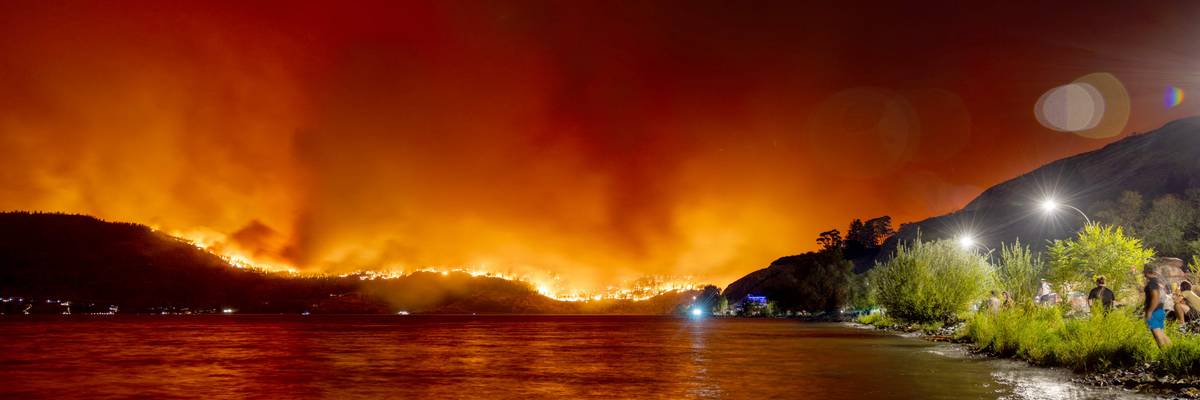
Residents watch the McDougall Creek wildfire in West Kelowna, British Columbia, Canada, on August 17, 2023, from Kelowna.
We cannot pursue solutions to the nuclear and global warming threats amid confusion, myths, half-truths, and a lack of basic understanding of facts.
The current state of our world has repeatedly been described as one of the most challenging moments since the end of World War II and certainly since the end of the Cold War. We are bombarded daily by the devastating and terrifying news of wars raging in the Middle East and Ukraine; global warming inducing unprecedented heatwaves, wildfires, glacial collapse, and floods; and more recently reports and debates surrounding the existential risk that artificial intelligence may present to humanity. How we address this seeming state of permanent crisis may not just be a matter of humanity’s ability to thrive into the future, but actually survive.
Two of the current threats that have seemingly disparate time scales and geographical footprints, and even differences as to whether they would make the world unlivable by way of decreased or increased temperatures, are nuclear war and global warming. And yet, in both cases, we are dealing with human-made problems that humans can resolve, with some work, yes, but certainly nothing insurmountable. The answer to the nuclear threat is the elimination of nuclear weapons, and the answer to the global warming threat is the remaking of how we produce and use energy to move away from burning fossil fuels. Arguably, the biggest impediment to the solutions to both crises are the false narratives that are advanced for the sake of power, profit, and dominance. We simply cannot agree on the solutions, let alone implement them, if we do not understand what is at stake when it comes to nuclear war and global warming.
The nuclear war threat has been with us since the dawn of the nuclear age. In 1946, when just one country, the United States, had a handful of atomic bombs, Albert Einstein wrote that the “unleashed power of the atom has changed everything save our modes of thinking and we thus drift to unparalleled catastrophe.” Einstein understood right away that: (1) the nuclear weapon threat was not going to reach its culmination with the destruction of individual cities the way that Hiroshima and Nagasaki were destroyed but something far greater and more catastrophic—he called it unparalleled catastrophe; and (2) what was needed was to change our modes of thinking—meaning that peace, cooperation, and a genuine fraternity among nations were needed in the nuclear age to ensure that the unparalleled catastrophe would not come to pass.
Alongside of the ever-present nuclear “sword of Damocles,” we have a planet that is warming and doing so very quickly, with the increase in temperatures creating numerous other climatic and environmental changes,
Eighty years after Einstein’s prophetic words, nine countries possess more than 12,000 atomic bombs and much more powerful hydrogen bombs, most of which make the explosions over Hiroshima and Nagasaki seem like child’s play. Even if the world were relatively peaceful, which it is not, these weapons would continue to hold us hostage to the threat of ultimate destruction, even just from accidents or misunderstandings or miscalculations. This is at least in part due to some of the current policies of nuclear-armed states, like hair-trigger alert, or readiness to launch nuclear weapons in a matter of a few minutes, and launch-on-warning, or readiness to launch nuclear weapons in response to a warning of a strike, not an actual strike, not to mention the advances in delivery vehicles of these weapons of mass destruction. In fact, the history of the nuclear age is full of incidents in which nuclear weapons could have been launched, with all indications pointing to nuclear war as the outcome of even an accidental nuclear explosion. Today, a time of widespread conflicts, the danger is not just a blunder into nuclear war, but even a deliberate use of nuclear weapons.
What is at stake in a nuclear war?
What we are facing is the unparalleled catastrophe that Einstein warned about. And for a variety of reasons, it remains largely out of the public’s consciousness, invisible, and yet all too real, especially today when there are, according to the Geneva Academy, over 100 armed conflicts around the world, including 24 international armed conflicts involving two or more nation states. Two play a prominent role—the war in Ukraine, which has been described as a proxy war between NATO and Russia, and the US and Israel war on Iran. In both wars, nuclear weapons have featured prominently, not just as the underlying justification for conflict, as the US and Israel have claimed about Iran’s potential to build a nuclear weapon, but also via direct and indirect threats, including by President Donald Trump on April 7 of this year, that “a whole civilization will die tonight.” Although the history of the nuclear age is full of examples of US presidents contemplating or outright threatening to use nuclear weapons in previous conflicts, we seem to have reached a novel stage of danger, risk, and complexity.
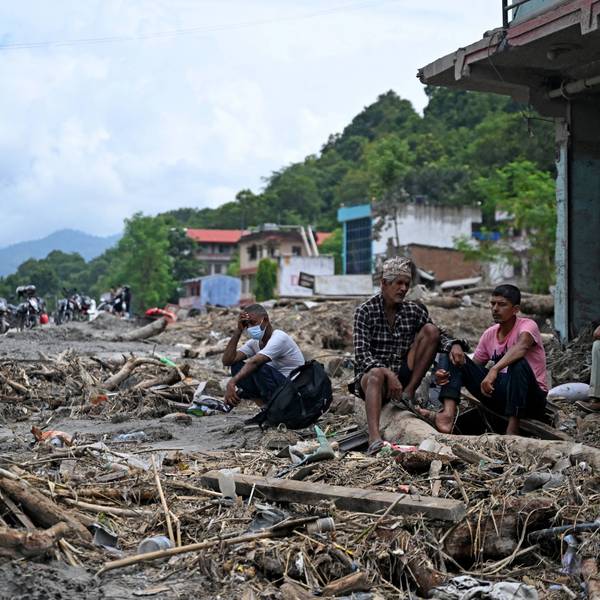
Alongside of the ever-present nuclear “sword of Damocles,” we have a planet that is warming and doing so very quickly, with the increase in temperatures creating numerous other climatic and environmental changes, including sea-level rise, wildfires, droughts, and more. We have watched and experienced some of these impacts in horror even just this summer, including the heatwave and wildfires in Europe and the glacier collapse and floods in Nepal and China. A commenter to a Geopolitical Economist Hour podcast episode where I spoke about the climate threat with the host, Radhika Desai, wrote, “In British Columbia, we no longer have summer season, we just have fire season,” which sums up the situation rather succinctly.
Why is the globe warming? The globe is warming because we humans are burning fossil fuels, which release additional carbon dioxide into the atmosphere, which acts as a greenhouse gas, trapping heat in the atmosphere and raising the temperature across the planet, albeit in uneven ways. For example, Europe has been warming at twice the rate of global temperature increases, and the Arctic is warming at nearly three times the rate of global temperature rise. Combined with the complexity of climate, streams, weather patterns, and more, this will continue to lead to widespread negative consequences across the globe, in fits and starts with devastating local and regional implications. Wildfire smoke spreading far and wide, for example, will ensure that even the regions least prone to impact will not be safe. No corner of the Earth will be unaffected.
Genuine solutions exist. In 1986, the world had more than 70,000 nuclear warheads and over the next 30 years, managed to eliminate more than 80% of them. Energy transformation solutions exist, and China, for one, has been employing them rapidly and effectively over the last few years. But we cannot pursue solutions amid confusion, myths, half-truths, and lack of even a basic understanding of facts.
Neither of these issues will be properly addressed with blind faith in a narrative. They will be resolved when ordinary people and elected leaders alike take up the hard task of understanding the issues and then discussing the solutions that are right for their communities, nation states, and the world as a whole. Knowledge is often considered to mean power. In this case, it may just mean survival.
A modified portion of these remarks was delivered during a webinar entitled Permanent Crisis? Permanent War? Who wants it? Who benefits? Who cares? with professors Radhika Desai, Ivana Nikolic Hughes, Fadhel Kaboub, Steve Keen, Jeffrey Sachs, and Genevieve Vaughan; chaired by Rajani Kanth, for the Global Political Economy channel: https://www.youtube.com/watch?v=KHarGYBto9A
Dear Common Dreams reader, It’s been nearly 30 years since I co-founded Common Dreams with my late wife, Lina Newhouser. We had the radical notion that journalism should serve the public good, not corporate profits. It was clear to us from the outset what it would take to build such a project. No paid advertisements. No corporate sponsors. No millionaire publisher telling us what to think or do. Many people said we wouldn't last a year, but we proved those doubters wrong. Together with a tremendous team of journalists and dedicated staff, we built an independent media outlet free from the constraints of profits and corporate control. Our mission has always been simple: To inform. To inspire. To ignite change for the common good. Building Common Dreams was not easy. Our survival was never guaranteed. When you take on the most powerful forces—Wall Street greed, fossil fuel industry destruction, Big Tech lobbyists, and uber-rich oligarchs who have spent billions upon billions rigging the economy and democracy in their favor—the only bulwark you have is supporters who believe in your work. But here’s the urgent message from me today. It's never been this bad out there. And it's never been this hard to keep us going. At the very moment Common Dreams is most needed, the threats we face are intensifying. We need your support now more than ever. We don't accept corporate advertising and never will. We don't have a paywall because we don't think people should be blocked from critical news based on their ability to pay. Everything we do is funded by the donations of readers like you. When everyone does the little they can afford, we are strong. But if that support retreats or dries up, so do we. Will you donate now to make sure Common Dreams not only survives but thrives? —Craig Brown, Co-founder |
The current state of our world has repeatedly been described as one of the most challenging moments since the end of World War II and certainly since the end of the Cold War. We are bombarded daily by the devastating and terrifying news of wars raging in the Middle East and Ukraine; global warming inducing unprecedented heatwaves, wildfires, glacial collapse, and floods; and more recently reports and debates surrounding the existential risk that artificial intelligence may present to humanity. How we address this seeming state of permanent crisis may not just be a matter of humanity’s ability to thrive into the future, but actually survive.
Two of the current threats that have seemingly disparate time scales and geographical footprints, and even differences as to whether they would make the world unlivable by way of decreased or increased temperatures, are nuclear war and global warming. And yet, in both cases, we are dealing with human-made problems that humans can resolve, with some work, yes, but certainly nothing insurmountable. The answer to the nuclear threat is the elimination of nuclear weapons, and the answer to the global warming threat is the remaking of how we produce and use energy to move away from burning fossil fuels. Arguably, the biggest impediment to the solutions to both crises are the false narratives that are advanced for the sake of power, profit, and dominance. We simply cannot agree on the solutions, let alone implement them, if we do not understand what is at stake when it comes to nuclear war and global warming.
The nuclear war threat has been with us since the dawn of the nuclear age. In 1946, when just one country, the United States, had a handful of atomic bombs, Albert Einstein wrote that the “unleashed power of the atom has changed everything save our modes of thinking and we thus drift to unparalleled catastrophe.” Einstein understood right away that: (1) the nuclear weapon threat was not going to reach its culmination with the destruction of individual cities the way that Hiroshima and Nagasaki were destroyed but something far greater and more catastrophic—he called it unparalleled catastrophe; and (2) what was needed was to change our modes of thinking—meaning that peace, cooperation, and a genuine fraternity among nations were needed in the nuclear age to ensure that the unparalleled catastrophe would not come to pass.
Alongside of the ever-present nuclear “sword of Damocles,” we have a planet that is warming and doing so very quickly, with the increase in temperatures creating numerous other climatic and environmental changes,
Eighty years after Einstein’s prophetic words, nine countries possess more than 12,000 atomic bombs and much more powerful hydrogen bombs, most of which make the explosions over Hiroshima and Nagasaki seem like child’s play. Even if the world were relatively peaceful, which it is not, these weapons would continue to hold us hostage to the threat of ultimate destruction, even just from accidents or misunderstandings or miscalculations. This is at least in part due to some of the current policies of nuclear-armed states, like hair-trigger alert, or readiness to launch nuclear weapons in a matter of a few minutes, and launch-on-warning, or readiness to launch nuclear weapons in response to a warning of a strike, not an actual strike, not to mention the advances in delivery vehicles of these weapons of mass destruction. In fact, the history of the nuclear age is full of incidents in which nuclear weapons could have been launched, with all indications pointing to nuclear war as the outcome of even an accidental nuclear explosion. Today, a time of widespread conflicts, the danger is not just a blunder into nuclear war, but even a deliberate use of nuclear weapons.
What is at stake in a nuclear war?
What we are facing is the unparalleled catastrophe that Einstein warned about. And for a variety of reasons, it remains largely out of the public’s consciousness, invisible, and yet all too real, especially today when there are, according to the Geneva Academy, over 100 armed conflicts around the world, including 24 international armed conflicts involving two or more nation states. Two play a prominent role—the war in Ukraine, which has been described as a proxy war between NATO and Russia, and the US and Israel war on Iran. In both wars, nuclear weapons have featured prominently, not just as the underlying justification for conflict, as the US and Israel have claimed about Iran’s potential to build a nuclear weapon, but also via direct and indirect threats, including by President Donald Trump on April 7 of this year, that “a whole civilization will die tonight.” Although the history of the nuclear age is full of examples of US presidents contemplating or outright threatening to use nuclear weapons in previous conflicts, we seem to have reached a novel stage of danger, risk, and complexity.
Alongside of the ever-present nuclear “sword of Damocles,” we have a planet that is warming and doing so very quickly, with the increase in temperatures creating numerous other climatic and environmental changes, including sea-level rise, wildfires, droughts, and more. We have watched and experienced some of these impacts in horror even just this summer, including the heatwave and wildfires in Europe and the glacier collapse and floods in Nepal and China. A commenter to a Geopolitical Economist Hour podcast episode where I spoke about the climate threat with the host, Radhika Desai, wrote, “In British Columbia, we no longer have summer season, we just have fire season,” which sums up the situation rather succinctly.
Why is the globe warming? The globe is warming because we humans are burning fossil fuels, which release additional carbon dioxide into the atmosphere, which acts as a greenhouse gas, trapping heat in the atmosphere and raising the temperature across the planet, albeit in uneven ways. For example, Europe has been warming at twice the rate of global temperature increases, and the Arctic is warming at nearly three times the rate of global temperature rise. Combined with the complexity of climate, streams, weather patterns, and more, this will continue to lead to widespread negative consequences across the globe, in fits and starts with devastating local and regional implications. Wildfire smoke spreading far and wide, for example, will ensure that even the regions least prone to impact will not be safe. No corner of the Earth will be unaffected.
Genuine solutions exist. In 1986, the world had more than 70,000 nuclear warheads and over the next 30 years, managed to eliminate more than 80% of them. Energy transformation solutions exist, and China, for one, has been employing them rapidly and effectively over the last few years. But we cannot pursue solutions amid confusion, myths, half-truths, and lack of even a basic understanding of facts.
Neither of these issues will be properly addressed with blind faith in a narrative. They will be resolved when ordinary people and elected leaders alike take up the hard task of understanding the issues and then discussing the solutions that are right for their communities, nation states, and the world as a whole. Knowledge is often considered to mean power. In this case, it may just mean survival.
A modified portion of these remarks was delivered during a webinar entitled Permanent Crisis? Permanent War? Who wants it? Who benefits? Who cares? with professors Radhika Desai, Ivana Nikolic Hughes, Fadhel Kaboub, Steve Keen, Jeffrey Sachs, and Genevieve Vaughan; chaired by Rajani Kanth, for the Global Political Economy channel: https://www.youtube.com/watch?v=KHarGYBto9A
The current state of our world has repeatedly been described as one of the most challenging moments since the end of World War II and certainly since the end of the Cold War. We are bombarded daily by the devastating and terrifying news of wars raging in the Middle East and Ukraine; global warming inducing unprecedented heatwaves, wildfires, glacial collapse, and floods; and more recently reports and debates surrounding the existential risk that artificial intelligence may present to humanity. How we address this seeming state of permanent crisis may not just be a matter of humanity’s ability to thrive into the future, but actually survive.
Two of the current threats that have seemingly disparate time scales and geographical footprints, and even differences as to whether they would make the world unlivable by way of decreased or increased temperatures, are nuclear war and global warming. And yet, in both cases, we are dealing with human-made problems that humans can resolve, with some work, yes, but certainly nothing insurmountable. The answer to the nuclear threat is the elimination of nuclear weapons, and the answer to the global warming threat is the remaking of how we produce and use energy to move away from burning fossil fuels. Arguably, the biggest impediment to the solutions to both crises are the false narratives that are advanced for the sake of power, profit, and dominance. We simply cannot agree on the solutions, let alone implement them, if we do not understand what is at stake when it comes to nuclear war and global warming.
The nuclear war threat has been with us since the dawn of the nuclear age. In 1946, when just one country, the United States, had a handful of atomic bombs, Albert Einstein wrote that the “unleashed power of the atom has changed everything save our modes of thinking and we thus drift to unparalleled catastrophe.” Einstein understood right away that: (1) the nuclear weapon threat was not going to reach its culmination with the destruction of individual cities the way that Hiroshima and Nagasaki were destroyed but something far greater and more catastrophic—he called it unparalleled catastrophe; and (2) what was needed was to change our modes of thinking—meaning that peace, cooperation, and a genuine fraternity among nations were needed in the nuclear age to ensure that the unparalleled catastrophe would not come to pass.
Alongside of the ever-present nuclear “sword of Damocles,” we have a planet that is warming and doing so very quickly, with the increase in temperatures creating numerous other climatic and environmental changes,
Eighty years after Einstein’s prophetic words, nine countries possess more than 12,000 atomic bombs and much more powerful hydrogen bombs, most of which make the explosions over Hiroshima and Nagasaki seem like child’s play. Even if the world were relatively peaceful, which it is not, these weapons would continue to hold us hostage to the threat of ultimate destruction, even just from accidents or misunderstandings or miscalculations. This is at least in part due to some of the current policies of nuclear-armed states, like hair-trigger alert, or readiness to launch nuclear weapons in a matter of a few minutes, and launch-on-warning, or readiness to launch nuclear weapons in response to a warning of a strike, not an actual strike, not to mention the advances in delivery vehicles of these weapons of mass destruction. In fact, the history of the nuclear age is full of incidents in which nuclear weapons could have been launched, with all indications pointing to nuclear war as the outcome of even an accidental nuclear explosion. Today, a time of widespread conflicts, the danger is not just a blunder into nuclear war, but even a deliberate use of nuclear weapons.
What is at stake in a nuclear war?
What we are facing is the unparalleled catastrophe that Einstein warned about. And for a variety of reasons, it remains largely out of the public’s consciousness, invisible, and yet all too real, especially today when there are, according to the Geneva Academy, over 100 armed conflicts around the world, including 24 international armed conflicts involving two or more nation states. Two play a prominent role—the war in Ukraine, which has been described as a proxy war between NATO and Russia, and the US and Israel war on Iran. In both wars, nuclear weapons have featured prominently, not just as the underlying justification for conflict, as the US and Israel have claimed about Iran’s potential to build a nuclear weapon, but also via direct and indirect threats, including by President Donald Trump on April 7 of this year, that “a whole civilization will die tonight.” Although the history of the nuclear age is full of examples of US presidents contemplating or outright threatening to use nuclear weapons in previous conflicts, we seem to have reached a novel stage of danger, risk, and complexity.
Alongside of the ever-present nuclear “sword of Damocles,” we have a planet that is warming and doing so very quickly, with the increase in temperatures creating numerous other climatic and environmental changes, including sea-level rise, wildfires, droughts, and more. We have watched and experienced some of these impacts in horror even just this summer, including the heatwave and wildfires in Europe and the glacier collapse and floods in Nepal and China. A commenter to a Geopolitical Economist Hour podcast episode where I spoke about the climate threat with the host, Radhika Desai, wrote, “In British Columbia, we no longer have summer season, we just have fire season,” which sums up the situation rather succinctly.
Why is the globe warming? The globe is warming because we humans are burning fossil fuels, which release additional carbon dioxide into the atmosphere, which acts as a greenhouse gas, trapping heat in the atmosphere and raising the temperature across the planet, albeit in uneven ways. For example, Europe has been warming at twice the rate of global temperature increases, and the Arctic is warming at nearly three times the rate of global temperature rise. Combined with the complexity of climate, streams, weather patterns, and more, this will continue to lead to widespread negative consequences across the globe, in fits and starts with devastating local and regional implications. Wildfire smoke spreading far and wide, for example, will ensure that even the regions least prone to impact will not be safe. No corner of the Earth will be unaffected.
Genuine solutions exist. In 1986, the world had more than 70,000 nuclear warheads and over the next 30 years, managed to eliminate more than 80% of them. Energy transformation solutions exist, and China, for one, has been employing them rapidly and effectively over the last few years. But we cannot pursue solutions amid confusion, myths, half-truths, and lack of even a basic understanding of facts.
Neither of these issues will be properly addressed with blind faith in a narrative. They will be resolved when ordinary people and elected leaders alike take up the hard task of understanding the issues and then discussing the solutions that are right for their communities, nation states, and the world as a whole. Knowledge is often considered to mean power. In this case, it may just mean survival.
A modified portion of these remarks was delivered during a webinar entitled Permanent Crisis? Permanent War? Who wants it? Who benefits? Who cares? with professors Radhika Desai, Ivana Nikolic Hughes, Fadhel Kaboub, Steve Keen, Jeffrey Sachs, and Genevieve Vaughan; chaired by Rajani Kanth, for the Global Political Economy channel: https://www.youtube.com/watch?v=KHarGYBto9A