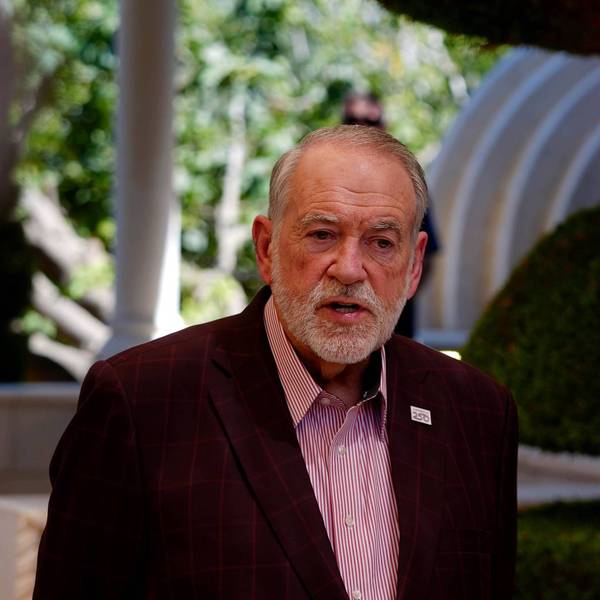
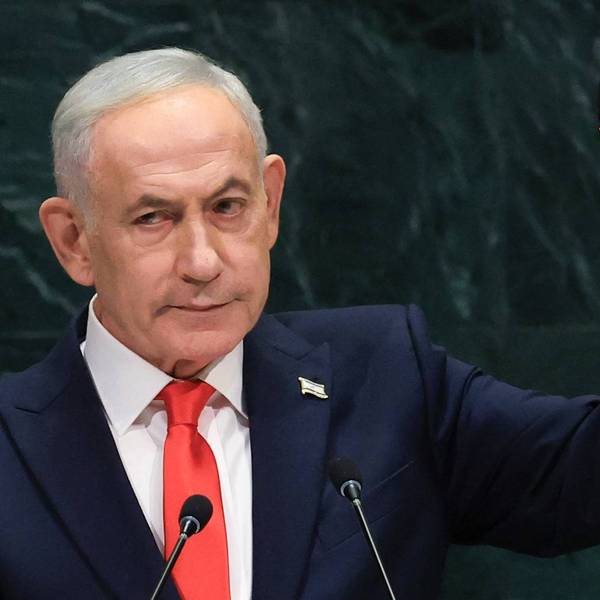
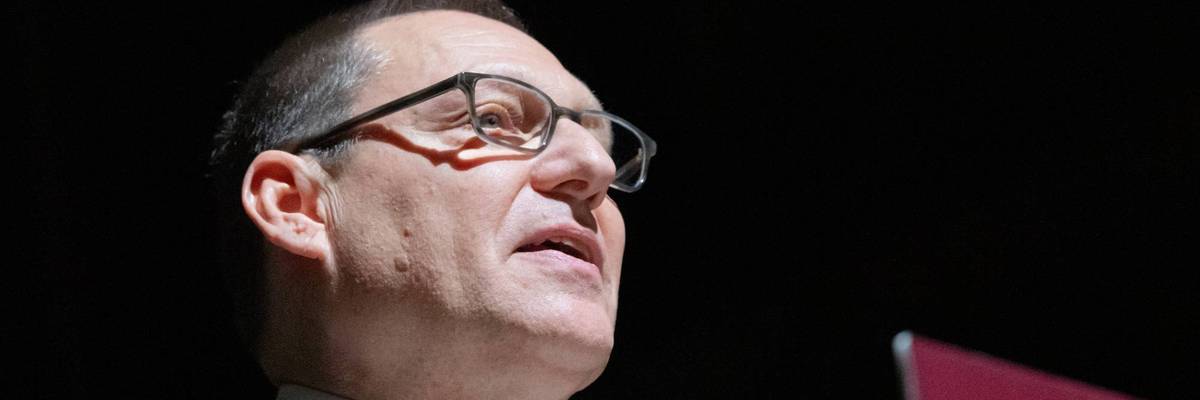
Avi Lewis, leader of the federal New Democratic Party (NDP) in Canada, speaking at the memorial service of his father Stephen Lewis, the Canadian politician, diplomat, and activist who died earlier this year at the age of 88.
In Defense of Avi Lewis, a Principled Voice in the Shadow of Genocide
Lewis’ track record of defending Palestinian rights reverberates with many in the Jewish community and with countless others across Canada and beyond.
One of the really likeable things about Canada, along with public health care and politeness, is our penchant for reasoned debate as a way to settle our political differences.
So it’s been jarring to see the level of vitriol recently directed toward Avi Lewis, federal leader of the New Democratic Party, who has been an outspoken critic of Israel’s assault on Gaza and Palestinians.
Lewis, who is Jewish, has come under harsh attack from several prominent critics, especially in response to a recent social media post on the eve of Yom Kippur.
Globe and Mail columnist Robyn Urback accused Lewis of engaging in “antisemitism,” and public finance economist Jack Mintz denounced Lewis at an award ceremony, saying that anti-Israel critics “soon turn to antisemitism.”
Most unsettling however was an article in the National Post, written by Yoni Goldstein, former editor of the Canadian Jewish News, which accused Lewis of “endanger(ing) Jews everywhere in Canada,” and insisting that “(w)hen the community is endangered from the inside, reasoned debate and private conversations are no longer options.”
Instead of reasoned debate, Goldstein suggests Biblical law provides guidance for handling the threat allegedly posed by Lewis. Under the headline “Jewish law tells us how to deal with Avi Lewis,” Goldstein’s article recounts the story of God punishing the Biblical dissenter Korach, burning him and his followers alive, after Korach endangered the Jewish community.
While the article doesn’t directly call for violence against Lewis, it certainly hints at it.
Surely, any suggestion that religious law justifies bloodshed against political dissenters — or anyone else — is completely out of sync with Canadian values, no matter what the religion.
Lewis enraged some in the Jewish community by writing on the eve of a Jewish holy day: “For Jewish people, the personal has always been political and the political always personal. This year I’m reflecting on the fact that we failed to do our part to stop an ongoing genocide committed in our name.”
When accused of suggesting some sort of collective responsibility, Lewis clarified: “I spoke as a Jewish Canadian from a place of profound sadness. … Many Jews have said that we have not done enough as Jewish people, among a family of faiths and communities around the world.”
In The Breach, Judy Rebick pointed out that Lewis’ comment was reminiscent of the conscientious men who created the White Ribbon campaign (which opposed violence against women) because they felt a special responsibility as men to address such violence.
Lewis says that, as a Jew, he feels particularly strongly about Israel’s actions against Palestinians, since Israel sometimes claims to act on behalf of the Jewish people.
As a political leader with a megaphone, Lewis really does represent a danger — namely, to the fiercely pro-Israel voices that have long managed to suppress criticism of Israel both inside and outside the community.
The response in some quarters has been extreme, not only smearing Lewis, but even hinting at violence against him.
Lewis comes from an honourable tradition of dissent within the Jewish community. He’s proud that his great-grandfather, Moishe Losz, was a leader of the Jewish Labour Bund, a trade union and political movement that battled antisemitism in Poland, while strongly resisting Zionist calls to solve the problem of Jewish dispossession by taking land from Palestinians.
The struggle between the Bund and the Zionists was bitter, with Zionists ultimately triumphing and managing to establish the state of Israel on land formerly occupied by Palestinians. However, the plight of the Palestinians has remained a central focus for a segment of the Jewish community.
Lewis’s track record of defending Palestinian rights reverberates with this segment of Jewish opinion, and with many other Canadians. His stand for Palestinian justice is a principled one — and all the more laudable given the ferocity — and occasional menace — of his critics.
We are at a crossroads
This country and this world are at a monumental crossroads. In a few short weeks, US voters will have an opportunity to beat back the forces of fascism and confront the billionaires who are rigging the economy, our media system, and our democracy, making it increasingly impossible for ordinary people to get by. We’re not just talking about the election. We’re talking about what must be done once these fascist elements are vanquished from power. We need a bolder set of solutions than what either major party has so far been willing to offer and a working-class movement ready to fight like hell for it. Trump didn't emerge from nowhere. The conditions that fueled MAGA authoritarianism were created by decades of radical neoliberal economic policies and a corrupt political system dominated by corporate interests. They slashed taxes on the super-rich, promising that the benefits would trickle down. They said giveaways to the corporate titans would make life more affordable for the rest of us. It was all bullshit. And when a bitter, betrayed populace searches for someone to blame, right-wing demagogues have little trouble finding scapegoats. People know when they're being lied to, but you won't hear any of this from the corporate media. Only independent journalism—powered and funded by people who believe in building a better world—can deliver truly trustworthy daily news. Our Fall Campaign is underway, and we need your help. To power our newsroom through the rest of the year, we need to raise $125,000 by midnight on October 31. So if you share our vision, please contribute whatever you can to sustain our work. |
One of the really likeable things about Canada, along with public health care and politeness, is our penchant for reasoned debate as a way to settle our political differences.
So it’s been jarring to see the level of vitriol recently directed toward Avi Lewis, federal leader of the New Democratic Party, who has been an outspoken critic of Israel’s assault on Gaza and Palestinians.
Lewis, who is Jewish, has come under harsh attack from several prominent critics, especially in response to a recent social media post on the eve of Yom Kippur.
Globe and Mail columnist Robyn Urback accused Lewis of engaging in “antisemitism,” and public finance economist Jack Mintz denounced Lewis at an award ceremony, saying that anti-Israel critics “soon turn to antisemitism.”
Most unsettling however was an article in the National Post, written by Yoni Goldstein, former editor of the Canadian Jewish News, which accused Lewis of “endanger(ing) Jews everywhere in Canada,” and insisting that “(w)hen the community is endangered from the inside, reasoned debate and private conversations are no longer options.”
Instead of reasoned debate, Goldstein suggests Biblical law provides guidance for handling the threat allegedly posed by Lewis. Under the headline “Jewish law tells us how to deal with Avi Lewis,” Goldstein’s article recounts the story of God punishing the Biblical dissenter Korach, burning him and his followers alive, after Korach endangered the Jewish community.
While the article doesn’t directly call for violence against Lewis, it certainly hints at it.
Surely, any suggestion that religious law justifies bloodshed against political dissenters — or anyone else — is completely out of sync with Canadian values, no matter what the religion.
Lewis enraged some in the Jewish community by writing on the eve of a Jewish holy day: “For Jewish people, the personal has always been political and the political always personal. This year I’m reflecting on the fact that we failed to do our part to stop an ongoing genocide committed in our name.”
When accused of suggesting some sort of collective responsibility, Lewis clarified: “I spoke as a Jewish Canadian from a place of profound sadness. … Many Jews have said that we have not done enough as Jewish people, among a family of faiths and communities around the world.”
In The Breach, Judy Rebick pointed out that Lewis’ comment was reminiscent of the conscientious men who created the White Ribbon campaign (which opposed violence against women) because they felt a special responsibility as men to address such violence.
Lewis says that, as a Jew, he feels particularly strongly about Israel’s actions against Palestinians, since Israel sometimes claims to act on behalf of the Jewish people.
As a political leader with a megaphone, Lewis really does represent a danger — namely, to the fiercely pro-Israel voices that have long managed to suppress criticism of Israel both inside and outside the community.
The response in some quarters has been extreme, not only smearing Lewis, but even hinting at violence against him.
Lewis comes from an honourable tradition of dissent within the Jewish community. He’s proud that his great-grandfather, Moishe Losz, was a leader of the Jewish Labour Bund, a trade union and political movement that battled antisemitism in Poland, while strongly resisting Zionist calls to solve the problem of Jewish dispossession by taking land from Palestinians.
The struggle between the Bund and the Zionists was bitter, with Zionists ultimately triumphing and managing to establish the state of Israel on land formerly occupied by Palestinians. However, the plight of the Palestinians has remained a central focus for a segment of the Jewish community.
Lewis’s track record of defending Palestinian rights reverberates with this segment of Jewish opinion, and with many other Canadians. His stand for Palestinian justice is a principled one — and all the more laudable given the ferocity — and occasional menace — of his critics.