

SUBSCRIBE TO OUR FREE NEWSLETTER
Daily news & progressive opinion—funded by the people, not the corporations—delivered straight to your inbox.
5
#000000
#FFFFFF
To donate by check, phone, or other method, see our More Ways to Give page.
Daily news & progressive opinion—funded by the people, not the corporations—delivered straight to your inbox.

His forthright approach on a difficult issue is likely to appeal to voters.
Well, as honeymoons go, that was brief.
Avi Lewis may well have set a record for honeymoon brevity in Canadian politics. He wasn’t even done accepting the great prize of winning the leadership of the federal New Democratic Party (NDP) last Sunday before two key figures in his own party denounced him over his resolve to move the country beyond fossil fuels.
Lewis may also have set something of a record for sheer cheerfulness in the face of such speedy backstabbing.
In response to Alberta NDP leader Naheed Nenshi’s attack, Lewis didn’t miss a beat. Even as reporters pressed him for some hot words, Lewis remained buoyant and smiling as he insisted these disputes are necessary and inevitable. He even went on to voice strong support for Nenshi, maintaining that what really matters is Nenshi defeating Danielle Smith to become Alberta premier.
But while the issue is tough, the way forward is clear. Science doesn’t give us a lot of wiggle room; the clock is running out on the world’s remaining chances of preventing carbon emissions from reaching catastrophic levels.
Talk about turning the other cheek; that was a class act. It suggests that Lewis may have a shot at knitting the party together, despite this rather troubled start.
Of course, knitting the party together won’t be easy. There’s a serious divide in the NDP over whether fossil fuels should be kept in the ground, for the sake of saving the planet.
Let’s face it—this is a tricky issue for the NDP.
On one hand, climate action is a winning issue for the party; most progressive voters care about climate, and Prime Minister Mark Carney has opened up lots of territory on his left flank by abandoning any plausible claim to being a climate champion with his willingness to embrace Big Oil.
On the other hand, the fossil fuel industry is powerful and employs Canadians, particularly in Alberta and Saskatchewan—the two provinces where NDP leaders are hostile to Lewis.
But while the issue is tough, the way forward is clear. Science doesn’t give us a lot of wiggle room; the clock is running out on the world’s remaining chances of preventing carbon emissions from reaching catastrophic levels.
Furthermore, the world has already started transitioning to renewable energy. Not only are renewables increasingly affordable—battery costs have declined by 99% over the last three decades—but rebuilding our economy around them would be a huge job creator.
In fact, fossil fuel employment is on the decline, as the industry becomes less labor-intensive. Over the past decade, fossil fuel employment in Canada has already shrunk by 38,000 jobs, even as oil and gas production has risen significantly, notes economist Jim Stanford, director of the Centre for Future Work.
So Lewis is doing the right thing—not only in championing climate action, but in coming out and stating his position clearly, despite the political heat he’s taking for it inside his own party. This forthright approach on a difficult issue is likely to appeal to voters.
In addition to the knives wielded inside the party, Lewis can expect scorn from mainstream commentators, who tend to dismiss him as a left-wing extremist.
But are his positions too extreme for the electorate, or just too extreme for mainstream commentators?
Lewis advocates publicly-owned grocery stores and banks—ideas outside the political mainstream. But, given the way grocery and bank monopolies are squeezing customers these days, is it far-fetched to imagine voters might support public alternatives?
Interestingly, Toronto City Council voted last week to establish a pilot project for public grocery stores. And public banking through the post office, which existed in Canada for decades, could be a welcome alternative for low-income customers stung by payday loan operators, as well as for residents in rural areas, where banks are scarce.
Lewis also proposes a wealth tax on the very rich—again, an idea ridiculed by many mainstream commentators. But polls show it has wide popular support.
Perhaps these sorts of left-wing populist ideas have had trouble succeeding in Canadian politics because they’ve lacked a passionate and articulate advocate.
That may have just changed.
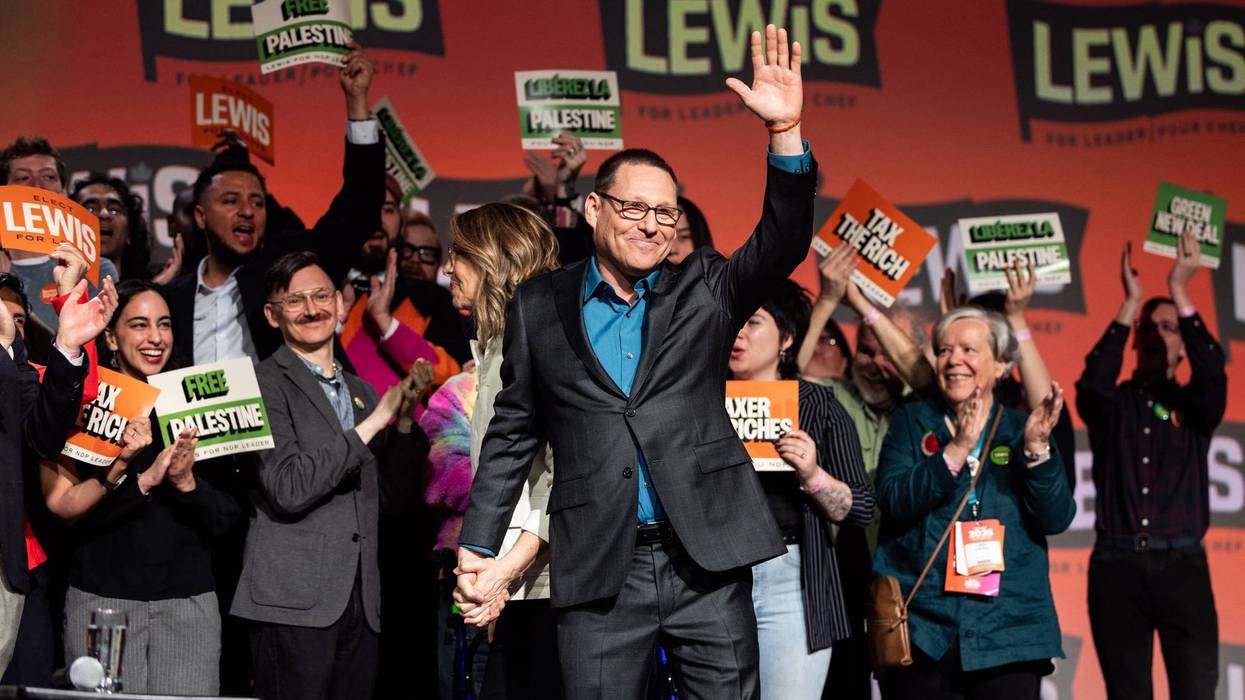
"The NDP will start winning again because we will become that beacon to the 99%," Lewis said.
Progressive activist Avi Lewis is pledging to bring Canada's New Democratic Party "out of the wilderness" after being decisively elected as its new leader on Sunday on the back of an ambitious, affordability-focused agenda aimed at winning back working-class voters.
Lewis, the grandson of one of the NDP's cofounders, cruised to a resounding victory, earning 56% of the vote to take over leadership of the long-ailing left-wing party, which has bled members in recent years to both Prime Minister Mark Carney's Liberals and Pierre Poilievre's Conservatives.
He was introduced at Sunday's Winnipeg convention by his wife, the acclaimed author and activist Naomi Klein, who said her husband's victory was an invitation for Canadians to “dream big once again" and renew the fight against corporate greed at a time when more than half of the population says they struggle to afford basic necessities.
Lewis has proposed a sweeping agenda of “public options” aimed at combating Canada’s affordability crisis, including publicly owned grocery stores and banks to compete with price-gouging corporate monopolies.
A scion of the party that helped to build Canada’s universal healthcare system—which covers hospital and physician care—he’s called for it to be expanded into a “head-to-toe” care system that guarantees dental, drugs, vision, hearing, and mental health services for all Canadians.
In order to pay for these programs and others—including public housing, green energy investment, and subsidized phone and internet plans—Lewis has campaigned to pass a wealth tax on the richest 1% of Canadians, who own nearly $1.25 trillion, almost as much as the bottom 80% of Canadians, according to a recent report by Oxfam Canada.
"This country is awash in wealth. We can have nice things," Lewis asserted to a raucous crowd during his acceptance speech. "Banks made $70 billion in profits last year alone. Oil companies are expecting a new windfall in the tens of billions. Grocery baron Galen Weston alone is worth $20 billion."
During his campaign, Lewis railed against tax cuts for wealthy Canadians passed by the Liberal government, which are projected to cost the government nearly $76 billion over five years and slash an estimated 57,000 public-sector jobs by 2028.
"It is time, far past time, to properly tax the billionaires and corporations that have been riding a tidal wave of profit," Lewis said.
While he acknowledged that Carney is still largely popular in Canada, in large part due to his fiery denunciations of US President Donald Trump's tariff war and threats to annex Canada, Lewis argued that the prime minister's revulsion toward Trumpism is only skin-deep.
"I think when you connect the dots, his moves do not add up to the vision that Canadians truly want and deserve in this perilous moment," he said. "Half a trillion dollars in a decade for weapons to make Canada a major arms exporter in a war-torn world. Slashing our cherished public services, sweeping aside indigenous rights... No regulations on AI and pipelines."
"In the last federal election, Canadians voted to say no to Trump and Trumpism," Lewis said. "What they're getting instead is our government following the US into a future of wars, fossil fuels, austerity, and job-killing generative AI."
Lewis will face a difficult task ahead in rebuilding the NDP from a disastrous loss of support under its previous leader, Jagmeet Singh, who stepped down from his post after the party suffered the worst defeat in its history during last April’s elections, dropping to just seven seats in Parliament—not even enough to be considered a “recognized” party.
The role of NDP leader is the highest office Lewis has held in his life, having run two failed campaigns for parliament in his native Vancouver in 2021 and 2025.
Though NDP currently sits at a distant third, with only about 7% support according to an Abacus poll from March, other polls show that their positions, including a wealth tax and expanding federal health coverage, are popular with the vast majority of voters across party lines.
Other polls show that Canadians, especially those with low incomes, increasingly view affordability and inequality as pressing issues, especially as Trump's war against Iran has caused global energy shortages and price hikes.
"The NDP is coming back because we know that a thriving world is possible, and we know who is standing in our way, and there are way more of us than there are of them," Lewis said. "The NDP will start winning again because we will become that beacon to the 99%."