SUBSCRIBE TO OUR FREE NEWSLETTER
Daily news & progressive opinion—funded by the people, not the corporations—delivered straight to your inbox.
5
#000000
#FFFFFF
To donate by check, phone, or other method, see our More Ways to Give page.
Daily news & progressive opinion—funded by the people, not the corporations—delivered straight to your inbox.
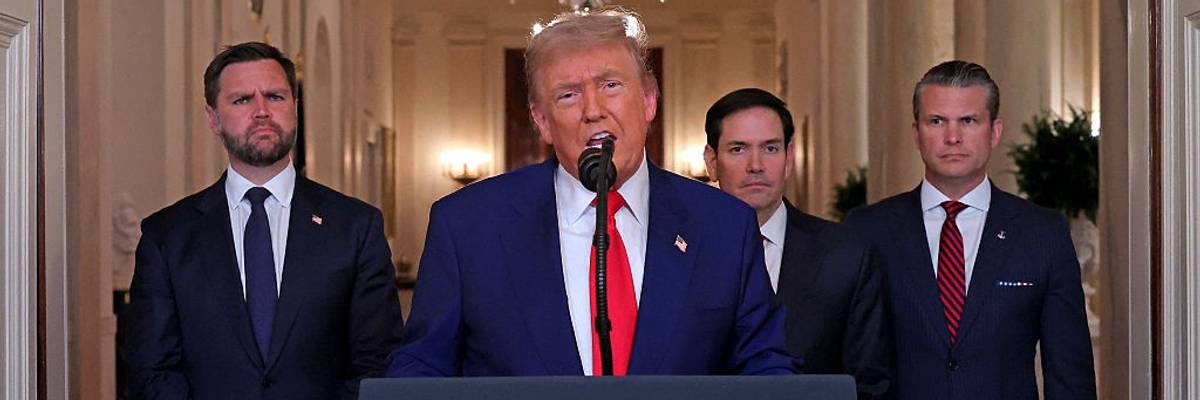
US President Donald Trump addresses the nation, alongside US Vice President JD Vance (L), US Secretary of State Marco Rubio (2nd R) and US Secretary of Defense Pete Hegseth (R), from the White House in Washington, DC on June 21, 2025, following the announcement that the US bombed nuclear sites in Iran.
Advance knowledge of both a military threat and its cancellation could allow politically connected traders to profit from the oil market twice—first from the panic, then from its disappearance.
Military threats move markets before they move armies. Announce a massive strike against Iranian oil, military, and infrastructure sites, and traders will immediately begin pricing in damaged production, regional retaliation, interrupted shipping, higher insurance costs, and possible disruption of the Strait of Hormuz. No missile needs to be launched. The announcement itself can add a substantial geopolitical premium to every barrel of oil.
Cancel the attack a few days later, however, and much of that premium may disappear just as quickly. Oil prices fall as traders conclude that the threatened supply disruption will not occur.
For ordinary investors, this is an exceptionally dangerous sequence. They must guess whether the threat is credible, whether an attack will happen, how much damage it might cause, whether Iran will retaliate, and how long any disruption will last. But for someone possessing advance knowledge of both the threat and its prearranged cancellation, the same sequence could provide an extraordinary opportunity to profit from a government-created price movement in both directions.
Consider a hypothetical political-corruption scheme.
Before the threat is announced, politically connected insiders go long 1,000 crude-oil futures contracts at $75 per barrel. A standard crude-oil futures contract represents 1,000 barrels, so 1,000 contracts provide exposure to one million barrels of oil. At $75 per barrel, the position has a notional value of $75 million.
This hypothetical identifies a corruption risk that should not be dismissed merely because it does not resemble the traditional envelope of cash passed beneath a table.
The traders do not necessarily put up the entire $75 million. Futures are leveraged instruments. Depending on prevailing exchange requirements, broker rules, and market volatility, a position of that size might require roughly $9 million in initial collateral, although a broker could demand considerably more for such a concentrated and conspicuous trade.
Then comes the public announcement: a massive military strike is imminent.
Television networks display maps of Iranian oil facilities. Analysts speculate about retaliation. Commentators warn that the Strait of Hormuz could be closed. Traders who had bet on lower oil prices rush to cover their short positions, while momentum buyers pile into the market out of fear that oil will soon become still more expensive.
Suppose the price rises from $75 to $100 per barrel.
The insiders close their 1,000 long contracts. A $25 increase across one million barrels produces a gross profit of $25 million.
But they are not finished.
Knowing the military threat is scheduled to be withdrawn, they immediately reverse direction and sell short 1,000 contracts at $100. To the public, the crisis appears to be intensifying. To the insiders, the ending is already known.
A few days later, the attack is canceled. With the immediate threat to oil production receding, the geopolitical premium collapses and oil falls from $100 back to $75. The insiders buy back the 1,000 contracts they previously sold short, earning another $25 million.
The two trades produce a combined gross profit of approximately $50 million. Measured against the roughly $9 million initially posted as collateral, that is about a 556% gross return. Not bad.
That figure should not be confused with a risk-free return on an ordinary $9 million investment. Technically, the traders would still control positions with notional values ranging from $75 million to $100 million. Futures margin requirements might rise. Prices could temporarily move against them. A broker might require additional collateral. A position of 1,000 contracts could attract regulatory scrutiny, although that possibility could be alleviated.
Inside information would not make those risks literally disappear. It would, however, radically reduce the central uncertainty facing everyone else: that is, which direction the market will move after each announcement. Knowing both turning points would make the enormous notional exposure far less worrisome than it would be to an ordinary trader.
Who pays for the insiders’ profits?
During the first phase, traders who had previously sold oil short may be forced to buy back their contracts as prices rise. Those purchases can accelerate the spike and provide liquidity for insiders closing profitable long positions near the top.
During the second phase, the losses fall on investors who buy after hearing the military threat. These late buyers are not necessarily irrational. They are reacting to public information supplied by government officials and to the genuine possibility of war, damaged infrastructure, and interrupted oil supplies. But they do not know that the threat is scripted to disappear.
When the attack is canceled and oil falls, those buyers are left holding the bag. Their losses become the economic counterpart of the insiders’ second profit.
What appears to the public as an unfolding geopolitical emergency therefore appears to the insider as a price chart whose two principal turning points have been conveniently set.
This hypothetical does not establish that any particular official, relative, donor, associate, or political ally has executed such trades. Suspicion is not proof. A serious allegation would require trading records, beneficial-ownership information, communications, financial disclosures, and evidence connecting traders to those controlling the announcements. Examining such records could be discouraged.
What appears to the public as an unfolding geopolitical emergency therefore appears to the insider as a price chart whose two principal turning points have been conveniently set.
This hypothetical identifies a corruption risk that should not be dismissed merely because it does not resemble the traditional envelope of cash passed beneath a table.
Government officials possess the power to create market-moving information. Military threats, sanctions, tariff announcements, regulatory decisions, and abrupt policy reversals can generate billions of dollars in gains and losses within hours. When advance notice of those actions is shared selectively—or when public policy is manipulated for private profit—the government itself becomes the instrument of market manipulation.
That possibility demands safeguards: timely disclosure of officials’ financial interests, meaningful restrictions on trading by senior policymakers and their households, scrutiny of unusual commodity positions surrounding major announcements, preservation of relevant communications, and investigation of accounts whose beneficial owners may be concealed behind partnerships, trusts, or shell entities.
The central question is not whether a hypothetical insider could make money from a manufactured crisis. The arithmetic shows that the opportunity is obvious.
The question is whether anyone with access to the script could begin trading before the public learns how the drama will end.
Dear Common Dreams reader, It’s been nearly 30 years since I co-founded Common Dreams with my late wife, Lina Newhouser. We had the radical notion that journalism should serve the public good, not corporate profits. It was clear to us from the outset what it would take to build such a project. No paid advertisements. No corporate sponsors. No millionaire publisher telling us what to think or do. Many people said we wouldn't last a year, but we proved those doubters wrong. Together with a tremendous team of journalists and dedicated staff, we built an independent media outlet free from the constraints of profits and corporate control. Our mission has always been simple: To inform. To inspire. To ignite change for the common good. Building Common Dreams was not easy. Our survival was never guaranteed. When you take on the most powerful forces—Wall Street greed, fossil fuel industry destruction, Big Tech lobbyists, and uber-rich oligarchs who have spent billions upon billions rigging the economy and democracy in their favor—the only bulwark you have is supporters who believe in your work. But here’s the urgent message from me today. It's never been this bad out there. And it's never been this hard to keep us going. At the very moment Common Dreams is most needed, the threats we face are intensifying. We need your support now more than ever. We don't accept corporate advertising and never will. We don't have a paywall because we don't think people should be blocked from critical news based on their ability to pay. Everything we do is funded by the donations of readers like you. When everyone does the little they can afford, we are strong. But if that support retreats or dries up, so do we. Will you donate now to make sure Common Dreams not only survives but thrives? —Craig Brown, Co-founder |
Military threats move markets before they move armies. Announce a massive strike against Iranian oil, military, and infrastructure sites, and traders will immediately begin pricing in damaged production, regional retaliation, interrupted shipping, higher insurance costs, and possible disruption of the Strait of Hormuz. No missile needs to be launched. The announcement itself can add a substantial geopolitical premium to every barrel of oil.
Cancel the attack a few days later, however, and much of that premium may disappear just as quickly. Oil prices fall as traders conclude that the threatened supply disruption will not occur.
For ordinary investors, this is an exceptionally dangerous sequence. They must guess whether the threat is credible, whether an attack will happen, how much damage it might cause, whether Iran will retaliate, and how long any disruption will last. But for someone possessing advance knowledge of both the threat and its prearranged cancellation, the same sequence could provide an extraordinary opportunity to profit from a government-created price movement in both directions.
Consider a hypothetical political-corruption scheme.
Before the threat is announced, politically connected insiders go long 1,000 crude-oil futures contracts at $75 per barrel. A standard crude-oil futures contract represents 1,000 barrels, so 1,000 contracts provide exposure to one million barrels of oil. At $75 per barrel, the position has a notional value of $75 million.
This hypothetical identifies a corruption risk that should not be dismissed merely because it does not resemble the traditional envelope of cash passed beneath a table.
The traders do not necessarily put up the entire $75 million. Futures are leveraged instruments. Depending on prevailing exchange requirements, broker rules, and market volatility, a position of that size might require roughly $9 million in initial collateral, although a broker could demand considerably more for such a concentrated and conspicuous trade.
Then comes the public announcement: a massive military strike is imminent.
Television networks display maps of Iranian oil facilities. Analysts speculate about retaliation. Commentators warn that the Strait of Hormuz could be closed. Traders who had bet on lower oil prices rush to cover their short positions, while momentum buyers pile into the market out of fear that oil will soon become still more expensive.
Suppose the price rises from $75 to $100 per barrel.
The insiders close their 1,000 long contracts. A $25 increase across one million barrels produces a gross profit of $25 million.
But they are not finished.
Knowing the military threat is scheduled to be withdrawn, they immediately reverse direction and sell short 1,000 contracts at $100. To the public, the crisis appears to be intensifying. To the insiders, the ending is already known.
A few days later, the attack is canceled. With the immediate threat to oil production receding, the geopolitical premium collapses and oil falls from $100 back to $75. The insiders buy back the 1,000 contracts they previously sold short, earning another $25 million.
The two trades produce a combined gross profit of approximately $50 million. Measured against the roughly $9 million initially posted as collateral, that is about a 556% gross return. Not bad.
That figure should not be confused with a risk-free return on an ordinary $9 million investment. Technically, the traders would still control positions with notional values ranging from $75 million to $100 million. Futures margin requirements might rise. Prices could temporarily move against them. A broker might require additional collateral. A position of 1,000 contracts could attract regulatory scrutiny, although that possibility could be alleviated.
Inside information would not make those risks literally disappear. It would, however, radically reduce the central uncertainty facing everyone else: that is, which direction the market will move after each announcement. Knowing both turning points would make the enormous notional exposure far less worrisome than it would be to an ordinary trader.
Who pays for the insiders’ profits?
During the first phase, traders who had previously sold oil short may be forced to buy back their contracts as prices rise. Those purchases can accelerate the spike and provide liquidity for insiders closing profitable long positions near the top.
During the second phase, the losses fall on investors who buy after hearing the military threat. These late buyers are not necessarily irrational. They are reacting to public information supplied by government officials and to the genuine possibility of war, damaged infrastructure, and interrupted oil supplies. But they do not know that the threat is scripted to disappear.
When the attack is canceled and oil falls, those buyers are left holding the bag. Their losses become the economic counterpart of the insiders’ second profit.
What appears to the public as an unfolding geopolitical emergency therefore appears to the insider as a price chart whose two principal turning points have been conveniently set.
This hypothetical does not establish that any particular official, relative, donor, associate, or political ally has executed such trades. Suspicion is not proof. A serious allegation would require trading records, beneficial-ownership information, communications, financial disclosures, and evidence connecting traders to those controlling the announcements. Examining such records could be discouraged.
What appears to the public as an unfolding geopolitical emergency therefore appears to the insider as a price chart whose two principal turning points have been conveniently set.
This hypothetical identifies a corruption risk that should not be dismissed merely because it does not resemble the traditional envelope of cash passed beneath a table.
Government officials possess the power to create market-moving information. Military threats, sanctions, tariff announcements, regulatory decisions, and abrupt policy reversals can generate billions of dollars in gains and losses within hours. When advance notice of those actions is shared selectively—or when public policy is manipulated for private profit—the government itself becomes the instrument of market manipulation.
That possibility demands safeguards: timely disclosure of officials’ financial interests, meaningful restrictions on trading by senior policymakers and their households, scrutiny of unusual commodity positions surrounding major announcements, preservation of relevant communications, and investigation of accounts whose beneficial owners may be concealed behind partnerships, trusts, or shell entities.
The central question is not whether a hypothetical insider could make money from a manufactured crisis. The arithmetic shows that the opportunity is obvious.
The question is whether anyone with access to the script could begin trading before the public learns how the drama will end.
Military threats move markets before they move armies. Announce a massive strike against Iranian oil, military, and infrastructure sites, and traders will immediately begin pricing in damaged production, regional retaliation, interrupted shipping, higher insurance costs, and possible disruption of the Strait of Hormuz. No missile needs to be launched. The announcement itself can add a substantial geopolitical premium to every barrel of oil.
Cancel the attack a few days later, however, and much of that premium may disappear just as quickly. Oil prices fall as traders conclude that the threatened supply disruption will not occur.
For ordinary investors, this is an exceptionally dangerous sequence. They must guess whether the threat is credible, whether an attack will happen, how much damage it might cause, whether Iran will retaliate, and how long any disruption will last. But for someone possessing advance knowledge of both the threat and its prearranged cancellation, the same sequence could provide an extraordinary opportunity to profit from a government-created price movement in both directions.
Consider a hypothetical political-corruption scheme.
Before the threat is announced, politically connected insiders go long 1,000 crude-oil futures contracts at $75 per barrel. A standard crude-oil futures contract represents 1,000 barrels, so 1,000 contracts provide exposure to one million barrels of oil. At $75 per barrel, the position has a notional value of $75 million.
This hypothetical identifies a corruption risk that should not be dismissed merely because it does not resemble the traditional envelope of cash passed beneath a table.
The traders do not necessarily put up the entire $75 million. Futures are leveraged instruments. Depending on prevailing exchange requirements, broker rules, and market volatility, a position of that size might require roughly $9 million in initial collateral, although a broker could demand considerably more for such a concentrated and conspicuous trade.
Then comes the public announcement: a massive military strike is imminent.
Television networks display maps of Iranian oil facilities. Analysts speculate about retaliation. Commentators warn that the Strait of Hormuz could be closed. Traders who had bet on lower oil prices rush to cover their short positions, while momentum buyers pile into the market out of fear that oil will soon become still more expensive.
Suppose the price rises from $75 to $100 per barrel.
The insiders close their 1,000 long contracts. A $25 increase across one million barrels produces a gross profit of $25 million.
But they are not finished.
Knowing the military threat is scheduled to be withdrawn, they immediately reverse direction and sell short 1,000 contracts at $100. To the public, the crisis appears to be intensifying. To the insiders, the ending is already known.
A few days later, the attack is canceled. With the immediate threat to oil production receding, the geopolitical premium collapses and oil falls from $100 back to $75. The insiders buy back the 1,000 contracts they previously sold short, earning another $25 million.
The two trades produce a combined gross profit of approximately $50 million. Measured against the roughly $9 million initially posted as collateral, that is about a 556% gross return. Not bad.
That figure should not be confused with a risk-free return on an ordinary $9 million investment. Technically, the traders would still control positions with notional values ranging from $75 million to $100 million. Futures margin requirements might rise. Prices could temporarily move against them. A broker might require additional collateral. A position of 1,000 contracts could attract regulatory scrutiny, although that possibility could be alleviated.
Inside information would not make those risks literally disappear. It would, however, radically reduce the central uncertainty facing everyone else: that is, which direction the market will move after each announcement. Knowing both turning points would make the enormous notional exposure far less worrisome than it would be to an ordinary trader.
Who pays for the insiders’ profits?
During the first phase, traders who had previously sold oil short may be forced to buy back their contracts as prices rise. Those purchases can accelerate the spike and provide liquidity for insiders closing profitable long positions near the top.
During the second phase, the losses fall on investors who buy after hearing the military threat. These late buyers are not necessarily irrational. They are reacting to public information supplied by government officials and to the genuine possibility of war, damaged infrastructure, and interrupted oil supplies. But they do not know that the threat is scripted to disappear.
When the attack is canceled and oil falls, those buyers are left holding the bag. Their losses become the economic counterpart of the insiders’ second profit.
What appears to the public as an unfolding geopolitical emergency therefore appears to the insider as a price chart whose two principal turning points have been conveniently set.
This hypothetical does not establish that any particular official, relative, donor, associate, or political ally has executed such trades. Suspicion is not proof. A serious allegation would require trading records, beneficial-ownership information, communications, financial disclosures, and evidence connecting traders to those controlling the announcements. Examining such records could be discouraged.
What appears to the public as an unfolding geopolitical emergency therefore appears to the insider as a price chart whose two principal turning points have been conveniently set.
This hypothetical identifies a corruption risk that should not be dismissed merely because it does not resemble the traditional envelope of cash passed beneath a table.
Government officials possess the power to create market-moving information. Military threats, sanctions, tariff announcements, regulatory decisions, and abrupt policy reversals can generate billions of dollars in gains and losses within hours. When advance notice of those actions is shared selectively—or when public policy is manipulated for private profit—the government itself becomes the instrument of market manipulation.
That possibility demands safeguards: timely disclosure of officials’ financial interests, meaningful restrictions on trading by senior policymakers and their households, scrutiny of unusual commodity positions surrounding major announcements, preservation of relevant communications, and investigation of accounts whose beneficial owners may be concealed behind partnerships, trusts, or shell entities.
The central question is not whether a hypothetical insider could make money from a manufactured crisis. The arithmetic shows that the opportunity is obvious.
The question is whether anyone with access to the script could begin trading before the public learns how the drama will end.