
SUBSCRIBE TO OUR FREE NEWSLETTER
Daily news & progressive opinion—funded by the people, not the corporations—delivered straight to your inbox.
5
#000000
#FFFFFF
To donate by check, phone, or other method, see our More Ways to Give page.


Daily news & progressive opinion—funded by the people, not the corporations—delivered straight to your inbox.
“Burgum’s actions on offshore wind appear to be motivated by the personal financial interests of those in the administration, not our collective national interests."
A week after the US Department of the Interior said it was immediately halting five offshore wind projects in the interest of "national security," a watchdog group told congressional committees Monday that the move is "not legally defensible" and raises "significant" questions about conflicts of interest concerning a top DOI official's investments in fossil gas.
Timothy Whitehouse, executive director of Public Employees for Environmental Responsibility (PEER), wrote to the top members of the Senate Energy and Natural Resources Committee and the House Committee on Natural Resources regarding the pause on projects off the coasts of Virginia, New York, Rhode Island, Connecticut, and Massachusetts—projects that account for billions of dollars in investment, employ thousands of people, and generate sustainable energy for roughly 2.5 million homes and businesses.
The announcement made by Interior Secretary Doug Burgum last week pertained to "five vague, perfunctory, cookie-cutter orders" halting the projects, wrote Whitehouse, but PEER is concerned that the orders were issued to evade the Congressional Review Act (CRA), under which the action to halt the projects likely constitutes a "major rule."
Whitehouse explained:
Under the CRA, a rule that meets any one of three criteria (an annual effect on the economy of $100,000,000 or more; a major increase in costs or prices for consumers, individual industries, federal, state, or local government agencies, or geographic regions; or in pertinent part significant adverse effects on competition, employment, investment, productivity, or innovation) is a major rule. Interior’s pause likely meets all three.
As a major rule under the CRA, the pause cannot take effect until at least 60 days after BOEM provides Congress the requisite notification and report under the CRA, which, according to GAO’s database, has not yet occurred. Congress must use its oversight authority to unveil the truth and, as appropriate, and to enforce the rule of law.
He said in a statement that “Burgum’s move is designed to bypass all congressional and public input."
The CRA states that a rule is "the whole or a part of an agency statement of general or particular applicability and future effect designed to implement, interpret, or prescribe law or policy or describing the organization, procedure, or practice requirements of an agency.”
Press statements by the DOI and by Burgum last week were "statements of general applicability and imminent future effect, designed to implement policy," wrote Whitehouse, who also said the interior secretary embarked on "a coordinated rollout with Fox News entities."
On December 22, Fox anchor Maria Bartiromo asked Burgum at 8:00 am Eastern, “What next action did you want to tell us about this morning?” Five minutes later, FoxNews.com published its first story on Burgum's orders, citing a press release that had not yet been made public and including a quote from the secretary about the "emerging national security risk" posed by the offshore wind projects.
"If last week’s actions are allowed to stand, future presidents will have unchecked authority under the guise of national security to target federal leases related to entire disfavored energy industries for political purposes."
Burgum's announcement to Fox came at least one to two hours before Bureau of Ocean Energy Management (BOEM) acting Director Matthew Giacona provided the orders to the lessees running the five wind projects.
Further, wrote Whitehouse, "Burgum’s voluminous public comments in the hours and days since the pause further show the true purpose of Interior’s singular action."
"The national security pretext quickly gives way to broad and spurious talking points about the 'Green New Scam,' how 'wind doesn’t blow 24-7' (evincing Burgum’s seeming unfamiliarity with energy storage technologies), and unyielding promotion of liquified natural gas projects," wrote Whitehouse.
Aside from the alleged illegality of Burgum's order, PEER pointed to Giacona's potential conflicts of interest with BOEM operations and specifically with halting wind projects. Giacona is a "diligent filer" of financial disclosure forms required by the Ethics in Government Act, noted Whitehouse—but those forms point to potential benefits he may reap from shutting down offshore wind infrastructure.
Giacona reported his purchase of interests in the United States Natural Gas Fund (UNG) on September 16. The fund tracks daily price movements of "natural" gas delivered at the Henry Hub in Louisiana and is subject to regulation by the Commodity Futures Trading Commission.
"Accordingly, a government employee who has an interest in UNG also has a potential conflict of interest with the underlying holdings of UNG (currently primarily natural gas futures contracts at the Henry Hub)," wrote Whitehouse.
PEER does not know whether Giacona continues to hold a financial interest in UNG or whether the offshore wind pause will have a "direct and predictable effect on a financial interest in UNG," but Whitehouse noted that Burgum and DIO have entwined the pause with the promotion of liquefied natural gas.
"It is disconcerting that Mr. Giacona temporarily had even a de minimis financial interest in natural gas futures while also leading the agency that manages the development of natural gas resources on the outer continental shelf," wrote Whitehouse, adding that Giacona also sold interests in the United States Oil Fund on September 3, while overseeing BOEM.
Based on Giacona's investments, said Whitehouse, “Burgum’s actions on offshore wind appear to be motivated by the personal financial interests of those in the administration, not our collective national interests. This is another misguided step in transforming the federal government into a franchise of the fossil fuel industry.”
“On public lands across the United States, the Department of the Interior has tens of thousands of additional active leases related to oil, gas, wind, solar, and geothermal production and mining for energy-related minerals," he added. "If last week’s actions are allowed to stand, future presidents will have unchecked authority under the guise of national security to target federal leases related to entire disfavored energy industries for political purposes."
Chad Mizelle, third-in-command at the Department of Justice, managed to serve in Trump’s administration without disclosing his financial entanglements publicly–and now, only after his departure, can we highlight his conflicts of interest.
Chad Mizelle was tapped to serve as Chief of Staff of the Department of Justice before Trump’s inauguration even took place. In that critical role, Mizelle worked closely with Attorney General Pam Bondi to implement Trump’s agenda at the Department of Justice, or in Mizelle’s own words, “everything that the President wants us to do.” But after just nine months on the job, Mizelle abruptly left administration after he brokered a settlement for Hewlett Packard Enterprises’s $14 billion acquisition of Juniper Networks, undermining the DOJ’s Antitrust Division for a political favor.
As a high-level government appointee, Mizelle was bound by ethics rules to submit a disclosure report detailing his sources of income and other financial entanglements. But despite our repeated requests, Mizelle’s financial ties haven’t been reported until now—nearly ten months after he first joined the administration, and weeks after his departure from Trump’s DOJ.
Mizelle’s financial disclosure report reveals up to $250,000 in investments in firms that the Department of Justice has pending lawsuits against, ongoing settlements to oversee, or the authority to investigate, which created conflicts of interest with Mizelle’s broad leadership role. Mizelle’s financial entanglements include:
Mizelle’s other eyebrow raising investments include between $15,001 – $50,000 in two more Big Tech companies, Oracle and Adobe (which apparently has an appetite for buying up smaller rivals).
These potential conflicts become all the more damning when considering that none of Mizelle’s investments were publicly accessible until days before the government shut down at the earliest. To our knowledge, we are the first to report on his financial disclosures.
In July 2025, I requested Mizelle’s personal financial disclosure report (PFD), as well as any ethics waivers from the DOJ’s Departmental Ethics Office. Despite receiving confirmation of my request, as well as the disclosures of other officials, weeks and weeks passed without further word about Mizelle’s PFD.
Then, in late September, Axios reported that Mizelle was planning on leaving the DOJ. And yet, when I followed up with the DOJ Departmental Ethics Office soon after the news broke, I was told that Mizelle’s PFD was still “not finalized.” I followed up the next week, but by then, the government had shut down, and my email to the DOJ ethics office was met with an auto response: “The appropriation that funds my salary has lapsed, and as a result I have been furloughed and am currently out of the office.”
It took until November 13, the day the government began to reopen from the shutdown, for the ethics office to share Mizelle’s PFD.
The drawn out timeline for his filings seems too convenient to be a coincidence. Per the document, Mizelle obtained a 90-day extension to file his financial disclosure report. That his entanglements could pose a conflict of interest was not lost on the ethics official working on his disclosures. In July 2025, an ethics official commented on the document that Mizelle was “reminded of recusal obligations.” (Notably, my request for ethics documents did not return any ethics waivers that would have allowed Mizelle to work on issues with which he had potential conflicts of interest. But his apparent reluctance to submit run-of-the-mill financial disclosures creates the question of whether he would have sought waivers at all.)
All in all, this means that Chad Mizelle, the third-in-command at the DOJ for nine months, did not have to face public scrutiny of his financial ties to companies the DOJ was overseeing until after he left the DOJ altogether. Even without meddling on Mizelle’s part, it’s deeply concerning that he was able to operate his entire tenure, potentially working on matters pertaining to companies he was invested in, without any sort of oversight or public accountability. This ethics-evading playbook may be new, but I doubt it’s the last we’ll see of it during this Trump administration.
In case you haven't noticed, the bribes Trump is taking are getting bigger and bigger.
Trump is overplaying his hand.
Not just by usurping the powers of Congress and ignoring Supreme Court rulings. Not just abducting people who are legally in the United States but have put their name to opinion pieces Trump doesn’t like and trucking them off to “detention” facilities. Not just using the Justice Department for personal vengeance. Not just unilaterally deciding how much tariff tax American consumers will have to pay on almost everything they buy.
Polls show all these are tanking Trump’s popularity.
But one thing almost all Americans are firmly against — even many loyal Trumpers — us bribery. And Trump is taking bigger and bigger bribes.
It was reported over the weekend that he’s accepting a luxury Boeing 747-8 plane worth at least $400 million from the Qatari royal family, for use during his presidency and for his personal use afterward.
Trump just can’t resist. He’s been salivating over the plane for months. It’s bigger and newer than Air Force One — and so opulently configured that it’s known as “a flying palace.” (No report on whether it contains a golden toilet.)
Apparently he’s been talking about the plane for months. In February, he toured it while it was parked at Palm Beach International Airport.
He’s tried to redecorate the White House into a palace but that’s not nearly as satisfying as flying around the world in one, especially once he’s left the White House (assuming he will).
Attorney General Pam Bondi said it’s perfectly legal for him to accept such a bribe, er, gift.
Hello?
The U.S. Constitution clearly forbids officers of the United States from taking gifts from foreign governments. It’s called the “emoluments clause.” (See Article I, Section 9.)
Anyone viewing Bondi as a neutral judge of what’s legal and what’s not when it comes to Trump can’t be trusted to be a neutral judge of Bondi. Recall that she represented Trump in a criminal proceeding. Presumably he appointed her attorney general because he knew she’d do and say anything he wanted.
Oh, and she used to lobby for Qatar.
So, what does Qatar get in return for the $400 million plane? What’s the quid for the quo?
This week Trump takes the first overseas trip of his second presidency. He’ll land in Saudi Arabia on Tuesday, followed by a visit to Qatar, and then to the United Arab Emirates (U.A.E).
That’s a big boost for Qatar right there.
Trump also just did what Qatar has been wanting done for years — announcing that the Persian Gulf (as it’s been known since at least 550 B.C.) will henceforth be known as the Arabian Gulf.
Trump’s company has just announced a new golf resort in Qatar, reportedly partnering with a company owned by the royal family.
Qatar is also pushing the Trump regime to lift sanctions on Syria.
The payback could be any number of things. The only certainty is that you and I and other Americans won’t necessarily benefit.
This week’s trip to Qatar, Saudi Arabia, and the U.A.E. is as much a personal business trip for Trump and his family businesses as a diplomatic trip.
Eric Trump, who officially runs the family business, has just announced plans for a Trump-branded hotel and tower in Dubai, part of the U.A.E.
The Trump family’s developments in the Middle East depend on a Saudi-based real estate company with close ties to the Saudi government. Saudi Arabia has a long list of pressing matters before the United States, including requests to buy F-35 fighter jets and gain access to nuclear power technology.
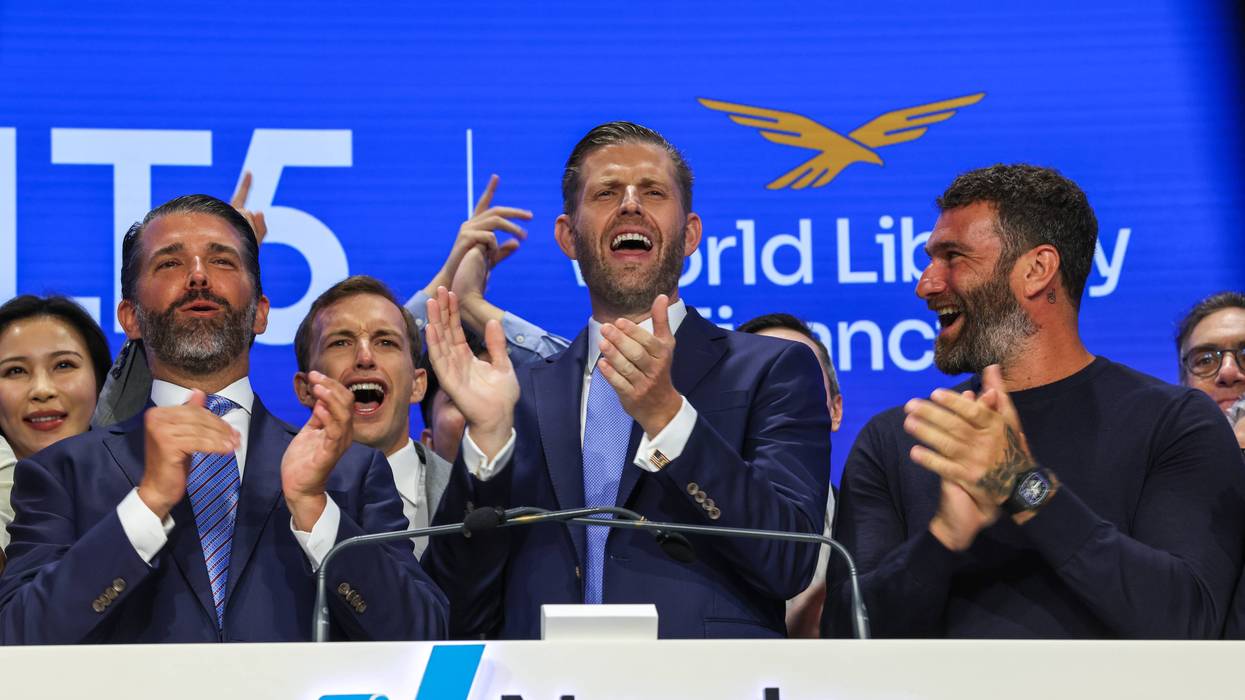
Trump’s family crypto firm, World Liberty Financial, announced that its so-called “stablecoin” — with Trump’s likeness all over it — will be used by the U.A.E. to make a $2 billion business deal with Binance, the largest crypto exchange in the world. The deal will generate hundreds of millions of dollars more for the Trump family.
I had assumed that Trump’s undoing would be his unquenchable thirst for power. It may yet be, but I’m beginning to think his insatiable greed will do him in. America’s Grifter-in-Chief knows no bounds.