

SUBSCRIBE TO OUR FREE NEWSLETTER
Daily news & progressive opinion—funded by the people, not the corporations—delivered straight to your inbox.
5
#000000
#FFFFFF
To donate by check, phone, or other method, see our More Ways to Give page.
Daily news & progressive opinion—funded by the people, not the corporations—delivered straight to your inbox.
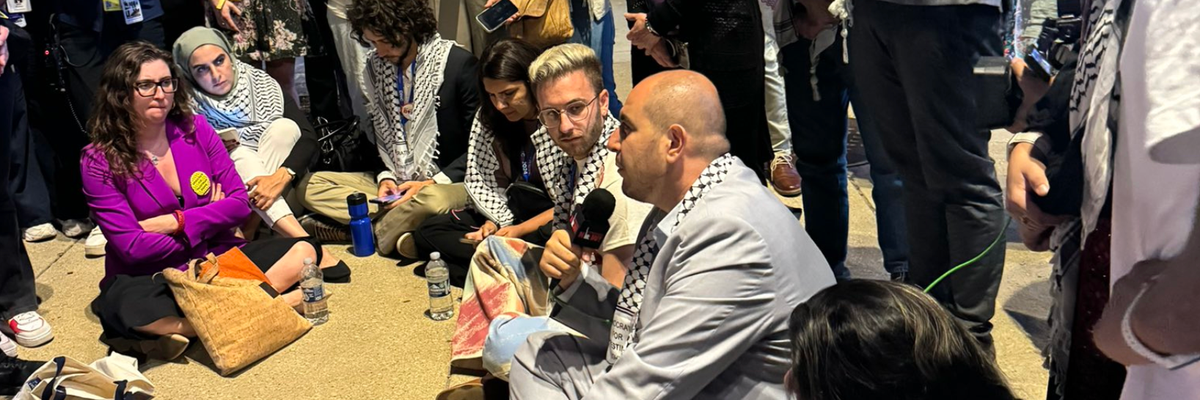
Uncommitted delegates to the Democratic National Convention hold a sit-in outside of the United Center in Chicago on August 22, 2024.
By committing to policy changes such as an arms embargo, Harris can regain the support of communities that have distanced themselves from the Democratic Party in recent months.
When U.S. Vice President Harris addresses the Democratic National Convention today, it will mark a historic moment for our nation, emblematic of what the future of representation can look like. As the first Black and Asian woman to earn a major party’s nomination, communities of color, much like my own, see in her the opportunity for a new direction in our country.
But for a majority of Americans, that new direction must include charting a different path than that of President Joe Biden and his predecessors when it comes to the war in Gaza and Palestinian rights.
As a Palestinian American who is an elected Democrat to the Colorado State House, it has been disheartening to witness Biden facilitate and abet Israel’s brutal war on Gaza with billions of dollars in U.S. weapons. While Israel has traditionally been the top recipient of U.S. foreign military aid (now surpassed by Ukraine since Russia’s invasion), the U.S. has, on average, sent Israel a weapons shipment every four days over the last 10 months, appropriating over $18 billion in weapons transfers during that period—and the administration just approved another $20 billion worth of military funding.
Harris can set a precedent in defending human rights without prejudice. Not only is this the right thing to do, it will also bolster her chances in November.
When I speak with my constituents, they are keenly aware of the billions in economic and military aid sent to Israel each year. Imagine if those funds were invested in education, housing, and healthcare right here at home.
Over the past 10 months, Israel has killed over 40,000 Palestinians, including upwards of 15,000 children. It has used starvation as a weapon against the population and violated every “red line” set by Biden. The International Court of Justice and a U.S. federal court have even ruled that Israel may be guilty of genocide and opened up an investigation.
In May, the chief prosecutor at the International Criminal Court requested arrest warrants for Israeli Prime Minister Benjamin Netanyahu and his defense minister for war crimes. In July, the International Court of Justice ruled that Israel’s military rule over Palestinians in the West Bank, East Jerusalem, and Gaza violates international law and constitutes apartheid.
Shortly after the court’s ruling, Israel’s parliament overwhelmingly voted to reject the creation of a Palestinian State, officially declaring what has been unofficial Israeli policy for decades. This rejectionist Israeli position is problematic for the U.S. at best.
For decades, the two-state solution has been the default talking point the U.S. uses to deflect from acknowledging the reality of Israel’s apartheid system, but Israel is making it harder and harder to maintain this fiction.
Biden has followed in the footsteps of his predecessors, providing, in essence, unconditional support to Israel despite its violations of international law and U.S. policy. This has fostered a sense of impunity among Israeli leaders, paving the way for and worsening the current crisis.
Earlier this year, however, more than 750,000 voters chose “uncommitted” on their ballots in the Democratic primaries, signaling a demand for a new direction.
Harris has expressed concern and empathy for Palestinian suffering in ways Biden has not, but she hasn’t shown any openness toward a fundamental policy change—at least not yet. Her notable absence during Netanyahu’s speech to Congress and her choice of Minnesota Gov. Tim Walz as her running mate—seen as more favorable to progressive and Palestinian rights supporters—are encouraging signs.
However, these symbolic gestures need to be matched with concrete policy changes.
Harris has said that an arms embargo—which human rights organizations have been calling for—is off the table, but that she supports a cease-fire. To truly reach a cease-fire and prevent a regional conflict, the U.S. must halt the arms shipments that fuel the conflict.
As a former attorney general and as current vice president, Harris has taken an oath to defend the Constitution. She is no stranger to the responsibility to enforce existing laws and policies that prevent weapons transfers to foreign military units that commit gross human rights violations. Meanwhile, U.S. made bombs continue to kill Palestinians seeking safety in schools, tents, and hospitals.
Harris can set a precedent in defending human rights without prejudice. Not only is this the right thing to do, it will also bolster her chances in November.
Polls and recent protests show that a majority of Democrats want an immediate cease-fire and a change in U.S. policy toward Israel and Palestine, including sanctions imposed on Israel over settlement construction, and sympathize more with Palestinians than Israelis. Indeed, most Americans of all political stripes want a cease-fire, a halt in weapons transfers to Israel until it ends its assault on Gaza, and for the U.S. to be neutral between the two parties. By committing to policy changes, Harris can regain the support of communities that have distanced themselves from the Democratic Party in recent months—Arab and Muslim voters, young people, people of color, progressives, anti-war advocates, and the uncommitted movement.
The national Democratic party platform states, “We will speak and act with clarity and purpose on behalf of human rights wherever they are under threat.” This week, the Democratic Party has a chance to correct course on the war in Gaza and revive our democratic principles. We must adhere to the values that define us as Democrats.
Dear Common Dreams reader, It’s been nearly 30 years since I co-founded Common Dreams with my late wife, Lina Newhouser. We had the radical notion that journalism should serve the public good, not corporate profits. It was clear to us from the outset what it would take to build such a project. No paid advertisements. No corporate sponsors. No millionaire publisher telling us what to think or do. Many people said we wouldn't last a year, but we proved those doubters wrong. Together with a tremendous team of journalists and dedicated staff, we built an independent media outlet free from the constraints of profits and corporate control. Our mission has always been simple: To inform. To inspire. To ignite change for the common good. Building Common Dreams was not easy. Our survival was never guaranteed. When you take on the most powerful forces—Wall Street greed, fossil fuel industry destruction, Big Tech lobbyists, and uber-rich oligarchs who have spent billions upon billions rigging the economy and democracy in their favor—the only bulwark you have is supporters who believe in your work. But here’s the urgent message from me today. It's never been this bad out there. And it's never been this hard to keep us going. At the very moment Common Dreams is most needed, the threats we face are intensifying. We need your support now more than ever. We don't accept corporate advertising and never will. We don't have a paywall because we don't think people should be blocked from critical news based on their ability to pay. Everything we do is funded by the donations of readers like you. When everyone does the little they can afford, we are strong. But if that support retreats or dries up, so do we. Will you donate now to make sure Common Dreams not only survives but thrives? —Craig Brown, Co-founder |
When U.S. Vice President Harris addresses the Democratic National Convention today, it will mark a historic moment for our nation, emblematic of what the future of representation can look like. As the first Black and Asian woman to earn a major party’s nomination, communities of color, much like my own, see in her the opportunity for a new direction in our country.
But for a majority of Americans, that new direction must include charting a different path than that of President Joe Biden and his predecessors when it comes to the war in Gaza and Palestinian rights.
As a Palestinian American who is an elected Democrat to the Colorado State House, it has been disheartening to witness Biden facilitate and abet Israel’s brutal war on Gaza with billions of dollars in U.S. weapons. While Israel has traditionally been the top recipient of U.S. foreign military aid (now surpassed by Ukraine since Russia’s invasion), the U.S. has, on average, sent Israel a weapons shipment every four days over the last 10 months, appropriating over $18 billion in weapons transfers during that period—and the administration just approved another $20 billion worth of military funding.
Harris can set a precedent in defending human rights without prejudice. Not only is this the right thing to do, it will also bolster her chances in November.
When I speak with my constituents, they are keenly aware of the billions in economic and military aid sent to Israel each year. Imagine if those funds were invested in education, housing, and healthcare right here at home.
Over the past 10 months, Israel has killed over 40,000 Palestinians, including upwards of 15,000 children. It has used starvation as a weapon against the population and violated every “red line” set by Biden. The International Court of Justice and a U.S. federal court have even ruled that Israel may be guilty of genocide and opened up an investigation.
In May, the chief prosecutor at the International Criminal Court requested arrest warrants for Israeli Prime Minister Benjamin Netanyahu and his defense minister for war crimes. In July, the International Court of Justice ruled that Israel’s military rule over Palestinians in the West Bank, East Jerusalem, and Gaza violates international law and constitutes apartheid.
Shortly after the court’s ruling, Israel’s parliament overwhelmingly voted to reject the creation of a Palestinian State, officially declaring what has been unofficial Israeli policy for decades. This rejectionist Israeli position is problematic for the U.S. at best.
For decades, the two-state solution has been the default talking point the U.S. uses to deflect from acknowledging the reality of Israel’s apartheid system, but Israel is making it harder and harder to maintain this fiction.
Biden has followed in the footsteps of his predecessors, providing, in essence, unconditional support to Israel despite its violations of international law and U.S. policy. This has fostered a sense of impunity among Israeli leaders, paving the way for and worsening the current crisis.
Earlier this year, however, more than 750,000 voters chose “uncommitted” on their ballots in the Democratic primaries, signaling a demand for a new direction.
Harris has expressed concern and empathy for Palestinian suffering in ways Biden has not, but she hasn’t shown any openness toward a fundamental policy change—at least not yet. Her notable absence during Netanyahu’s speech to Congress and her choice of Minnesota Gov. Tim Walz as her running mate—seen as more favorable to progressive and Palestinian rights supporters—are encouraging signs.
However, these symbolic gestures need to be matched with concrete policy changes.
Harris has said that an arms embargo—which human rights organizations have been calling for—is off the table, but that she supports a cease-fire. To truly reach a cease-fire and prevent a regional conflict, the U.S. must halt the arms shipments that fuel the conflict.
As a former attorney general and as current vice president, Harris has taken an oath to defend the Constitution. She is no stranger to the responsibility to enforce existing laws and policies that prevent weapons transfers to foreign military units that commit gross human rights violations. Meanwhile, U.S. made bombs continue to kill Palestinians seeking safety in schools, tents, and hospitals.
Harris can set a precedent in defending human rights without prejudice. Not only is this the right thing to do, it will also bolster her chances in November.
Polls and recent protests show that a majority of Democrats want an immediate cease-fire and a change in U.S. policy toward Israel and Palestine, including sanctions imposed on Israel over settlement construction, and sympathize more with Palestinians than Israelis. Indeed, most Americans of all political stripes want a cease-fire, a halt in weapons transfers to Israel until it ends its assault on Gaza, and for the U.S. to be neutral between the two parties. By committing to policy changes, Harris can regain the support of communities that have distanced themselves from the Democratic Party in recent months—Arab and Muslim voters, young people, people of color, progressives, anti-war advocates, and the uncommitted movement.
The national Democratic party platform states, “We will speak and act with clarity and purpose on behalf of human rights wherever they are under threat.” This week, the Democratic Party has a chance to correct course on the war in Gaza and revive our democratic principles. We must adhere to the values that define us as Democrats.
When U.S. Vice President Harris addresses the Democratic National Convention today, it will mark a historic moment for our nation, emblematic of what the future of representation can look like. As the first Black and Asian woman to earn a major party’s nomination, communities of color, much like my own, see in her the opportunity for a new direction in our country.
But for a majority of Americans, that new direction must include charting a different path than that of President Joe Biden and his predecessors when it comes to the war in Gaza and Palestinian rights.
As a Palestinian American who is an elected Democrat to the Colorado State House, it has been disheartening to witness Biden facilitate and abet Israel’s brutal war on Gaza with billions of dollars in U.S. weapons. While Israel has traditionally been the top recipient of U.S. foreign military aid (now surpassed by Ukraine since Russia’s invasion), the U.S. has, on average, sent Israel a weapons shipment every four days over the last 10 months, appropriating over $18 billion in weapons transfers during that period—and the administration just approved another $20 billion worth of military funding.
Harris can set a precedent in defending human rights without prejudice. Not only is this the right thing to do, it will also bolster her chances in November.
When I speak with my constituents, they are keenly aware of the billions in economic and military aid sent to Israel each year. Imagine if those funds were invested in education, housing, and healthcare right here at home.
Over the past 10 months, Israel has killed over 40,000 Palestinians, including upwards of 15,000 children. It has used starvation as a weapon against the population and violated every “red line” set by Biden. The International Court of Justice and a U.S. federal court have even ruled that Israel may be guilty of genocide and opened up an investigation.
In May, the chief prosecutor at the International Criminal Court requested arrest warrants for Israeli Prime Minister Benjamin Netanyahu and his defense minister for war crimes. In July, the International Court of Justice ruled that Israel’s military rule over Palestinians in the West Bank, East Jerusalem, and Gaza violates international law and constitutes apartheid.
Shortly after the court’s ruling, Israel’s parliament overwhelmingly voted to reject the creation of a Palestinian State, officially declaring what has been unofficial Israeli policy for decades. This rejectionist Israeli position is problematic for the U.S. at best.
For decades, the two-state solution has been the default talking point the U.S. uses to deflect from acknowledging the reality of Israel’s apartheid system, but Israel is making it harder and harder to maintain this fiction.
Biden has followed in the footsteps of his predecessors, providing, in essence, unconditional support to Israel despite its violations of international law and U.S. policy. This has fostered a sense of impunity among Israeli leaders, paving the way for and worsening the current crisis.
Earlier this year, however, more than 750,000 voters chose “uncommitted” on their ballots in the Democratic primaries, signaling a demand for a new direction.
Harris has expressed concern and empathy for Palestinian suffering in ways Biden has not, but she hasn’t shown any openness toward a fundamental policy change—at least not yet. Her notable absence during Netanyahu’s speech to Congress and her choice of Minnesota Gov. Tim Walz as her running mate—seen as more favorable to progressive and Palestinian rights supporters—are encouraging signs.
However, these symbolic gestures need to be matched with concrete policy changes.
Harris has said that an arms embargo—which human rights organizations have been calling for—is off the table, but that she supports a cease-fire. To truly reach a cease-fire and prevent a regional conflict, the U.S. must halt the arms shipments that fuel the conflict.
As a former attorney general and as current vice president, Harris has taken an oath to defend the Constitution. She is no stranger to the responsibility to enforce existing laws and policies that prevent weapons transfers to foreign military units that commit gross human rights violations. Meanwhile, U.S. made bombs continue to kill Palestinians seeking safety in schools, tents, and hospitals.
Harris can set a precedent in defending human rights without prejudice. Not only is this the right thing to do, it will also bolster her chances in November.
Polls and recent protests show that a majority of Democrats want an immediate cease-fire and a change in U.S. policy toward Israel and Palestine, including sanctions imposed on Israel over settlement construction, and sympathize more with Palestinians than Israelis. Indeed, most Americans of all political stripes want a cease-fire, a halt in weapons transfers to Israel until it ends its assault on Gaza, and for the U.S. to be neutral between the two parties. By committing to policy changes, Harris can regain the support of communities that have distanced themselves from the Democratic Party in recent months—Arab and Muslim voters, young people, people of color, progressives, anti-war advocates, and the uncommitted movement.
The national Democratic party platform states, “We will speak and act with clarity and purpose on behalf of human rights wherever they are under threat.” This week, the Democratic Party has a chance to correct course on the war in Gaza and revive our democratic principles. We must adhere to the values that define us as Democrats.

