SUBSCRIBE TO OUR FREE NEWSLETTER
Daily news & progressive opinion—funded by the people, not the corporations—delivered straight to your inbox.
5
#000000
#FFFFFF
To donate by check, phone, or other method, see our More Ways to Give page.
Daily news & progressive opinion—funded by the people, not the corporations—delivered straight to your inbox.
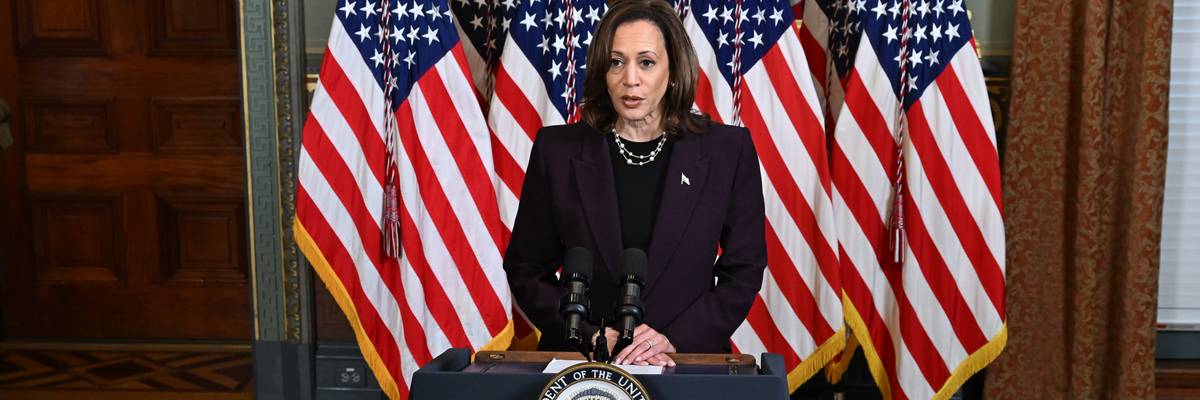
Vice President Kamala Harris speaks to reporters after meeting with Israeli Prime Minister Benjamin Netanyahu in the Vice President's ceremonial office in the Eisenhower Executive Office Building on July 25, 2024 in Washington, D.C.
Simply displaying more empathy toward Palestinians, while shipping arms to Israel that are used in killing those same Palestinians, is not likely to win over recalcitrant voters or to truly energize peace voters.
As the surreal and high-stakes 2024 Presidential election careens through its surprising twists and turns, one thing is near certain—at the finish line the election will be decided by a relatively small margin. U.S. Vice President Kamala Harris, as the likely Democratic nominee, would do well to appeal to the over 650,000 people who voted for “uncommitted” or cast other protest votes in the primary.
Vice President Harris has seen polling revealing that the Democrats suffered from a large enthusiasm gap—trailing Republicans by 11 points in one Gallup poll before President Joe Biden Biden dropped out. Given Democratic-leaning voters’ well-founded existential angst about former President Donald Trump’s authoritarian impulses, such a gap in this election is astounding.
At least part of that “enthusiasm gap” was reflected in the “uncommitted” vote over the last few months. In addition to the 650,000 Democrats voted against Biden by choosing options such as “uncommitted,” etc., millions of rank-and-file Democrats are unhappy with the war in Gaza. According to one Reuters poll, 44% of Democratic voters disapprove of the administration’s handling of the Gaza crisis and these voters said they were less likely to vote for Biden come fall. Obviously, Arab American voters are watching Harris’ actions on Gaza closely. But so are other critical constituencies. Younger voters, and particularly younger voters of color, are more likely to support an immediate cease-fire in Gaza and disapprove of Israel’s actions. Seven major labor unions, representing 6 million workers, just wrote to President Biden and called on him to “shut off military aid to Israel.”
Harris is unlikely to truly change course without being pushed to do so by her base.
Some former Biden administration officials who resigned over Biden’s Gaza policy are “cautiously optimistic” about a fresh approach with Harris. They point to Harris speaking in favor of a cease-fire before Biden did. Former State Department arms control expert Josh Paul described Harris as less “fixed and intransigent” on Gaza and said, “I have cautious and limited optimism—but also a deep sense of relief that the Democratic party will not be nominating for the presidency of the United States a man who has made us all complicit in so much and such unnecessary harm.” At the same time, most observers feel it is unrealistic to expect her positions to be a radical departure from Biden’s based on her history of strong support for Israel.
Clearly Biden-Harris messaging has recently become more focused on seeking peace and a cease-fire. In Biden’s historic address explaining his decision to drop out of the race, the president courted peace voters by bragging that he was “the first president this century to report to the American people that the United States is not at war anywhere in the world.” That was at best a fib, given that the U.S. had just bombed Yemen hours earlier. But it displayed recognition of the importance of the peace vote. He also promised to work for a cease-fire for Gaza.
VP Harris’ remarks after meeting with Israeli Prime Minister Benjamin Netanyahu reflected an even greater emphasis on a cease-fire. She bluntly stated, “It is time for the war to end.” It was refreshing to hear her emphasize the famine in Gaza, a critical issue that the media is underreporting. As Randa Slim of the Middle East Institute put it in a post on X (formerly Twitter): “This is the best speech I heard so far from a senior U.S. official about Israel[’s] war on Gaza. [The] VP mentioned the word Palestinians more times than in all Joe Biden speeches combined. There is hope fellow Arab #Americans!” But simply displaying more empathy toward Palestinians, while shipping arms to Israel that are used in killing those same Palestinians, is not likely to win over recalcitrant uncommitted voters or to truly energize peace voters.
The task in front of Harris is daunting. Ideally she needs to deliver a cease-fire despite the fact that she is not (yet) the president of the U.S., let alone the prime minister of Israel. But the U.S., as Israel’s crucial ally, has immense leverage, and it’s long past time to fully deploy it. Netanyahu has ignored U.S. calls to prevent human rights violations for months. He is resisting a cease-fire. One way to reach a desperately needed lasting cease-fire—including the release of all Israeli and Palestinian captives—is for the U.S. to put real pressure on Netanyahu by ending the flow of weapons to the Israeli government.
If Netanyahu will not agree to a cease-fire, the Biden-Harris administration needs to become more assertive in concrete policy terms. Matt Duss, of the Center for International Policy, laid out some of the policy changes that could be the basis of a real pivot on Gaza that goes beyond a change in tone:
She can announce that as president, she will immediately suspend the U.S.-supplied military aid being used in violation of U.S. law. She can reject the baseless and inflammatory claims that the United Nations Relief and Works Agency for Palestine Refugees in the Near East (UNRWA), the largest and most important relief agency in Gaza, is a “Hamas front,” and state that she’ll work to see UNRWA funding resumed as soon as legally possible.
The grassroots has a role to play in all this. Harris is unlikely to truly change course without being pushed to do so by her base. The Uncommitted National Movement, now that their ballot box campaigns are over, is pushing a “Not Another Bomb” campaign to push Harris to take a bolder position on ending the war. Peace groups like Peace Action are calling on Harris to support an arms embargo on Israel and other concrete policies. Everyone who cares about these issues should be contacting the vice president and getting out the message that her empathetic words are refreshing, but it is long past time for bold action to end the killing and famine in Gaza once and for all.
Dear Common Dreams reader, It’s been nearly 30 years since I co-founded Common Dreams with my late wife, Lina Newhouser. We had the radical notion that journalism should serve the public good, not corporate profits. It was clear to us from the outset what it would take to build such a project. No paid advertisements. No corporate sponsors. No millionaire publisher telling us what to think or do. Many people said we wouldn't last a year, but we proved those doubters wrong. Together with a tremendous team of journalists and dedicated staff, we built an independent media outlet free from the constraints of profits and corporate control. Our mission has always been simple: To inform. To inspire. To ignite change for the common good. Building Common Dreams was not easy. Our survival was never guaranteed. When you take on the most powerful forces—Wall Street greed, fossil fuel industry destruction, Big Tech lobbyists, and uber-rich oligarchs who have spent billions upon billions rigging the economy and democracy in their favor—the only bulwark you have is supporters who believe in your work. But here’s the urgent message from me today. It's never been this bad out there. And it's never been this hard to keep us going. At the very moment Common Dreams is most needed, the threats we face are intensifying. We need your support now more than ever. We don't accept corporate advertising and never will. We don't have a paywall because we don't think people should be blocked from critical news based on their ability to pay. Everything we do is funded by the donations of readers like you. When everyone does the little they can afford, we are strong. But if that support retreats or dries up, so do we. Will you donate now to make sure Common Dreams not only survives but thrives? —Craig Brown, Co-founder |
As the surreal and high-stakes 2024 Presidential election careens through its surprising twists and turns, one thing is near certain—at the finish line the election will be decided by a relatively small margin. U.S. Vice President Kamala Harris, as the likely Democratic nominee, would do well to appeal to the over 650,000 people who voted for “uncommitted” or cast other protest votes in the primary.
Vice President Harris has seen polling revealing that the Democrats suffered from a large enthusiasm gap—trailing Republicans by 11 points in one Gallup poll before President Joe Biden Biden dropped out. Given Democratic-leaning voters’ well-founded existential angst about former President Donald Trump’s authoritarian impulses, such a gap in this election is astounding.
At least part of that “enthusiasm gap” was reflected in the “uncommitted” vote over the last few months. In addition to the 650,000 Democrats voted against Biden by choosing options such as “uncommitted,” etc., millions of rank-and-file Democrats are unhappy with the war in Gaza. According to one Reuters poll, 44% of Democratic voters disapprove of the administration’s handling of the Gaza crisis and these voters said they were less likely to vote for Biden come fall. Obviously, Arab American voters are watching Harris’ actions on Gaza closely. But so are other critical constituencies. Younger voters, and particularly younger voters of color, are more likely to support an immediate cease-fire in Gaza and disapprove of Israel’s actions. Seven major labor unions, representing 6 million workers, just wrote to President Biden and called on him to “shut off military aid to Israel.”
Harris is unlikely to truly change course without being pushed to do so by her base.
Some former Biden administration officials who resigned over Biden’s Gaza policy are “cautiously optimistic” about a fresh approach with Harris. They point to Harris speaking in favor of a cease-fire before Biden did. Former State Department arms control expert Josh Paul described Harris as less “fixed and intransigent” on Gaza and said, “I have cautious and limited optimism—but also a deep sense of relief that the Democratic party will not be nominating for the presidency of the United States a man who has made us all complicit in so much and such unnecessary harm.” At the same time, most observers feel it is unrealistic to expect her positions to be a radical departure from Biden’s based on her history of strong support for Israel.
Clearly Biden-Harris messaging has recently become more focused on seeking peace and a cease-fire. In Biden’s historic address explaining his decision to drop out of the race, the president courted peace voters by bragging that he was “the first president this century to report to the American people that the United States is not at war anywhere in the world.” That was at best a fib, given that the U.S. had just bombed Yemen hours earlier. But it displayed recognition of the importance of the peace vote. He also promised to work for a cease-fire for Gaza.
VP Harris’ remarks after meeting with Israeli Prime Minister Benjamin Netanyahu reflected an even greater emphasis on a cease-fire. She bluntly stated, “It is time for the war to end.” It was refreshing to hear her emphasize the famine in Gaza, a critical issue that the media is underreporting. As Randa Slim of the Middle East Institute put it in a post on X (formerly Twitter): “This is the best speech I heard so far from a senior U.S. official about Israel[’s] war on Gaza. [The] VP mentioned the word Palestinians more times than in all Joe Biden speeches combined. There is hope fellow Arab #Americans!” But simply displaying more empathy toward Palestinians, while shipping arms to Israel that are used in killing those same Palestinians, is not likely to win over recalcitrant uncommitted voters or to truly energize peace voters.
The task in front of Harris is daunting. Ideally she needs to deliver a cease-fire despite the fact that she is not (yet) the president of the U.S., let alone the prime minister of Israel. But the U.S., as Israel’s crucial ally, has immense leverage, and it’s long past time to fully deploy it. Netanyahu has ignored U.S. calls to prevent human rights violations for months. He is resisting a cease-fire. One way to reach a desperately needed lasting cease-fire—including the release of all Israeli and Palestinian captives—is for the U.S. to put real pressure on Netanyahu by ending the flow of weapons to the Israeli government.
If Netanyahu will not agree to a cease-fire, the Biden-Harris administration needs to become more assertive in concrete policy terms. Matt Duss, of the Center for International Policy, laid out some of the policy changes that could be the basis of a real pivot on Gaza that goes beyond a change in tone:
She can announce that as president, she will immediately suspend the U.S.-supplied military aid being used in violation of U.S. law. She can reject the baseless and inflammatory claims that the United Nations Relief and Works Agency for Palestine Refugees in the Near East (UNRWA), the largest and most important relief agency in Gaza, is a “Hamas front,” and state that she’ll work to see UNRWA funding resumed as soon as legally possible.
The grassroots has a role to play in all this. Harris is unlikely to truly change course without being pushed to do so by her base. The Uncommitted National Movement, now that their ballot box campaigns are over, is pushing a “Not Another Bomb” campaign to push Harris to take a bolder position on ending the war. Peace groups like Peace Action are calling on Harris to support an arms embargo on Israel and other concrete policies. Everyone who cares about these issues should be contacting the vice president and getting out the message that her empathetic words are refreshing, but it is long past time for bold action to end the killing and famine in Gaza once and for all.
As the surreal and high-stakes 2024 Presidential election careens through its surprising twists and turns, one thing is near certain—at the finish line the election will be decided by a relatively small margin. U.S. Vice President Kamala Harris, as the likely Democratic nominee, would do well to appeal to the over 650,000 people who voted for “uncommitted” or cast other protest votes in the primary.
Vice President Harris has seen polling revealing that the Democrats suffered from a large enthusiasm gap—trailing Republicans by 11 points in one Gallup poll before President Joe Biden Biden dropped out. Given Democratic-leaning voters’ well-founded existential angst about former President Donald Trump’s authoritarian impulses, such a gap in this election is astounding.
At least part of that “enthusiasm gap” was reflected in the “uncommitted” vote over the last few months. In addition to the 650,000 Democrats voted against Biden by choosing options such as “uncommitted,” etc., millions of rank-and-file Democrats are unhappy with the war in Gaza. According to one Reuters poll, 44% of Democratic voters disapprove of the administration’s handling of the Gaza crisis and these voters said they were less likely to vote for Biden come fall. Obviously, Arab American voters are watching Harris’ actions on Gaza closely. But so are other critical constituencies. Younger voters, and particularly younger voters of color, are more likely to support an immediate cease-fire in Gaza and disapprove of Israel’s actions. Seven major labor unions, representing 6 million workers, just wrote to President Biden and called on him to “shut off military aid to Israel.”
Harris is unlikely to truly change course without being pushed to do so by her base.
Some former Biden administration officials who resigned over Biden’s Gaza policy are “cautiously optimistic” about a fresh approach with Harris. They point to Harris speaking in favor of a cease-fire before Biden did. Former State Department arms control expert Josh Paul described Harris as less “fixed and intransigent” on Gaza and said, “I have cautious and limited optimism—but also a deep sense of relief that the Democratic party will not be nominating for the presidency of the United States a man who has made us all complicit in so much and such unnecessary harm.” At the same time, most observers feel it is unrealistic to expect her positions to be a radical departure from Biden’s based on her history of strong support for Israel.
Clearly Biden-Harris messaging has recently become more focused on seeking peace and a cease-fire. In Biden’s historic address explaining his decision to drop out of the race, the president courted peace voters by bragging that he was “the first president this century to report to the American people that the United States is not at war anywhere in the world.” That was at best a fib, given that the U.S. had just bombed Yemen hours earlier. But it displayed recognition of the importance of the peace vote. He also promised to work for a cease-fire for Gaza.
VP Harris’ remarks after meeting with Israeli Prime Minister Benjamin Netanyahu reflected an even greater emphasis on a cease-fire. She bluntly stated, “It is time for the war to end.” It was refreshing to hear her emphasize the famine in Gaza, a critical issue that the media is underreporting. As Randa Slim of the Middle East Institute put it in a post on X (formerly Twitter): “This is the best speech I heard so far from a senior U.S. official about Israel[’s] war on Gaza. [The] VP mentioned the word Palestinians more times than in all Joe Biden speeches combined. There is hope fellow Arab #Americans!” But simply displaying more empathy toward Palestinians, while shipping arms to Israel that are used in killing those same Palestinians, is not likely to win over recalcitrant uncommitted voters or to truly energize peace voters.
The task in front of Harris is daunting. Ideally she needs to deliver a cease-fire despite the fact that she is not (yet) the president of the U.S., let alone the prime minister of Israel. But the U.S., as Israel’s crucial ally, has immense leverage, and it’s long past time to fully deploy it. Netanyahu has ignored U.S. calls to prevent human rights violations for months. He is resisting a cease-fire. One way to reach a desperately needed lasting cease-fire—including the release of all Israeli and Palestinian captives—is for the U.S. to put real pressure on Netanyahu by ending the flow of weapons to the Israeli government.
If Netanyahu will not agree to a cease-fire, the Biden-Harris administration needs to become more assertive in concrete policy terms. Matt Duss, of the Center for International Policy, laid out some of the policy changes that could be the basis of a real pivot on Gaza that goes beyond a change in tone:
She can announce that as president, she will immediately suspend the U.S.-supplied military aid being used in violation of U.S. law. She can reject the baseless and inflammatory claims that the United Nations Relief and Works Agency for Palestine Refugees in the Near East (UNRWA), the largest and most important relief agency in Gaza, is a “Hamas front,” and state that she’ll work to see UNRWA funding resumed as soon as legally possible.
The grassroots has a role to play in all this. Harris is unlikely to truly change course without being pushed to do so by her base. The Uncommitted National Movement, now that their ballot box campaigns are over, is pushing a “Not Another Bomb” campaign to push Harris to take a bolder position on ending the war. Peace groups like Peace Action are calling on Harris to support an arms embargo on Israel and other concrete policies. Everyone who cares about these issues should be contacting the vice president and getting out the message that her empathetic words are refreshing, but it is long past time for bold action to end the killing and famine in Gaza once and for all.