

SUBSCRIBE TO OUR FREE NEWSLETTER
Daily news & progressive opinion—funded by the people, not the corporations—delivered straight to your inbox.
5
#000000
#FFFFFF
To donate by check, phone, or other method, see our More Ways to Give page.
Daily news & progressive opinion—funded by the people, not the corporations—delivered straight to your inbox.
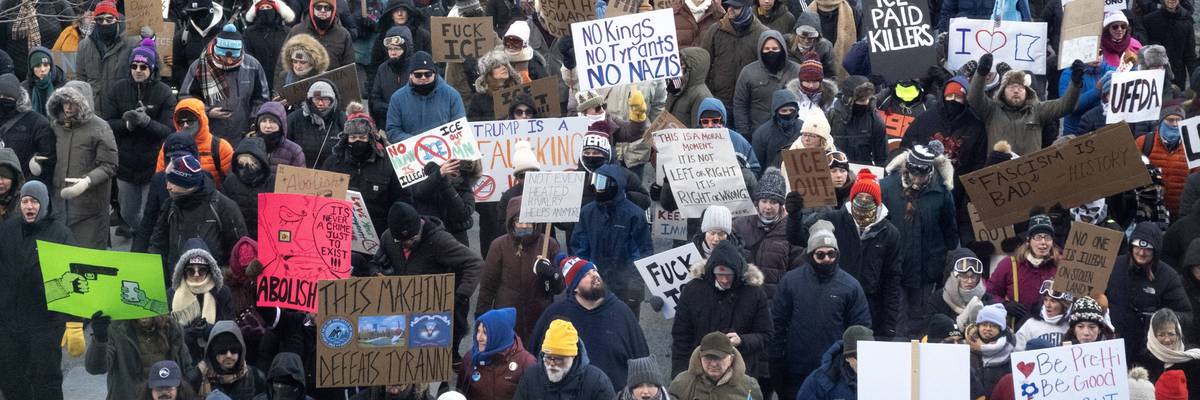
Demonstrators march through downtown protesting ICE operations and the death of Renee Good and Alex Pretti on January 25, 2026 in Minneapolis, Minnesota.
Join me in adding your voice to the millions of other people who are choosing to stand and speak up for their neighbors, our communities, the rule of law, the Constitution, and democracy.
In 2004, I wrote about a peaceful protest I had just attended with my young children that turned into a sudden melee, with riot police shooting pepper bullets into the crowd.
Desperate to find a place to share what felt like important information I discovered after the experience, I decided to take a chance and submit my piece to Common Dreams, a progressive news and opinion website. I was shocked to log on the morning after my late-night submission and see that they’d published it: "To Be Silenced, Or Not to Be: That is the Question."
At the time, Common Dreams didn’t have, as they do now, a section for comments or discussion following a piece they published. I did receive, however, over 600 emails. Those emails helped me know that something I—an everyday American without a collegiate degree—had written about not being silent had resonated, informed, and inspired.
I no longer have access to those emails, a few of which were from well-known people, but I often think of one in particular, in which a couple wrote to say that they were installing new stairs in their home and they wanted me to know that they’d printed my piece and put it under the stairs in a small time capsule they had created.
While I attended the two local No Kings protests last year, and a local ORD2 Indivisible protest this year after the murder of Renée Good, I did think twice before going, and mostly hung quietly around the edges (in order to try and make a hasty exit if anything went awry).
I’ve barely written about any of the administration’s growing atrocities, other than notes in my journal.
And, until the horrific murder of Alex Pretti by federal agents, and the administration’s immediate lies, including saying he was a domestic terrorist (just as they’d lied about Renée Good and others), I hadn’t posted anything “political” on Facebook for over five years. (Mostly due to a friend on the platform telling me a mutual friend didn’t like my political posts, even though they’ve been minimal, respectful, and mostly with a reach-across-the aisle sentiment. This “friend” said the platform is only for “fun” stuff.)
Yes, the masses of everyday people have power in any society. Power to do nothing, or power to rise in resistance.
Yes, fear has kept me silenced. Fear of what may happen to myself or my loved ones if I choose to stand up and not be silenced, be it at a protest, or by sharing things on social media, or if I write something critical of President Donald Trump and his administration.
Following are just two new examples leading to what I’d suggest are rational fears, and are specifically intended to chill and silence dissent and criticism of Trump and his regime:
In a recent opinion piece published at the Boston Globe, Sen. Edward Markey (D-Mass.) wrote:
This pervasive surveillance doesn’t just undermine our privacy. It also changes how we behave. If you know that DHS can identify you at a protest, track your movements, or pull up years of personal information with a single inquiry, you may—consciously or unconsciously—begin to self-censor. You may think twice before criticizing the government online or showing up at a rally. This chilling effect is real. It’s dangerous. And it’s a direct threat to our freedom of speech.
At the end of the piece I wrote in 2004, I’d shared a chilling quote, an excerpt really, from something I’d recently read. It has stuck with me ever since, and started reverberating more loudly once Trump’s second term in office began.
The excerpt comes from chapter 13, “But Then It Was Too Late,” from Milton Mayer’s book They Thought They Were Free, The Germans 1933-45 (1955, University of Chicago Press). In it, the person doing most of the talking in this eight-page chapter—who Mayer only names as a colleague of his, a philologist who lives in Germany—speaks of trying to understand the silence and inaction of masses of everyday people, including “learned men” like himself, that allowed the horrendous evil of Nazi Germany:
What no one seemed to notice... was the ever widening gap, after 1933, between the government and the people... And it became always wider... The dictatorship, and the whole process of its coming into being, was above all diverting. It provided an excuse not to think for people who did not want to think anyway...
Nazism gave us some dreadful, fundamental things to think about—we were decent people—and kept us so busy with continuous changes and "crises" and so fascinated, yes fascinated, by the machinations of the "national enemies," without and within, that we had no time to think about these dreadful things that were growing, little by little, all around us... Each act, each occasion, is worse than the last, but only a little worse. You wait for the next and the next. You wait for one great shocking occasion, thinking that others, when such a shock comes, will join with you in resisting somehow.
Clearly feeling regret and wondering how it might’ve been different had they resisted, Mayer’s colleague finally admits a painful realization:
And one day, too late, your principles, if you were ever sensible of them, all rush in upon you... The world you live in—your nation, your people—is not the world you were born in at all. The forms are all there, all untouched, all reassuring, the houses, the shops, the jobs, the mealtimes, the visits, the concerts, the cinema, the holidays... Now you live in a world of hate and fear, and the people who hate and fear do not even know it themselves...
Suddenly it all comes down, all at once. You see what you are, what you have done, or, more accurately, what you haven’t done (for that was all that was required of most of us: that we do nothing)... If one had stood, others would have stood, perhaps, but no one stood...You remember everything now, and your heart breaks. Too late. You are compromised beyond repair.
Ever since learning about Nazi Germany as a youth, and the monstrosity of horrors committed therein, I’ve been curious why many everyday Germans responded (or not) the way they did. At the same time, I’ve wondered how I would have responded if living in Nazi Germany. Shortly after the end of World War II, Mayer, an American journalist and author, traveled to Marburg, Germany and took up residence for a year to try and learn the answers to these questions as well.
Via extensive interviews, “a year’s conversations, in their own language, under informal conditions involving meals, ‘a glass of wine,’ or, more preciously, a cup of coffee, exchange of family visits (including the children), and long, easy evenings, Saturday afternoons, or Sunday walks,” Mayer sought to understand the thinking of 10 men, “little men” he called them, who were members of the National Socialist German Workers’ Party, aka, Nazis. He also interviewed women related to these “little men,” but alas, did not include those interviews.
Mayer, a German descendant (and also Jewish, though he didn’t admit that to the interviewees he came to call friends), wrote:
Every one of my ten Nazi friends... spoke again and again during our discussions of “wir kleine Leute, we little people.”
These 10 men were not men of distinction. They were not men of influence. They were not opinion-makers...Their importance lay in the fact that God... had made so many of them. In a nation of 70 million, they were the 69 million plus.
Those 69 million plus everyday people in Nazi Germany had power, but the majority didn’t recognize or use it. As Mayer wrote, “The German community—the rest of the 70 million Germans, apart from the million or so who operated the whole machinery of Nazism—had nothing to do except not to interfere.”
I’m just an everyday person, too, in a nation of mostly 349 million other everyday people—minus those few at the top seeking to control us, and those few among us who seem to only know hate (maybe because they’ve never known love). An everyday American who is increasingly concerned about the frightening and escalating actions of the current “administration” of my country, and what they portend for us (and also the rest of the world and planet).
As recently reported by The Guardian, based on data from the Crowd Counting Consortium: “There were more than 10,700 protests in 2025, a 133% increase from the 4,588 recorded in 2017, the first year of Trump’s first term... An overwhelming majority of US counties—including 42% that voted for Trump—have had at least one protest since he was re-inaugurated last year.”
According to other informative data compiled by Britannica regarding No Kings demonstrations in June and October of last year: “Both demonstrations were some of the largest single-day protests to occur in US history, with more than 5 million protesters attending in June and almost 7 million protesters attending in October.”
And then there’s the recent massive and predominantly nonviolent demonstrations in Minneapolis and the surrounding region.
But, until now, aside from cautiously attending a few local protests, I’ve still been too silent.
Interestingly, it was the colleague of Mayer’s mention of the forms that has stuck with me the most from that particular excerpt: “The forms are all there, all untouched, all reassuring, the houses, the shops, the jobs, the mealtimes, the visits, the concerts, the cinema, the holidays.”
None of the above forms, nor the addition of so many others since, such as TV, computers, cell phones, social media, streaming programs, and more—most forms that I, too, partake of—are bad forms in and of themselves. But is it possible that at least some are used to manipulate us masses? Or, at the very least, used to take advantage of our attention being, as the excerpt from Mayer’s book says, diverted?
Think of all the time, work, and money that we exhaust just to (hopefully) make ends meet. There’s the skyrocketing rent or mortgages, utilities, transportation, groceries, childcare, household insurance, etc. There’s the medical bills, health insurance (which I and millions of others can no longer afford), taxes, college tuition (which is now leaving graduates with difficulty finding work), Social Security and Medicare—which we’ve paid into, and more, along with all of the attendant literal forms that keep us busy. There’s all we spend trying to pay for the myriad of things they tell us to need or want, and then all of the time we spend organizing and taking care of those things (and often later getting rid). And then, exhausted from it all, if we even have time or energy left over, we (yes, me, too) often check-out with our never-ending sports and streaming programs.
All of these things, and more—including any debt we go into, not only keeps our attention diverted and out of their way, effectively silencing us, it also makes those seeking to control us wealthier than the majority of all Americans combined (if you figure those seeking to control us are likely in the top 10% of the population owning 63.77% of all wealth in the country, per the following data).
We can look at new Federal Reserve reporting, assets by wealth percentile group in 2025:Q3. Using their data, I have created the following to make it easier to follow:
I certainly can attest to this effective silencing in my own life (aside from having an amazing landlord who charges fair rent). But I definitely see at least some room where I could choose differently.
In addition to allowing myself to be silenced through both covert and overt means, there has also been the very distinct paralysis I’ve felt after trying to follow the absolute barrage of appalling things coming from Trump and his administration. It’s a constant blitz, which comes from “blitzkrieg” of course, which Britannica deftly explains as a military tactic “calculated to create psychological shock and resultant disorganization in enemy forces.”
The speed and seeming chaos of these shocking and growing anti-democratic and authoritarian actions by the current administration are surely no accident, and are instead more intentional attempts at diverting our attention with the common authoritarian modus operandi of Ruling by Distraction and Chaos. Oh, and a Barrage of Outright Lies.
I’d been shocked and stunned by the murder of Renée Good, of course, but, for me apparently, Pretti’s murder was the “one great shocking occasion” that spurred me back into speaking up more publicly. Regretfully, I admit there were many, so many, shocking occasions before Pretti’s murder which should have done so.
The Monday after Pretti was murdered, doing chores while listening to and watching the reporting out of Minneapolis, I stopped myself short, asking: “If I received an emergency alert on my phone that a wildfire was on its way, would I continue trying to ‘finally get my house and life organized’ before I evacuated?” It was an incredibly clarifying question, as that’s exactly what I’ve been doing regarding the fire raging in our country.
Almost immediately, I ceased everything else and sat down and started writing. And have been writing for weeks since.
We have a five-alarm fire going on in our country that is getting terrifyingly close to, among other things, incinerating the rule of law, our civil liberties and constitutional rights, and democracy.
It can be difficult to track, especially when most media are only able to report on the immediate fire(s) of the day, but the following are just some of the Trump Regime’s current blitzkrieg. It is not necessarily in order of importance, nor is it exhaustive by any means.
Again, that’s just a partial list. Just a small bit of the scope of what we everyday people should be deeply concerned about. Each have been important factors in helping me recommit myself to doing what little I can to add my voice to the millions of other everyday people who are currently refusing to be silenced—often at risk to their own safety—and are choosing to stand and speak up for their neighbors, our communities, the rule of law, the Constitution, and democracy.
For those who are ready to act but haven’t yet—or, like me, haven’t done much more than attend a protest or two in recent years—here are just a few ways we can start speaking up more:
Whatever we are motivated to do, nonviolently, helps. It all matters. It all adds up. And in doing so, together we millions of everyday people will intensify and help sustain the needed resistance to an attempted authoritarian (or fascist) takeover of our country. An attempted takeover by this administration and its allies that is clearly devoid of heart, truth, justice, rule of law, conscience, empathy, or any concern whatsoever for anything other than their own selfish and unquenchable thirst for control, money, and power.
Many have probably already heard of the “3.5% rule.” It was coined by political scientist Erica Chenoweth following research she and a colleague undertook over a decade ago at the Harvard Kennedy School. In an updated paper in 2020, she explains the rule again: “The ‘3.5% rule’ refers to the claim that no government has withstood a challenge of 3.5% of their population mobilized against it during a peak event.”
Chenoweth also shared new data showing there has been at least one time where the 3.5% rule didn’t work, as well as other times where it took less than 3.5% of the population to resist. Chenoweth also has cautioned that the 3.5% rule is more a “rule-of-thumb,” and that it’s a “descriptive finding but not necessarily a prescriptive one.”
To be up front, Chenoweth is also, as noted on her website, currently working to understand why the “rule” has appeared to be less effective over the last decade. From an interview with Harvard Magazine last year, we learn, “Chenoweth sees a number of factors at work, such as regimes managing to control the information environment, or provoking violence within a movement to discredit it, or criminalizing protests.” She believes autocrats are catching on, and it is likely going to take more than just mass nonviolent protests going forward.
There are clearly many factors that may affect the success of a particular resistance. Nevertheless, the data on the 3.5% rule remains impressive concerning the potential power of even just a small percentage of a population participating in a sustained and organized campaign of nonviolent resistance.
Let’s look at just Minneapolis for a moment. Population estimates vary, but according to Minnesota Monthly, in March of last year the combined population for the Twin Cities was 724,630, with Minneapolis being 423,250 and St. Paul being 301,380.
Applying the 3.5% “rule of thumb” here: Minneapolis proper would need 14,814 people to actively protest, and St. Paul would need 10,548.
According to estimates, the amount of people who marched in the massive “ICE Out of Minnesota: Day of Truth and Freedom” event on January 23 in Minneapolis was widely estimated to be at 50,000, with some reports even suggesting it was closer to 100,000. Not even one month after that historic and peaceful march of at least 50,000 everyday people—in sub-zero temperatures—border czar Tom Homan declared in a news conference: “I have proposed, and President Trump has concurred, that this surge operation conclude.”
The population of the United States sits at around 349 million people; 3.5% of that is a little over 12 million. Seven million of us already showed up around the country at the October 18, 2025 No Kings peaceful protests. Imagine what might happen at the next one coming up on March 28? Will we everyday people become Democracy’s 12th man?!
The regime’s mass deportation plan clearly has little to do with deporting the “worst of the worst.” We can have a dream, however, with so many of us everyday people standing up and speaking out across the country, in greater and greater and greater numbers—that Trump, Miller, and the rest of the regime will be quickly forced to agree as they did in Minnesota: “We concur that all mass deportation operations conclude.” (And may they concur thusly before spending billions of our dollars creating more unnecessary and inhumane concentration camps.)
From a spiritual perspective, I tend to believe that what we focus on expands. I also believe we are all intrinsically connected. So, even while fighting (nonviolently) against the abhorrent is necessary, I believe it’s important to remember (and I have to remind myself often) that it’s also important, perhaps even more so, to also focus on what we are fighting for.
While standing up and speaking out about the Trump regime and its clearly authoritarian push and inherent ills, we are also standing and nonviolently fighting for: kindness; compassion; empathy; joy; respect; dignity; forgiveness; equality; diversity; understanding; love; a healthy life for ourselves and our loved ones; and a just, equitable, safe, supportive, peaceful, inhabitable world for all.
Wouldn’t we masses of everyday people—which far, far outnumber both those who seek to control us, as well as the small percentage among us who only know hate—agree on most of those ideals?
As former President Barack Obama said in a recent interview:
Right now, we’re being tested, and the good news is, what we saw in Minneapolis and St. Paul, and what we’re seeing in places across the country... has been the American people saying... at least a good number of the American people saying, "We’re going to live up to those values that we say we believe in." As long as we have folks doing that, I feel like we’re going to get through this.
I’m going to conclude here the same way I concluded another piece back in 2020. It was a piece about questioning so-called truth, especially as disseminated by organizations, corporations, governments, etc. It was also, more importantly, about the power of everyday people:
In George Orwell’s all-too-prescient novel Nineteen Eighty-Four, the proles are the proletariat who make up 85% of the population of Oceania… In Orwell’s novel, the proles came to represent hope, if for no other reason than the power their sheer numbers represented. Orwell’s protagonist Winston Smith observed: “If there was hope, it must lie in the proles… If only they could somehow become conscious of their own strength.”
Yes, the masses of everyday people have power in any society. Power to do nothing, or power to rise in resistance. We could choose to ignore what is going on before our very eyes, like the mostly 69 million that Mayer mentioned doing so in Nazi Germany before realizing it was too late. Or we can choose to become more and more conscious of our own strength, which is already being evidenced across the country as more and more of us everyday people are standing up and saying, nonviolently and in unison: We Will Not Be Silenced.
Dear Common Dreams reader, It’s been nearly 30 years since I co-founded Common Dreams with my late wife, Lina Newhouser. We had the radical notion that journalism should serve the public good, not corporate profits. It was clear to us from the outset what it would take to build such a project. No paid advertisements. No corporate sponsors. No millionaire publisher telling us what to think or do. Many people said we wouldn't last a year, but we proved those doubters wrong. Together with a tremendous team of journalists and dedicated staff, we built an independent media outlet free from the constraints of profits and corporate control. Our mission has always been simple: To inform. To inspire. To ignite change for the common good. Building Common Dreams was not easy. Our survival was never guaranteed. When you take on the most powerful forces—Wall Street greed, fossil fuel industry destruction, Big Tech lobbyists, and uber-rich oligarchs who have spent billions upon billions rigging the economy and democracy in their favor—the only bulwark you have is supporters who believe in your work. But here’s the urgent message from me today. It's never been this bad out there. And it's never been this hard to keep us going. At the very moment Common Dreams is most needed, the threats we face are intensifying. We need your support now more than ever. We don't accept corporate advertising and never will. We don't have a paywall because we don't think people should be blocked from critical news based on their ability to pay. Everything we do is funded by the donations of readers like you. When everyone does the little they can afford, we are strong. But if that support retreats or dries up, so do we. Will you donate now to make sure Common Dreams not only survives but thrives? —Craig Brown, Co-founder |
In 2004, I wrote about a peaceful protest I had just attended with my young children that turned into a sudden melee, with riot police shooting pepper bullets into the crowd.
Desperate to find a place to share what felt like important information I discovered after the experience, I decided to take a chance and submit my piece to Common Dreams, a progressive news and opinion website. I was shocked to log on the morning after my late-night submission and see that they’d published it: "To Be Silenced, Or Not to Be: That is the Question."
At the time, Common Dreams didn’t have, as they do now, a section for comments or discussion following a piece they published. I did receive, however, over 600 emails. Those emails helped me know that something I—an everyday American without a collegiate degree—had written about not being silent had resonated, informed, and inspired.
I no longer have access to those emails, a few of which were from well-known people, but I often think of one in particular, in which a couple wrote to say that they were installing new stairs in their home and they wanted me to know that they’d printed my piece and put it under the stairs in a small time capsule they had created.
While I attended the two local No Kings protests last year, and a local ORD2 Indivisible protest this year after the murder of Renée Good, I did think twice before going, and mostly hung quietly around the edges (in order to try and make a hasty exit if anything went awry).
I’ve barely written about any of the administration’s growing atrocities, other than notes in my journal.
And, until the horrific murder of Alex Pretti by federal agents, and the administration’s immediate lies, including saying he was a domestic terrorist (just as they’d lied about Renée Good and others), I hadn’t posted anything “political” on Facebook for over five years. (Mostly due to a friend on the platform telling me a mutual friend didn’t like my political posts, even though they’ve been minimal, respectful, and mostly with a reach-across-the aisle sentiment. This “friend” said the platform is only for “fun” stuff.)
Yes, the masses of everyday people have power in any society. Power to do nothing, or power to rise in resistance.
Yes, fear has kept me silenced. Fear of what may happen to myself or my loved ones if I choose to stand up and not be silenced, be it at a protest, or by sharing things on social media, or if I write something critical of President Donald Trump and his administration.
Following are just two new examples leading to what I’d suggest are rational fears, and are specifically intended to chill and silence dissent and criticism of Trump and his regime:
In a recent opinion piece published at the Boston Globe, Sen. Edward Markey (D-Mass.) wrote:
This pervasive surveillance doesn’t just undermine our privacy. It also changes how we behave. If you know that DHS can identify you at a protest, track your movements, or pull up years of personal information with a single inquiry, you may—consciously or unconsciously—begin to self-censor. You may think twice before criticizing the government online or showing up at a rally. This chilling effect is real. It’s dangerous. And it’s a direct threat to our freedom of speech.
At the end of the piece I wrote in 2004, I’d shared a chilling quote, an excerpt really, from something I’d recently read. It has stuck with me ever since, and started reverberating more loudly once Trump’s second term in office began.
The excerpt comes from chapter 13, “But Then It Was Too Late,” from Milton Mayer’s book They Thought They Were Free, The Germans 1933-45 (1955, University of Chicago Press). In it, the person doing most of the talking in this eight-page chapter—who Mayer only names as a colleague of his, a philologist who lives in Germany—speaks of trying to understand the silence and inaction of masses of everyday people, including “learned men” like himself, that allowed the horrendous evil of Nazi Germany:
What no one seemed to notice... was the ever widening gap, after 1933, between the government and the people... And it became always wider... The dictatorship, and the whole process of its coming into being, was above all diverting. It provided an excuse not to think for people who did not want to think anyway...
Nazism gave us some dreadful, fundamental things to think about—we were decent people—and kept us so busy with continuous changes and "crises" and so fascinated, yes fascinated, by the machinations of the "national enemies," without and within, that we had no time to think about these dreadful things that were growing, little by little, all around us... Each act, each occasion, is worse than the last, but only a little worse. You wait for the next and the next. You wait for one great shocking occasion, thinking that others, when such a shock comes, will join with you in resisting somehow.
Clearly feeling regret and wondering how it might’ve been different had they resisted, Mayer’s colleague finally admits a painful realization:
And one day, too late, your principles, if you were ever sensible of them, all rush in upon you... The world you live in—your nation, your people—is not the world you were born in at all. The forms are all there, all untouched, all reassuring, the houses, the shops, the jobs, the mealtimes, the visits, the concerts, the cinema, the holidays... Now you live in a world of hate and fear, and the people who hate and fear do not even know it themselves...
Suddenly it all comes down, all at once. You see what you are, what you have done, or, more accurately, what you haven’t done (for that was all that was required of most of us: that we do nothing)... If one had stood, others would have stood, perhaps, but no one stood...You remember everything now, and your heart breaks. Too late. You are compromised beyond repair.
Ever since learning about Nazi Germany as a youth, and the monstrosity of horrors committed therein, I’ve been curious why many everyday Germans responded (or not) the way they did. At the same time, I’ve wondered how I would have responded if living in Nazi Germany. Shortly after the end of World War II, Mayer, an American journalist and author, traveled to Marburg, Germany and took up residence for a year to try and learn the answers to these questions as well.
Via extensive interviews, “a year’s conversations, in their own language, under informal conditions involving meals, ‘a glass of wine,’ or, more preciously, a cup of coffee, exchange of family visits (including the children), and long, easy evenings, Saturday afternoons, or Sunday walks,” Mayer sought to understand the thinking of 10 men, “little men” he called them, who were members of the National Socialist German Workers’ Party, aka, Nazis. He also interviewed women related to these “little men,” but alas, did not include those interviews.
Mayer, a German descendant (and also Jewish, though he didn’t admit that to the interviewees he came to call friends), wrote:
Every one of my ten Nazi friends... spoke again and again during our discussions of “wir kleine Leute, we little people.”
These 10 men were not men of distinction. They were not men of influence. They were not opinion-makers...Their importance lay in the fact that God... had made so many of them. In a nation of 70 million, they were the 69 million plus.
Those 69 million plus everyday people in Nazi Germany had power, but the majority didn’t recognize or use it. As Mayer wrote, “The German community—the rest of the 70 million Germans, apart from the million or so who operated the whole machinery of Nazism—had nothing to do except not to interfere.”
I’m just an everyday person, too, in a nation of mostly 349 million other everyday people—minus those few at the top seeking to control us, and those few among us who seem to only know hate (maybe because they’ve never known love). An everyday American who is increasingly concerned about the frightening and escalating actions of the current “administration” of my country, and what they portend for us (and also the rest of the world and planet).
As recently reported by The Guardian, based on data from the Crowd Counting Consortium: “There were more than 10,700 protests in 2025, a 133% increase from the 4,588 recorded in 2017, the first year of Trump’s first term... An overwhelming majority of US counties—including 42% that voted for Trump—have had at least one protest since he was re-inaugurated last year.”
According to other informative data compiled by Britannica regarding No Kings demonstrations in June and October of last year: “Both demonstrations were some of the largest single-day protests to occur in US history, with more than 5 million protesters attending in June and almost 7 million protesters attending in October.”
And then there’s the recent massive and predominantly nonviolent demonstrations in Minneapolis and the surrounding region.
But, until now, aside from cautiously attending a few local protests, I’ve still been too silent.
Interestingly, it was the colleague of Mayer’s mention of the forms that has stuck with me the most from that particular excerpt: “The forms are all there, all untouched, all reassuring, the houses, the shops, the jobs, the mealtimes, the visits, the concerts, the cinema, the holidays.”
None of the above forms, nor the addition of so many others since, such as TV, computers, cell phones, social media, streaming programs, and more—most forms that I, too, partake of—are bad forms in and of themselves. But is it possible that at least some are used to manipulate us masses? Or, at the very least, used to take advantage of our attention being, as the excerpt from Mayer’s book says, diverted?
Think of all the time, work, and money that we exhaust just to (hopefully) make ends meet. There’s the skyrocketing rent or mortgages, utilities, transportation, groceries, childcare, household insurance, etc. There’s the medical bills, health insurance (which I and millions of others can no longer afford), taxes, college tuition (which is now leaving graduates with difficulty finding work), Social Security and Medicare—which we’ve paid into, and more, along with all of the attendant literal forms that keep us busy. There’s all we spend trying to pay for the myriad of things they tell us to need or want, and then all of the time we spend organizing and taking care of those things (and often later getting rid). And then, exhausted from it all, if we even have time or energy left over, we (yes, me, too) often check-out with our never-ending sports and streaming programs.
All of these things, and more—including any debt we go into, not only keeps our attention diverted and out of their way, effectively silencing us, it also makes those seeking to control us wealthier than the majority of all Americans combined (if you figure those seeking to control us are likely in the top 10% of the population owning 63.77% of all wealth in the country, per the following data).
We can look at new Federal Reserve reporting, assets by wealth percentile group in 2025:Q3. Using their data, I have created the following to make it easier to follow:
I certainly can attest to this effective silencing in my own life (aside from having an amazing landlord who charges fair rent). But I definitely see at least some room where I could choose differently.
In addition to allowing myself to be silenced through both covert and overt means, there has also been the very distinct paralysis I’ve felt after trying to follow the absolute barrage of appalling things coming from Trump and his administration. It’s a constant blitz, which comes from “blitzkrieg” of course, which Britannica deftly explains as a military tactic “calculated to create psychological shock and resultant disorganization in enemy forces.”
The speed and seeming chaos of these shocking and growing anti-democratic and authoritarian actions by the current administration are surely no accident, and are instead more intentional attempts at diverting our attention with the common authoritarian modus operandi of Ruling by Distraction and Chaos. Oh, and a Barrage of Outright Lies.
I’d been shocked and stunned by the murder of Renée Good, of course, but, for me apparently, Pretti’s murder was the “one great shocking occasion” that spurred me back into speaking up more publicly. Regretfully, I admit there were many, so many, shocking occasions before Pretti’s murder which should have done so.
The Monday after Pretti was murdered, doing chores while listening to and watching the reporting out of Minneapolis, I stopped myself short, asking: “If I received an emergency alert on my phone that a wildfire was on its way, would I continue trying to ‘finally get my house and life organized’ before I evacuated?” It was an incredibly clarifying question, as that’s exactly what I’ve been doing regarding the fire raging in our country.
Almost immediately, I ceased everything else and sat down and started writing. And have been writing for weeks since.
We have a five-alarm fire going on in our country that is getting terrifyingly close to, among other things, incinerating the rule of law, our civil liberties and constitutional rights, and democracy.
It can be difficult to track, especially when most media are only able to report on the immediate fire(s) of the day, but the following are just some of the Trump Regime’s current blitzkrieg. It is not necessarily in order of importance, nor is it exhaustive by any means.
Again, that’s just a partial list. Just a small bit of the scope of what we everyday people should be deeply concerned about. Each have been important factors in helping me recommit myself to doing what little I can to add my voice to the millions of other everyday people who are currently refusing to be silenced—often at risk to their own safety—and are choosing to stand and speak up for their neighbors, our communities, the rule of law, the Constitution, and democracy.
For those who are ready to act but haven’t yet—or, like me, haven’t done much more than attend a protest or two in recent years—here are just a few ways we can start speaking up more:
Whatever we are motivated to do, nonviolently, helps. It all matters. It all adds up. And in doing so, together we millions of everyday people will intensify and help sustain the needed resistance to an attempted authoritarian (or fascist) takeover of our country. An attempted takeover by this administration and its allies that is clearly devoid of heart, truth, justice, rule of law, conscience, empathy, or any concern whatsoever for anything other than their own selfish and unquenchable thirst for control, money, and power.
Many have probably already heard of the “3.5% rule.” It was coined by political scientist Erica Chenoweth following research she and a colleague undertook over a decade ago at the Harvard Kennedy School. In an updated paper in 2020, she explains the rule again: “The ‘3.5% rule’ refers to the claim that no government has withstood a challenge of 3.5% of their population mobilized against it during a peak event.”
Chenoweth also shared new data showing there has been at least one time where the 3.5% rule didn’t work, as well as other times where it took less than 3.5% of the population to resist. Chenoweth also has cautioned that the 3.5% rule is more a “rule-of-thumb,” and that it’s a “descriptive finding but not necessarily a prescriptive one.”
To be up front, Chenoweth is also, as noted on her website, currently working to understand why the “rule” has appeared to be less effective over the last decade. From an interview with Harvard Magazine last year, we learn, “Chenoweth sees a number of factors at work, such as regimes managing to control the information environment, or provoking violence within a movement to discredit it, or criminalizing protests.” She believes autocrats are catching on, and it is likely going to take more than just mass nonviolent protests going forward.
There are clearly many factors that may affect the success of a particular resistance. Nevertheless, the data on the 3.5% rule remains impressive concerning the potential power of even just a small percentage of a population participating in a sustained and organized campaign of nonviolent resistance.
Let’s look at just Minneapolis for a moment. Population estimates vary, but according to Minnesota Monthly, in March of last year the combined population for the Twin Cities was 724,630, with Minneapolis being 423,250 and St. Paul being 301,380.
Applying the 3.5% “rule of thumb” here: Minneapolis proper would need 14,814 people to actively protest, and St. Paul would need 10,548.
According to estimates, the amount of people who marched in the massive “ICE Out of Minnesota: Day of Truth and Freedom” event on January 23 in Minneapolis was widely estimated to be at 50,000, with some reports even suggesting it was closer to 100,000. Not even one month after that historic and peaceful march of at least 50,000 everyday people—in sub-zero temperatures—border czar Tom Homan declared in a news conference: “I have proposed, and President Trump has concurred, that this surge operation conclude.”
The population of the United States sits at around 349 million people; 3.5% of that is a little over 12 million. Seven million of us already showed up around the country at the October 18, 2025 No Kings peaceful protests. Imagine what might happen at the next one coming up on March 28? Will we everyday people become Democracy’s 12th man?!
The regime’s mass deportation plan clearly has little to do with deporting the “worst of the worst.” We can have a dream, however, with so many of us everyday people standing up and speaking out across the country, in greater and greater and greater numbers—that Trump, Miller, and the rest of the regime will be quickly forced to agree as they did in Minnesota: “We concur that all mass deportation operations conclude.” (And may they concur thusly before spending billions of our dollars creating more unnecessary and inhumane concentration camps.)
From a spiritual perspective, I tend to believe that what we focus on expands. I also believe we are all intrinsically connected. So, even while fighting (nonviolently) against the abhorrent is necessary, I believe it’s important to remember (and I have to remind myself often) that it’s also important, perhaps even more so, to also focus on what we are fighting for.
While standing up and speaking out about the Trump regime and its clearly authoritarian push and inherent ills, we are also standing and nonviolently fighting for: kindness; compassion; empathy; joy; respect; dignity; forgiveness; equality; diversity; understanding; love; a healthy life for ourselves and our loved ones; and a just, equitable, safe, supportive, peaceful, inhabitable world for all.
Wouldn’t we masses of everyday people—which far, far outnumber both those who seek to control us, as well as the small percentage among us who only know hate—agree on most of those ideals?
As former President Barack Obama said in a recent interview:
Right now, we’re being tested, and the good news is, what we saw in Minneapolis and St. Paul, and what we’re seeing in places across the country... has been the American people saying... at least a good number of the American people saying, "We’re going to live up to those values that we say we believe in." As long as we have folks doing that, I feel like we’re going to get through this.
I’m going to conclude here the same way I concluded another piece back in 2020. It was a piece about questioning so-called truth, especially as disseminated by organizations, corporations, governments, etc. It was also, more importantly, about the power of everyday people:
In George Orwell’s all-too-prescient novel Nineteen Eighty-Four, the proles are the proletariat who make up 85% of the population of Oceania… In Orwell’s novel, the proles came to represent hope, if for no other reason than the power their sheer numbers represented. Orwell’s protagonist Winston Smith observed: “If there was hope, it must lie in the proles… If only they could somehow become conscious of their own strength.”
Yes, the masses of everyday people have power in any society. Power to do nothing, or power to rise in resistance. We could choose to ignore what is going on before our very eyes, like the mostly 69 million that Mayer mentioned doing so in Nazi Germany before realizing it was too late. Or we can choose to become more and more conscious of our own strength, which is already being evidenced across the country as more and more of us everyday people are standing up and saying, nonviolently and in unison: We Will Not Be Silenced.
In 2004, I wrote about a peaceful protest I had just attended with my young children that turned into a sudden melee, with riot police shooting pepper bullets into the crowd.
Desperate to find a place to share what felt like important information I discovered after the experience, I decided to take a chance and submit my piece to Common Dreams, a progressive news and opinion website. I was shocked to log on the morning after my late-night submission and see that they’d published it: "To Be Silenced, Or Not to Be: That is the Question."
At the time, Common Dreams didn’t have, as they do now, a section for comments or discussion following a piece they published. I did receive, however, over 600 emails. Those emails helped me know that something I—an everyday American without a collegiate degree—had written about not being silent had resonated, informed, and inspired.
I no longer have access to those emails, a few of which were from well-known people, but I often think of one in particular, in which a couple wrote to say that they were installing new stairs in their home and they wanted me to know that they’d printed my piece and put it under the stairs in a small time capsule they had created.
While I attended the two local No Kings protests last year, and a local ORD2 Indivisible protest this year after the murder of Renée Good, I did think twice before going, and mostly hung quietly around the edges (in order to try and make a hasty exit if anything went awry).
I’ve barely written about any of the administration’s growing atrocities, other than notes in my journal.
And, until the horrific murder of Alex Pretti by federal agents, and the administration’s immediate lies, including saying he was a domestic terrorist (just as they’d lied about Renée Good and others), I hadn’t posted anything “political” on Facebook for over five years. (Mostly due to a friend on the platform telling me a mutual friend didn’t like my political posts, even though they’ve been minimal, respectful, and mostly with a reach-across-the aisle sentiment. This “friend” said the platform is only for “fun” stuff.)
Yes, the masses of everyday people have power in any society. Power to do nothing, or power to rise in resistance.
Yes, fear has kept me silenced. Fear of what may happen to myself or my loved ones if I choose to stand up and not be silenced, be it at a protest, or by sharing things on social media, or if I write something critical of President Donald Trump and his administration.
Following are just two new examples leading to what I’d suggest are rational fears, and are specifically intended to chill and silence dissent and criticism of Trump and his regime:
In a recent opinion piece published at the Boston Globe, Sen. Edward Markey (D-Mass.) wrote:
This pervasive surveillance doesn’t just undermine our privacy. It also changes how we behave. If you know that DHS can identify you at a protest, track your movements, or pull up years of personal information with a single inquiry, you may—consciously or unconsciously—begin to self-censor. You may think twice before criticizing the government online or showing up at a rally. This chilling effect is real. It’s dangerous. And it’s a direct threat to our freedom of speech.
At the end of the piece I wrote in 2004, I’d shared a chilling quote, an excerpt really, from something I’d recently read. It has stuck with me ever since, and started reverberating more loudly once Trump’s second term in office began.
The excerpt comes from chapter 13, “But Then It Was Too Late,” from Milton Mayer’s book They Thought They Were Free, The Germans 1933-45 (1955, University of Chicago Press). In it, the person doing most of the talking in this eight-page chapter—who Mayer only names as a colleague of his, a philologist who lives in Germany—speaks of trying to understand the silence and inaction of masses of everyday people, including “learned men” like himself, that allowed the horrendous evil of Nazi Germany:
What no one seemed to notice... was the ever widening gap, after 1933, between the government and the people... And it became always wider... The dictatorship, and the whole process of its coming into being, was above all diverting. It provided an excuse not to think for people who did not want to think anyway...
Nazism gave us some dreadful, fundamental things to think about—we were decent people—and kept us so busy with continuous changes and "crises" and so fascinated, yes fascinated, by the machinations of the "national enemies," without and within, that we had no time to think about these dreadful things that were growing, little by little, all around us... Each act, each occasion, is worse than the last, but only a little worse. You wait for the next and the next. You wait for one great shocking occasion, thinking that others, when such a shock comes, will join with you in resisting somehow.
Clearly feeling regret and wondering how it might’ve been different had they resisted, Mayer’s colleague finally admits a painful realization:
And one day, too late, your principles, if you were ever sensible of them, all rush in upon you... The world you live in—your nation, your people—is not the world you were born in at all. The forms are all there, all untouched, all reassuring, the houses, the shops, the jobs, the mealtimes, the visits, the concerts, the cinema, the holidays... Now you live in a world of hate and fear, and the people who hate and fear do not even know it themselves...
Suddenly it all comes down, all at once. You see what you are, what you have done, or, more accurately, what you haven’t done (for that was all that was required of most of us: that we do nothing)... If one had stood, others would have stood, perhaps, but no one stood...You remember everything now, and your heart breaks. Too late. You are compromised beyond repair.
Ever since learning about Nazi Germany as a youth, and the monstrosity of horrors committed therein, I’ve been curious why many everyday Germans responded (or not) the way they did. At the same time, I’ve wondered how I would have responded if living in Nazi Germany. Shortly after the end of World War II, Mayer, an American journalist and author, traveled to Marburg, Germany and took up residence for a year to try and learn the answers to these questions as well.
Via extensive interviews, “a year’s conversations, in their own language, under informal conditions involving meals, ‘a glass of wine,’ or, more preciously, a cup of coffee, exchange of family visits (including the children), and long, easy evenings, Saturday afternoons, or Sunday walks,” Mayer sought to understand the thinking of 10 men, “little men” he called them, who were members of the National Socialist German Workers’ Party, aka, Nazis. He also interviewed women related to these “little men,” but alas, did not include those interviews.
Mayer, a German descendant (and also Jewish, though he didn’t admit that to the interviewees he came to call friends), wrote:
Every one of my ten Nazi friends... spoke again and again during our discussions of “wir kleine Leute, we little people.”
These 10 men were not men of distinction. They were not men of influence. They were not opinion-makers...Their importance lay in the fact that God... had made so many of them. In a nation of 70 million, they were the 69 million plus.
Those 69 million plus everyday people in Nazi Germany had power, but the majority didn’t recognize or use it. As Mayer wrote, “The German community—the rest of the 70 million Germans, apart from the million or so who operated the whole machinery of Nazism—had nothing to do except not to interfere.”
I’m just an everyday person, too, in a nation of mostly 349 million other everyday people—minus those few at the top seeking to control us, and those few among us who seem to only know hate (maybe because they’ve never known love). An everyday American who is increasingly concerned about the frightening and escalating actions of the current “administration” of my country, and what they portend for us (and also the rest of the world and planet).
As recently reported by The Guardian, based on data from the Crowd Counting Consortium: “There were more than 10,700 protests in 2025, a 133% increase from the 4,588 recorded in 2017, the first year of Trump’s first term... An overwhelming majority of US counties—including 42% that voted for Trump—have had at least one protest since he was re-inaugurated last year.”
According to other informative data compiled by Britannica regarding No Kings demonstrations in June and October of last year: “Both demonstrations were some of the largest single-day protests to occur in US history, with more than 5 million protesters attending in June and almost 7 million protesters attending in October.”
And then there’s the recent massive and predominantly nonviolent demonstrations in Minneapolis and the surrounding region.
But, until now, aside from cautiously attending a few local protests, I’ve still been too silent.
Interestingly, it was the colleague of Mayer’s mention of the forms that has stuck with me the most from that particular excerpt: “The forms are all there, all untouched, all reassuring, the houses, the shops, the jobs, the mealtimes, the visits, the concerts, the cinema, the holidays.”
None of the above forms, nor the addition of so many others since, such as TV, computers, cell phones, social media, streaming programs, and more—most forms that I, too, partake of—are bad forms in and of themselves. But is it possible that at least some are used to manipulate us masses? Or, at the very least, used to take advantage of our attention being, as the excerpt from Mayer’s book says, diverted?
Think of all the time, work, and money that we exhaust just to (hopefully) make ends meet. There’s the skyrocketing rent or mortgages, utilities, transportation, groceries, childcare, household insurance, etc. There’s the medical bills, health insurance (which I and millions of others can no longer afford), taxes, college tuition (which is now leaving graduates with difficulty finding work), Social Security and Medicare—which we’ve paid into, and more, along with all of the attendant literal forms that keep us busy. There’s all we spend trying to pay for the myriad of things they tell us to need or want, and then all of the time we spend organizing and taking care of those things (and often later getting rid). And then, exhausted from it all, if we even have time or energy left over, we (yes, me, too) often check-out with our never-ending sports and streaming programs.
All of these things, and more—including any debt we go into, not only keeps our attention diverted and out of their way, effectively silencing us, it also makes those seeking to control us wealthier than the majority of all Americans combined (if you figure those seeking to control us are likely in the top 10% of the population owning 63.77% of all wealth in the country, per the following data).
We can look at new Federal Reserve reporting, assets by wealth percentile group in 2025:Q3. Using their data, I have created the following to make it easier to follow:
I certainly can attest to this effective silencing in my own life (aside from having an amazing landlord who charges fair rent). But I definitely see at least some room where I could choose differently.
In addition to allowing myself to be silenced through both covert and overt means, there has also been the very distinct paralysis I’ve felt after trying to follow the absolute barrage of appalling things coming from Trump and his administration. It’s a constant blitz, which comes from “blitzkrieg” of course, which Britannica deftly explains as a military tactic “calculated to create psychological shock and resultant disorganization in enemy forces.”
The speed and seeming chaos of these shocking and growing anti-democratic and authoritarian actions by the current administration are surely no accident, and are instead more intentional attempts at diverting our attention with the common authoritarian modus operandi of Ruling by Distraction and Chaos. Oh, and a Barrage of Outright Lies.
I’d been shocked and stunned by the murder of Renée Good, of course, but, for me apparently, Pretti’s murder was the “one great shocking occasion” that spurred me back into speaking up more publicly. Regretfully, I admit there were many, so many, shocking occasions before Pretti’s murder which should have done so.
The Monday after Pretti was murdered, doing chores while listening to and watching the reporting out of Minneapolis, I stopped myself short, asking: “If I received an emergency alert on my phone that a wildfire was on its way, would I continue trying to ‘finally get my house and life organized’ before I evacuated?” It was an incredibly clarifying question, as that’s exactly what I’ve been doing regarding the fire raging in our country.
Almost immediately, I ceased everything else and sat down and started writing. And have been writing for weeks since.
We have a five-alarm fire going on in our country that is getting terrifyingly close to, among other things, incinerating the rule of law, our civil liberties and constitutional rights, and democracy.
It can be difficult to track, especially when most media are only able to report on the immediate fire(s) of the day, but the following are just some of the Trump Regime’s current blitzkrieg. It is not necessarily in order of importance, nor is it exhaustive by any means.
Again, that’s just a partial list. Just a small bit of the scope of what we everyday people should be deeply concerned about. Each have been important factors in helping me recommit myself to doing what little I can to add my voice to the millions of other everyday people who are currently refusing to be silenced—often at risk to their own safety—and are choosing to stand and speak up for their neighbors, our communities, the rule of law, the Constitution, and democracy.
For those who are ready to act but haven’t yet—or, like me, haven’t done much more than attend a protest or two in recent years—here are just a few ways we can start speaking up more:
Whatever we are motivated to do, nonviolently, helps. It all matters. It all adds up. And in doing so, together we millions of everyday people will intensify and help sustain the needed resistance to an attempted authoritarian (or fascist) takeover of our country. An attempted takeover by this administration and its allies that is clearly devoid of heart, truth, justice, rule of law, conscience, empathy, or any concern whatsoever for anything other than their own selfish and unquenchable thirst for control, money, and power.
Many have probably already heard of the “3.5% rule.” It was coined by political scientist Erica Chenoweth following research she and a colleague undertook over a decade ago at the Harvard Kennedy School. In an updated paper in 2020, she explains the rule again: “The ‘3.5% rule’ refers to the claim that no government has withstood a challenge of 3.5% of their population mobilized against it during a peak event.”
Chenoweth also shared new data showing there has been at least one time where the 3.5% rule didn’t work, as well as other times where it took less than 3.5% of the population to resist. Chenoweth also has cautioned that the 3.5% rule is more a “rule-of-thumb,” and that it’s a “descriptive finding but not necessarily a prescriptive one.”
To be up front, Chenoweth is also, as noted on her website, currently working to understand why the “rule” has appeared to be less effective over the last decade. From an interview with Harvard Magazine last year, we learn, “Chenoweth sees a number of factors at work, such as regimes managing to control the information environment, or provoking violence within a movement to discredit it, or criminalizing protests.” She believes autocrats are catching on, and it is likely going to take more than just mass nonviolent protests going forward.
There are clearly many factors that may affect the success of a particular resistance. Nevertheless, the data on the 3.5% rule remains impressive concerning the potential power of even just a small percentage of a population participating in a sustained and organized campaign of nonviolent resistance.
Let’s look at just Minneapolis for a moment. Population estimates vary, but according to Minnesota Monthly, in March of last year the combined population for the Twin Cities was 724,630, with Minneapolis being 423,250 and St. Paul being 301,380.
Applying the 3.5% “rule of thumb” here: Minneapolis proper would need 14,814 people to actively protest, and St. Paul would need 10,548.
According to estimates, the amount of people who marched in the massive “ICE Out of Minnesota: Day of Truth and Freedom” event on January 23 in Minneapolis was widely estimated to be at 50,000, with some reports even suggesting it was closer to 100,000. Not even one month after that historic and peaceful march of at least 50,000 everyday people—in sub-zero temperatures—border czar Tom Homan declared in a news conference: “I have proposed, and President Trump has concurred, that this surge operation conclude.”
The population of the United States sits at around 349 million people; 3.5% of that is a little over 12 million. Seven million of us already showed up around the country at the October 18, 2025 No Kings peaceful protests. Imagine what might happen at the next one coming up on March 28? Will we everyday people become Democracy’s 12th man?!
The regime’s mass deportation plan clearly has little to do with deporting the “worst of the worst.” We can have a dream, however, with so many of us everyday people standing up and speaking out across the country, in greater and greater and greater numbers—that Trump, Miller, and the rest of the regime will be quickly forced to agree as they did in Minnesota: “We concur that all mass deportation operations conclude.” (And may they concur thusly before spending billions of our dollars creating more unnecessary and inhumane concentration camps.)
From a spiritual perspective, I tend to believe that what we focus on expands. I also believe we are all intrinsically connected. So, even while fighting (nonviolently) against the abhorrent is necessary, I believe it’s important to remember (and I have to remind myself often) that it’s also important, perhaps even more so, to also focus on what we are fighting for.
While standing up and speaking out about the Trump regime and its clearly authoritarian push and inherent ills, we are also standing and nonviolently fighting for: kindness; compassion; empathy; joy; respect; dignity; forgiveness; equality; diversity; understanding; love; a healthy life for ourselves and our loved ones; and a just, equitable, safe, supportive, peaceful, inhabitable world for all.
Wouldn’t we masses of everyday people—which far, far outnumber both those who seek to control us, as well as the small percentage among us who only know hate—agree on most of those ideals?
As former President Barack Obama said in a recent interview:
Right now, we’re being tested, and the good news is, what we saw in Minneapolis and St. Paul, and what we’re seeing in places across the country... has been the American people saying... at least a good number of the American people saying, "We’re going to live up to those values that we say we believe in." As long as we have folks doing that, I feel like we’re going to get through this.
I’m going to conclude here the same way I concluded another piece back in 2020. It was a piece about questioning so-called truth, especially as disseminated by organizations, corporations, governments, etc. It was also, more importantly, about the power of everyday people:
In George Orwell’s all-too-prescient novel Nineteen Eighty-Four, the proles are the proletariat who make up 85% of the population of Oceania… In Orwell’s novel, the proles came to represent hope, if for no other reason than the power their sheer numbers represented. Orwell’s protagonist Winston Smith observed: “If there was hope, it must lie in the proles… If only they could somehow become conscious of their own strength.”
Yes, the masses of everyday people have power in any society. Power to do nothing, or power to rise in resistance. We could choose to ignore what is going on before our very eyes, like the mostly 69 million that Mayer mentioned doing so in Nazi Germany before realizing it was too late. Or we can choose to become more and more conscious of our own strength, which is already being evidenced across the country as more and more of us everyday people are standing up and saying, nonviolently and in unison: We Will Not Be Silenced.

