SUBSCRIBE TO OUR FREE NEWSLETTER
Daily news & progressive opinion—funded by the people, not the corporations—delivered straight to your inbox.
5
#000000
#FFFFFF
To donate by check, phone, or other method, see our More Ways to Give page.
Daily news & progressive opinion—funded by the people, not the corporations—delivered straight to your inbox.
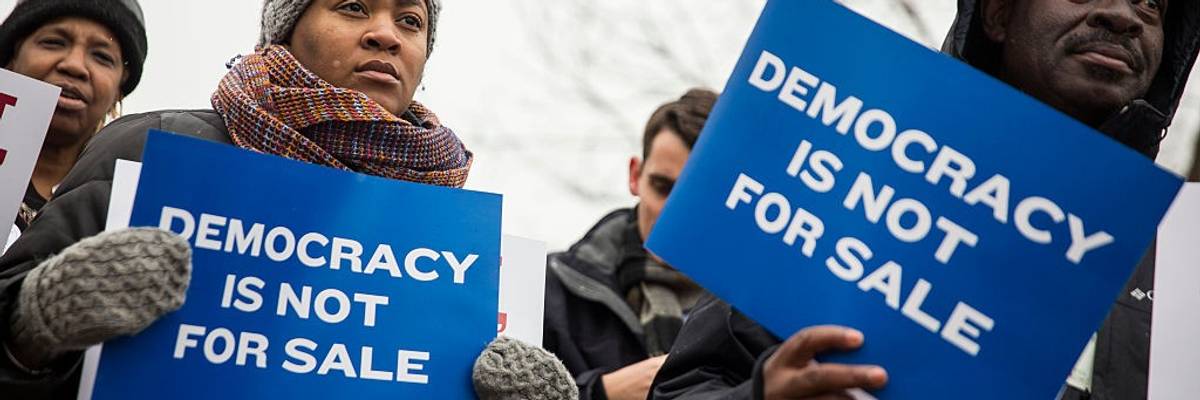
Attendees hold signs as they listen to speakers during a rally calling for an end to corporate money in politics and to mark the fifth anniversary of the Supreme Court's Citizens United decision, at Lafayette Square near the White House, January 21, 2015 in Washington, DC.
This critical 2026 midterm election may be decided by dark money, big money, tech money. Above all, secret money. The money storm is now gathering. It could tip the outcome of many races. And we may never really know what happened.
Political consultants warn Democratic candidates not to talk about regulating artificial intelligence, Politico reported this week. Not because that would be unpopular—it would be very popular!. No, the consultants warned, it’s that outspoken candidates could be demolished by millions of dollars suddenly dumped into their races by tech companies.
This critical 2026 midterm election may be decided by dark money, big money, tech money. Above all, secret money. The money storm is now gathering. It could tip the outcome of many races. And we may never really know what happened. It all has received far too little attention.
According to The New York Times, “All across America, the midterm elections are drowning in dark money.” That term is used when the identity of the person giving or spending the money is kept secret from the public. So far this year, the Times reports, $1 billion of dark money is sloshing through the political system, and the real number will surely be much higher. I’ll be talking with Theodore Schleifer, one of the authors of that story, on our podcast, out Wednesday.
Voters should ask candidates: Speeches about democracy are nice, but what are you actually going to do to take on big money?
Committees with vaguely patriotic names spring into being and suddenly have tens of millions of dollars to spend. Ads focus on topics far removed from the real concern of the donors. It’s not just television anymore. Money flows to digital ads and content creators as well. The public doesn’t know where all this money comes from, but candidates surely do.
Earlier this year, super PACs backed by rival AI firms dueled on the streets of Manhattan, spending tens of millions of dollars for or against a single congressional candidate, Alex Bores, an outspoken industry critic. Across the country, AI and cryptocurrency companies spent more than $127 million in primaries this year.
Too often, money in politics becomes background noise. Journalists often look at only the fully disclosed “hard money” to candidates and ignore the harder-to-quantify secret spending. Headlines focus on flashy democratic socialists or on attacks on pro-Israel groups like American Israel Public Affairs Committee. Meanwhile, big industries do what they do, pouring massive funds into the political process.
What will be the partisan impact? Twenty big donors, the Times reported, mostly billionaires, have so far spent $1.2 billion on this year’s elections. All but two favored Republicans. Elon Musk recently announced plans to spend at least $100 million through his super PAC. On the other hand, in 2024 most dark money was spent for Democrats in federal races.
After the votes are counted, we may learn if and how money made the difference in many races. But we won’t necessarily know whose spending tilted the election. Perhaps more importantly, all this money surely will have a big impact on government.
For all this, thank the Supreme Court. It has demolished the campaign finance laws, in Citizens United and other cases. According to the justices, such unlimited spending is allowed if it is disclosed (it isn’t) and if it is independent (gimme a break). At one point, Chief Justice John Roberts ruled that the ability to give unlimited campaign contributions was “the whole point” of the First Amendment. Our dystopian, money-drenched politics is a product of a Supreme Court badly in need of reform.
The media could do much more to explain what’s happening. The Times and a few other outlets have done stellar work. But far too often, campaign cash totals are treated merely as part of the horse race of politics.
Politicians themselves must respond. Year after year, politicians decry corruption but fail to act to pass stronger campaign finance laws. The next Congress must make reform a central goal. We need a law to end dark money and implement small donor public financing, as well as a constitutional amendment to undo misguided rulings such as Citizens United and Buckley v. Valeo.
Public outrage about corruption is extraordinarily high across party lines, as a recent Brennan Center survey showed. This time of year is when we have the full attention of those who would lead us. Voters should ask candidates: Speeches about democracy are nice, but what are you actually going to do to take on big money? And then hold them to their promises.
Dear Common Dreams reader, It’s been nearly 30 years since I co-founded Common Dreams with my late wife, Lina Newhouser. We had the radical notion that journalism should serve the public good, not corporate profits. It was clear to us from the outset what it would take to build such a project. No paid advertisements. No corporate sponsors. No millionaire publisher telling us what to think or do. Many people said we wouldn't last a year, but we proved those doubters wrong. Together with a tremendous team of journalists and dedicated staff, we built an independent media outlet free from the constraints of profits and corporate control. Our mission has always been simple: To inform. To inspire. To ignite change for the common good. Building Common Dreams was not easy. Our survival was never guaranteed. When you take on the most powerful forces—Wall Street greed, fossil fuel industry destruction, Big Tech lobbyists, and uber-rich oligarchs who have spent billions upon billions rigging the economy and democracy in their favor—the only bulwark you have is supporters who believe in your work. But here’s the urgent message from me today. It's never been this bad out there. And it's never been this hard to keep us going. At the very moment Common Dreams is most needed, the threats we face are intensifying. We need your support now more than ever. We don't accept corporate advertising and never will. We don't have a paywall because we don't think people should be blocked from critical news based on their ability to pay. Everything we do is funded by the donations of readers like you. When everyone does the little they can afford, we are strong. But if that support retreats or dries up, so do we. Will you donate now to make sure Common Dreams not only survives but thrives? —Craig Brown, Co-founder |
Political consultants warn Democratic candidates not to talk about regulating artificial intelligence, Politico reported this week. Not because that would be unpopular—it would be very popular!. No, the consultants warned, it’s that outspoken candidates could be demolished by millions of dollars suddenly dumped into their races by tech companies.
This critical 2026 midterm election may be decided by dark money, big money, tech money. Above all, secret money. The money storm is now gathering. It could tip the outcome of many races. And we may never really know what happened. It all has received far too little attention.
According to The New York Times, “All across America, the midterm elections are drowning in dark money.” That term is used when the identity of the person giving or spending the money is kept secret from the public. So far this year, the Times reports, $1 billion of dark money is sloshing through the political system, and the real number will surely be much higher. I’ll be talking with Theodore Schleifer, one of the authors of that story, on our podcast, out Wednesday.
Voters should ask candidates: Speeches about democracy are nice, but what are you actually going to do to take on big money?
Committees with vaguely patriotic names spring into being and suddenly have tens of millions of dollars to spend. Ads focus on topics far removed from the real concern of the donors. It’s not just television anymore. Money flows to digital ads and content creators as well. The public doesn’t know where all this money comes from, but candidates surely do.
Earlier this year, super PACs backed by rival AI firms dueled on the streets of Manhattan, spending tens of millions of dollars for or against a single congressional candidate, Alex Bores, an outspoken industry critic. Across the country, AI and cryptocurrency companies spent more than $127 million in primaries this year.
Too often, money in politics becomes background noise. Journalists often look at only the fully disclosed “hard money” to candidates and ignore the harder-to-quantify secret spending. Headlines focus on flashy democratic socialists or on attacks on pro-Israel groups like American Israel Public Affairs Committee. Meanwhile, big industries do what they do, pouring massive funds into the political process.
What will be the partisan impact? Twenty big donors, the Times reported, mostly billionaires, have so far spent $1.2 billion on this year’s elections. All but two favored Republicans. Elon Musk recently announced plans to spend at least $100 million through his super PAC. On the other hand, in 2024 most dark money was spent for Democrats in federal races.
After the votes are counted, we may learn if and how money made the difference in many races. But we won’t necessarily know whose spending tilted the election. Perhaps more importantly, all this money surely will have a big impact on government.
For all this, thank the Supreme Court. It has demolished the campaign finance laws, in Citizens United and other cases. According to the justices, such unlimited spending is allowed if it is disclosed (it isn’t) and if it is independent (gimme a break). At one point, Chief Justice John Roberts ruled that the ability to give unlimited campaign contributions was “the whole point” of the First Amendment. Our dystopian, money-drenched politics is a product of a Supreme Court badly in need of reform.
The media could do much more to explain what’s happening. The Times and a few other outlets have done stellar work. But far too often, campaign cash totals are treated merely as part of the horse race of politics.
Politicians themselves must respond. Year after year, politicians decry corruption but fail to act to pass stronger campaign finance laws. The next Congress must make reform a central goal. We need a law to end dark money and implement small donor public financing, as well as a constitutional amendment to undo misguided rulings such as Citizens United and Buckley v. Valeo.
Public outrage about corruption is extraordinarily high across party lines, as a recent Brennan Center survey showed. This time of year is when we have the full attention of those who would lead us. Voters should ask candidates: Speeches about democracy are nice, but what are you actually going to do to take on big money? And then hold them to their promises.
Political consultants warn Democratic candidates not to talk about regulating artificial intelligence, Politico reported this week. Not because that would be unpopular—it would be very popular!. No, the consultants warned, it’s that outspoken candidates could be demolished by millions of dollars suddenly dumped into their races by tech companies.
This critical 2026 midterm election may be decided by dark money, big money, tech money. Above all, secret money. The money storm is now gathering. It could tip the outcome of many races. And we may never really know what happened. It all has received far too little attention.
According to The New York Times, “All across America, the midterm elections are drowning in dark money.” That term is used when the identity of the person giving or spending the money is kept secret from the public. So far this year, the Times reports, $1 billion of dark money is sloshing through the political system, and the real number will surely be much higher. I’ll be talking with Theodore Schleifer, one of the authors of that story, on our podcast, out Wednesday.
Voters should ask candidates: Speeches about democracy are nice, but what are you actually going to do to take on big money?
Committees with vaguely patriotic names spring into being and suddenly have tens of millions of dollars to spend. Ads focus on topics far removed from the real concern of the donors. It’s not just television anymore. Money flows to digital ads and content creators as well. The public doesn’t know where all this money comes from, but candidates surely do.
Earlier this year, super PACs backed by rival AI firms dueled on the streets of Manhattan, spending tens of millions of dollars for or against a single congressional candidate, Alex Bores, an outspoken industry critic. Across the country, AI and cryptocurrency companies spent more than $127 million in primaries this year.
Too often, money in politics becomes background noise. Journalists often look at only the fully disclosed “hard money” to candidates and ignore the harder-to-quantify secret spending. Headlines focus on flashy democratic socialists or on attacks on pro-Israel groups like American Israel Public Affairs Committee. Meanwhile, big industries do what they do, pouring massive funds into the political process.
What will be the partisan impact? Twenty big donors, the Times reported, mostly billionaires, have so far spent $1.2 billion on this year’s elections. All but two favored Republicans. Elon Musk recently announced plans to spend at least $100 million through his super PAC. On the other hand, in 2024 most dark money was spent for Democrats in federal races.
After the votes are counted, we may learn if and how money made the difference in many races. But we won’t necessarily know whose spending tilted the election. Perhaps more importantly, all this money surely will have a big impact on government.
For all this, thank the Supreme Court. It has demolished the campaign finance laws, in Citizens United and other cases. According to the justices, such unlimited spending is allowed if it is disclosed (it isn’t) and if it is independent (gimme a break). At one point, Chief Justice John Roberts ruled that the ability to give unlimited campaign contributions was “the whole point” of the First Amendment. Our dystopian, money-drenched politics is a product of a Supreme Court badly in need of reform.
The media could do much more to explain what’s happening. The Times and a few other outlets have done stellar work. But far too often, campaign cash totals are treated merely as part of the horse race of politics.
Politicians themselves must respond. Year after year, politicians decry corruption but fail to act to pass stronger campaign finance laws. The next Congress must make reform a central goal. We need a law to end dark money and implement small donor public financing, as well as a constitutional amendment to undo misguided rulings such as Citizens United and Buckley v. Valeo.
Public outrage about corruption is extraordinarily high across party lines, as a recent Brennan Center survey showed. This time of year is when we have the full attention of those who would lead us. Voters should ask candidates: Speeches about democracy are nice, but what are you actually going to do to take on big money? And then hold them to their promises.