SUBSCRIBE TO OUR FREE NEWSLETTER
Daily news & progressive opinion—funded by the people, not the corporations—delivered straight to your inbox.
5
#000000
#FFFFFF
To donate by check, phone, or other method, see our More Ways to Give page.
Daily news & progressive opinion—funded by the people, not the corporations—delivered straight to your inbox.
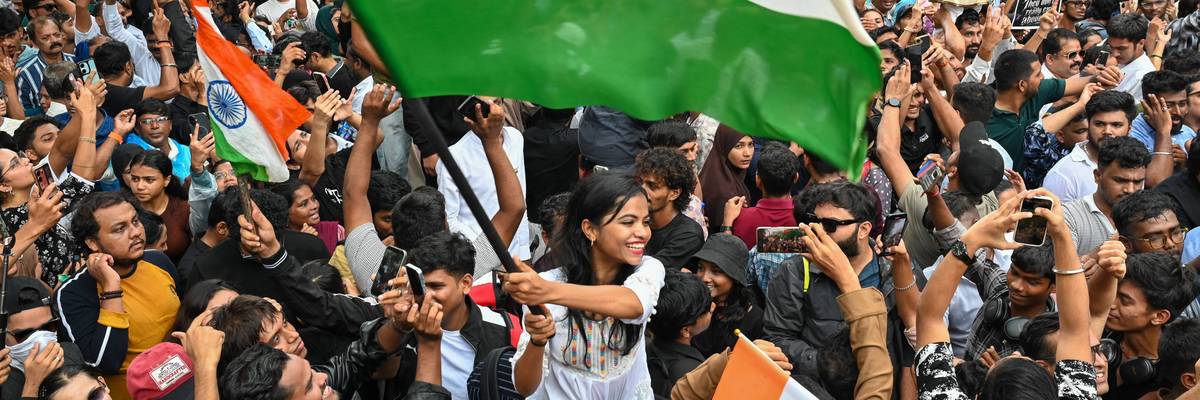
Cockroach Janta Party (CJP) supporters wave national flags a day after the resignation of India's Education Minister Dharmendra Pradhan in Mumbai on July 26, 2026, as protests over alleged NEET exam irregularities were called off.
The protests have yet to produce lasting institutional change, yet they have already demonstrated the capacity of young people to organize and exercise self-determination over their own political future.
Through a meme and a movement, Indian students have once again mobilized, this time in response to Chief Justice Surya Kant’s comparison of unemployed youth to “cockroaches” and “parasites” attacking the system. This remark led to the creation of the Cockroach Janta Party, or CJP, a mass-scale satirical movement with a mission to amplify the “voice of the lazy & unemployed.”
The political movement was fueled by compounding grievances. The precipitating factor was the leak of a medical entrance exam paper and irregularities in the government’s on-screen marking system forced millions of students to retake exams. But discontent has been building up for some time because of surging unemployment rates and a deepening disillusionment with the government. Student suicides associated with increasing academic pressure have reached as many as 13,000 a year.
Matters escalated further when hunger-striking activist Sonam Wangchuk was forcibly removed from a student protest site in Delhi and hospitalized by authorities. Tear gas and baton charges on student protesters catalyzed a countrywide youth uprising that would culminate in the resignation last week of the Modi government’s education minister.
Apart from material grievance, the student movement was ignited by what philosopher Axel Honneth argues is a form of moral indignation. Widespread feelings of injustice have changed the nature of emancipatory struggles from rational economic interests to ones that are personal and emotional. Framing students as parasites through dehumanizing language, rather than as citizens facing systemic and institutional barriers, strips them of political dignity and represents them as inferior and shameful in addition to diverting attention from the state’s own policy failures.
Across South Asia, contemporaneous youth-led, digitally organized uprisings have taken place in quick succession. Sri Lanka’s Aragalaya protest in 2022 forced the resignation of both the president and the prime minister. Bangladesh’s student-led movement in 2024 against a quota system in government jobs, compounded by rising authoritarianism, led to the resignation of Prime Minister Sheikh Hasina after 15 years in power. And in Nepal, a country where nearly 56% of the population is under 30, a generation disproportionately affected by economic precarity and a housing crisis, a Gen Z protest in 2025 toppled Prime Minister K.P Sharma Oli within days of a government ban on social media.
These cases mark different points on the spectrum of outcomes. Protesters in Sri Lanka and Nepal converted disruption into institutional turnover, resulting in the installation of new elected governments following the uprisings. Young people in Bangladesh toppled a government but have struggled to translate that disruption into a stable institutional order. In India, CJP called off its protest after the government met its three immediate demands—the education minister’s resignation, withdrawal of criminal investigations against protesters, and compensation for the families of students who died by suicide following the leak. However, the settlement remains contentious, as CJP raised concerns that the government was not honoring its commitments, with a spokesperson warning that the protest would resume if punitive action against student protesters continued.
Youth uprisings matter, then, not simply as sudden, spectacular action but as a means of amplifying the voice of a demographic majority and reshaping the terms of legitimacy and accountability between citizens and the state.
The movement’s broader charter—a new Public Examinations Act, reform of national examination bodies, a students’ rights charter, a national aspirant welfare fund, and permanent parliamentary oversight of examination authorities—is due to be taken up in a further round of talks with the government. The protests have yet to produce lasting institutional change, yet they have already demonstrated the capacity of young people to organize and exercise self-determination over their own political future.
The United Nations estimates that the world is home to 1.3 billion young people, more than half of them living in low- and lower-middle-income countries. Almost half of South Asia’s 1.8 billion people are under the age of 24, giving the region the world’s largest youth labor force until 2040.
Yet political power across South Asia remains generationally divided with the average age of Indian parliamentary representatives at 56. In Sri Lanka, only 4 of 212 MPs are under 30, while in Pakistan it’s just 7 of 311.
These figures expose a widening generational gap between aging political elites who have long monopolized legislative power and a younger generation that has grown up in the digital age expecting greater accountability but experiencing political marginalization. A related tension is a growing disconnect between economic liberalization and meaningful employment opportunities and social mobility for a generation of youth pursuing higher education.
In India, a democracy of 1.4 billion people, youth representation in the country’s legislative politics remains strikingly narrow along lines of age, gender, and caste. Over the past few decades, the share of young MPs aged 25-40 in the lower house of India’s parliament has fallen from 30% to just 10%.
Youth uprisings matter, then, not simply as sudden, spectacular action but as a means of amplifying the voice of a demographic majority and reshaping the terms of legitimacy and accountability between citizens and the state. These movements have galvanized global solidarity around regional struggles. They have been made increasingly possible by digitally mediated technology and decentralized, leaderless organizing.
Central to the profound historical shifts in social movements is the emergence of the internet as a space for dissent. Sociologist Manuel Castells frames the internet as a “hybrid space of autonomy” where cyberspace and physical urban space merge into a new kind of social location for political actions. These networked movements, Castells argues, are characterized by spontaneity, virality, decentralization, and ad hoc collaborative deliberation with no single leader.
As the CJP movement tweeted, filmed, and Instagrammed in real time, its networked visibility diversified participation and displaced the state and the traditional media’s monopoly over the narratives of its violence and police brutality. However, Zeynep Tufekci cautions against the fragility of networked movements, which mobilize with extraordinary speed but often lack the internal capacities, leadership structures, negotiating experience, and resilience that older movements built over years of slower political organization.
Their activism reflects a wider shift toward collective action that is increasingly contentious, globalized, and proactive.
Although digital movements enable horizontal mobilization and egalitarian participation in emancipatory struggles, post-uprising outcomes often remain uncertain. Social movement scholars have noted a recurring pattern. Movements built on decentralized coordination excel at forcing concessions or toppling governments, but they struggle to convert that same horizontal structure into hierarchical institutional governance. This leaves established political actors better positioned to reassert control during the transition, making it harder for movements to transcend regime change and translate initial disruption into long-term democratic transformation that the participants demanded. Nevertheless, these movements have expanded democratic possibilities by opening up new locations of collective belonging, political self-expression, and altruism.
In the end, the collective benefits of a social movement can outweigh the success or failure of a challenger’s program because social movements have many influences, both tangible and intangible, that go beyond the explicitly stated goals. In CJP’s case, these benefits include the representation of youth voices and the democratic rights of the country’s largest demographic group. Their activism reflects a wider shift toward collective action that is increasingly contentious, globalized, and proactive. In a larger sense, this contributes to a more participatory polity where Indian citizens exercise political rights and shape political outcomes directly.
Dear Common Dreams reader, It’s been nearly 30 years since I co-founded Common Dreams with my late wife, Lina Newhouser. We had the radical notion that journalism should serve the public good, not corporate profits. It was clear to us from the outset what it would take to build such a project. No paid advertisements. No corporate sponsors. No millionaire publisher telling us what to think or do. Many people said we wouldn't last a year, but we proved those doubters wrong. Together with a tremendous team of journalists and dedicated staff, we built an independent media outlet free from the constraints of profits and corporate control. Our mission has always been simple: To inform. To inspire. To ignite change for the common good. Building Common Dreams was not easy. Our survival was never guaranteed. When you take on the most powerful forces—Wall Street greed, fossil fuel industry destruction, Big Tech lobbyists, and uber-rich oligarchs who have spent billions upon billions rigging the economy and democracy in their favor—the only bulwark you have is supporters who believe in your work. But here’s the urgent message from me today. It's never been this bad out there. And it's never been this hard to keep us going. At the very moment Common Dreams is most needed, the threats we face are intensifying. We need your support now more than ever. We don't accept corporate advertising and never will. We don't have a paywall because we don't think people should be blocked from critical news based on their ability to pay. Everything we do is funded by the donations of readers like you. When everyone does the little they can afford, we are strong. But if that support retreats or dries up, so do we. Will you donate now to make sure Common Dreams not only survives but thrives? —Craig Brown, Co-founder |
Through a meme and a movement, Indian students have once again mobilized, this time in response to Chief Justice Surya Kant’s comparison of unemployed youth to “cockroaches” and “parasites” attacking the system. This remark led to the creation of the Cockroach Janta Party, or CJP, a mass-scale satirical movement with a mission to amplify the “voice of the lazy & unemployed.”
The political movement was fueled by compounding grievances. The precipitating factor was the leak of a medical entrance exam paper and irregularities in the government’s on-screen marking system forced millions of students to retake exams. But discontent has been building up for some time because of surging unemployment rates and a deepening disillusionment with the government. Student suicides associated with increasing academic pressure have reached as many as 13,000 a year.
Matters escalated further when hunger-striking activist Sonam Wangchuk was forcibly removed from a student protest site in Delhi and hospitalized by authorities. Tear gas and baton charges on student protesters catalyzed a countrywide youth uprising that would culminate in the resignation last week of the Modi government’s education minister.
Apart from material grievance, the student movement was ignited by what philosopher Axel Honneth argues is a form of moral indignation. Widespread feelings of injustice have changed the nature of emancipatory struggles from rational economic interests to ones that are personal and emotional. Framing students as parasites through dehumanizing language, rather than as citizens facing systemic and institutional barriers, strips them of political dignity and represents them as inferior and shameful in addition to diverting attention from the state’s own policy failures.
Across South Asia, contemporaneous youth-led, digitally organized uprisings have taken place in quick succession. Sri Lanka’s Aragalaya protest in 2022 forced the resignation of both the president and the prime minister. Bangladesh’s student-led movement in 2024 against a quota system in government jobs, compounded by rising authoritarianism, led to the resignation of Prime Minister Sheikh Hasina after 15 years in power. And in Nepal, a country where nearly 56% of the population is under 30, a generation disproportionately affected by economic precarity and a housing crisis, a Gen Z protest in 2025 toppled Prime Minister K.P Sharma Oli within days of a government ban on social media.
These cases mark different points on the spectrum of outcomes. Protesters in Sri Lanka and Nepal converted disruption into institutional turnover, resulting in the installation of new elected governments following the uprisings. Young people in Bangladesh toppled a government but have struggled to translate that disruption into a stable institutional order. In India, CJP called off its protest after the government met its three immediate demands—the education minister’s resignation, withdrawal of criminal investigations against protesters, and compensation for the families of students who died by suicide following the leak. However, the settlement remains contentious, as CJP raised concerns that the government was not honoring its commitments, with a spokesperson warning that the protest would resume if punitive action against student protesters continued.
Youth uprisings matter, then, not simply as sudden, spectacular action but as a means of amplifying the voice of a demographic majority and reshaping the terms of legitimacy and accountability between citizens and the state.
The movement’s broader charter—a new Public Examinations Act, reform of national examination bodies, a students’ rights charter, a national aspirant welfare fund, and permanent parliamentary oversight of examination authorities—is due to be taken up in a further round of talks with the government. The protests have yet to produce lasting institutional change, yet they have already demonstrated the capacity of young people to organize and exercise self-determination over their own political future.
The United Nations estimates that the world is home to 1.3 billion young people, more than half of them living in low- and lower-middle-income countries. Almost half of South Asia’s 1.8 billion people are under the age of 24, giving the region the world’s largest youth labor force until 2040.
Yet political power across South Asia remains generationally divided with the average age of Indian parliamentary representatives at 56. In Sri Lanka, only 4 of 212 MPs are under 30, while in Pakistan it’s just 7 of 311.
These figures expose a widening generational gap between aging political elites who have long monopolized legislative power and a younger generation that has grown up in the digital age expecting greater accountability but experiencing political marginalization. A related tension is a growing disconnect between economic liberalization and meaningful employment opportunities and social mobility for a generation of youth pursuing higher education.
In India, a democracy of 1.4 billion people, youth representation in the country’s legislative politics remains strikingly narrow along lines of age, gender, and caste. Over the past few decades, the share of young MPs aged 25-40 in the lower house of India’s parliament has fallen from 30% to just 10%.
Youth uprisings matter, then, not simply as sudden, spectacular action but as a means of amplifying the voice of a demographic majority and reshaping the terms of legitimacy and accountability between citizens and the state. These movements have galvanized global solidarity around regional struggles. They have been made increasingly possible by digitally mediated technology and decentralized, leaderless organizing.
Central to the profound historical shifts in social movements is the emergence of the internet as a space for dissent. Sociologist Manuel Castells frames the internet as a “hybrid space of autonomy” where cyberspace and physical urban space merge into a new kind of social location for political actions. These networked movements, Castells argues, are characterized by spontaneity, virality, decentralization, and ad hoc collaborative deliberation with no single leader.
As the CJP movement tweeted, filmed, and Instagrammed in real time, its networked visibility diversified participation and displaced the state and the traditional media’s monopoly over the narratives of its violence and police brutality. However, Zeynep Tufekci cautions against the fragility of networked movements, which mobilize with extraordinary speed but often lack the internal capacities, leadership structures, negotiating experience, and resilience that older movements built over years of slower political organization.
Their activism reflects a wider shift toward collective action that is increasingly contentious, globalized, and proactive.
Although digital movements enable horizontal mobilization and egalitarian participation in emancipatory struggles, post-uprising outcomes often remain uncertain. Social movement scholars have noted a recurring pattern. Movements built on decentralized coordination excel at forcing concessions or toppling governments, but they struggle to convert that same horizontal structure into hierarchical institutional governance. This leaves established political actors better positioned to reassert control during the transition, making it harder for movements to transcend regime change and translate initial disruption into long-term democratic transformation that the participants demanded. Nevertheless, these movements have expanded democratic possibilities by opening up new locations of collective belonging, political self-expression, and altruism.
In the end, the collective benefits of a social movement can outweigh the success or failure of a challenger’s program because social movements have many influences, both tangible and intangible, that go beyond the explicitly stated goals. In CJP’s case, these benefits include the representation of youth voices and the democratic rights of the country’s largest demographic group. Their activism reflects a wider shift toward collective action that is increasingly contentious, globalized, and proactive. In a larger sense, this contributes to a more participatory polity where Indian citizens exercise political rights and shape political outcomes directly.
Through a meme and a movement, Indian students have once again mobilized, this time in response to Chief Justice Surya Kant’s comparison of unemployed youth to “cockroaches” and “parasites” attacking the system. This remark led to the creation of the Cockroach Janta Party, or CJP, a mass-scale satirical movement with a mission to amplify the “voice of the lazy & unemployed.”
The political movement was fueled by compounding grievances. The precipitating factor was the leak of a medical entrance exam paper and irregularities in the government’s on-screen marking system forced millions of students to retake exams. But discontent has been building up for some time because of surging unemployment rates and a deepening disillusionment with the government. Student suicides associated with increasing academic pressure have reached as many as 13,000 a year.
Matters escalated further when hunger-striking activist Sonam Wangchuk was forcibly removed from a student protest site in Delhi and hospitalized by authorities. Tear gas and baton charges on student protesters catalyzed a countrywide youth uprising that would culminate in the resignation last week of the Modi government’s education minister.
Apart from material grievance, the student movement was ignited by what philosopher Axel Honneth argues is a form of moral indignation. Widespread feelings of injustice have changed the nature of emancipatory struggles from rational economic interests to ones that are personal and emotional. Framing students as parasites through dehumanizing language, rather than as citizens facing systemic and institutional barriers, strips them of political dignity and represents them as inferior and shameful in addition to diverting attention from the state’s own policy failures.
Across South Asia, contemporaneous youth-led, digitally organized uprisings have taken place in quick succession. Sri Lanka’s Aragalaya protest in 2022 forced the resignation of both the president and the prime minister. Bangladesh’s student-led movement in 2024 against a quota system in government jobs, compounded by rising authoritarianism, led to the resignation of Prime Minister Sheikh Hasina after 15 years in power. And in Nepal, a country where nearly 56% of the population is under 30, a generation disproportionately affected by economic precarity and a housing crisis, a Gen Z protest in 2025 toppled Prime Minister K.P Sharma Oli within days of a government ban on social media.
These cases mark different points on the spectrum of outcomes. Protesters in Sri Lanka and Nepal converted disruption into institutional turnover, resulting in the installation of new elected governments following the uprisings. Young people in Bangladesh toppled a government but have struggled to translate that disruption into a stable institutional order. In India, CJP called off its protest after the government met its three immediate demands—the education minister’s resignation, withdrawal of criminal investigations against protesters, and compensation for the families of students who died by suicide following the leak. However, the settlement remains contentious, as CJP raised concerns that the government was not honoring its commitments, with a spokesperson warning that the protest would resume if punitive action against student protesters continued.
Youth uprisings matter, then, not simply as sudden, spectacular action but as a means of amplifying the voice of a demographic majority and reshaping the terms of legitimacy and accountability between citizens and the state.
The movement’s broader charter—a new Public Examinations Act, reform of national examination bodies, a students’ rights charter, a national aspirant welfare fund, and permanent parliamentary oversight of examination authorities—is due to be taken up in a further round of talks with the government. The protests have yet to produce lasting institutional change, yet they have already demonstrated the capacity of young people to organize and exercise self-determination over their own political future.
The United Nations estimates that the world is home to 1.3 billion young people, more than half of them living in low- and lower-middle-income countries. Almost half of South Asia’s 1.8 billion people are under the age of 24, giving the region the world’s largest youth labor force until 2040.
Yet political power across South Asia remains generationally divided with the average age of Indian parliamentary representatives at 56. In Sri Lanka, only 4 of 212 MPs are under 30, while in Pakistan it’s just 7 of 311.
These figures expose a widening generational gap between aging political elites who have long monopolized legislative power and a younger generation that has grown up in the digital age expecting greater accountability but experiencing political marginalization. A related tension is a growing disconnect between economic liberalization and meaningful employment opportunities and social mobility for a generation of youth pursuing higher education.
In India, a democracy of 1.4 billion people, youth representation in the country’s legislative politics remains strikingly narrow along lines of age, gender, and caste. Over the past few decades, the share of young MPs aged 25-40 in the lower house of India’s parliament has fallen from 30% to just 10%.
Youth uprisings matter, then, not simply as sudden, spectacular action but as a means of amplifying the voice of a demographic majority and reshaping the terms of legitimacy and accountability between citizens and the state. These movements have galvanized global solidarity around regional struggles. They have been made increasingly possible by digitally mediated technology and decentralized, leaderless organizing.
Central to the profound historical shifts in social movements is the emergence of the internet as a space for dissent. Sociologist Manuel Castells frames the internet as a “hybrid space of autonomy” where cyberspace and physical urban space merge into a new kind of social location for political actions. These networked movements, Castells argues, are characterized by spontaneity, virality, decentralization, and ad hoc collaborative deliberation with no single leader.
As the CJP movement tweeted, filmed, and Instagrammed in real time, its networked visibility diversified participation and displaced the state and the traditional media’s monopoly over the narratives of its violence and police brutality. However, Zeynep Tufekci cautions against the fragility of networked movements, which mobilize with extraordinary speed but often lack the internal capacities, leadership structures, negotiating experience, and resilience that older movements built over years of slower political organization.
Their activism reflects a wider shift toward collective action that is increasingly contentious, globalized, and proactive.
Although digital movements enable horizontal mobilization and egalitarian participation in emancipatory struggles, post-uprising outcomes often remain uncertain. Social movement scholars have noted a recurring pattern. Movements built on decentralized coordination excel at forcing concessions or toppling governments, but they struggle to convert that same horizontal structure into hierarchical institutional governance. This leaves established political actors better positioned to reassert control during the transition, making it harder for movements to transcend regime change and translate initial disruption into long-term democratic transformation that the participants demanded. Nevertheless, these movements have expanded democratic possibilities by opening up new locations of collective belonging, political self-expression, and altruism.
In the end, the collective benefits of a social movement can outweigh the success or failure of a challenger’s program because social movements have many influences, both tangible and intangible, that go beyond the explicitly stated goals. In CJP’s case, these benefits include the representation of youth voices and the democratic rights of the country’s largest demographic group. Their activism reflects a wider shift toward collective action that is increasingly contentious, globalized, and proactive. In a larger sense, this contributes to a more participatory polity where Indian citizens exercise political rights and shape political outcomes directly.