SUBSCRIBE TO OUR FREE NEWSLETTER
Daily news & progressive opinion—funded by the people, not the corporations—delivered straight to your inbox.
5
#000000
#FFFFFF
To donate by check, phone, or other method, see our More Ways to Give page.
Daily news & progressive opinion—funded by the people, not the corporations—delivered straight to your inbox.
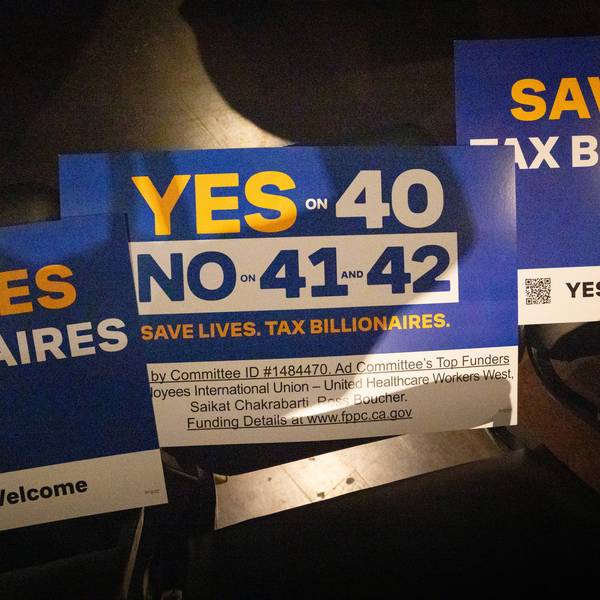
Yes on 40 signs sit on seats at the "Ballots Over Billionaires" rally on Monday, October 5, 2026 in Los Angeles, California.
In this anti-billionaire election, how could a targeted wealth tax—a tax only to be paid by 260 billionaires—fail in liberal California? Lessons from the Prop 40 fight.
The midterm results were a striking repudiation of billionaires and the AI tech billionaire class. Up and down the ballot, candidates who campaigned for working people and against the billionaire donor class won.
In California, however, billionaires are popping champagne bottles to celebrate the defeat of Prop 40, a one-time 5% wealth tax on billionaires. Voters narrowly defeated the measure.
Introduced by the state’s most powerful healthcare union, Service Employees International Union, the initiative would have been the first state-based wealth tax in US history. The estimated $107 billion in revenue would have largely offset federal healthcare cuts for millions of Californians. Remaining funds were earmarked for food assistance, education initiatives, and tax administration.
Prop 40 was a direct shot at the billionaire class—and they stepped up to fight it.
In this anti-billionaire election, how could a targeted wealth tax—a tax only to be paid by 260 billionaires—fail in liberal California?
The first reason is obvious: Wealth tax advocates picked a fight with the wealthiest and most powerful people on the planet. The second: Proponents were plagued by rifts within the Democratic Party, some of them fomented by billionaire donors themselves.
Prop 40 was a direct shot at the billionaire class—and they stepped up to fight it.
Silicon Valley billionaires spent $370 million to defeat the initiative, going up against $34 million from wealth tax supporters. California voters were flooded with advertisements and paid influencer social media posts suggesting the wealth tax would punish all Californians, not just a few billionaires.
Opponents also financed two “poison pill” ballot initiatives of their own—Props 41 and 42—that attempted to nullify Prop 40. Billionaires announced they would litigate the tax’s constitutionality and implementation, while also threatening to renounce their California residency.
The billionaire opponents were probably more motivated by a fear of future initiatives than the one-time 5% tax. Twenty-two of the most outspoken billionaire critics and donors—including figures like Sergey Brin, Peter Thiel, and at least one playboy prince—saw their average wealth increase over 64% in the 20 months prior to the vote. They’d barely notice a 5% tax on these immense fortunes.
The campaign for a wealth tax might have overcome the money disadvantage if potential allies had not been divided—again in part by billionaire opponents. While the state Democratic Party joined the state AFL-CIO and the Teamsters unions in support of the initiatives, prominent Democrats publicly opposed the tax—including Gov. Gavin Newsom, Gov.-elect Xavier Becerra, and former US Rep. Katie Porter.
Newsom claimed to support a federal wealth tax but alleged a state-level tax would lead to billionaire flight and reduced capital gains income from existing state taxes. Some of Newsom’s billionaire donors, key to his future presidential ambitions, were among the biggest donors to the anti-wealth tax coffers, including cryptocurrency billionaire Chris Larsen.
Opposition came from some liberal organizations such as Planned Parenthood and several unions, including the California Teachers Association, partly because they didn’t think they would benefit from the revenue the measure would raise. Some nonprofits may also have worried about offending wealthy donors by backing the tax.
The billionaires and their allies won this round. In this new populist era, the issue is sure to resurface.
Even while rejecting Prop 40, California voters overwhelmingly approved Prop 3, which permanently extends a higher income tax rate on the state’s wealthiest earners. National polls show overwhelming majority support for taxing billionaire wealth.
Taxing oligarchs is going to be hard, in part because the Democratic Party establishment has its own influential billionaire donor class. The new wave of elected progressives has other plans to tax extreme wealth, especially at the federal level.
A number of proposals to “tax the top” have been introduced, including proposals to levy an income tax surcharge on billionaire incomes and a federal wealth tax. Sen. Ron Wyden (D-Ore.), will become chair of the tax-writing Finance Committee, and has introduced the Fair Trusts for Fiscal Responsibility Act to crack down on the tax avoidance of millionaires and billionaires. “The committee will redouble its efforts to ensure billionaires pay their fair share and hold tax cheats accountable,” Wyden said after the election.
Democratic leaders acknowledge that President Donald Trump will veto their tax proposals. They should put them forward anyway. “It is essential that we show the American people where we stand,” said Maryland Sen. Chris Van Hollen, lead sponsor of several proposals to tax billionaires. “If Trump vetoes it, it will just show people that he’s on the side of billionaires.”
This country and this world are at a monumental crossroads. US voters have an opportunity to beat back the forces of fascism and confront the billionaires who are rigging the economy, our media system, and our democracy, making it increasingly impossible for ordinary people to get by. We’re not just talking about the election. We’re talking about what must be done once these fascist elements are vanquished from power. We need a bolder set of solutions than what either major party has so far been willing to offer and a working-class movement ready to fight like hell for it. Trump didn't emerge from nowhere. The conditions that fueled MAGA authoritarianism were created by decades of radical neoliberal economic policies and a corrupt political system dominated by corporate interests. They slashed taxes on the super-rich, promising that the benefits would trickle down. They said giveaways to the corporate titans would make life more affordable for the rest of us. It was all bullshit. And when a bitter, betrayed populace searches for someone to blame, right-wing demagogues have little trouble finding scapegoats. People know when they're being lied to, but you won't hear any of this from the corporate media. Only independent journalism—powered and funded by people who believe in building a better world—can deliver truly trustworthy daily news. If you share our vision, please contribute whatever you can to sustain our work. |
The midterm results were a striking repudiation of billionaires and the AI tech billionaire class. Up and down the ballot, candidates who campaigned for working people and against the billionaire donor class won.
In California, however, billionaires are popping champagne bottles to celebrate the defeat of Prop 40, a one-time 5% wealth tax on billionaires. Voters narrowly defeated the measure.
Introduced by the state’s most powerful healthcare union, Service Employees International Union, the initiative would have been the first state-based wealth tax in US history. The estimated $107 billion in revenue would have largely offset federal healthcare cuts for millions of Californians. Remaining funds were earmarked for food assistance, education initiatives, and tax administration.
Prop 40 was a direct shot at the billionaire class—and they stepped up to fight it.
In this anti-billionaire election, how could a targeted wealth tax—a tax only to be paid by 260 billionaires—fail in liberal California?
The first reason is obvious: Wealth tax advocates picked a fight with the wealthiest and most powerful people on the planet. The second: Proponents were plagued by rifts within the Democratic Party, some of them fomented by billionaire donors themselves.
Prop 40 was a direct shot at the billionaire class—and they stepped up to fight it.
Silicon Valley billionaires spent $370 million to defeat the initiative, going up against $34 million from wealth tax supporters. California voters were flooded with advertisements and paid influencer social media posts suggesting the wealth tax would punish all Californians, not just a few billionaires.
Opponents also financed two “poison pill” ballot initiatives of their own—Props 41 and 42—that attempted to nullify Prop 40. Billionaires announced they would litigate the tax’s constitutionality and implementation, while also threatening to renounce their California residency.
The billionaire opponents were probably more motivated by a fear of future initiatives than the one-time 5% tax. Twenty-two of the most outspoken billionaire critics and donors—including figures like Sergey Brin, Peter Thiel, and at least one playboy prince—saw their average wealth increase over 64% in the 20 months prior to the vote. They’d barely notice a 5% tax on these immense fortunes.
The campaign for a wealth tax might have overcome the money disadvantage if potential allies had not been divided—again in part by billionaire opponents. While the state Democratic Party joined the state AFL-CIO and the Teamsters unions in support of the initiatives, prominent Democrats publicly opposed the tax—including Gov. Gavin Newsom, Gov.-elect Xavier Becerra, and former US Rep. Katie Porter.
Newsom claimed to support a federal wealth tax but alleged a state-level tax would lead to billionaire flight and reduced capital gains income from existing state taxes. Some of Newsom’s billionaire donors, key to his future presidential ambitions, were among the biggest donors to the anti-wealth tax coffers, including cryptocurrency billionaire Chris Larsen.
Opposition came from some liberal organizations such as Planned Parenthood and several unions, including the California Teachers Association, partly because they didn’t think they would benefit from the revenue the measure would raise. Some nonprofits may also have worried about offending wealthy donors by backing the tax.
The billionaires and their allies won this round. In this new populist era, the issue is sure to resurface.
Even while rejecting Prop 40, California voters overwhelmingly approved Prop 3, which permanently extends a higher income tax rate on the state’s wealthiest earners. National polls show overwhelming majority support for taxing billionaire wealth.
Taxing oligarchs is going to be hard, in part because the Democratic Party establishment has its own influential billionaire donor class. The new wave of elected progressives has other plans to tax extreme wealth, especially at the federal level.
A number of proposals to “tax the top” have been introduced, including proposals to levy an income tax surcharge on billionaire incomes and a federal wealth tax. Sen. Ron Wyden (D-Ore.), will become chair of the tax-writing Finance Committee, and has introduced the Fair Trusts for Fiscal Responsibility Act to crack down on the tax avoidance of millionaires and billionaires. “The committee will redouble its efforts to ensure billionaires pay their fair share and hold tax cheats accountable,” Wyden said after the election.
Democratic leaders acknowledge that President Donald Trump will veto their tax proposals. They should put them forward anyway. “It is essential that we show the American people where we stand,” said Maryland Sen. Chris Van Hollen, lead sponsor of several proposals to tax billionaires. “If Trump vetoes it, it will just show people that he’s on the side of billionaires.”