SUBSCRIBE TO OUR FREE NEWSLETTER
Daily news & progressive opinion—funded by the people, not the corporations—delivered straight to your inbox.
5
#000000
#FFFFFF
To donate by check, phone, or other method, see our More Ways to Give page.
Daily news & progressive opinion—funded by the people, not the corporations—delivered straight to your inbox.
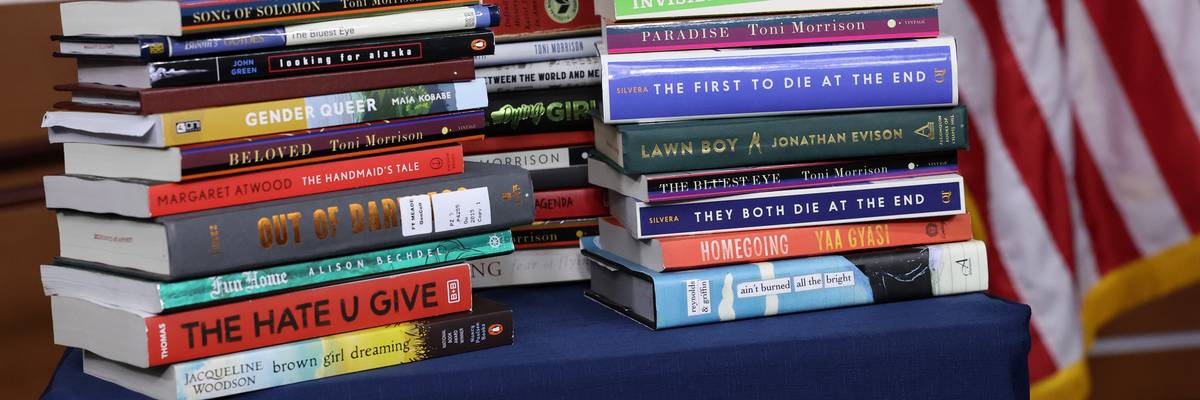
Copies of banned books from various states and school systems from around the county are seen during a press conference by US House Democratic Leader Hakeem Jeffries (D-NY) at the US Capitol on March 24, 2023 in Washington, DC.
When we ban books for young readers that tackle topics surrounding marginalized people, we strip many young readers of the opportunity to feel seen when they are already painfully underrepresented.
As a first-generation Mexican American, the first time I ever connected with a book and felt genuinely excited to write a book report was when we were assigned to read Esperanza Rising by Pam Muñoz Ryan by Pam Muñoz Ryan in sixth grade. The story, which follows a girl learning to navigate her new life inside a labor camp in California after being forced to move there following the tragic death of her father in Mexico, included themes that really resonated with me.
Up until then, I had never read a book like that. It spoke to me in a way I never imagined a book would, and it made me want to read more. Sixth grade became the year I started considering myself an avid reader because I was pursuing that “special feeling” Esperanza Rising gave me in other books. I was chasing the feeling of being seen.
Today, Esperanza Rising is being challenged in states like Texas and North Carolina because parents feel uncomfortable with its themes of racism and immigration, and I can’t help but think back to my 11-year-old self. If this book had been banned before I got the opportunity to read it, I’m not sure that I would have discovered that “special feeling,” at least not in sixth grade. It would have taken me longer to discover it, if I discovered it at all.
There must be a collective understanding among the gatekeepers of children’s literature that these stories matter, and a commitment to protecting them from being removed from shelves.
This is what makes book bans incredibly dangerous, especially at a time of declining literacy rates, and parents struggling to get their kids to pick up a book instead of their tablets or devices. In October 2026, PEN America reported nearly 12,000 book bans involving more than 7,300 individual titles in US schools during the 2025-2026 school year, which the organization says is the largest censorship case numbers it had ever recorded.
There have been multiple studies reporting on the negative impact book bans are having on teacher morale and student learning, with marginalized young readers especially bearing the brunt of these decisions. The American Library Association reports that a significant proportion of contested books center on LGBTQ+ experiences, racial identity, or themes of systemic inequality, essentially sending the message that those themes should be censored.
When I wrote the first book in my middle-grade magic school series featuring the daughter of undocumented immigrants as the protagonist, Chloe Vega and the Agents of Magic, my goal was to educate young readers about immigration in a way that is digestible and age appropriate. It follows Chloe, who is terrified that Immigration and Customs Enforcement will take her undocumented parents from her. She’s unaware magic exists until a sorcerer disguised as an immigration officer takes her parents, forcing her to embark on a journey to harness her abilities at a magical academy so she can reunite her family.
Despite its fantasy elements, the book is essentially about a little girl fighting to reunite with her family. It’s a heavy message for many young readers, but the magical elements make it easier for them to process. The book has been out for a year, and many parents have reported that it served as an excellent gateway to serious conversations with their children about immigration and the times we’re living in.
The sequel to Chloe’s story, Chloe Vega and the Missing Unseen, was published on October 6, 2026, and both books could be challenged or banned in many states because they address immigration, despite their age appropriateness.
When we ban books for young readers that tackle topics surrounding marginalized people, we lose a critical avenue for parents, educators, and librarians to educate children on these serious topics and help them develop understanding and empathy. We also strip marginalized young readers of the opportunity to feel seen when they are already painfully underrepresented. In the times that we’re living in, this can be extremely harmful.
It also puts these authors at a significant disadvantage, making it harder to get their books into the hands of the readers who need them most. Many have had school visits canceled because educators and administrators fear repercussions from lawmakers and increasingly restrictive book-banning policies. These challenges create greater financial risk for both authors and publishers, which can make publishers more hesitant to invest in books by marginalized authors and further limit the diversity of stories available to young readers.
So far, many efforts have been made to combat book bans. In 2024, a group of authors banded together to launch Authors Against Book Bans, whose mission is to stand united against the unconstitutional movement to limit the freedom to read and to unequivocally support the availability of diverse voices in schools, libraries, and culture. Organizations such as PEN America are actively filing lawsuits against school boards, arguing that these bans violate the First Amendment.
But more needs to be done. There must be a collective understanding among the gatekeepers of children’s literature that these stories matter, and a commitment to protecting them from being removed from shelves. Books have long been celebrated for their ability to build empathy and compassion by inviting readers into lives and experiences different from their own. But when the books being challenged and removed are disproportionately about marginalized people, it does more than limit what children can read. It erases the experiences and identities of the very people whose voices deserve to be heard.
Dear Common Dreams reader, It’s been nearly 30 years since I co-founded Common Dreams with my late wife, Lina Newhouser. We had the radical notion that journalism should serve the public good, not corporate profits. It was clear to us from the outset what it would take to build such a project. No paid advertisements. No corporate sponsors. No millionaire publisher telling us what to think or do. Many people said we wouldn't last a year, but we proved those doubters wrong. Together with a tremendous team of journalists and dedicated staff, we built an independent media outlet free from the constraints of profits and corporate control. Our mission has always been simple: To inform. To inspire. To ignite change for the common good. Building Common Dreams was not easy. Our survival was never guaranteed. When you take on the most powerful forces—Wall Street greed, fossil fuel industry destruction, Big Tech lobbyists, and uber-rich oligarchs who have spent billions upon billions rigging the economy and democracy in their favor—the only bulwark you have is supporters who believe in your work. But here’s the urgent message from me today. It's never been this bad out there. And it's never been this hard to keep us going. At the very moment Common Dreams is most needed, the threats we face are intensifying. We need your support now more than ever. We don't accept corporate advertising and never will. We don't have a paywall because we don't think people should be blocked from critical news based on their ability to pay. Everything we do is funded by the donations of readers like you. When everyone does the little they can afford, we are strong. But if that support retreats or dries up, so do we. Will you donate now to make sure Common Dreams not only survives but thrives? —Craig Brown, Co-founder |
As a first-generation Mexican American, the first time I ever connected with a book and felt genuinely excited to write a book report was when we were assigned to read Esperanza Rising by Pam Muñoz Ryan by Pam Muñoz Ryan in sixth grade. The story, which follows a girl learning to navigate her new life inside a labor camp in California after being forced to move there following the tragic death of her father in Mexico, included themes that really resonated with me.
Up until then, I had never read a book like that. It spoke to me in a way I never imagined a book would, and it made me want to read more. Sixth grade became the year I started considering myself an avid reader because I was pursuing that “special feeling” Esperanza Rising gave me in other books. I was chasing the feeling of being seen.
Today, Esperanza Rising is being challenged in states like Texas and North Carolina because parents feel uncomfortable with its themes of racism and immigration, and I can’t help but think back to my 11-year-old self. If this book had been banned before I got the opportunity to read it, I’m not sure that I would have discovered that “special feeling,” at least not in sixth grade. It would have taken me longer to discover it, if I discovered it at all.
There must be a collective understanding among the gatekeepers of children’s literature that these stories matter, and a commitment to protecting them from being removed from shelves.
This is what makes book bans incredibly dangerous, especially at a time of declining literacy rates, and parents struggling to get their kids to pick up a book instead of their tablets or devices. In October 2026, PEN America reported nearly 12,000 book bans involving more than 7,300 individual titles in US schools during the 2025-2026 school year, which the organization says is the largest censorship case numbers it had ever recorded.
There have been multiple studies reporting on the negative impact book bans are having on teacher morale and student learning, with marginalized young readers especially bearing the brunt of these decisions. The American Library Association reports that a significant proportion of contested books center on LGBTQ+ experiences, racial identity, or themes of systemic inequality, essentially sending the message that those themes should be censored.
When I wrote the first book in my middle-grade magic school series featuring the daughter of undocumented immigrants as the protagonist, Chloe Vega and the Agents of Magic, my goal was to educate young readers about immigration in a way that is digestible and age appropriate. It follows Chloe, who is terrified that Immigration and Customs Enforcement will take her undocumented parents from her. She’s unaware magic exists until a sorcerer disguised as an immigration officer takes her parents, forcing her to embark on a journey to harness her abilities at a magical academy so she can reunite her family.
Despite its fantasy elements, the book is essentially about a little girl fighting to reunite with her family. It’s a heavy message for many young readers, but the magical elements make it easier for them to process. The book has been out for a year, and many parents have reported that it served as an excellent gateway to serious conversations with their children about immigration and the times we’re living in.
The sequel to Chloe’s story, Chloe Vega and the Missing Unseen, was published on October 6, 2026, and both books could be challenged or banned in many states because they address immigration, despite their age appropriateness.
When we ban books for young readers that tackle topics surrounding marginalized people, we lose a critical avenue for parents, educators, and librarians to educate children on these serious topics and help them develop understanding and empathy. We also strip marginalized young readers of the opportunity to feel seen when they are already painfully underrepresented. In the times that we’re living in, this can be extremely harmful.
It also puts these authors at a significant disadvantage, making it harder to get their books into the hands of the readers who need them most. Many have had school visits canceled because educators and administrators fear repercussions from lawmakers and increasingly restrictive book-banning policies. These challenges create greater financial risk for both authors and publishers, which can make publishers more hesitant to invest in books by marginalized authors and further limit the diversity of stories available to young readers.
So far, many efforts have been made to combat book bans. In 2024, a group of authors banded together to launch Authors Against Book Bans, whose mission is to stand united against the unconstitutional movement to limit the freedom to read and to unequivocally support the availability of diverse voices in schools, libraries, and culture. Organizations such as PEN America are actively filing lawsuits against school boards, arguing that these bans violate the First Amendment.
But more needs to be done. There must be a collective understanding among the gatekeepers of children’s literature that these stories matter, and a commitment to protecting them from being removed from shelves. Books have long been celebrated for their ability to build empathy and compassion by inviting readers into lives and experiences different from their own. But when the books being challenged and removed are disproportionately about marginalized people, it does more than limit what children can read. It erases the experiences and identities of the very people whose voices deserve to be heard.
As a first-generation Mexican American, the first time I ever connected with a book and felt genuinely excited to write a book report was when we were assigned to read Esperanza Rising by Pam Muñoz Ryan by Pam Muñoz Ryan in sixth grade. The story, which follows a girl learning to navigate her new life inside a labor camp in California after being forced to move there following the tragic death of her father in Mexico, included themes that really resonated with me.
Up until then, I had never read a book like that. It spoke to me in a way I never imagined a book would, and it made me want to read more. Sixth grade became the year I started considering myself an avid reader because I was pursuing that “special feeling” Esperanza Rising gave me in other books. I was chasing the feeling of being seen.
Today, Esperanza Rising is being challenged in states like Texas and North Carolina because parents feel uncomfortable with its themes of racism and immigration, and I can’t help but think back to my 11-year-old self. If this book had been banned before I got the opportunity to read it, I’m not sure that I would have discovered that “special feeling,” at least not in sixth grade. It would have taken me longer to discover it, if I discovered it at all.
There must be a collective understanding among the gatekeepers of children’s literature that these stories matter, and a commitment to protecting them from being removed from shelves.
This is what makes book bans incredibly dangerous, especially at a time of declining literacy rates, and parents struggling to get their kids to pick up a book instead of their tablets or devices. In October 2026, PEN America reported nearly 12,000 book bans involving more than 7,300 individual titles in US schools during the 2025-2026 school year, which the organization says is the largest censorship case numbers it had ever recorded.
There have been multiple studies reporting on the negative impact book bans are having on teacher morale and student learning, with marginalized young readers especially bearing the brunt of these decisions. The American Library Association reports that a significant proportion of contested books center on LGBTQ+ experiences, racial identity, or themes of systemic inequality, essentially sending the message that those themes should be censored.
When I wrote the first book in my middle-grade magic school series featuring the daughter of undocumented immigrants as the protagonist, Chloe Vega and the Agents of Magic, my goal was to educate young readers about immigration in a way that is digestible and age appropriate. It follows Chloe, who is terrified that Immigration and Customs Enforcement will take her undocumented parents from her. She’s unaware magic exists until a sorcerer disguised as an immigration officer takes her parents, forcing her to embark on a journey to harness her abilities at a magical academy so she can reunite her family.
Despite its fantasy elements, the book is essentially about a little girl fighting to reunite with her family. It’s a heavy message for many young readers, but the magical elements make it easier for them to process. The book has been out for a year, and many parents have reported that it served as an excellent gateway to serious conversations with their children about immigration and the times we’re living in.
The sequel to Chloe’s story, Chloe Vega and the Missing Unseen, was published on October 6, 2026, and both books could be challenged or banned in many states because they address immigration, despite their age appropriateness.
When we ban books for young readers that tackle topics surrounding marginalized people, we lose a critical avenue for parents, educators, and librarians to educate children on these serious topics and help them develop understanding and empathy. We also strip marginalized young readers of the opportunity to feel seen when they are already painfully underrepresented. In the times that we’re living in, this can be extremely harmful.
It also puts these authors at a significant disadvantage, making it harder to get their books into the hands of the readers who need them most. Many have had school visits canceled because educators and administrators fear repercussions from lawmakers and increasingly restrictive book-banning policies. These challenges create greater financial risk for both authors and publishers, which can make publishers more hesitant to invest in books by marginalized authors and further limit the diversity of stories available to young readers.
So far, many efforts have been made to combat book bans. In 2024, a group of authors banded together to launch Authors Against Book Bans, whose mission is to stand united against the unconstitutional movement to limit the freedom to read and to unequivocally support the availability of diverse voices in schools, libraries, and culture. Organizations such as PEN America are actively filing lawsuits against school boards, arguing that these bans violate the First Amendment.
But more needs to be done. There must be a collective understanding among the gatekeepers of children’s literature that these stories matter, and a commitment to protecting them from being removed from shelves. Books have long been celebrated for their ability to build empathy and compassion by inviting readers into lives and experiences different from their own. But when the books being challenged and removed are disproportionately about marginalized people, it does more than limit what children can read. It erases the experiences and identities of the very people whose voices deserve to be heard.