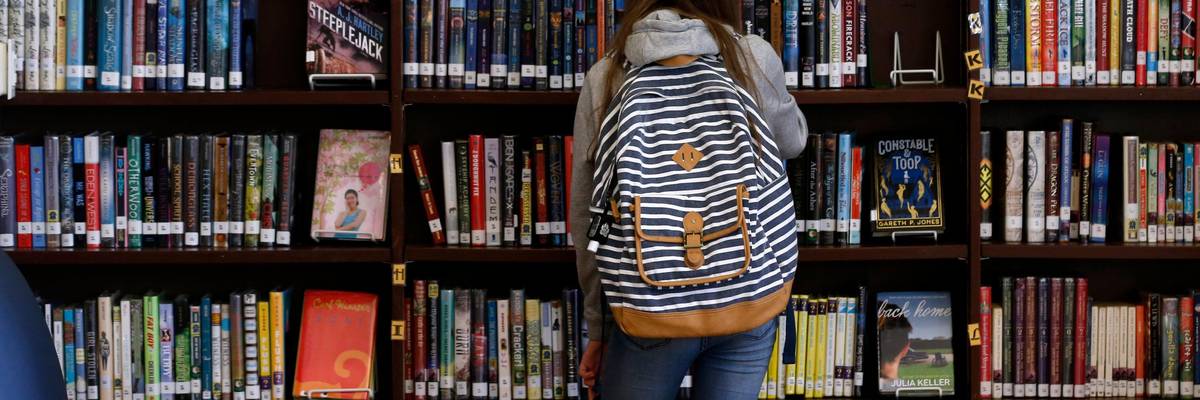
A student browses through books in the Presidio Middle School library in San Francisco on Tuesday, Sept. 10, 2019. Salesforce provided funds to refurbish and upgrade the schoolyard and library. (Photo: Paul Chinn/The San Francisco Chronicle via Getty Images)
Librarians, Teachers Form Coalition to Fight GOP's Book-Banning Frenzy
"Book bans are about limiting kids' freedom to read and teachers' freedom to teach," warned the head of the American Federation of Teachers.
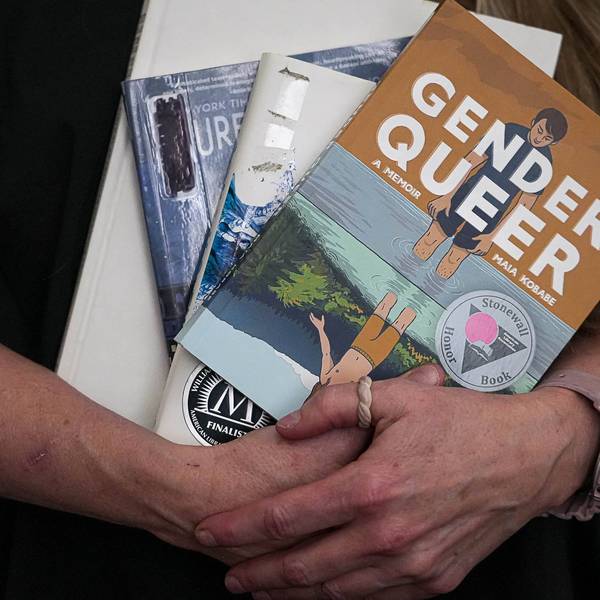
The American Library Association, the American Federation of Teachers, and more than two dozen other organizations on Tuesday formed a coalition to fight the far-right's record-breaking censorship barrage--wherein nearly 1,600 books were targeted for removal from public shelves and schools across the United States in 2021.
The goal of Unite Against Book Bans--which also includes the Authors Guild and prominent publishers such as Penguin Random House and Simon & Schuster--is "to empower individuals and communities to fight censorship and protect the freedom to read," according to the ALA.
"This is a dangerous time for readers and the public servants who provide access to reading materials," Deborah Caldwell-Stone, director of the ALA's Office for Intellectual Freedom, said in a statement. "Readers, particularly students, are losing access to critical information, and librarians and teachers are under attack for doing their jobs."
"It's time that policymakers understand the severity of this issue," said Caldwell-Stone. "ALA is taking the steps necessary to protect individuals' access to information, but we can't do this alone."
Last month, the group launched the Unite Against Book Bans initiative to coincide with the publication of its annual report, which documented 729 attempted bans of 1,597 unique titles last year--the highest number of challenges to library, school, and university materials in a 12-month period since the ALA began tracking more than two decades ago.
In a separate report released last month, PEN America found that U.S. school districts with a combined enrollment of more than two million students successfully banned 1,145 books between July 1, 2021 and March 31, 2022. Thanks to resistance from students, teachers, librarians, and local residents, however, some book bans have been reversed in recent months.
The ALA hopes to leverage "the strength and reach" of the 26 national organizations that have so far joined its growing coalition. "These groups," the ALA noted, "are uniting around the principles of reading as fundamental to learning, the right of readers to access a variety of books, and the need to work together to protect that right."
AFT President Randi Weingarten said in a statement that "reading is foundational."
"It helps us dream, helps us create, and helps us access opportunity. Whether you're a kid in rural West Virginia, in the suburbs of Texas, or in a shelter in New York City, opening a book means you're opening the world," she continued. "But reading is hard without books."
"Book bans are about limiting kids' freedom to read and teachers' freedom to teach," said Weingarten. "Parents agree--they want their children to learn the lessons of the past in an age-appropriate way, even as certain politicians try to turn classrooms into cultural battlefields and censor what gets taught."
Recent polling shows that over two-thirds of voters oppose efforts to remove books from public libraries and school libraries.
Book bans are part of the Republican Party's broader war on public education that continues to sweep the country. In addition to trying to remove specific titles from schools, colleges, and libraries, GOP lawmakers in 42 states have introduced more than 180 bills since January 2021 that seek to limit the ability of educators and students to discuss gender, racism, and other topics, according to PEN America.
Weingarten noted that the majority of recent book bans "target titles with racial and LGBTQ themes, cruelly erasing young readers' lived experience."
"While it's uncomfortable to talk about tough issues like genocide, slavery, and racism," she added, "reading honest history helps kids learn the good and the bad about our country and emerge as well-informed, engaged citizens of the world."
Caldwell-Stone stressed that "our partners and supporters are critical in moving the needle to ultimately bring an end to book bans."
Calling Tuesday's announcement "just the beginning," Caldwell-Stone said that she is "excited to see how this growing collective will influence local boards and state and national legislation to protect the rights of readers and students and the librarians and educators who provide the books they read."
"There's clearly a disconnect between what most persons want and the actions of elected officials, given the large number of book bans happening around the country," she added. "As the campaign evolves, our growing network of supporters will join forces to prevent those bans, ensuring access to information for all and advocating for the important work of libraries and librarians."
We are at a crossroads
This country and this world are at a monumental crossroads. In a few short weeks, US voters will have an opportunity to beat back the forces of fascism and confront the billionaires who are rigging the economy, our media system, and our democracy, making it increasingly impossible for ordinary people to get by. We’re not just talking about the election. We’re talking about what must be done once these fascist elements are vanquished from power. We need a bolder set of solutions than what either major party has so far been willing to offer and a working-class movement ready to fight like hell for it. Trump didn't emerge from nowhere. The conditions that fueled MAGA authoritarianism were created by decades of radical neoliberal economic policies and a corrupt political system dominated by corporate interests. They slashed taxes on the super-rich, promising that the benefits would trickle down. They said giveaways to the corporate titans would make life more affordable for the rest of us. It was all bullshit. And when a bitter, betrayed populace searches for someone to blame, right-wing demagogues have little trouble finding scapegoats. People know when they're being lied to, but you won't hear any of this from the corporate media. Only independent journalism—powered and funded by people who believe in building a better world—can deliver truly trustworthy daily news. Our Fall Campaign is underway, and we need your help. To power our newsroom through the rest of the year, we need to raise $125,000 by midnight on October 31. So if you share our vision, please contribute whatever you can to sustain our work. |
The American Library Association, the American Federation of Teachers, and more than two dozen other organizations on Tuesday formed a coalition to fight the far-right's record-breaking censorship barrage--wherein nearly 1,600 books were targeted for removal from public shelves and schools across the United States in 2021.
The goal of Unite Against Book Bans--which also includes the Authors Guild and prominent publishers such as Penguin Random House and Simon & Schuster--is "to empower individuals and communities to fight censorship and protect the freedom to read," according to the ALA.
"This is a dangerous time for readers and the public servants who provide access to reading materials," Deborah Caldwell-Stone, director of the ALA's Office for Intellectual Freedom, said in a statement. "Readers, particularly students, are losing access to critical information, and librarians and teachers are under attack for doing their jobs."
"It's time that policymakers understand the severity of this issue," said Caldwell-Stone. "ALA is taking the steps necessary to protect individuals' access to information, but we can't do this alone."
Last month, the group launched the Unite Against Book Bans initiative to coincide with the publication of its annual report, which documented 729 attempted bans of 1,597 unique titles last year--the highest number of challenges to library, school, and university materials in a 12-month period since the ALA began tracking more than two decades ago.
In a separate report released last month, PEN America found that U.S. school districts with a combined enrollment of more than two million students successfully banned 1,145 books between July 1, 2021 and March 31, 2022. Thanks to resistance from students, teachers, librarians, and local residents, however, some book bans have been reversed in recent months.
The ALA hopes to leverage "the strength and reach" of the 26 national organizations that have so far joined its growing coalition. "These groups," the ALA noted, "are uniting around the principles of reading as fundamental to learning, the right of readers to access a variety of books, and the need to work together to protect that right."
AFT President Randi Weingarten said in a statement that "reading is foundational."
"It helps us dream, helps us create, and helps us access opportunity. Whether you're a kid in rural West Virginia, in the suburbs of Texas, or in a shelter in New York City, opening a book means you're opening the world," she continued. "But reading is hard without books."
"Book bans are about limiting kids' freedom to read and teachers' freedom to teach," said Weingarten. "Parents agree--they want their children to learn the lessons of the past in an age-appropriate way, even as certain politicians try to turn classrooms into cultural battlefields and censor what gets taught."
Recent polling shows that over two-thirds of voters oppose efforts to remove books from public libraries and school libraries.
Book bans are part of the Republican Party's broader war on public education that continues to sweep the country. In addition to trying to remove specific titles from schools, colleges, and libraries, GOP lawmakers in 42 states have introduced more than 180 bills since January 2021 that seek to limit the ability of educators and students to discuss gender, racism, and other topics, according to PEN America.
Weingarten noted that the majority of recent book bans "target titles with racial and LGBTQ themes, cruelly erasing young readers' lived experience."
"While it's uncomfortable to talk about tough issues like genocide, slavery, and racism," she added, "reading honest history helps kids learn the good and the bad about our country and emerge as well-informed, engaged citizens of the world."
Caldwell-Stone stressed that "our partners and supporters are critical in moving the needle to ultimately bring an end to book bans."
Calling Tuesday's announcement "just the beginning," Caldwell-Stone said that she is "excited to see how this growing collective will influence local boards and state and national legislation to protect the rights of readers and students and the librarians and educators who provide the books they read."
"There's clearly a disconnect between what most persons want and the actions of elected officials, given the large number of book bans happening around the country," she added. "As the campaign evolves, our growing network of supporters will join forces to prevent those bans, ensuring access to information for all and advocating for the important work of libraries and librarians."
- 'Relentless' GOP Push Leads to Nearly 1,500 Book Bans in First Half of School Year: Report ›
- Alabama Republicans Try to 'Criminalize Librarians Simply for Doing Their Jobs' ›
- Alabama House Passes Bill That Could Be 'Used to Arrest Librarians' | Common Dreams ›
- Opinion | Why Book Bans Harm Marginalized Young Readers | Common Dreams ›
The American Library Association, the American Federation of Teachers, and more than two dozen other organizations on Tuesday formed a coalition to fight the far-right's record-breaking censorship barrage--wherein nearly 1,600 books were targeted for removal from public shelves and schools across the United States in 2021.
The goal of Unite Against Book Bans--which also includes the Authors Guild and prominent publishers such as Penguin Random House and Simon & Schuster--is "to empower individuals and communities to fight censorship and protect the freedom to read," according to the ALA.
"This is a dangerous time for readers and the public servants who provide access to reading materials," Deborah Caldwell-Stone, director of the ALA's Office for Intellectual Freedom, said in a statement. "Readers, particularly students, are losing access to critical information, and librarians and teachers are under attack for doing their jobs."
"It's time that policymakers understand the severity of this issue," said Caldwell-Stone. "ALA is taking the steps necessary to protect individuals' access to information, but we can't do this alone."
Last month, the group launched the Unite Against Book Bans initiative to coincide with the publication of its annual report, which documented 729 attempted bans of 1,597 unique titles last year--the highest number of challenges to library, school, and university materials in a 12-month period since the ALA began tracking more than two decades ago.
In a separate report released last month, PEN America found that U.S. school districts with a combined enrollment of more than two million students successfully banned 1,145 books between July 1, 2021 and March 31, 2022. Thanks to resistance from students, teachers, librarians, and local residents, however, some book bans have been reversed in recent months.
The ALA hopes to leverage "the strength and reach" of the 26 national organizations that have so far joined its growing coalition. "These groups," the ALA noted, "are uniting around the principles of reading as fundamental to learning, the right of readers to access a variety of books, and the need to work together to protect that right."
AFT President Randi Weingarten said in a statement that "reading is foundational."
"It helps us dream, helps us create, and helps us access opportunity. Whether you're a kid in rural West Virginia, in the suburbs of Texas, or in a shelter in New York City, opening a book means you're opening the world," she continued. "But reading is hard without books."
"Book bans are about limiting kids' freedom to read and teachers' freedom to teach," said Weingarten. "Parents agree--they want their children to learn the lessons of the past in an age-appropriate way, even as certain politicians try to turn classrooms into cultural battlefields and censor what gets taught."
Recent polling shows that over two-thirds of voters oppose efforts to remove books from public libraries and school libraries.
Book bans are part of the Republican Party's broader war on public education that continues to sweep the country. In addition to trying to remove specific titles from schools, colleges, and libraries, GOP lawmakers in 42 states have introduced more than 180 bills since January 2021 that seek to limit the ability of educators and students to discuss gender, racism, and other topics, according to PEN America.
Weingarten noted that the majority of recent book bans "target titles with racial and LGBTQ themes, cruelly erasing young readers' lived experience."
"While it's uncomfortable to talk about tough issues like genocide, slavery, and racism," she added, "reading honest history helps kids learn the good and the bad about our country and emerge as well-informed, engaged citizens of the world."
Caldwell-Stone stressed that "our partners and supporters are critical in moving the needle to ultimately bring an end to book bans."
Calling Tuesday's announcement "just the beginning," Caldwell-Stone said that she is "excited to see how this growing collective will influence local boards and state and national legislation to protect the rights of readers and students and the librarians and educators who provide the books they read."
"There's clearly a disconnect between what most persons want and the actions of elected officials, given the large number of book bans happening around the country," she added. "As the campaign evolves, our growing network of supporters will join forces to prevent those bans, ensuring access to information for all and advocating for the important work of libraries and librarians."
- 'Relentless' GOP Push Leads to Nearly 1,500 Book Bans in First Half of School Year: Report ›
- Alabama Republicans Try to 'Criminalize Librarians Simply for Doing Their Jobs' ›
- Alabama House Passes Bill That Could Be 'Used to Arrest Librarians' | Common Dreams ›
- Opinion | Why Book Bans Harm Marginalized Young Readers | Common Dreams ›