SUBSCRIBE TO OUR FREE NEWSLETTER
Daily news & progressive opinion—funded by the people, not the corporations—delivered straight to your inbox.
5
#000000
#FFFFFF
To donate by check, phone, or other method, see our More Ways to Give page.
Daily news & progressive opinion—funded by the people, not the corporations—delivered straight to your inbox.
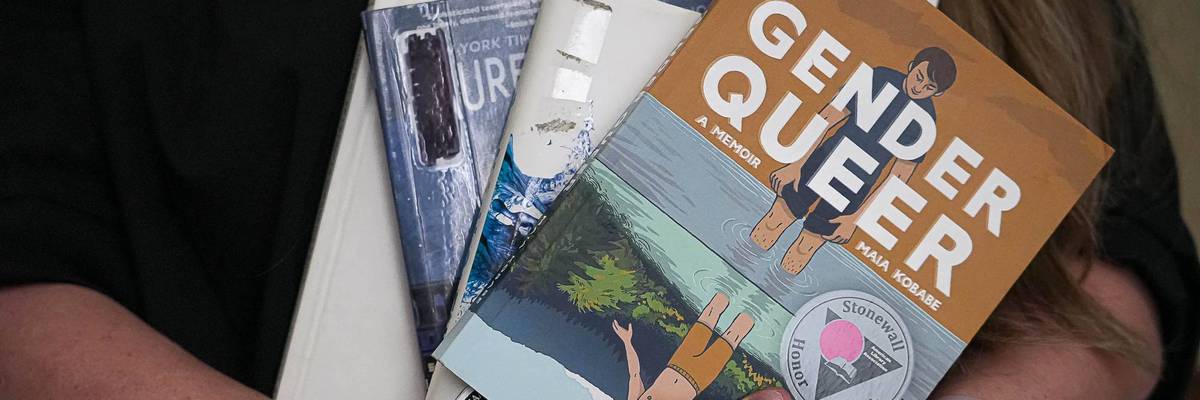
Suzette Baker, former head librarian at the Kingsland Branch Library in the Llano County Library System, holds some banned books at the Edwards Law office on March 4, 2024 in Austin, Texas.
"In several cases, AI recommended banning books that were banned elsewhere, creating a snowball effect for frequently banned books while the expertise of librarians and the communities they serve are ignored."
PEN America released a report on Monday documenting nearly 12,000 book bans involving more than 7,300 individual titles in US schools during the 2025-2026 school year, which the organization said were the largest censorship case numbers it had ever recorded.
The state of Texas accounted for more than 8,100 book bans—roughly three-fourths of the nationwide total and more than double that of Florida, which was the second-most censorious state with over 3,200 book bans.
PEN America said that the surge in Texas book bans came from SB 13, a state law passed in 2025 that banned a broad array of books that censorship proponents view as "profane" or "indecent."
According to PEN America, the Texas book bans carried out over the last year have been particularly broad because officials in the state used artificial intelligence to make a recommended list of banned books.
"In several cases, AI recommended banning books that were banned elsewhere," the report notes, "creating a snowball effect for frequently banned books while the expertise of librarians and the communities they serve are ignored."
Sold, a 2006 young adult novel by journalist Patricia McCormick about a teenage girl in Nepal who gets sold into sexual slavery, was the most frequently banned book in the US.
Popular horror writer Stephen King was the most banned individual author, according to the report.
Kasey Meehan, director of PEN America’s Freedom to Read program, said that banning popular young adult titles was a particularly harmful policy given the broad decline in reading throughout the US.
"Schools should be doing everything possible to connect kids with reading by introducing them to engaging stories and formats," Meehan said. "Instead, many are doing the opposite, banning books that help kids see themselves in literature, deepen their understanding and empathy of others, and develop their imaginations."
Philomena Polefrone, senior manager of the Freedom to Read program, said the broad books bans documented by the PEN America report are due to "chilling directives from state politicians" that "have created chaos and fear."
"Unsure how to comply, districts are removing books en masse, sometimes with the ‘help’ of crude AI tools that only make the problem worse," Polefrone said. "Increasingly, these bans are invisible. Thousands of these cases are only recorded because of public information requests by Florida Freedom to Read and Texas Freedom to Read. Books paid for by taxpayers are being removed from shelves and the local community may not even know about it."
Dear Common Dreams reader, It’s been nearly 30 years since I co-founded Common Dreams with my late wife, Lina Newhouser. We had the radical notion that journalism should serve the public good, not corporate profits. It was clear to us from the outset what it would take to build such a project. No paid advertisements. No corporate sponsors. No millionaire publisher telling us what to think or do. Many people said we wouldn't last a year, but we proved those doubters wrong. Together with a tremendous team of journalists and dedicated staff, we built an independent media outlet free from the constraints of profits and corporate control. Our mission has always been simple: To inform. To inspire. To ignite change for the common good. Building Common Dreams was not easy. Our survival was never guaranteed. When you take on the most powerful forces—Wall Street greed, fossil fuel industry destruction, Big Tech lobbyists, and uber-rich oligarchs who have spent billions upon billions rigging the economy and democracy in their favor—the only bulwark you have is supporters who believe in your work. But here’s the urgent message from me today. It's never been this bad out there. And it's never been this hard to keep us going. At the very moment Common Dreams is most needed, the threats we face are intensifying. We need your support now more than ever. We don't accept corporate advertising and never will. We don't have a paywall because we don't think people should be blocked from critical news based on their ability to pay. Everything we do is funded by the donations of readers like you. When everyone does the little they can afford, we are strong. But if that support retreats or dries up, so do we. Will you donate now to make sure Common Dreams not only survives but thrives? —Craig Brown, Co-founder |
PEN America released a report on Monday documenting nearly 12,000 book bans involving more than 7,300 individual titles in US schools during the 2025-2026 school year, which the organization said were the largest censorship case numbers it had ever recorded.
The state of Texas accounted for more than 8,100 book bans—roughly three-fourths of the nationwide total and more than double that of Florida, which was the second-most censorious state with over 3,200 book bans.
PEN America said that the surge in Texas book bans came from SB 13, a state law passed in 2025 that banned a broad array of books that censorship proponents view as "profane" or "indecent."
According to PEN America, the Texas book bans carried out over the last year have been particularly broad because officials in the state used artificial intelligence to make a recommended list of banned books.
"In several cases, AI recommended banning books that were banned elsewhere," the report notes, "creating a snowball effect for frequently banned books while the expertise of librarians and the communities they serve are ignored."
Sold, a 2006 young adult novel by journalist Patricia McCormick about a teenage girl in Nepal who gets sold into sexual slavery, was the most frequently banned book in the US.
Popular horror writer Stephen King was the most banned individual author, according to the report.
Kasey Meehan, director of PEN America’s Freedom to Read program, said that banning popular young adult titles was a particularly harmful policy given the broad decline in reading throughout the US.
"Schools should be doing everything possible to connect kids with reading by introducing them to engaging stories and formats," Meehan said. "Instead, many are doing the opposite, banning books that help kids see themselves in literature, deepen their understanding and empathy of others, and develop their imaginations."
Philomena Polefrone, senior manager of the Freedom to Read program, said the broad books bans documented by the PEN America report are due to "chilling directives from state politicians" that "have created chaos and fear."
"Unsure how to comply, districts are removing books en masse, sometimes with the ‘help’ of crude AI tools that only make the problem worse," Polefrone said. "Increasingly, these bans are invisible. Thousands of these cases are only recorded because of public information requests by Florida Freedom to Read and Texas Freedom to Read. Books paid for by taxpayers are being removed from shelves and the local community may not even know about it."
PEN America released a report on Monday documenting nearly 12,000 book bans involving more than 7,300 individual titles in US schools during the 2025-2026 school year, which the organization said were the largest censorship case numbers it had ever recorded.
The state of Texas accounted for more than 8,100 book bans—roughly three-fourths of the nationwide total and more than double that of Florida, which was the second-most censorious state with over 3,200 book bans.
PEN America said that the surge in Texas book bans came from SB 13, a state law passed in 2025 that banned a broad array of books that censorship proponents view as "profane" or "indecent."
According to PEN America, the Texas book bans carried out over the last year have been particularly broad because officials in the state used artificial intelligence to make a recommended list of banned books.
"In several cases, AI recommended banning books that were banned elsewhere," the report notes, "creating a snowball effect for frequently banned books while the expertise of librarians and the communities they serve are ignored."
Sold, a 2006 young adult novel by journalist Patricia McCormick about a teenage girl in Nepal who gets sold into sexual slavery, was the most frequently banned book in the US.
Popular horror writer Stephen King was the most banned individual author, according to the report.
Kasey Meehan, director of PEN America’s Freedom to Read program, said that banning popular young adult titles was a particularly harmful policy given the broad decline in reading throughout the US.
"Schools should be doing everything possible to connect kids with reading by introducing them to engaging stories and formats," Meehan said. "Instead, many are doing the opposite, banning books that help kids see themselves in literature, deepen their understanding and empathy of others, and develop their imaginations."
Philomena Polefrone, senior manager of the Freedom to Read program, said the broad books bans documented by the PEN America report are due to "chilling directives from state politicians" that "have created chaos and fear."
"Unsure how to comply, districts are removing books en masse, sometimes with the ‘help’ of crude AI tools that only make the problem worse," Polefrone said. "Increasingly, these bans are invisible. Thousands of these cases are only recorded because of public information requests by Florida Freedom to Read and Texas Freedom to Read. Books paid for by taxpayers are being removed from shelves and the local community may not even know about it."