5
#000000
#FFFFFF
To donate by check, phone, or other method, see our More Ways to Give page.
Daily news & progressive opinion—funded by the people, not the corporations—delivered straight to your inbox.

Parcels are packed for customers at the Amazon Dartford Fulfilment Centre ahead of Black Friday and Christmas on Thursday November 19, 2026.
Amazon made $20.7 billion in profit between July and September 2026, on an operating margin of 13.9 percent, the highest in its history. That is about $225 million a day. Or $156,000 a minute, if you like your outrage in smaller change.
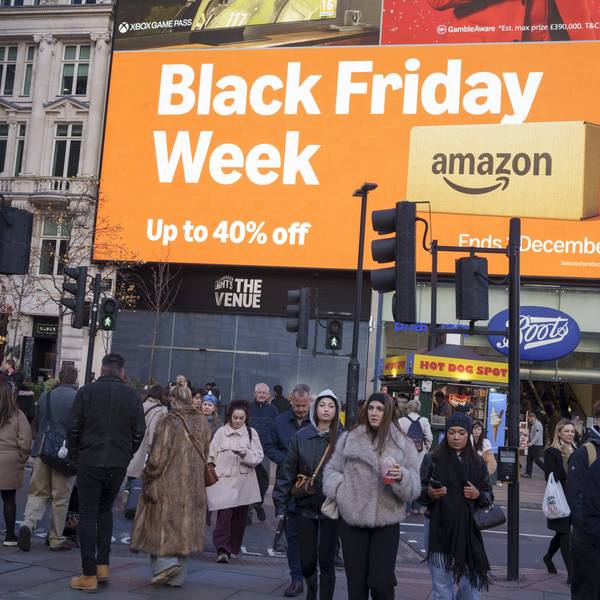
The promotions started weeks ago. Fridges, sports shoes, air fryers — every one a deal of the day, every one ending at midnight, every one ending again tomorrow. Adobe expects Americans to spend $12.9 billion online on Black Friday alone. Shoppers are expected to have to use short-term credit plans to purchase more than $800 million in goods that day.
When wages can stretch no more, the corporations sell you the stretch.
The biggest deal is the one Amazon and Jeff Bezos get every day of the year through exploiting their workers. On Friday, the people who pack and drive those parcels will try to take some of it back.
Make Amazon Pay is a coalition founded in 2020 of more than 80 unions and campaign groups, led by UNI Global Union, the global union for service workers, and Progressive International.
The campaign’s demands: decent wages, safe work, union rights, fair taxation, and climate justice. This year, unions and campaigners in more than 20 countries are expected to take part in strikes and protests from November 27 to November 30.
In response to last year’s actions, an Amazon spokesperson called the campaign “intentionally misleading” and said Amazon offers “great pay, great benefits, and great opportunities.” Then the company published its numbers.
Amazon made $20.7 billion in profit between July and September 2026, on an operating margin of 13.9 percent, the highest in its history. That is about $225 million a day. Or $156,000 a minute, if you like your outrage in smaller change.
Amazon’s own press release puts U.S. warehouse starting pay at $20 an hour, or $41,600 for a full-time employee before tax. They do not reveal pay levels for their many part-time employees.
If that makes you angry, add your name to our petition to tax extreme wealth.
The company plans to spend about $220 billion this year, much of it on AI data centers. The company’s internal plan is to use robots to avoid hiring more than 600,000 U.S. workers by 2033. So the “great opportunities” come with an expiry date for many employees.
Forbes says Jeff Bezos, Amazon’s founder and executive chair, had a net worth of $361 billion on November 1, 2026. That makes him the second-richest person alive. The richest, Elon Musk, had a bad week earlier this month and didn’t notice.
A worker on Amazon’s $20 starting rate would need about 8.7 million years of full-time shifts to earn as much as Bezos’s personal wealth. Clock on 8.7 million years ago and you’d be finishing about now, if the scanner gun lets you take your break.
Bezos would like you to think he built his fortune himself. In reality, he built it with warehouse workers, delivery drivers, public roads, and every customer who ever paid extra for next-day delivery. Profits soared. The people holding the scanners got a $1 an hour rise in September.
Black Friday has gone global. So have the bills. In Nigeria, delivery-app Black Friday deals trended on X on November 20. The same week, the national statistics office put food inflation at 19.13 percent, and 31.43 percent in Lagos.
In Pakistan, the government’s weekly price index shows cooking gas up 111 percent in a year and tomatoes up 79 percent. In Brazil, the basic food basket in Fortaleza has risen 21.52 percent since December.
Nobody is running a Black Friday sale on rice.
The same rules produce both numbers. Big companies set the prices, pay trails behind, and the winners keep what they bank. That is a choice made by people with names, and governments can change it.
Six years in, Make Amazon Pay can point to concrete victories. In Italy, workers won a nationwide Amazon agreement curbing surveillance. In India, they won social-security protections for delivery workers. In Canada, warehouse workers have won union recognition. And across Germany, they’ve formed Amazon works councils, legally protected bodies through which employees elected by their peers represent worker interests before management.
On November 19, Brazil’s President Lula signed a decree ending the six-day workweek. Starting December 16, 14.8 million workers on six-day rotations get two days off a week with no pay cut. The maximum week drops from 44 hours to 42, then 40 in December 2027.
“There’s no point giving people two days off if, for lack of money, they’re stuck at home,” Lula stated. Time and money, back to the people who make the profit. That is the fight.
Amazon can afford decent pay and its full share of tax. So can the 3,428 billionaires on Forbes’s list, whose annual circus we watch every spring. You don’t need an economics degree to see that a company making $156,000 a minute can pay the person packing the box better.
The fix is to tax extreme wealth, so governments have money for the schools, clinics and buses the rest of us use.
The big retailers will spend Friday telling you the deal ends at midnight. Amazon’s workers will spend it telling Jeff Bezos his deal needs to end.
This country and this world are at a monumental crossroads. US voters have an opportunity to beat back the forces of fascism and confront the billionaires who are rigging the economy, our media system, and our democracy, making it increasingly impossible for ordinary people to get by. We’re not just talking about the election. We’re talking about what must be done once these fascist elements are vanquished from power. We need a bolder set of solutions than what either major party has so far been willing to offer and a working-class movement ready to fight like hell for it. Trump didn't emerge from nowhere. The conditions that fueled MAGA authoritarianism were created by decades of radical neoliberal economic policies and a corrupt political system dominated by corporate interests. They slashed taxes on the super-rich, promising that the benefits would trickle down. They said giveaways to the corporate titans would make life more affordable for the rest of us. It was all bullshit. And when a bitter, betrayed populace searches for someone to blame, right-wing demagogues have little trouble finding scapegoats. People know when they're being lied to, but you won't hear any of this from the corporate media. Only independent journalism—powered and funded by people who believe in building a better world—can deliver truly trustworthy daily news. If you share our vision, please contribute whatever you can to sustain our work. |
The promotions started weeks ago. Fridges, sports shoes, air fryers — every one a deal of the day, every one ending at midnight, every one ending again tomorrow. Adobe expects Americans to spend $12.9 billion online on Black Friday alone. Shoppers are expected to have to use short-term credit plans to purchase more than $800 million in goods that day.
When wages can stretch no more, the corporations sell you the stretch.
The biggest deal is the one Amazon and Jeff Bezos get every day of the year through exploiting their workers. On Friday, the people who pack and drive those parcels will try to take some of it back.
Make Amazon Pay is a coalition founded in 2020 of more than 80 unions and campaign groups, led by UNI Global Union, the global union for service workers, and Progressive International.
The campaign’s demands: decent wages, safe work, union rights, fair taxation, and climate justice. This year, unions and campaigners in more than 20 countries are expected to take part in strikes and protests from November 27 to November 30.
In response to last year’s actions, an Amazon spokesperson called the campaign “intentionally misleading” and said Amazon offers “great pay, great benefits, and great opportunities.” Then the company published its numbers.
Amazon made $20.7 billion in profit between July and September 2026, on an operating margin of 13.9 percent, the highest in its history. That is about $225 million a day. Or $156,000 a minute, if you like your outrage in smaller change.
Amazon’s own press release puts U.S. warehouse starting pay at $20 an hour, or $41,600 for a full-time employee before tax. They do not reveal pay levels for their many part-time employees.
If that makes you angry, add your name to our petition to tax extreme wealth.
The company plans to spend about $220 billion this year, much of it on AI data centers. The company’s internal plan is to use robots to avoid hiring more than 600,000 U.S. workers by 2033. So the “great opportunities” come with an expiry date for many employees.
Forbes says Jeff Bezos, Amazon’s founder and executive chair, had a net worth of $361 billion on November 1, 2026. That makes him the second-richest person alive. The richest, Elon Musk, had a bad week earlier this month and didn’t notice.
A worker on Amazon’s $20 starting rate would need about 8.7 million years of full-time shifts to earn as much as Bezos’s personal wealth. Clock on 8.7 million years ago and you’d be finishing about now, if the scanner gun lets you take your break.
Bezos would like you to think he built his fortune himself. In reality, he built it with warehouse workers, delivery drivers, public roads, and every customer who ever paid extra for next-day delivery. Profits soared. The people holding the scanners got a $1 an hour rise in September.
Black Friday has gone global. So have the bills. In Nigeria, delivery-app Black Friday deals trended on X on November 20. The same week, the national statistics office put food inflation at 19.13 percent, and 31.43 percent in Lagos.
In Pakistan, the government’s weekly price index shows cooking gas up 111 percent in a year and tomatoes up 79 percent. In Brazil, the basic food basket in Fortaleza has risen 21.52 percent since December.
Nobody is running a Black Friday sale on rice.
The same rules produce both numbers. Big companies set the prices, pay trails behind, and the winners keep what they bank. That is a choice made by people with names, and governments can change it.
Six years in, Make Amazon Pay can point to concrete victories. In Italy, workers won a nationwide Amazon agreement curbing surveillance. In India, they won social-security protections for delivery workers. In Canada, warehouse workers have won union recognition. And across Germany, they’ve formed Amazon works councils, legally protected bodies through which employees elected by their peers represent worker interests before management.
On November 19, Brazil’s President Lula signed a decree ending the six-day workweek. Starting December 16, 14.8 million workers on six-day rotations get two days off a week with no pay cut. The maximum week drops from 44 hours to 42, then 40 in December 2027.
“There’s no point giving people two days off if, for lack of money, they’re stuck at home,” Lula stated. Time and money, back to the people who make the profit. That is the fight.
Amazon can afford decent pay and its full share of tax. So can the 3,428 billionaires on Forbes’s list, whose annual circus we watch every spring. You don’t need an economics degree to see that a company making $156,000 a minute can pay the person packing the box better.
The fix is to tax extreme wealth, so governments have money for the schools, clinics and buses the rest of us use.
The big retailers will spend Friday telling you the deal ends at midnight. Amazon’s workers will spend it telling Jeff Bezos his deal needs to end.