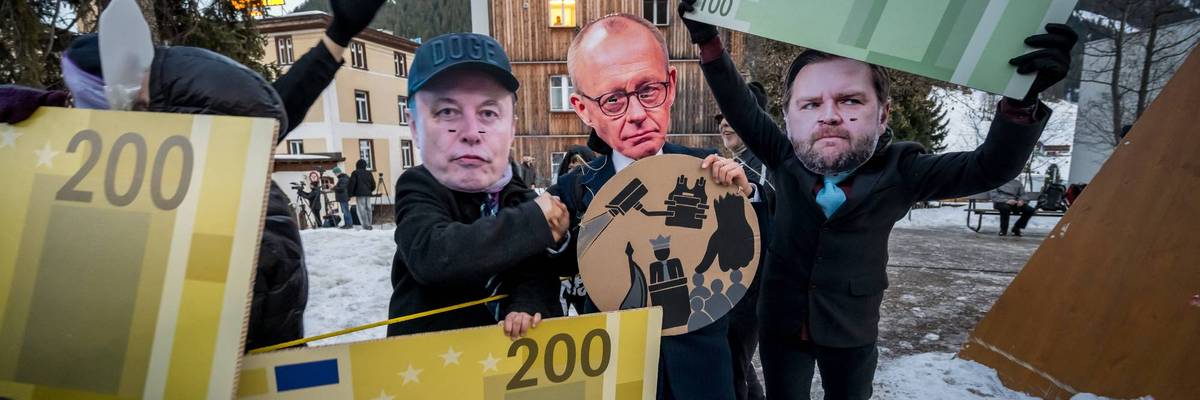
Protesters wearing a mask of Tesla CEO Elon Musk, German Chancellor Friedrich Merz, and US Vice President JD Vance hold cardboard euro banknotes during a protest in Davos, Switzerland on January 18, 2026.
Oxfam Warns Record $18.3 Trillion in Billionaire Wealth 'Highly Dangerous' to Democracy
"Governments are making wrong choices to pander to the elite and defend wealth while repressing people’s rights and anger at how so many of their lives are becoming unaffordable and unbearable."
A report released Monday as global elites convened in Davos, Switzerland for the annual World Economic Forum found that the collective wealth of the world's billionaires hit a record $18.3 trillion last year, a marker of supercharged inequality that is threatening democracy across the globe.
Oxfam International's report, Resisting the Rule of the Rich: Protecting Freedom From Billionaire Power, found that the total number of billionaires worldwide surpassed 3,000 for the first time in history in 2025. Billionaire wealth rose by $2.5 trillion, over 16%, last year. That sum, Oxfam observed, would be enough to eradicate extreme poverty 26 times over.
The new report focuses on the dire political consequences of allowing a small fraction of the world's population to capture so much wealth.
As Oxfam put it:
It is one thing for a billionaire to buy an enormous yacht or many luxury homes around the world. This excessive consumption can be rightly criticized in a deeply unequal world where the majority of people have very little and our planet is suffocating from relentless carbon emissions and waste. But many would reject this criticism, describing it as the politics on envy.
Yet far fewer people would disagree that when a billionaire uses their wealth to buy a politician, to influence a government, to own a newspaper or a social media platform, or to out-lawyer any opposition to ensure they are above the law, that these actions undermine progress and fairness. Such power gives billionaires control over all our futures, undermining political freedom and the rights of the rest of us.
Amitabh Behar, Oxfam International's executive director, said Monday that "the widening gap between the rich and the rest is at the same time creating a political deficit that is highly dangerous and unsustainable."
“Governments are making wrong choices to pander to the elite and defend wealth while repressing people’s rights and anger at how so many of their lives are becoming unaffordable and unbearable,” Behar said. “Being economically poor creates hunger. Being politically poor creates anger."
Oxfam's report notes that highly unequal countries are seven times more likely to experience forms of democratic backsliding, such as the erosion of the rule of law and the undermining of elections.
Both are currently taking place under President Donald Trump in the United States, which is home to more billionaires than any other nation.
That includes Tesla CEO and X owner Elon Musk, the world's richest man, who reportedly just dumped a personal record $10 million into the US Senate race on the side of a pro-Trump candidate vying to replace retiring Sen. Mitch McConnell (R-Ky.). Musk was the largest single donor in the 2024 election, deploying his wealth to help propel Trump to the White House for a second term.
“No country can afford to be complacent. The pace that economic and political inequality can hasten the erosion of people’s rights and safety can be frighteningly fast."
Oxfam pointed out that billionaires also use their wealth to influence politics in ways other than bankrolling their preferred candidates. The group observed that "billionaires own more than half the world’s largest media companies and all the main social media companies."
Billionaires are also an estimated 4,000 times more likely to hold political office than ordinary people, the report states.
"The outsized influence that the super-rich have over our politicians, economies, and media has deepened inequality and led us far off track on tackling poverty," said Behar. "Governments should be listening to the needs of the people on things like quality healthcare, action on climate change, and tax fairness."
Oxfam urged governments around the world to pursue a number of reforms aimed at redressing massive inequities in income, wealth, and political power, including "effectively taxing the super-rich," establishing "stronger firewalls between wealth and politics including by tougher regulations against lobbying and campaign financing by the rich," and creating "realistic and time-bound National Inequality Reduction Plans, with well-established benchmarks and regular monitoring of progress."
“No country can afford to be complacent," Behar said. "The pace that economic and political inequality can hasten the erosion of people’s rights and safety can be frighteningly fast."
We are at a crossroads
This country and this world are at a monumental crossroads. In a few short weeks, US voters will have an opportunity to beat back the forces of fascism and confront the billionaires who are rigging the economy, our media system, and our democracy, making it increasingly impossible for ordinary people to get by. We’re not just talking about the election. We’re talking about what must be done once these fascist elements are vanquished from power. We need a bolder set of solutions than what either major party has so far been willing to offer and a working-class movement ready to fight like hell for it. Trump didn't emerge from nowhere. The conditions that fueled MAGA authoritarianism were created by decades of radical neoliberal economic policies and a corrupt political system dominated by corporate interests. They slashed taxes on the super-rich, promising that the benefits would trickle down. They said giveaways to the corporate titans would make life more affordable for the rest of us. It was all bullshit. And when a bitter, betrayed populace searches for someone to blame, right-wing demagogues have little trouble finding scapegoats. People know when they're being lied to, but you won't hear any of this from the corporate media. Only independent journalism—powered and funded by people who believe in building a better world—can deliver truly trustworthy daily news. Our Fall Campaign is underway, and we need your help. To power our newsroom through the rest of the year, we need to raise $125,000 by midnight on October 31. So if you share our vision, please contribute whatever you can to sustain our work. |
A report released Monday as global elites convened in Davos, Switzerland for the annual World Economic Forum found that the collective wealth of the world's billionaires hit a record $18.3 trillion last year, a marker of supercharged inequality that is threatening democracy across the globe.
Oxfam International's report, Resisting the Rule of the Rich: Protecting Freedom From Billionaire Power, found that the total number of billionaires worldwide surpassed 3,000 for the first time in history in 2025. Billionaire wealth rose by $2.5 trillion, over 16%, last year. That sum, Oxfam observed, would be enough to eradicate extreme poverty 26 times over.
The new report focuses on the dire political consequences of allowing a small fraction of the world's population to capture so much wealth.
As Oxfam put it:
It is one thing for a billionaire to buy an enormous yacht or many luxury homes around the world. This excessive consumption can be rightly criticized in a deeply unequal world where the majority of people have very little and our planet is suffocating from relentless carbon emissions and waste. But many would reject this criticism, describing it as the politics on envy.
Yet far fewer people would disagree that when a billionaire uses their wealth to buy a politician, to influence a government, to own a newspaper or a social media platform, or to out-lawyer any opposition to ensure they are above the law, that these actions undermine progress and fairness. Such power gives billionaires control over all our futures, undermining political freedom and the rights of the rest of us.
Amitabh Behar, Oxfam International's executive director, said Monday that "the widening gap between the rich and the rest is at the same time creating a political deficit that is highly dangerous and unsustainable."
“Governments are making wrong choices to pander to the elite and defend wealth while repressing people’s rights and anger at how so many of their lives are becoming unaffordable and unbearable,” Behar said. “Being economically poor creates hunger. Being politically poor creates anger."
Oxfam's report notes that highly unequal countries are seven times more likely to experience forms of democratic backsliding, such as the erosion of the rule of law and the undermining of elections.
Both are currently taking place under President Donald Trump in the United States, which is home to more billionaires than any other nation.
That includes Tesla CEO and X owner Elon Musk, the world's richest man, who reportedly just dumped a personal record $10 million into the US Senate race on the side of a pro-Trump candidate vying to replace retiring Sen. Mitch McConnell (R-Ky.). Musk was the largest single donor in the 2024 election, deploying his wealth to help propel Trump to the White House for a second term.
“No country can afford to be complacent. The pace that economic and political inequality can hasten the erosion of people’s rights and safety can be frighteningly fast."
Oxfam pointed out that billionaires also use their wealth to influence politics in ways other than bankrolling their preferred candidates. The group observed that "billionaires own more than half the world’s largest media companies and all the main social media companies."
Billionaires are also an estimated 4,000 times more likely to hold political office than ordinary people, the report states.
"The outsized influence that the super-rich have over our politicians, economies, and media has deepened inequality and led us far off track on tackling poverty," said Behar. "Governments should be listening to the needs of the people on things like quality healthcare, action on climate change, and tax fairness."
Oxfam urged governments around the world to pursue a number of reforms aimed at redressing massive inequities in income, wealth, and political power, including "effectively taxing the super-rich," establishing "stronger firewalls between wealth and politics including by tougher regulations against lobbying and campaign financing by the rich," and creating "realistic and time-bound National Inequality Reduction Plans, with well-established benchmarks and regular monitoring of progress."
“No country can afford to be complacent," Behar said. "The pace that economic and political inequality can hasten the erosion of people’s rights and safety can be frighteningly fast."
A report released Monday as global elites convened in Davos, Switzerland for the annual World Economic Forum found that the collective wealth of the world's billionaires hit a record $18.3 trillion last year, a marker of supercharged inequality that is threatening democracy across the globe.
Oxfam International's report, Resisting the Rule of the Rich: Protecting Freedom From Billionaire Power, found that the total number of billionaires worldwide surpassed 3,000 for the first time in history in 2025. Billionaire wealth rose by $2.5 trillion, over 16%, last year. That sum, Oxfam observed, would be enough to eradicate extreme poverty 26 times over.
The new report focuses on the dire political consequences of allowing a small fraction of the world's population to capture so much wealth.
As Oxfam put it:
It is one thing for a billionaire to buy an enormous yacht or many luxury homes around the world. This excessive consumption can be rightly criticized in a deeply unequal world where the majority of people have very little and our planet is suffocating from relentless carbon emissions and waste. But many would reject this criticism, describing it as the politics on envy.
Yet far fewer people would disagree that when a billionaire uses their wealth to buy a politician, to influence a government, to own a newspaper or a social media platform, or to out-lawyer any opposition to ensure they are above the law, that these actions undermine progress and fairness. Such power gives billionaires control over all our futures, undermining political freedom and the rights of the rest of us.
Amitabh Behar, Oxfam International's executive director, said Monday that "the widening gap between the rich and the rest is at the same time creating a political deficit that is highly dangerous and unsustainable."
“Governments are making wrong choices to pander to the elite and defend wealth while repressing people’s rights and anger at how so many of their lives are becoming unaffordable and unbearable,” Behar said. “Being economically poor creates hunger. Being politically poor creates anger."
Oxfam's report notes that highly unequal countries are seven times more likely to experience forms of democratic backsliding, such as the erosion of the rule of law and the undermining of elections.
Both are currently taking place under President Donald Trump in the United States, which is home to more billionaires than any other nation.
That includes Tesla CEO and X owner Elon Musk, the world's richest man, who reportedly just dumped a personal record $10 million into the US Senate race on the side of a pro-Trump candidate vying to replace retiring Sen. Mitch McConnell (R-Ky.). Musk was the largest single donor in the 2024 election, deploying his wealth to help propel Trump to the White House for a second term.
“No country can afford to be complacent. The pace that economic and political inequality can hasten the erosion of people’s rights and safety can be frighteningly fast."
Oxfam pointed out that billionaires also use their wealth to influence politics in ways other than bankrolling their preferred candidates. The group observed that "billionaires own more than half the world’s largest media companies and all the main social media companies."
Billionaires are also an estimated 4,000 times more likely to hold political office than ordinary people, the report states.
"The outsized influence that the super-rich have over our politicians, economies, and media has deepened inequality and led us far off track on tackling poverty," said Behar. "Governments should be listening to the needs of the people on things like quality healthcare, action on climate change, and tax fairness."
Oxfam urged governments around the world to pursue a number of reforms aimed at redressing massive inequities in income, wealth, and political power, including "effectively taxing the super-rich," establishing "stronger firewalls between wealth and politics including by tougher regulations against lobbying and campaign financing by the rich," and creating "realistic and time-bound National Inequality Reduction Plans, with well-established benchmarks and regular monitoring of progress."
“No country can afford to be complacent," Behar said. "The pace that economic and political inequality can hasten the erosion of people’s rights and safety can be frighteningly fast."