SUBSCRIBE TO OUR FREE NEWSLETTER
Daily news & progressive opinion—funded by the people, not the corporations—delivered straight to your inbox.
5
#000000
#FFFFFF
To donate by check, phone, or other method, see our More Ways to Give page.
Daily news & progressive opinion—funded by the people, not the corporations—delivered straight to your inbox.
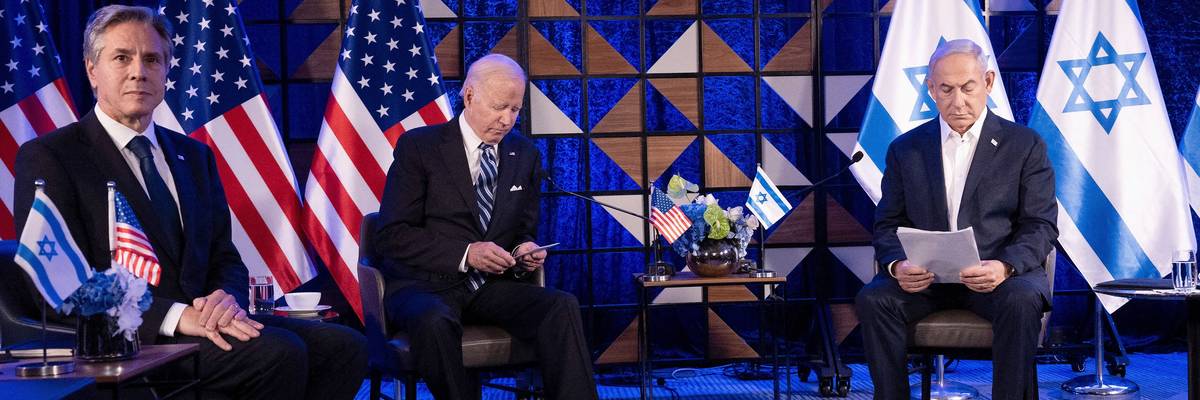
the administration is working to take advantage of the current crisis for the purpose of strengthening U.S. dominance in the Middle East, regardless of the consequences for the Palestinians.
While Israel continues its military siege of Gaza, the United States is trying to exploit the situation with the goal of strengthening U.S. power in the Middle East.
Rather than seeking a long-term solution to the Israel-Palestine conflict, the United States is prioritizing its longstanding goal of normalizing relations between Israel and Saudi Arabia. With such a deal, which would require calm in Gaza to bring Saudi Arabia on board, the United States would further marginalize the Palestinians while more tightly integrating Israel into its regional network of alliances and partnerships.
“I think we’re at a point where the necessary agreements between the United States and Saudi Arabia are very well within reach,” Secretary of State Antony Blinken told Congress last month.
For decades, the United States has dominated the Middle East. A key to U.S. power has been the U.S.-led network of alliances and partnerships that includes Israel and the Arab states. It enables the United States to station tens of thousands of soldiers across the Middle East and quickly surge additional forces into the area.
“It’s a vast strategic advantage,” Secretary of Defense Lloyd Austin explained in 2021, referring to the U.S.-led network. “It is unmatched. It is unparalleled. And it is unrivaled.”
Although U.S. officials have boasted of their power, their approach has been a major source of instability, especially as it concerns relations between Israel and the Arab states. Since the founding of Israel in 1948 and the Nakba for the Palestinians, many Arab states have refused to recognize Israel. Israel and the Arab states have fought several wars.
U.S. officials have been nearly unanimous in hailing the Abraham Accords as a great achievement, but critics have pointed out that the accords exclude the Palestinians.
The international community has favored a two-state solution, which would create a state of Palestine alongside the state of Israel, but the United States has effectively opposed it, even while rhetorically supporting it. Focused on maintaining its regional network, the United States has pursued bilateral deals with Arab states that are willing to establish peaceful relations with Israel. By the end of the 20th century, the United States had played a central role in brokering deals with Egypt and Jordan, both of which now receive extensive economic and military assistance.
Most Arab states rejected such deals, insisting that there must first be a resolution of the Israel-Palestine conflict, but some of them changed their positions during the Trump administration. Under the Abraham Accords, several additional Arab states vowed to normalize relations with Israel. They entered into agreements with Israel, enticed by special deals with the United States.
U.S. officials have been nearly unanimous in hailing the Abraham Accords as a great achievement, but critics have pointed out that the accords exclude the Palestinians. In Foreign Policy in Focus, John Feffer has warned that it would be unwise to wish away the Palestinians, especially if there is genuine interest in ending the “fratricide” that has been so destructive to Israelis and Palestinians.
Officials in Washington are aware of the criticisms. “It has been fashionable in some foreign policy circles to believe… that you could somehow achieve peace and stability and security by jumping over the Palestinian issue,” Sen. Chris Van Hollen (D-Md.) acknowledged last month.
Few officials have taken such concerns seriously, however. Before Hamas carried out its October 7 terrorist attack against Israel, the Biden administration had been trying to expand the accords by including Saudi Arabia.
President Joe Biden had once promised to make Saudi Arabia into a pariah over its killing of a Washington Post columnist, but he wanted a deal even more, knowing that Saudi Arabia had dropped its longstanding insistence upon the establishment of a Palestinian state as a condition for normalization with Israel. Saudi leaders, it was reported, sought a deal that would merely keep open the possibility of a Palestinian state.
“We’ve been working—this goes back well before October 7—working with Saudi Arabia and with Israel to pursue normalization between the two countries,” Blinken acknowledged in May. “This would be a game changer.”
One of the most striking things about U.S. policy is that the Biden administration has not changed its approach since October 7. Not only has it continued its one-sided support of Israel, but it has moved forward with its plans to bring Saudi Arabia into the accords, even while indicating that the accords may have led to the current crisis.
“I’m convinced one of the reasons Hamas attacked when they did—and I have no proof of this; just my instinct tells me—is because of the progress we were making towards regional integration for Israel and regional integration overall,” Biden said on October 25, just weeks after the attack. “And we can’t leave that work behind.”
As the Biden administration has chased its imperial ambitions, officials have insisted that relations between Israel and Palestine must change. Without a new arrangement, they say, the cycle of violence will continue. There will be what Blinken called “endless cycles of violence, destruction, death, and insecurity.”
At a congressional hearing in May, State Department official Barbara Leaf called the status quo “terrible,” especially for the Palestinians. They live “in a state of everything ranging from unhappiness to frustration to rage to despair to militancy,” Leaf said. “It’s a terrible recipe for militancy, for radicalization.”
In fact, the Biden administration has insisted that it supports a two-state solution. Its plans for normalization between Israel and Saudi Arabia, administration officials say, will eventually lead to the creation of a Palestinian state. They are even endorsing plans for a cease-fire in Gaza, a move that follows their acknowledgment that Saudi Arabia now requires a period of calm and a pathway to a Palestinian state to enter into a deal.
The Biden administration remains focused on the goal of integrating Israel into the U.S.-led network of alliances and partnerships in the Middle East, just as it had been trying to do before October 7.
Still, the Biden administration has made it clear that it opposes the creation of a viable Palestinian state. As it has blocked efforts at the United Nations to establish a Palestinian state, it has worked to impose constraints on Palestine.
A major priority of the Biden administration is to limit Palestine’s security. Administration officials insist that any future Palestinian state must be demilitarized.
“There are a number of types of two-state solutions,” Biden claimed earlier this year. “There’s a number of countries that are members of the U.N. that… don’t have their own militaries. Number of states that have limitations… And so I think there’s ways in which this could work.”
The Biden administration is also requiring Israel to have a say in the creation of a Palestinian state. It demands that the Palestinians negotiate with the Israelis, despite the fact that the Israeli government and the Israeli public oppose a two-state solution.
When Congress questioned Blinken last month about the administration’s plans for normalization between Israel and Saudi Arabia, Blinken made note of another condition, which is that any deal would not result in the immediate establishment of a Palestinian state. In fact, Blinken indicated that the U.S. vision of a longer pathway to a Palestinian state is not intended to fulfill the aspirations of the Palestinian people.
“The whole point of normalization but also the whole point of the establishment of a Palestinian state is to make sure that Israel’s security is better ensured,” Blinken said.
Indeed, the Biden administration remains focused on the goal of integrating Israel into the U.S.-led network of alliances and partnerships in the Middle East, just as it had been trying to do before October 7. Rather than trying to achieve a two-state solution that could bring an end to what one U.S. representative recently called “75 years of misery,” the administration is working to take advantage of the current crisis for the purpose of strengthening U.S. dominance, regardless of the consequences for the Palestinians.
“Despite the fact that we say those words”—two-state solution—“we have never addressed our policy to use our influence to make it happen,” Van Hollen acknowledged.
Dear Common Dreams reader, It’s been nearly 30 years since I co-founded Common Dreams with my late wife, Lina Newhouser. We had the radical notion that journalism should serve the public good, not corporate profits. It was clear to us from the outset what it would take to build such a project. No paid advertisements. No corporate sponsors. No millionaire publisher telling us what to think or do. Many people said we wouldn't last a year, but we proved those doubters wrong. Together with a tremendous team of journalists and dedicated staff, we built an independent media outlet free from the constraints of profits and corporate control. Our mission has always been simple: To inform. To inspire. To ignite change for the common good. Building Common Dreams was not easy. Our survival was never guaranteed. When you take on the most powerful forces—Wall Street greed, fossil fuel industry destruction, Big Tech lobbyists, and uber-rich oligarchs who have spent billions upon billions rigging the economy and democracy in their favor—the only bulwark you have is supporters who believe in your work. But here’s the urgent message from me today. It's never been this bad out there. And it's never been this hard to keep us going. At the very moment Common Dreams is most needed, the threats we face are intensifying. We need your support now more than ever. We don't accept corporate advertising and never will. We don't have a paywall because we don't think people should be blocked from critical news based on their ability to pay. Everything we do is funded by the donations of readers like you. When everyone does the little they can afford, we are strong. But if that support retreats or dries up, so do we. Will you donate now to make sure Common Dreams not only survives but thrives? —Craig Brown, Co-founder |
While Israel continues its military siege of Gaza, the United States is trying to exploit the situation with the goal of strengthening U.S. power in the Middle East.
Rather than seeking a long-term solution to the Israel-Palestine conflict, the United States is prioritizing its longstanding goal of normalizing relations between Israel and Saudi Arabia. With such a deal, which would require calm in Gaza to bring Saudi Arabia on board, the United States would further marginalize the Palestinians while more tightly integrating Israel into its regional network of alliances and partnerships.
“I think we’re at a point where the necessary agreements between the United States and Saudi Arabia are very well within reach,” Secretary of State Antony Blinken told Congress last month.
For decades, the United States has dominated the Middle East. A key to U.S. power has been the U.S.-led network of alliances and partnerships that includes Israel and the Arab states. It enables the United States to station tens of thousands of soldiers across the Middle East and quickly surge additional forces into the area.
“It’s a vast strategic advantage,” Secretary of Defense Lloyd Austin explained in 2021, referring to the U.S.-led network. “It is unmatched. It is unparalleled. And it is unrivaled.”
Although U.S. officials have boasted of their power, their approach has been a major source of instability, especially as it concerns relations between Israel and the Arab states. Since the founding of Israel in 1948 and the Nakba for the Palestinians, many Arab states have refused to recognize Israel. Israel and the Arab states have fought several wars.
U.S. officials have been nearly unanimous in hailing the Abraham Accords as a great achievement, but critics have pointed out that the accords exclude the Palestinians.
The international community has favored a two-state solution, which would create a state of Palestine alongside the state of Israel, but the United States has effectively opposed it, even while rhetorically supporting it. Focused on maintaining its regional network, the United States has pursued bilateral deals with Arab states that are willing to establish peaceful relations with Israel. By the end of the 20th century, the United States had played a central role in brokering deals with Egypt and Jordan, both of which now receive extensive economic and military assistance.
Most Arab states rejected such deals, insisting that there must first be a resolution of the Israel-Palestine conflict, but some of them changed their positions during the Trump administration. Under the Abraham Accords, several additional Arab states vowed to normalize relations with Israel. They entered into agreements with Israel, enticed by special deals with the United States.
U.S. officials have been nearly unanimous in hailing the Abraham Accords as a great achievement, but critics have pointed out that the accords exclude the Palestinians. In Foreign Policy in Focus, John Feffer has warned that it would be unwise to wish away the Palestinians, especially if there is genuine interest in ending the “fratricide” that has been so destructive to Israelis and Palestinians.
Officials in Washington are aware of the criticisms. “It has been fashionable in some foreign policy circles to believe… that you could somehow achieve peace and stability and security by jumping over the Palestinian issue,” Sen. Chris Van Hollen (D-Md.) acknowledged last month.
Few officials have taken such concerns seriously, however. Before Hamas carried out its October 7 terrorist attack against Israel, the Biden administration had been trying to expand the accords by including Saudi Arabia.
President Joe Biden had once promised to make Saudi Arabia into a pariah over its killing of a Washington Post columnist, but he wanted a deal even more, knowing that Saudi Arabia had dropped its longstanding insistence upon the establishment of a Palestinian state as a condition for normalization with Israel. Saudi leaders, it was reported, sought a deal that would merely keep open the possibility of a Palestinian state.
“We’ve been working—this goes back well before October 7—working with Saudi Arabia and with Israel to pursue normalization between the two countries,” Blinken acknowledged in May. “This would be a game changer.”
One of the most striking things about U.S. policy is that the Biden administration has not changed its approach since October 7. Not only has it continued its one-sided support of Israel, but it has moved forward with its plans to bring Saudi Arabia into the accords, even while indicating that the accords may have led to the current crisis.
“I’m convinced one of the reasons Hamas attacked when they did—and I have no proof of this; just my instinct tells me—is because of the progress we were making towards regional integration for Israel and regional integration overall,” Biden said on October 25, just weeks after the attack. “And we can’t leave that work behind.”
As the Biden administration has chased its imperial ambitions, officials have insisted that relations between Israel and Palestine must change. Without a new arrangement, they say, the cycle of violence will continue. There will be what Blinken called “endless cycles of violence, destruction, death, and insecurity.”
At a congressional hearing in May, State Department official Barbara Leaf called the status quo “terrible,” especially for the Palestinians. They live “in a state of everything ranging from unhappiness to frustration to rage to despair to militancy,” Leaf said. “It’s a terrible recipe for militancy, for radicalization.”
In fact, the Biden administration has insisted that it supports a two-state solution. Its plans for normalization between Israel and Saudi Arabia, administration officials say, will eventually lead to the creation of a Palestinian state. They are even endorsing plans for a cease-fire in Gaza, a move that follows their acknowledgment that Saudi Arabia now requires a period of calm and a pathway to a Palestinian state to enter into a deal.
The Biden administration remains focused on the goal of integrating Israel into the U.S.-led network of alliances and partnerships in the Middle East, just as it had been trying to do before October 7.
Still, the Biden administration has made it clear that it opposes the creation of a viable Palestinian state. As it has blocked efforts at the United Nations to establish a Palestinian state, it has worked to impose constraints on Palestine.
A major priority of the Biden administration is to limit Palestine’s security. Administration officials insist that any future Palestinian state must be demilitarized.
“There are a number of types of two-state solutions,” Biden claimed earlier this year. “There’s a number of countries that are members of the U.N. that… don’t have their own militaries. Number of states that have limitations… And so I think there’s ways in which this could work.”
The Biden administration is also requiring Israel to have a say in the creation of a Palestinian state. It demands that the Palestinians negotiate with the Israelis, despite the fact that the Israeli government and the Israeli public oppose a two-state solution.
When Congress questioned Blinken last month about the administration’s plans for normalization between Israel and Saudi Arabia, Blinken made note of another condition, which is that any deal would not result in the immediate establishment of a Palestinian state. In fact, Blinken indicated that the U.S. vision of a longer pathway to a Palestinian state is not intended to fulfill the aspirations of the Palestinian people.
“The whole point of normalization but also the whole point of the establishment of a Palestinian state is to make sure that Israel’s security is better ensured,” Blinken said.
Indeed, the Biden administration remains focused on the goal of integrating Israel into the U.S.-led network of alliances and partnerships in the Middle East, just as it had been trying to do before October 7. Rather than trying to achieve a two-state solution that could bring an end to what one U.S. representative recently called “75 years of misery,” the administration is working to take advantage of the current crisis for the purpose of strengthening U.S. dominance, regardless of the consequences for the Palestinians.
“Despite the fact that we say those words”—two-state solution—“we have never addressed our policy to use our influence to make it happen,” Van Hollen acknowledged.
While Israel continues its military siege of Gaza, the United States is trying to exploit the situation with the goal of strengthening U.S. power in the Middle East.
Rather than seeking a long-term solution to the Israel-Palestine conflict, the United States is prioritizing its longstanding goal of normalizing relations between Israel and Saudi Arabia. With such a deal, which would require calm in Gaza to bring Saudi Arabia on board, the United States would further marginalize the Palestinians while more tightly integrating Israel into its regional network of alliances and partnerships.
“I think we’re at a point where the necessary agreements between the United States and Saudi Arabia are very well within reach,” Secretary of State Antony Blinken told Congress last month.
For decades, the United States has dominated the Middle East. A key to U.S. power has been the U.S.-led network of alliances and partnerships that includes Israel and the Arab states. It enables the United States to station tens of thousands of soldiers across the Middle East and quickly surge additional forces into the area.
“It’s a vast strategic advantage,” Secretary of Defense Lloyd Austin explained in 2021, referring to the U.S.-led network. “It is unmatched. It is unparalleled. And it is unrivaled.”
Although U.S. officials have boasted of their power, their approach has been a major source of instability, especially as it concerns relations between Israel and the Arab states. Since the founding of Israel in 1948 and the Nakba for the Palestinians, many Arab states have refused to recognize Israel. Israel and the Arab states have fought several wars.
U.S. officials have been nearly unanimous in hailing the Abraham Accords as a great achievement, but critics have pointed out that the accords exclude the Palestinians.
The international community has favored a two-state solution, which would create a state of Palestine alongside the state of Israel, but the United States has effectively opposed it, even while rhetorically supporting it. Focused on maintaining its regional network, the United States has pursued bilateral deals with Arab states that are willing to establish peaceful relations with Israel. By the end of the 20th century, the United States had played a central role in brokering deals with Egypt and Jordan, both of which now receive extensive economic and military assistance.
Most Arab states rejected such deals, insisting that there must first be a resolution of the Israel-Palestine conflict, but some of them changed their positions during the Trump administration. Under the Abraham Accords, several additional Arab states vowed to normalize relations with Israel. They entered into agreements with Israel, enticed by special deals with the United States.
U.S. officials have been nearly unanimous in hailing the Abraham Accords as a great achievement, but critics have pointed out that the accords exclude the Palestinians. In Foreign Policy in Focus, John Feffer has warned that it would be unwise to wish away the Palestinians, especially if there is genuine interest in ending the “fratricide” that has been so destructive to Israelis and Palestinians.
Officials in Washington are aware of the criticisms. “It has been fashionable in some foreign policy circles to believe… that you could somehow achieve peace and stability and security by jumping over the Palestinian issue,” Sen. Chris Van Hollen (D-Md.) acknowledged last month.
Few officials have taken such concerns seriously, however. Before Hamas carried out its October 7 terrorist attack against Israel, the Biden administration had been trying to expand the accords by including Saudi Arabia.
President Joe Biden had once promised to make Saudi Arabia into a pariah over its killing of a Washington Post columnist, but he wanted a deal even more, knowing that Saudi Arabia had dropped its longstanding insistence upon the establishment of a Palestinian state as a condition for normalization with Israel. Saudi leaders, it was reported, sought a deal that would merely keep open the possibility of a Palestinian state.
“We’ve been working—this goes back well before October 7—working with Saudi Arabia and with Israel to pursue normalization between the two countries,” Blinken acknowledged in May. “This would be a game changer.”
One of the most striking things about U.S. policy is that the Biden administration has not changed its approach since October 7. Not only has it continued its one-sided support of Israel, but it has moved forward with its plans to bring Saudi Arabia into the accords, even while indicating that the accords may have led to the current crisis.
“I’m convinced one of the reasons Hamas attacked when they did—and I have no proof of this; just my instinct tells me—is because of the progress we were making towards regional integration for Israel and regional integration overall,” Biden said on October 25, just weeks after the attack. “And we can’t leave that work behind.”
As the Biden administration has chased its imperial ambitions, officials have insisted that relations between Israel and Palestine must change. Without a new arrangement, they say, the cycle of violence will continue. There will be what Blinken called “endless cycles of violence, destruction, death, and insecurity.”
At a congressional hearing in May, State Department official Barbara Leaf called the status quo “terrible,” especially for the Palestinians. They live “in a state of everything ranging from unhappiness to frustration to rage to despair to militancy,” Leaf said. “It’s a terrible recipe for militancy, for radicalization.”
In fact, the Biden administration has insisted that it supports a two-state solution. Its plans for normalization between Israel and Saudi Arabia, administration officials say, will eventually lead to the creation of a Palestinian state. They are even endorsing plans for a cease-fire in Gaza, a move that follows their acknowledgment that Saudi Arabia now requires a period of calm and a pathway to a Palestinian state to enter into a deal.
The Biden administration remains focused on the goal of integrating Israel into the U.S.-led network of alliances and partnerships in the Middle East, just as it had been trying to do before October 7.
Still, the Biden administration has made it clear that it opposes the creation of a viable Palestinian state. As it has blocked efforts at the United Nations to establish a Palestinian state, it has worked to impose constraints on Palestine.
A major priority of the Biden administration is to limit Palestine’s security. Administration officials insist that any future Palestinian state must be demilitarized.
“There are a number of types of two-state solutions,” Biden claimed earlier this year. “There’s a number of countries that are members of the U.N. that… don’t have their own militaries. Number of states that have limitations… And so I think there’s ways in which this could work.”
The Biden administration is also requiring Israel to have a say in the creation of a Palestinian state. It demands that the Palestinians negotiate with the Israelis, despite the fact that the Israeli government and the Israeli public oppose a two-state solution.
When Congress questioned Blinken last month about the administration’s plans for normalization between Israel and Saudi Arabia, Blinken made note of another condition, which is that any deal would not result in the immediate establishment of a Palestinian state. In fact, Blinken indicated that the U.S. vision of a longer pathway to a Palestinian state is not intended to fulfill the aspirations of the Palestinian people.
“The whole point of normalization but also the whole point of the establishment of a Palestinian state is to make sure that Israel’s security is better ensured,” Blinken said.
Indeed, the Biden administration remains focused on the goal of integrating Israel into the U.S.-led network of alliances and partnerships in the Middle East, just as it had been trying to do before October 7. Rather than trying to achieve a two-state solution that could bring an end to what one U.S. representative recently called “75 years of misery,” the administration is working to take advantage of the current crisis for the purpose of strengthening U.S. dominance, regardless of the consequences for the Palestinians.
“Despite the fact that we say those words”—two-state solution—“we have never addressed our policy to use our influence to make it happen,” Van Hollen acknowledged.