5
#000000
#FFFFFF
To donate by check, phone, or other method, see our More Ways to Give page.
Daily news & progressive opinion—funded by the people, not the corporations—delivered straight to your inbox.
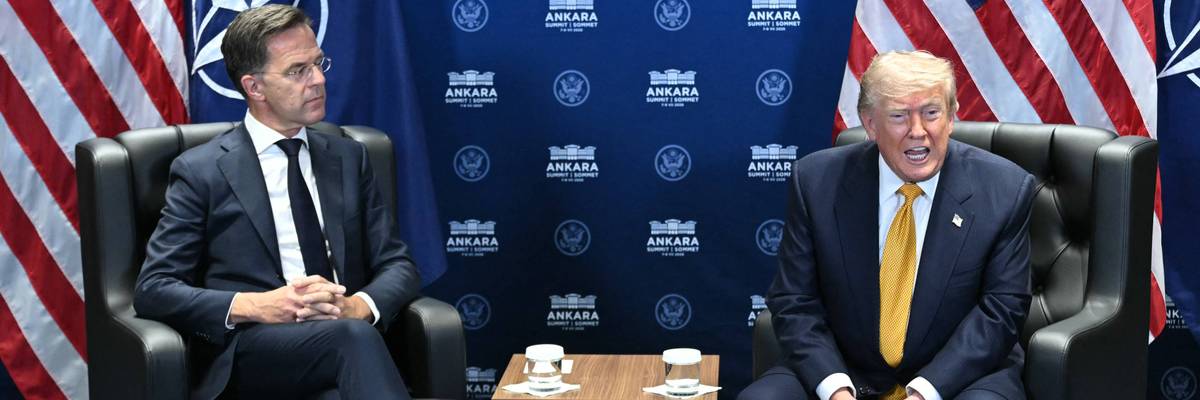
What was gained—and what did they refuse to admit—when the powerful military bloc held talks in Türkiye?
Despite its well-advertised tensions and tectonic geopolitical changes, this week’s NATO summit demonstrated that NATO has survived and is resilient. It remains committed to reinforcing US hegemony across Europe and globally. Not a lot has changed since former US National Security Advisor Zbigniew Brzezinski wrote that US global dominance relies on controlling the periphery of Eurasia: NATO in the West, in Southwest Asia to the South, as well as its Asia-Pacific allies from South Korea and Japan through the Philippines and Australia. In the 21st century, military planning as well as trade is deeply integrated across these three regions.
The Summit served to reinforce what is emerging as a new bloc system for our yet to be named era. Threatened by the US and NATO, as John Mearsheimer remarked, Russia, China, Iran, and North Korea each see the US as a mortal enemy. While each of these nations’ situations and ambitions are vastly different, they share an interest in fending off threats from the US. They are thus increasingly binding themselves to one another economically, militarily, and diplomatically.
There were four major dimensions to the summit: 1) NATO’s survival despite its fault lines, 2) the first day’s focus on expanding and integrating European and US military production infrastructures and weapons sales contracts. 3) The final declaration celebrated and committed to still more European military spending. And 4) support for Ukraine was manifest.
The move to what is termed NATO 3.0, with European nations assuming greater responsibilities for the European theater, reflects the United States relative decline, something which has been glaringly demonstrated in its failed war against Iran. Trump and his coterie understand that US “leadership” is only possible with NATO. Despite his rhetoric, Trump and company value NATO because it allows them to do what they want to do elsewhere, especially in the most economically dynamic part of the world: the Indo-Pacific.
The transatlantic and increasingly global NATO alliance remains strong despite its fault lines due to what the elites understand as overlapping US and European shared interests, if not values.
NATO Secretary General Rutte and his allies insulated the alliance from Trump, from his madness, his dementia, his claim that US ships have been attacked by the Islamic Republic of Japan, demands for Greenland, and his complaints that European nations didn’t deliver all that he wanted in his war on Iran. Toward that end, the summit was convened and adjourned in less than a day, and the final declaration was limited to just six paragraphs, leaving little room for debate.
In fact, although not widely reported, during the war European allies have allowed US warplanes and ships to operate from bases across the continent, and they have provided access to their facilities for repairs and refueling.
As we could read in Carnegie Europe, “…trans-Atlanticism was never only a values project. It was—and remains—a convergence of security, economic, and technological interests between two regions that together account for roughly 43 percent of global GDP and comprise the world’s most capable alliance.”
The best way to understand what transpired in Ankara may be to use the lens of transactional dealmaking among Mafia families. Trump and Colby got what they wanted: European elites signed onto NATO 3.0 with increased European military spending and preparations to militarily contain and press Russia, so that the US can focus on containing China’s ambitions and reinforcing its 21st century Indo-Pacific hegemony. Remember, this has been a US goal that began with Obama’s “pivot to Asia.”
With NATO 3.0, the US intends to gradually reduce its ostensible role in guaranteeing European security. It is worth noting that European NATO members already massively outspending Russia on their militaries. They have conventional military superiority over Russia. And with NATO 3.0 these differentials will only become greater.
In time, the US will provide only what its European allies cannot: nuclear threats and high-tech intelligence. But it is also worth noting is that Trump said nothing in Ankara about pulling more troops out of Europe. The announced 5,000 troop reduction in Germany has yet to begin, and a commitment for increased US troop rotations in Poland was made. The Hegseth-Colby campaign for major US force reductions in Europe has been slowed by the two-month review won by Secretary of State Marco Rubio. In the end, Trump, and no one else, is the decision maker. Remember too that despite Trump ranting about NATO’s limited support for his war against Iran, the US would be very limited in its Southwest Asian and North African power projection without it bases still in Europe.
The West wasn’t shattered. In the transactional exchange, the US joined the dominant European narrative forged by the Baltic states and Poland about Russia and signed onto the summit’s final declaration with its commitments to support Ukraine in the war with Russia. This includes blessing Ukrainian debilitating attacks on Russian energy infrastructure deep within Russia. The declaration identified Russia as a long-term threat and reinterred the Treaty’s Article V commitment to come to the aid of any NATO member that is attacked. Ukraine won’t be joining NATO any time soon, but its advanced military technologies and warfighting experience make it an increasingly powerful adjunct to NATO.
In fact, the arms sales announced as the summit began serve as glue for the alliance’s future. Fifty billion dollars in weapons contracts were signed, with commitments made to Lockheed Martin, Raytheon, Palantir, Anduril, Germany’s Rheinmetall, French Airbus, Sweden’s Saab, and Turkey’s Aselsan. Even Denmark, despite Trump’s Greenland threats, will be buying US Hellfire missiles and ships to patrol the Arctic.
NATO 3.0 makes it possible for the US to reinforce its lattice-like military alliance system and its military buildup across the Indo-Pacific. Note that the RIMPAC (Rim of the Pacific) naval show of force was held at the same time as the NATO summit. It includes the forces of 10 of 30 NATO nations. Almost one-third of all NATO countries sent military forces: land, air, and sea to Hawaii to participate in the RIMPAC 38-day war drills.
The summit also demonstrated Turkey’s increased role in NATO, both in relation to Southwest Asia, but also via its increased weapons production capacity for the alliance. Trump tossed Erdogan what may prove to be only a symbolic military bone with his offer to endorse the sale of F-35s to Turkey. There remain two major obstacles to those sales: Turkey’s S-400 air defense systems which were purchased from Moscow and the need for Congressional authorization for those sales.
On the subject of weapons sales, in his ostensible tilt toward Ukraine, Trump authorized the much-ballyhooed licensing for Ukraine to produce Patriot missile defense systems. This is too little too late to be meaningful. It will take at least a year to get such a complex weapons manufacturing system up and running. And Putin would certainly make these weapons facilities a primary target while they are being built. Moreover, to defend the construction of these facilities the already beleaguered Ukraine would need to divert its very limited missile and drone defenses to protect the construction, leaving the country still more vulnerable.
Reinforcing the global commitments of NATO, at a meeting on the sidelines of the summit the Japanese government called for deeper cooperation between NATO and its Indo-Pacific partners Australia, Japan, South Korea, and New Zealand at a meeting on the summit sidelines. Japan, which hosts more than 100 US military bases and installations, and has its most militarist government since 1945, has a security and defense pact with the EU. In recent months, Tokyo has created or deepened strategic partnerships and weapons development agreements with countries including Britain, Germany, Italy, and Sweden.
Tokyo is in the process of doubling its military spending. It is moving to trash Article 9, the heart of its Peace Constitution. It has deployed conventional preemptive strike missiles that can reach China and North Korea. And it has declared its readiness to go to war for Taiwan.
Despite the still open wounds of Japanese conquest and colonization of Korea in the last century, the US backed Japanese-ROK alliance is the strongest it has ever been. And there is increasing discussion in South Korea about returning US nuclear weapons to the Peninsula or developing its own nuclear arsenal.
Filling out the network of Indo-Pacific alliances, the US has been deepening military ties with its former colony, the Philippines. Add to this AUKUS (Australia, Britain and the US) and the QUAD (US, Japan, Australia, and India).
Several other points are worth noting. Europe’s massive military spending increases, trending at an annual rate of 20%, have been financed by increasing debt. That can’t continue. As Stop Re/Arm Europe network warns, if this increased spending continues it can only come at the expense of essential social services. Those cuts, and the suffering they cause, will further open the way for far-right wing political gains.
In truth, we are still a long way from an operational NATO 3.0. As the French and German refusal to cooperate on development of the next jet fighter indicates, continuing divisions among the leading European powers remain very real. Issues of command and control and many other concerns will be challenging for NATO to address. And while not widely reported in the US media, US and European national security mandarins have been remarking about the failure to announce a NATO summit in 2027. The absence of a NATO summit next year may serve to prevent a new round of headlines and reports about US-NATO divisions, and it will also allow for more backroom deals.
For more than 60 years (1945 – 1980) humanity was plagued by the clash of competing block systems. The Cold War was not always cold, and on several occasions, we were confronted by the specter of nuclear annihilation.
During the Cuban Missile Crisis, President Kennedy and his advisors believed the odds were 50-50 that the crisis would end in a thermonuclear exchange.
Computer and human errors were not uncommon. NATO’s 1983 Abel Archer military exercise sparked fears that they were under attack. That same year computer Soviet systems mistook a rare alignment of sunlight on high-altitude clouds for incoming US nuclear armed missiles. Most of us are alive today because Soviet Colonel Petrov, believed it to be a false alarm, defied his standing orders, dismissed the nuclear alert, and was later reprimanded for his courageous act.
Millions, from Vietnam to Afghanistan and Greece to Mozambique died in proxy wars between the US and Soviet led blocs. As President Dwight Eisenhower warned, the US military-industrial complex threatened democratic values and practice. And trillions of dollars, rubles, francs and other currencies were wasted on weaponry at the cost of essential medical care, education, housing and more.
One definition of stupidity is doing the same thing twice but expecting different results. With the creation of a new bloc system, the expansion and upgrading of the world’s nuclear arsenals, the climate emergency’s fires and rising seas, and uncertainty over where new high-tech weaponry will lead, it appears that NATO, Russian, and many other elites failed to learn the Cold War’s existential lessons.
But there is still time. It should be obvious that the only way to end the war between Russia and Ukraine is with a dirty deal that includes a ceasefire in place, security guarantees for both Ukraine and Russia, and a commitment to negotiate the status of currently occupied territories over time. How many more Russian and Ukrainian lives should be sacrificed in the killing fields of Donbass? How long should we tolerate spiraling military spending at the sacrifice of our living standards which in turn opens the way for fascist forces on the right?
There is also the lesson of Common Security diplomacy which thankfully provided the foundation for détente and the end of the Cold War. We can take some hope from off the record Track II discussions and others among elite Europeans, Russians, and US figures that there are increasing references to building on the traditions and surviving resources of the Helsinki process and the OSCE (Organization for Security and Cooperation in Europe) to build a post-war Common Security European and transatlantic strategic architecture. Too few among us now remember that three decades ago the Cold War came to an end when NATO and Russian leaders finally came to understand that security cannot be achieved against a nation’s rival, but only through hard won win-win diplomacy that addresses the fears of all parties to a conflict.
Dear Common Dreams reader, It’s been nearly 30 years since I co-founded Common Dreams with my late wife, Lina Newhouser. We had the radical notion that journalism should serve the public good, not corporate profits. It was clear to us from the outset what it would take to build such a project. No paid advertisements. No corporate sponsors. No millionaire publisher telling us what to think or do. Many people said we wouldn't last a year, but we proved those doubters wrong. Together with a tremendous team of journalists and dedicated staff, we built an independent media outlet free from the constraints of profits and corporate control. Our mission has always been simple: To inform. To inspire. To ignite change for the common good. Building Common Dreams was not easy. Our survival was never guaranteed. When you take on the most powerful forces—Wall Street greed, fossil fuel industry destruction, Big Tech lobbyists, and uber-rich oligarchs who have spent billions upon billions rigging the economy and democracy in their favor—the only bulwark you have is supporters who believe in your work. But here’s the urgent message from me today. It's never been this bad out there. And it's never been this hard to keep us going. At the very moment Common Dreams is most needed, the threats we face are intensifying. We need your support now more than ever. We don't accept corporate advertising and never will. We don't have a paywall because we don't think people should be blocked from critical news based on their ability to pay. Everything we do is funded by the donations of readers like you. When everyone does the little they can afford, we are strong. But if that support retreats or dries up, so do we. Will you donate now to make sure Common Dreams not only survives but thrives? —Craig Brown, Co-founder |
Despite its well-advertised tensions and tectonic geopolitical changes, this week’s NATO summit demonstrated that NATO has survived and is resilient. It remains committed to reinforcing US hegemony across Europe and globally. Not a lot has changed since former US National Security Advisor Zbigniew Brzezinski wrote that US global dominance relies on controlling the periphery of Eurasia: NATO in the West, in Southwest Asia to the South, as well as its Asia-Pacific allies from South Korea and Japan through the Philippines and Australia. In the 21st century, military planning as well as trade is deeply integrated across these three regions.
The Summit served to reinforce what is emerging as a new bloc system for our yet to be named era. Threatened by the US and NATO, as John Mearsheimer remarked, Russia, China, Iran, and North Korea each see the US as a mortal enemy. While each of these nations’ situations and ambitions are vastly different, they share an interest in fending off threats from the US. They are thus increasingly binding themselves to one another economically, militarily, and diplomatically.
There were four major dimensions to the summit: 1) NATO’s survival despite its fault lines, 2) the first day’s focus on expanding and integrating European and US military production infrastructures and weapons sales contracts. 3) The final declaration celebrated and committed to still more European military spending. And 4) support for Ukraine was manifest.
The move to what is termed NATO 3.0, with European nations assuming greater responsibilities for the European theater, reflects the United States relative decline, something which has been glaringly demonstrated in its failed war against Iran. Trump and his coterie understand that US “leadership” is only possible with NATO. Despite his rhetoric, Trump and company value NATO because it allows them to do what they want to do elsewhere, especially in the most economically dynamic part of the world: the Indo-Pacific.
The transatlantic and increasingly global NATO alliance remains strong despite its fault lines due to what the elites understand as overlapping US and European shared interests, if not values.
NATO Secretary General Rutte and his allies insulated the alliance from Trump, from his madness, his dementia, his claim that US ships have been attacked by the Islamic Republic of Japan, demands for Greenland, and his complaints that European nations didn’t deliver all that he wanted in his war on Iran. Toward that end, the summit was convened and adjourned in less than a day, and the final declaration was limited to just six paragraphs, leaving little room for debate.
In fact, although not widely reported, during the war European allies have allowed US warplanes and ships to operate from bases across the continent, and they have provided access to their facilities for repairs and refueling.
As we could read in Carnegie Europe, “…trans-Atlanticism was never only a values project. It was—and remains—a convergence of security, economic, and technological interests between two regions that together account for roughly 43 percent of global GDP and comprise the world’s most capable alliance.”
The best way to understand what transpired in Ankara may be to use the lens of transactional dealmaking among Mafia families. Trump and Colby got what they wanted: European elites signed onto NATO 3.0 with increased European military spending and preparations to militarily contain and press Russia, so that the US can focus on containing China’s ambitions and reinforcing its 21st century Indo-Pacific hegemony. Remember, this has been a US goal that began with Obama’s “pivot to Asia.”
With NATO 3.0, the US intends to gradually reduce its ostensible role in guaranteeing European security. It is worth noting that European NATO members already massively outspending Russia on their militaries. They have conventional military superiority over Russia. And with NATO 3.0 these differentials will only become greater.
In time, the US will provide only what its European allies cannot: nuclear threats and high-tech intelligence. But it is also worth noting is that Trump said nothing in Ankara about pulling more troops out of Europe. The announced 5,000 troop reduction in Germany has yet to begin, and a commitment for increased US troop rotations in Poland was made. The Hegseth-Colby campaign for major US force reductions in Europe has been slowed by the two-month review won by Secretary of State Marco Rubio. In the end, Trump, and no one else, is the decision maker. Remember too that despite Trump ranting about NATO’s limited support for his war against Iran, the US would be very limited in its Southwest Asian and North African power projection without it bases still in Europe.
The West wasn’t shattered. In the transactional exchange, the US joined the dominant European narrative forged by the Baltic states and Poland about Russia and signed onto the summit’s final declaration with its commitments to support Ukraine in the war with Russia. This includes blessing Ukrainian debilitating attacks on Russian energy infrastructure deep within Russia. The declaration identified Russia as a long-term threat and reinterred the Treaty’s Article V commitment to come to the aid of any NATO member that is attacked. Ukraine won’t be joining NATO any time soon, but its advanced military technologies and warfighting experience make it an increasingly powerful adjunct to NATO.
In fact, the arms sales announced as the summit began serve as glue for the alliance’s future. Fifty billion dollars in weapons contracts were signed, with commitments made to Lockheed Martin, Raytheon, Palantir, Anduril, Germany’s Rheinmetall, French Airbus, Sweden’s Saab, and Turkey’s Aselsan. Even Denmark, despite Trump’s Greenland threats, will be buying US Hellfire missiles and ships to patrol the Arctic.
NATO 3.0 makes it possible for the US to reinforce its lattice-like military alliance system and its military buildup across the Indo-Pacific. Note that the RIMPAC (Rim of the Pacific) naval show of force was held at the same time as the NATO summit. It includes the forces of 10 of 30 NATO nations. Almost one-third of all NATO countries sent military forces: land, air, and sea to Hawaii to participate in the RIMPAC 38-day war drills.
The summit also demonstrated Turkey’s increased role in NATO, both in relation to Southwest Asia, but also via its increased weapons production capacity for the alliance. Trump tossed Erdogan what may prove to be only a symbolic military bone with his offer to endorse the sale of F-35s to Turkey. There remain two major obstacles to those sales: Turkey’s S-400 air defense systems which were purchased from Moscow and the need for Congressional authorization for those sales.
On the subject of weapons sales, in his ostensible tilt toward Ukraine, Trump authorized the much-ballyhooed licensing for Ukraine to produce Patriot missile defense systems. This is too little too late to be meaningful. It will take at least a year to get such a complex weapons manufacturing system up and running. And Putin would certainly make these weapons facilities a primary target while they are being built. Moreover, to defend the construction of these facilities the already beleaguered Ukraine would need to divert its very limited missile and drone defenses to protect the construction, leaving the country still more vulnerable.
Reinforcing the global commitments of NATO, at a meeting on the sidelines of the summit the Japanese government called for deeper cooperation between NATO and its Indo-Pacific partners Australia, Japan, South Korea, and New Zealand at a meeting on the summit sidelines. Japan, which hosts more than 100 US military bases and installations, and has its most militarist government since 1945, has a security and defense pact with the EU. In recent months, Tokyo has created or deepened strategic partnerships and weapons development agreements with countries including Britain, Germany, Italy, and Sweden.
Tokyo is in the process of doubling its military spending. It is moving to trash Article 9, the heart of its Peace Constitution. It has deployed conventional preemptive strike missiles that can reach China and North Korea. And it has declared its readiness to go to war for Taiwan.
Despite the still open wounds of Japanese conquest and colonization of Korea in the last century, the US backed Japanese-ROK alliance is the strongest it has ever been. And there is increasing discussion in South Korea about returning US nuclear weapons to the Peninsula or developing its own nuclear arsenal.
Filling out the network of Indo-Pacific alliances, the US has been deepening military ties with its former colony, the Philippines. Add to this AUKUS (Australia, Britain and the US) and the QUAD (US, Japan, Australia, and India).
Several other points are worth noting. Europe’s massive military spending increases, trending at an annual rate of 20%, have been financed by increasing debt. That can’t continue. As Stop Re/Arm Europe network warns, if this increased spending continues it can only come at the expense of essential social services. Those cuts, and the suffering they cause, will further open the way for far-right wing political gains.
In truth, we are still a long way from an operational NATO 3.0. As the French and German refusal to cooperate on development of the next jet fighter indicates, continuing divisions among the leading European powers remain very real. Issues of command and control and many other concerns will be challenging for NATO to address. And while not widely reported in the US media, US and European national security mandarins have been remarking about the failure to announce a NATO summit in 2027. The absence of a NATO summit next year may serve to prevent a new round of headlines and reports about US-NATO divisions, and it will also allow for more backroom deals.
For more than 60 years (1945 – 1980) humanity was plagued by the clash of competing block systems. The Cold War was not always cold, and on several occasions, we were confronted by the specter of nuclear annihilation.
During the Cuban Missile Crisis, President Kennedy and his advisors believed the odds were 50-50 that the crisis would end in a thermonuclear exchange.
Computer and human errors were not uncommon. NATO’s 1983 Abel Archer military exercise sparked fears that they were under attack. That same year computer Soviet systems mistook a rare alignment of sunlight on high-altitude clouds for incoming US nuclear armed missiles. Most of us are alive today because Soviet Colonel Petrov, believed it to be a false alarm, defied his standing orders, dismissed the nuclear alert, and was later reprimanded for his courageous act.
Millions, from Vietnam to Afghanistan and Greece to Mozambique died in proxy wars between the US and Soviet led blocs. As President Dwight Eisenhower warned, the US military-industrial complex threatened democratic values and practice. And trillions of dollars, rubles, francs and other currencies were wasted on weaponry at the cost of essential medical care, education, housing and more.
One definition of stupidity is doing the same thing twice but expecting different results. With the creation of a new bloc system, the expansion and upgrading of the world’s nuclear arsenals, the climate emergency’s fires and rising seas, and uncertainty over where new high-tech weaponry will lead, it appears that NATO, Russian, and many other elites failed to learn the Cold War’s existential lessons.
But there is still time. It should be obvious that the only way to end the war between Russia and Ukraine is with a dirty deal that includes a ceasefire in place, security guarantees for both Ukraine and Russia, and a commitment to negotiate the status of currently occupied territories over time. How many more Russian and Ukrainian lives should be sacrificed in the killing fields of Donbass? How long should we tolerate spiraling military spending at the sacrifice of our living standards which in turn opens the way for fascist forces on the right?
There is also the lesson of Common Security diplomacy which thankfully provided the foundation for détente and the end of the Cold War. We can take some hope from off the record Track II discussions and others among elite Europeans, Russians, and US figures that there are increasing references to building on the traditions and surviving resources of the Helsinki process and the OSCE (Organization for Security and Cooperation in Europe) to build a post-war Common Security European and transatlantic strategic architecture. Too few among us now remember that three decades ago the Cold War came to an end when NATO and Russian leaders finally came to understand that security cannot be achieved against a nation’s rival, but only through hard won win-win diplomacy that addresses the fears of all parties to a conflict.
Despite its well-advertised tensions and tectonic geopolitical changes, this week’s NATO summit demonstrated that NATO has survived and is resilient. It remains committed to reinforcing US hegemony across Europe and globally. Not a lot has changed since former US National Security Advisor Zbigniew Brzezinski wrote that US global dominance relies on controlling the periphery of Eurasia: NATO in the West, in Southwest Asia to the South, as well as its Asia-Pacific allies from South Korea and Japan through the Philippines and Australia. In the 21st century, military planning as well as trade is deeply integrated across these three regions.
The Summit served to reinforce what is emerging as a new bloc system for our yet to be named era. Threatened by the US and NATO, as John Mearsheimer remarked, Russia, China, Iran, and North Korea each see the US as a mortal enemy. While each of these nations’ situations and ambitions are vastly different, they share an interest in fending off threats from the US. They are thus increasingly binding themselves to one another economically, militarily, and diplomatically.
There were four major dimensions to the summit: 1) NATO’s survival despite its fault lines, 2) the first day’s focus on expanding and integrating European and US military production infrastructures and weapons sales contracts. 3) The final declaration celebrated and committed to still more European military spending. And 4) support for Ukraine was manifest.
The move to what is termed NATO 3.0, with European nations assuming greater responsibilities for the European theater, reflects the United States relative decline, something which has been glaringly demonstrated in its failed war against Iran. Trump and his coterie understand that US “leadership” is only possible with NATO. Despite his rhetoric, Trump and company value NATO because it allows them to do what they want to do elsewhere, especially in the most economically dynamic part of the world: the Indo-Pacific.
The transatlantic and increasingly global NATO alliance remains strong despite its fault lines due to what the elites understand as overlapping US and European shared interests, if not values.
NATO Secretary General Rutte and his allies insulated the alliance from Trump, from his madness, his dementia, his claim that US ships have been attacked by the Islamic Republic of Japan, demands for Greenland, and his complaints that European nations didn’t deliver all that he wanted in his war on Iran. Toward that end, the summit was convened and adjourned in less than a day, and the final declaration was limited to just six paragraphs, leaving little room for debate.
In fact, although not widely reported, during the war European allies have allowed US warplanes and ships to operate from bases across the continent, and they have provided access to their facilities for repairs and refueling.
As we could read in Carnegie Europe, “…trans-Atlanticism was never only a values project. It was—and remains—a convergence of security, economic, and technological interests between two regions that together account for roughly 43 percent of global GDP and comprise the world’s most capable alliance.”
The best way to understand what transpired in Ankara may be to use the lens of transactional dealmaking among Mafia families. Trump and Colby got what they wanted: European elites signed onto NATO 3.0 with increased European military spending and preparations to militarily contain and press Russia, so that the US can focus on containing China’s ambitions and reinforcing its 21st century Indo-Pacific hegemony. Remember, this has been a US goal that began with Obama’s “pivot to Asia.”
With NATO 3.0, the US intends to gradually reduce its ostensible role in guaranteeing European security. It is worth noting that European NATO members already massively outspending Russia on their militaries. They have conventional military superiority over Russia. And with NATO 3.0 these differentials will only become greater.
In time, the US will provide only what its European allies cannot: nuclear threats and high-tech intelligence. But it is also worth noting is that Trump said nothing in Ankara about pulling more troops out of Europe. The announced 5,000 troop reduction in Germany has yet to begin, and a commitment for increased US troop rotations in Poland was made. The Hegseth-Colby campaign for major US force reductions in Europe has been slowed by the two-month review won by Secretary of State Marco Rubio. In the end, Trump, and no one else, is the decision maker. Remember too that despite Trump ranting about NATO’s limited support for his war against Iran, the US would be very limited in its Southwest Asian and North African power projection without it bases still in Europe.
The West wasn’t shattered. In the transactional exchange, the US joined the dominant European narrative forged by the Baltic states and Poland about Russia and signed onto the summit’s final declaration with its commitments to support Ukraine in the war with Russia. This includes blessing Ukrainian debilitating attacks on Russian energy infrastructure deep within Russia. The declaration identified Russia as a long-term threat and reinterred the Treaty’s Article V commitment to come to the aid of any NATO member that is attacked. Ukraine won’t be joining NATO any time soon, but its advanced military technologies and warfighting experience make it an increasingly powerful adjunct to NATO.
In fact, the arms sales announced as the summit began serve as glue for the alliance’s future. Fifty billion dollars in weapons contracts were signed, with commitments made to Lockheed Martin, Raytheon, Palantir, Anduril, Germany’s Rheinmetall, French Airbus, Sweden’s Saab, and Turkey’s Aselsan. Even Denmark, despite Trump’s Greenland threats, will be buying US Hellfire missiles and ships to patrol the Arctic.
NATO 3.0 makes it possible for the US to reinforce its lattice-like military alliance system and its military buildup across the Indo-Pacific. Note that the RIMPAC (Rim of the Pacific) naval show of force was held at the same time as the NATO summit. It includes the forces of 10 of 30 NATO nations. Almost one-third of all NATO countries sent military forces: land, air, and sea to Hawaii to participate in the RIMPAC 38-day war drills.
The summit also demonstrated Turkey’s increased role in NATO, both in relation to Southwest Asia, but also via its increased weapons production capacity for the alliance. Trump tossed Erdogan what may prove to be only a symbolic military bone with his offer to endorse the sale of F-35s to Turkey. There remain two major obstacles to those sales: Turkey’s S-400 air defense systems which were purchased from Moscow and the need for Congressional authorization for those sales.
On the subject of weapons sales, in his ostensible tilt toward Ukraine, Trump authorized the much-ballyhooed licensing for Ukraine to produce Patriot missile defense systems. This is too little too late to be meaningful. It will take at least a year to get such a complex weapons manufacturing system up and running. And Putin would certainly make these weapons facilities a primary target while they are being built. Moreover, to defend the construction of these facilities the already beleaguered Ukraine would need to divert its very limited missile and drone defenses to protect the construction, leaving the country still more vulnerable.
Reinforcing the global commitments of NATO, at a meeting on the sidelines of the summit the Japanese government called for deeper cooperation between NATO and its Indo-Pacific partners Australia, Japan, South Korea, and New Zealand at a meeting on the summit sidelines. Japan, which hosts more than 100 US military bases and installations, and has its most militarist government since 1945, has a security and defense pact with the EU. In recent months, Tokyo has created or deepened strategic partnerships and weapons development agreements with countries including Britain, Germany, Italy, and Sweden.
Tokyo is in the process of doubling its military spending. It is moving to trash Article 9, the heart of its Peace Constitution. It has deployed conventional preemptive strike missiles that can reach China and North Korea. And it has declared its readiness to go to war for Taiwan.
Despite the still open wounds of Japanese conquest and colonization of Korea in the last century, the US backed Japanese-ROK alliance is the strongest it has ever been. And there is increasing discussion in South Korea about returning US nuclear weapons to the Peninsula or developing its own nuclear arsenal.
Filling out the network of Indo-Pacific alliances, the US has been deepening military ties with its former colony, the Philippines. Add to this AUKUS (Australia, Britain and the US) and the QUAD (US, Japan, Australia, and India).
Several other points are worth noting. Europe’s massive military spending increases, trending at an annual rate of 20%, have been financed by increasing debt. That can’t continue. As Stop Re/Arm Europe network warns, if this increased spending continues it can only come at the expense of essential social services. Those cuts, and the suffering they cause, will further open the way for far-right wing political gains.
In truth, we are still a long way from an operational NATO 3.0. As the French and German refusal to cooperate on development of the next jet fighter indicates, continuing divisions among the leading European powers remain very real. Issues of command and control and many other concerns will be challenging for NATO to address. And while not widely reported in the US media, US and European national security mandarins have been remarking about the failure to announce a NATO summit in 2027. The absence of a NATO summit next year may serve to prevent a new round of headlines and reports about US-NATO divisions, and it will also allow for more backroom deals.
For more than 60 years (1945 – 1980) humanity was plagued by the clash of competing block systems. The Cold War was not always cold, and on several occasions, we were confronted by the specter of nuclear annihilation.
During the Cuban Missile Crisis, President Kennedy and his advisors believed the odds were 50-50 that the crisis would end in a thermonuclear exchange.
Computer and human errors were not uncommon. NATO’s 1983 Abel Archer military exercise sparked fears that they were under attack. That same year computer Soviet systems mistook a rare alignment of sunlight on high-altitude clouds for incoming US nuclear armed missiles. Most of us are alive today because Soviet Colonel Petrov, believed it to be a false alarm, defied his standing orders, dismissed the nuclear alert, and was later reprimanded for his courageous act.
Millions, from Vietnam to Afghanistan and Greece to Mozambique died in proxy wars between the US and Soviet led blocs. As President Dwight Eisenhower warned, the US military-industrial complex threatened democratic values and practice. And trillions of dollars, rubles, francs and other currencies were wasted on weaponry at the cost of essential medical care, education, housing and more.
One definition of stupidity is doing the same thing twice but expecting different results. With the creation of a new bloc system, the expansion and upgrading of the world’s nuclear arsenals, the climate emergency’s fires and rising seas, and uncertainty over where new high-tech weaponry will lead, it appears that NATO, Russian, and many other elites failed to learn the Cold War’s existential lessons.
But there is still time. It should be obvious that the only way to end the war between Russia and Ukraine is with a dirty deal that includes a ceasefire in place, security guarantees for both Ukraine and Russia, and a commitment to negotiate the status of currently occupied territories over time. How many more Russian and Ukrainian lives should be sacrificed in the killing fields of Donbass? How long should we tolerate spiraling military spending at the sacrifice of our living standards which in turn opens the way for fascist forces on the right?
There is also the lesson of Common Security diplomacy which thankfully provided the foundation for détente and the end of the Cold War. We can take some hope from off the record Track II discussions and others among elite Europeans, Russians, and US figures that there are increasing references to building on the traditions and surviving resources of the Helsinki process and the OSCE (Organization for Security and Cooperation in Europe) to build a post-war Common Security European and transatlantic strategic architecture. Too few among us now remember that three decades ago the Cold War came to an end when NATO and Russian leaders finally came to understand that security cannot be achieved against a nation’s rival, but only through hard won win-win diplomacy that addresses the fears of all parties to a conflict.