SUBSCRIBE TO OUR FREE NEWSLETTER
Daily news & progressive opinion—funded by the people, not the corporations—delivered straight to your inbox.
5
#000000
#FFFFFF
To donate by check, phone, or other method, see our More Ways to Give page.


Daily news & progressive opinion—funded by the people, not the corporations—delivered straight to your inbox.

David Vance 202-736-5712 dvance@commoncause.org
Jay Riestenberg 202-736-5741 jriestenberg@commoncause.org
The Michigan Supreme Court voted 4-3 to reject a lawsuit by well-funded special interests to keep the Voters Not Politicians ballot initiative off the November ballot. The initiative would end political gerrymandering in Michigan by stripping the power to draw districts from state legislators and creating an independent citizen redistricting commission to draw U.S. House and state legislative districts after each decennial census.
"We are thrilled that the Michigan Supreme Court has respected the will of the 425,000 Michiganders who signed a petition to place the Voters Not Politicians initiative on the ballot," said Kathay Feng, Common Cause national redistricting director. "This all-volunteer effort started so citizens could end a corrupt system in which self-interested politicians manipulate districts for political advantage behind closed doors. Now Michigan voters will have the opportunity to make their voices heard."
Former U.S. Sen. Carl Levin (D-MI) and former Gov. Arnold Schwarzenegger (R-CA) joined Common Cause to file an amicus brief supporting placement of the Voters Not Politicians initiative on the November ballot. Common Cause, which led the effort to create a citizen redistricting commission in California and other states, played a role in the early stages of the policy development process to assist the coalition in designing the initiative. Three other states - Colorado, Missouri and Utah - are also looking to the November 2018 ballot to approve proposed redistricting reforms; Ohio approved reforms in May 2018.
To read the amicus brief, click here.
To view this release online, click here.
Common Cause is a nonpartisan, grassroots organization dedicated to upholding the core values of American democracy. We work to create open, honest, and accountable government that serves the public interest; promote equal rights, opportunity, and representation for all; and empower all people to make their voices heard in the political process.
(202) 833-1200"The House Judiciary Committee is committed to ensuring that public officials and their families cannot profit from and exploit inside government information and insider access."
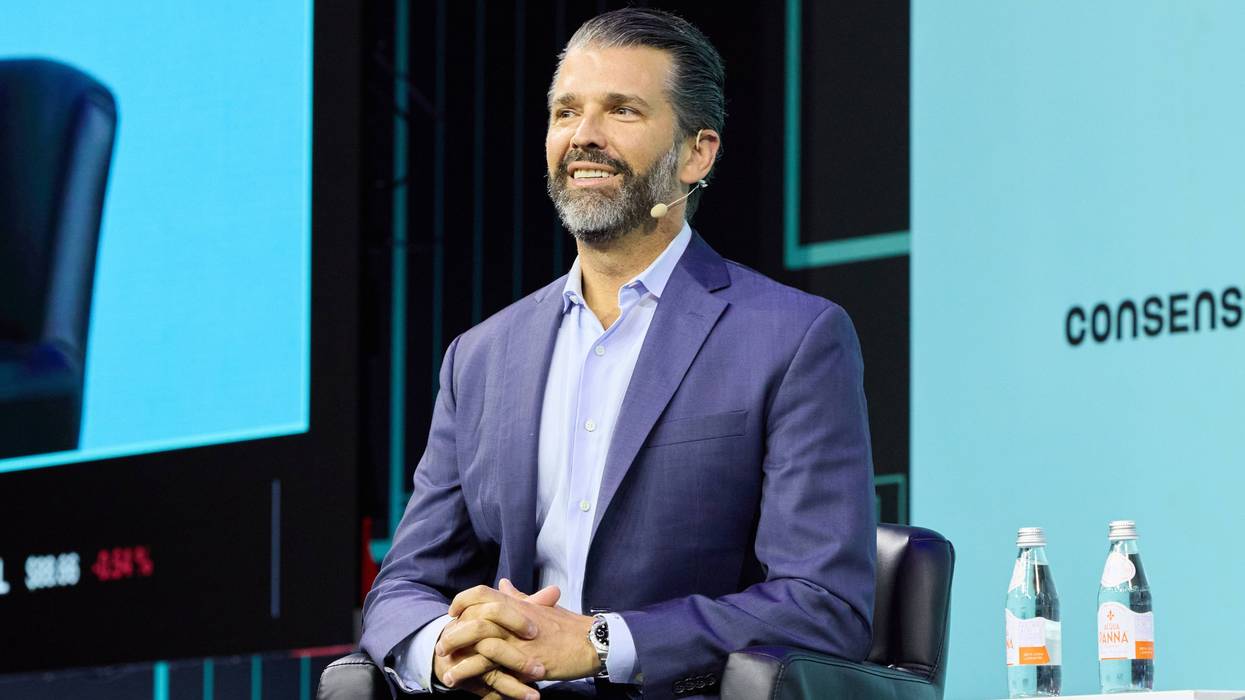
Rep. Jamie Raskin said on Tuesday that he is expanding his investigation into 1789 Capital Management, a investment firm linked to Donald Trump Jr., which has funded multiple companies that have gone on to win lucrative deals with the US Department of Defense.
Raskin (D-Md.), who is in line to be the next chair of the House Judiciary Committee, said he is demanding records from four companies—Hadrian Automation, Juul Labs, Polymarket, and GrabAGun—as part of his probe into whether Trump Jr. and his associates at 1789 Capital helped "steer federal contracts or regulatory decisions to companies in which they had a significant financial interest."
The four companies named by Raskin have either benefited or stand to benefit from Trump administration policies—including federal contracts and regulatory changes—after receiving investments from 1789 Capital, the Maryland Democrat said.
Raskin is seeking the companies' records of any meetings they've had with Trump Jr. or 1789 Capital representatives, as well as term sheets, investment agreements, valuations, and due diligence files exchanged with the firm.
1789 Capital, which was founded by pro-Trump donors who brought on Trump Jr. as a partner after the 2024 election, has come under scrutiny in recent months for financing several companies that have won Pentagon contracts.
Raskin noted the firm's "striking success in predicting both the imminent award of government contracts and the release of favorable regulatory actions to its portfolio or affiliated companies," which he said could be part of "a brazen conspiracy to use the machinery of the executive branch... to rig both public policy and the markets in order to enrich" the president's family.
“The House Judiciary Committee is committed to ensuring that public officials and their families cannot profit from and exploit inside government information and insider access," Raskin emphasized. "The American people demand and expect nothing less."
Raskin first launched his investigation into 1789 Capital in August, sparked in part by the Pentagon's decision to award a $620 million loan to Vulcan Elements, a rare earths magnet startup that has received funding from the firm.
“It is civilians, especially children, who continue to suffer terrible harm from landmines. This harm is avoidable, but only if all countries commit to preventing any further use."
An advocacy coalition working to eradicate the production and use of antipersonnel landmines worldwide said Tuesday that such weapons killed or injured at least 6,929 people last year, the highest toll since 2020 and a sign of growing cracks in the 1997 treaty banning the mines.
Civilians made up at least 84% of those killed or injured by landmines in 2025, according to the International Campaign to Ban Landmines (ICBL). The campaign's latest "Landmine Monitor" report estimates that, in cases where the age group of victims was known, children made up 50% of the casualties. Afghanistan was the most-impacted state party to the 1997 ban, with nearly 500 casualties last year. Myanmar, whose government was found guilty of genocide earlier this month, recorded the most landmine casualties for 2025 overall, with 1,891.
"It is civilians, especially children, who continue to suffer terrible harm from landmines," said Loren Persi Vicentic, an editor of the new report. "This harm is avoidable, but only if all countries commit to preventing any further use."
ICBL said that the Mine Ban Treaty faces its "greatest test" in nearly three decades, noting that five countries—Estonia, Finland, Latvia, Lithuania, and Poland—ditched the convention over the last year, "the first withdrawals in its history."
"Poland and Finland are preparing to bring antipersonnel mines back into their arsenals," the report says. "Poland is moving to acquire almost 15 million antipersonnel mines from domestic manufacturers, with production poised to begin as early as the end of 2026."
Ukraine, a state party to the 1997 agreement, used landmines against invading Russian forces, in violation of its treaty obligations, the new report observes. The report also found that countries not party to the treaty—Iran, Myanmar, North Korea, Russia, and "possibly" the US—have recently used landmines.
"Open-source researchers reviewed and geolocated visual evidence that indicates US forces may have used antivehicle mines from the air-delivered GATOR Mine Scattering System in or near populated areas of Iran in March 2026," the report states, noting that the Trump administration last year reversed earlier US limits on landmine use.
Tamar Gabelnick, ICBL's director, said that while the "withdrawals, new use, and new production" of landmines "are dangerous steps backward" for the 1997 ban, "they do not define the treaty."
“We urge all states to reject the production and use of antipersonnel mines, by any actor, under any circumstances," said Gabelnick.
“We hold the occupation fully and directly responsible for the epidemic outbreak," said the Gaza Health Ministry.
On the heels of a major international report that accused Israel of committing "environmental war crimes" in Gaza, including by exposing Palestinians to toxins and endangering the drinking water supply with its continued US-backed bombardment, the exclave's health ministry on Tuesday issued an "epidemiological alert” warning health workers and communities of a "shocking" rise in meningitis infections.
The Gaza Health Ministry called on the World Health Organization and the United Nations Children's Fund to send lab supplies and antibiotics, and establish isolation wards as Dr. Nidal Ghunaim, deputy director general of primary healthcare for the agency, said 272 meningitis cases had been reported in October—eight times the usual monthly average.
Bacterial meningitis cases rose from about 10-20 per month to 108 last month, and another 100 have been recorded in November. Fifteen people have died of the illness this year, including five between August-October.
The UN Office for the Coordination of Humanitarian Affairs (OCHA) reported that 77% of cases were in babies under one year of age.
Lab tests suggested the cases were linked to enteroviruses, which can spread through the water supply.
"The severe overcrowding in displacement camps and the absence of a healthy, preventive environment greatly increase the likelihood of transmission."
The health ministry said the outbreak was the “inevitable result of the destruction of infrastructure, overcrowding of shelters, mixing of drinking water with sewage, and the disaster being exacerbated by flooding due to rain."
A report released by Oxfam International Monday warned that, among other harms, the destruction of wastewater treatment plants in Gaza made it more likely that Palestinians could come into contact with water contaminated with pathogens.
The ministry warned that children are particularly at risk for meningitis infections, which cause inflammation of the membranes around the spinal cord and brain.
Officials said that in addition to making the outbreak more likely by destroying infrastructure across Gaza and pushing Palestinians into crowded makeshift shelters, Israel has also made it impossible for healthcare workers to stop the outbreak from spreading, by blocking "maintenance spare parts, sterilization materials, and fuel" from reaching Gaza.
Winter rains earlier this month caused catastrophic flooding that destroyed tens of thousands of tents—the only shelter for more than 1 million people after the vast majority of structures have been decimated by Israel's bombardment over the past three years. Makeshift encampments have been inundated with rainwater mixed with sewage.
“We hold the [Israeli] occupation fully and directly responsible for the epidemic outbreak," the ministry said.
Bahaa al-Sous, the father of newborn twin girls, told The New Arab Tuesday that he had discovered his daughter Ilat was sick 10 days ago after the storm.
"I came back from work to our tent, and God inspired me to bend down and kiss my daughter's forehead. I was shocked by the burning heat coming from her small body," he said.
His daughter finished treatment at Al-Aqsa Martyrs Hospital, but al-Sous was taking her sister, Elin, to the hospital Tuesday after she became ill.
A woman named Iman also brought her six-year-old daughter to the hospital for treatment, but had to buy some medications from private pharmacies.
"The water we drink is not clean like it was before the war. Nothing has stayed the same; even the air we breathe has changed and been polluted by [Israel's] bombing and destruction," Iman told The New Arab.
OCHA's report on conditions in the territory on November 18 said that 45% of households surveyed by the agency were living less than 10 meters from sewage and sludge following the flooding.
"The severe overcrowding in displacement camps and the absence of a healthy, preventive environment greatly increase the likelihood of transmission," Dr. Iyad Abu Mu'ailaq, a pediatrician at Al-Aqsa Martyrs Hospital, told The New Arab. "The complications of meningitis are very serious. If the child does not receive the right treatment at the right time, it may leave permanent effects on their growth and future, such as loss of hearing or sight."
Despite last year's ceasefire deal requiring Israel to allow humanitarian aid to reach Palestinians, the country has continued to block tents, shelter materials, and other supplies from entering Gaza.
Ahmed Abu Rukba, a representative for al-Iyadat camp in central Gaza, told The New Arab that new tents are needed, as well as sand to raise the low-lying camp and prevent worse flooding—especially since more storms are expected.
"If we don't get the sand and the tents," said Abu Rukba, "we will definitely flood again, and the children's tragedy will be repeated."
"In any other era, a monumental political scandal for the president. But not in ours, apparently."
The value of President Donald Trump's holdings in the AI chip giant Nvidia rose by up to $15 million on Monday after the company's board reinstated White House ally and Trump project donor Jensen Huang as chief executive.
Trump, whose investment accounts owned up to 370,000 Nvidia shares as of September 30, publicly took credit for the board's decision, telling CNBC that he "convinced them" and "made the deal" to bring back Huang. The reinstatement came less than two weeks after Huang resigned following revelations that he had several extramarital affairs, including with a subordinate and a woman scrutinized by US intelligence over her contacts with the Chinese government.
Nvidia's stock price surged more than 30% on Monday after news of Huang's reinstatement broke. The news also sparked a broad share price rally in the tech sector, which had sold off sharply in the wake of Huang's exit and amid news that the semiconductor giant was facing a Securities and Exchange Commission probe over its accounting practices.
The Financial Times, which first reported Trump's $15 million estimated gain from the Nvidia rally, noted that Trump "applied pressure" to the corporation's board over the weekend "after watching what was once America’s most valuable company as well as the wider tech sector hemorrhage value last week."
"Just to be clear: the president of the United States called into a private company’s board meeting and pressured them into reinstating a fired CEO whose actions his own government is investigating, and personally made 15 million dollars in the process," wrote Zeteo's Mehdi Hasan in response to FT's reporting. "In any other era, a monumental political scandal for the president. But not in ours, apparently."
Rep. Don Beyer (D-Va.) called Trump's intervention "psychotically crooked," arguing that the president once again put "private gain above the national interest."
"He is attempting to grant functional immunity to Nvidia and declare Huang 'exonerated' even though ongoing investigations continue to reveal national security risks and a seeming contempt for the law," Beyer wrote. "And the leaders of the tech industry are all too eager to exploit Trump's corruption for their own ends, regardless of the consequences."
A BBC analysis of Trump's financial disclosures for the last two years found that the president's investment accounts "purchased shares of Nvidia worth between $23 million and $86 million," and that "he has bought Nvidia stock 85 separate times through a number of investment accounts."
"Trump has also sold some of his stake in Nvidia since returning to the presidency," BBC added. "Over 19 sales, Trump gained between $3.5 million and $10.2 million, according to his government disclosures."
"We need to investigate what stock positions took place before the announcement," US Sen. Ruben Gallego (D-Ariz.) said on Monday. "This White House is the most corrupt in history."
"The Army still has failed to explain to the public why this detonation needs to happen this way—and too many people fear for their family’s health and safety," said Sen. Tammy Duckworth.
A federal appeals court on Monday cleared the way for the US Army to detonate nearly five tons of deteriorating lead-based explosives at an ammunition plant in southeastern Iowa, a ruling that came amid warnings from environmental defenders that the planned detonation could send toxic lead dust into surrounding communities.
The 11-page ruling by the Eighth Circuit Court of Appeals lifted a temporary stay that had blocked an emergency permit issued by the Environmental Protection Agency (EPA) to allow the blast.
“We are mindful of the very real risks presented by the Army’s planned detonation,” the judges wrote in their ruling. “However, we must acknowledge the realities of the situation: The degraded explosives present a risk of an uncontrolled and unplanned explosion," unless they are destroyed.
The decision followed a legal challenge by Earthjustice on behalf of the Iowa Environmental Council and the state chapter of the Sierra Club that argued that the federal government had failed to adequately consider alternatives to the detonation and protect public health.
The US Army is set to detonate 68 drums containing approximately 9,773 pounds of lead azide at the Iowa Army Ammunition Plant near Middletown on Wednesday.
Lead azide is a highly sensitive explosive used in the manufacture of ammunition and other military munitions. The material became increasingly unstable after water evaporated from its storage containers, allowing crystals to form. An April inspection reportedly found crystallization on 58 of the 68 drums.
Army officials contend that moving or chemically treating the deteriorating explosives might trigger an accidental explosion that could kill or wound workers and people nearby. They argue that a controlled detonation under carefully selected weather conditions is the least dangerous option.
However, green groups warn that the consequences could extend far beyond the immediate blast site. Earthjustice said the lead plume could travel up to 100 miles from ground zero, depending on the weather.
“The EPA itself admits that there is no safe level of lead exposure for humans,” said Michael Schmidt, general counsel for the Iowa Environmental Council, when the lawsuit was announced.
Iowa's Department of Health and Human Services acknowledges that the explosion will create a dust plume containing lead particles that could travel beyond the military installation and settle on surrounding surfaces. The agency warned of two main exposure pathways: inhalation of airborne lead particles and ingesting or even touching contaminated dust deposited on soil, playgrounds, vehicles, buildings, and other surfaces.
Children and pregnant women are particularly vulnerable. Lead exposure can cause serious neurological and developmental damage, including impaired brain development in children. Unlike some airborne pollutants, lead deposited on farmland, soil, and household surfaces can remain a source of exposure long after the initial explosion.
State health officials have told residents in potentially affected areas to stay indoors, keep their windows and doors shut for 24 to 48 hours, use indoor air filtration, and wet-clean potentially contaminated surfaces after the airborne exposure period ends.
In addition to environmental groups, elected officials from around the region vehemently oppose the planned detonation.
"The Army still has failed to explain to the public why this detonation needs to happen this way—and too many people fear for their family’s health and safety," Sen. Tammy Duckworth (D-Ill.), an Army veteran, said Sunday on social media. "This is an extreme failure of communication, planning, and leadership. And they must be held accountable for the harm done."
Earlier Monday, Trump said he had ordered the Army to hold off on the detonation until the Eighth Circuit ruled on the matter, and made the operation contingent on approval from Democratic sIowa Gov.-elect Rob Sand.
The president said on his Truth Social platform that if the court gave the green light, "we will have no choice but to not proceed with the controlled removal of these hazardous materials, and be forced to hold the incoming governor responsible for any and all death or destruction caused by this very unfortunate, and long-term, situation."
Sand stated that the Trump administration should be the one to "make this decision based on the information they have from the people they brought in to do the job months ago."
Area residents, including many farmers, are scrambling to protect their families, homes, fields, and livestock.
"We’re feeling less confident that anybody knows what they’re doing,” retired school teacher Jim Plate, who lives with his wife Krys Plate two miles south of the Army installation, told The New York Times. “We’re getting very frustrated by whatever the heck is going on.”
Krys Plate said that she is "terrified."
"Everybody knows," she told the Times, "that the acceptable level of lead is zero."
“BAAJA enables Trump rollbacks and eliminates bedrock environmental safeguards,” said one campaigner. “That’s not ‘accountability.’”
As the battle over a broad GOP permitting reform bill that green groups have condemned as a giveaway to fossil fuel companies and Big Tech heads to the House after clearing the Senate, opponents of the legislation are asking whether Democrats will challenge corporate interests or help Republicans deliver a victory for President Donald Trump as they did in the upper chamber.
The Senate passed the Bipartisan American Affordability and Jobs Act (BAAJA) 62-33 on Thursday, with 15 members of the Democratic caucus joining 47 Republicans in supporting the legislation. The bill now heads to the Republican-controlled House, where there is a growing rift between corporate Democrats and progressives who say the measure would undermine environmental protections and Indigenous rights.
Opponents say BAAJA would weaken the Clean Water Act and Endangered Species Act, exempt certain pipeline expansions from National Environmental Policy Act review, restrict judicial challenges to approved projects, and curtail state and tribal authority to protect waterways and sites of cultural importance to Indigenous peoples.
Critics also say the legislation would also make it harder for future administrations to revoke permits—even for improperly approved projects—while potentially exposing the government to substantial financial liability for delaying projects.
The Trump administration strongly supports BAAJA. The American Petroleum Institute (API), the country's largest fossil fuel industry lobbying group, also hailed its passage in the Senate.
"If we're going to build more, if we're going to produce more, and we want to pay less, that means passing this historic permitting bill that the United States Senate passed," API president and CEO Mike Sommers said Monday on Fox Business Network.
In response, Natural Resources Defense Council senior attorney John Walke said on social media, "Tell me what industry is lobbying for a bill and I'll tell you whose interests it serves."
"That includes energy companies whose financial interests will be served by, or are indifferent to, rolling back environmental laws, stripping states and tribes of rights, and speeding data centers," Walke added.
The BAAJA permitting bill won’t end the Trump administration's attempts to undermine clean energy projects, but could lock in future fossil fuel projects. on.nrdc.org/3VIitaf
[image or embed]
— NRDC (@nrdc.org) November 23, 2026 at 7:18 AM
Sen. Sheldon Whitehouse (D-RI)—one of BAAJA's chief architects—on Monday urged House Democrats to support the bill.
“BAAJA would end data center freeloading and require current and future data centers to pay for the upgrades to the grid that their huge electricity consumption requires, without passing off any of their costs to consumers, which they are currently doing," Whitehouse said. "It’s a strong, bipartisan whack against an industry run amok."
“Democrats should not deny Americans the data center accountability they have demanded over ghost stories being told to try to deliberately mislead people," he added.
While Whitehouse claimed that BAAJA will deliver "accountability" and "lower electricity bills," Walke noted that the bill is projected to save ratepayers just a few dollars per month "and doesn't protect people from any other data center-driven costs."
"BAAJA enables Trump rollbacks and eliminates bedrock environmental safeguards," he said. "That's not 'accountability.'"
The House Democrats who have indicated their position appear split on BAAJA. Corporate Democrats, including Reps. Jared Golden (Maine), Nikki Budzinski (Ill.), Scott Peters Calif.), and George Whitesides (Calif.) have argued that permitting reform should happen now rather than waiting until January.
On the other side, opponents argue that Democrats just won control of Congress and should not help Trump enact legislation that could weaken environmental protections for decades when they will soon have the opportunity to write their own permitting legislation after the 120th Congress convenes in January.
Progressive Democrats, including Reps. Alexandria Ocasio-Cortez (NY), Adelita Grijalva (Ariz.), Ro Khanna (Calif.), Summer Lee (Pa.), and Rashida Tlaib (Mich.), as well as more mainstream Democratic lawmakers like Reps. Jared Huffman (Calif.), Melanie Stansbury (NM), and Mike Levin (Calif.) publicly oppose BAAJA as currently written, with at least some explicitly saying they will vote against it unless it is substantially changed.
Levin said Monday that while "there’s real promise on costs and clean energy deployment," he warned that “other parts of the bill raise concerns."
He continued:
The bill would limit California’s ability to protect its own water, weaken the science behind endangered species decisions, and keep courts from halting a project even when an agency skips the review the law requires. It would also make this administration’s fossil fuel approvals, offshore leases included, extremely hard for a future president or a judge to undo. For those of us who have spent years fighting to keep new oil rigs off the California coast, that’s a serious threat.
Tribal nations have warned that the bill’s changes to historic preservation law could endanger sacred sites and undercut tribal sovereignty, and they deserved a far bigger voice in writing it.
“Those harms would be permanent, while the clean energy gains would rise or fall with whoever happens to be carrying out the law," Levin said.
“There’s still time to get this right," he added. "If House and Senate leaders from both parties sit down together and negotiate sufficient changes, I’ll be ready to vote yes."
Notably, House Speaker-designate Hakeem Jeffries (D-NY) says he is undecided on BAAJA, stating that the legislation "falls short" and needs to be reworked before he can support it.
“We can have democracy. We can have great wealth concentrated in the hands of a few. We cannot have both.”
Millions of Americans have seen their retirement savings rise and fall with the fortunes of a single scandal-plagued billionaire, Jensen Huang, who was restored Monday to his role as CEO of the artificial intelligence chipmaker Nvidia following the personal intervention of his friend, President Donald Trump.
For New York City Mayor Zohran Mamdani, the entire saga was a perfect illustration of the dangers that come with concentrating unfathomable amounts of money in the hands of so few.
“I do not think that working people across the country signed up for their pensions being tied to the question of Jensen Huang’s fidelity to his marriage. And yet, for many days, that had a massive impact,” Mamdani said when asked about Huang’s reinstatement at a press briefing Monday.
Mamdani: I do not think that working people across the country signed up for their pensions being tied to the question of Jensen Huang’s fidelity to his marriage. And yet, for many days, that had a massive impact.And what we’re also talking about here—we’re speaking about Mr. Huang—we’re speaking about a divorce settlement that has been rumored to be around $81 billion. That would be the cost of providing universal child care for every three- and four-year-old in the United States of America for an entire year.And a lot of this just brings to mind what Justice Brandeis said quite some time ago, which is: We can have democracy. We can have great wealth concentrated in the hands of a few. We cannot have both.And when you look at our stock market, and you look at how disproportionately dependent it is on artificial intelligence-related stocks, it cannot help but give you a sense of concern about just how much this technology is now dominant, not just in terms of the discourse that we are having around it on a day-to-day basis, but also the strength of the United States economy.
— Acyn (@Acyn) November 23, 2026
Earlier this month, Huang acknowledged his infidelity, including an affair with a woman suspected of being a Chinese spy, who allegedly helped China circumvent US restrictions on Nvidia chip exports. The company’s stock fell sharply in the days after Huang’s disclosure, plummeting further after he announced his resignation on November 12.
The scandal sent shock waves through US financial markets, dragging down major indexes like the S&P 500, which underpin the retirement savings of millions of Americans. Axios estimated that the nearly 30% drop in Nvidia shares could have shaved thousands of dollars off the average baby boomer’s 401(k), depending on its holdings.

The announcement of Huang's return on Monday sent the company's shares soaring once more, recovering more than 80% of the loss since Huang's resignation.
The mayor said these dramatic fluctuations underscore how “disproportionately dependent” the US stock market is on AI stocks.
After Monday’s gains, Nvidia alone accounts for an eye-popping 6.4% of the S&P 500, while AI-related companies as a group account for nearly half of the index, according to an analysis by JPMorgan.
"It cannot help but give you a sense of concern about just how much this technology is now dominant, not just in terms of the discourse that we are having around it on a day-to-day basis, but also the strength of the United States economy," Mamdani said.
This is not a meme stock.This is Nvidia, one of the most valuable companies in the world, and it’s up 32% today.$NVDA has added about $1 trillion in market cap in under 3 hours. https://t.co/xlF0cXFM6n
— unusual_whales (@unusual_whales) November 23, 2026
Beyond the astonishing power that the highly erratic and largely unregulated AI industry now holds over the fate of the entire US economy, Mamdani said one detail of the Huang scandal illustrated the sheer scale of the personal wealth the industry’s leaders control.
“What we’re also talking about here—we’re speaking about Mr. Huang—we’re speaking about a divorce settlement that has been rumored to be around $81 billion,” Mamdani noted. “That would be the cost of providing universal childcare for every 3- and 4-year-old in the United States of America for an entire year.”
Mamdani said the intervention of the president, who said Monday that he'd assured Nvidia's board that Huang would not be prosecuted despite potential violations of US export-control laws, economic espionage, or securities fraud related to the scandal, was a profound demonstration of elite impunity.
Mamdani added that the episode called to mind a quote widely attributed to former US Supreme Court Justice Louis Brandeis, a vocal critic of concentrated private wealth and monopolies: “We can have democracy. We can have great wealth concentrated in the hands of a few. We cannot have both.”
"Without knowing their client’s detention location, attorneys cannot file time-sensitive habeas petitions... This policy change therefore raises deep concerns regarding violations of immigration, legal, and civil rights."
Following multiple recent reports of people who have been detained by federal immigration agents under the Trump administration disappearing from the government's tracking system, the progressive lawmaker who is pushing to become the leader of the Democratic Party's new majority in the US Senate was among those demanding on Monday that officials investigate how thousands of names have vanished—and warned that the administration is depriving those detainees of their constitutional rights.
Sen. Chris Van Hollen (D-Md.)—who is challenging Senate Minority Leader Chuck Schumer (D-NY) for the leadership role—joined Sens. Elizabeth Warren (D-Mass.) and Ben Ray Luján (D-NM) in leading 21 Democrats and Independents in a letter to Joseph Cuffari, the inspector general of the US Department of Homeland Security (DHS).
Their letter, dated Sunday, came two months after The Associated Press reported that US Immigration and Customs Enforcement (ICE) had abruptly stopped listing people with final deportation orders in its Online Detainee Locator System (ODLS).
The locator system, which was created by ICE, has been "critical in allowing detainees access to legal representation and their loved ones," said the senators, who also included Sens. Bernie Sanders (I-Vt.), Ed Markey (D-Mass.), and Tina Smith (D-Minn.).
But suddenly, “an official government policy of disappearing people," as one senior fellow at the Center for American Progress said, appeared to emerge in September when the names of people with final removal orders were no longer visible in the ODLS, and the locations of newly arrested people were hidden from view.
Legal experts warned that failing to make detainees' locations known to their legal representatives and families could violate their habeas corpus rights. The senators said in their letter that with the new practice, ICE is not "meeting its stated policy of updating its database “within eight hours of the release, removal, or transfer of detainees."
In a Monday statement, Warren's office noted that ICE appeared to have "deliberately changed its policy to exclude people with final removal orders from the locator system," and said the senators wanted Cuffari "to determine when the change was made and how many detainees have been affected."
Warren noted that she has led numerous investigations into the Trump administration's immigration enforcement practices, while Van Hollen was lauded last year for traveling to El Salvador to advocate for the release of his constituent, Kilmar Ábrego García, who had been wrongly deported.
The recent news reports about the absence of detainees' names and locations in the ODLS "suggest that the problem is not just one of delays or glitches but instead, DHS appears to have made an intentional policy change—without any warning to the public," wrote the senators.
"Without knowing their client’s detention location, attorneys cannot file time-sensitive habeas petitions in the proper venue and cannot intervene to challenge third-country removals," they continued. "Families and attorneys are now left scrambling to find out where the affected detainees have been taken. This policy change therefore raises deep concerns regarding violations of immigration, legal, and civil rights by the US government."
The lawmakers noted that the apparent policy change began as ICE arrests were at a "record high," with more than 50,000 people arrested in August and nearly 500,000 arrests in the 2026 fiscal year. In July, ICE was detaining more than 65,000 people in hundreds of detention centers across the country, and an estimated 30% of those people faced final removal orders.
The names also disappeared at a time when deaths in ICE detention are at a 20-year high, with at least 32 people having died while in the agency's custody this year, and the senators warned that removing people from the ODLS could put many at grave risk of physical harm.
"In one reported case, a woman with epilepsy and a history of seizures was transferred across the country without notifying her family and legal counsel," said the senators. "She became seriously ill and required oxygen during transit, but her treatment was delayed because ICE failed to inform the receiving facility about her medical conditions despite its stated transfer policy. Amid growing reports of medical neglect in detention, ICE’s failure to notify facilities and attorneys can be deadly."
"Many more lives could suffer in silence because help cannot reach them," they added.
The lawmakers demanded to know how many people's names have been removed from the ODLS, whether ICE has instructed personnel not to provide detainees' names and locations to family members and lawyers, and whether detainees have been transferred, deported, or faced medical emergencies since their records disappeared from the system.
"Your investigation," the lawmakers told Cuffari, "would help inform legislative efforts to pursue immigration reform and would
be consistent with your mission to 'provide independent oversight and promote excellence, integrity, and accountability within DHS.'"
"Workers should never have to choose between a healthy pregnancy and keeping their jobs," said one critic.
Advocates for workers' and women's rights are crying foul after a federal court last week struck down a landmark bill providing protections for pregnant employees.
In a Friday ruling, the 5th Circuit Court of Appeals declared that Congress violated the US Constitution when it passed the Pregnant Workers Fairness Act in 2022 without a majority of members physically present during the vote.
At the time, the US House of Representatives was operating under rules adopted during the Covid-19 pandemic that allowed lawmakers to vote by proxy.
The court's ruling invalidates the law in Texas, Louisiana, and Mississippi, and "could imperil" protections elsewhere, according to a Sunday report in The Associated Press.
Among other things, the Pregnant Workers Fairness Act mandates that employers "make reasonable accommodations to the known limitations related to the pregnancy, childbirth, or related medical conditions," while also making it unlawful to deny employment opportunities if "such denial is based on the need... to make reasonable accommodations" for pregnant workers.
Inimai Chettiar, president of worker advocacy group A Better Balance, said the 5th Circuit's ruling "effectively erases essential rights to pregnancy accommodations for workers," while putting "the health, livelihoods, and economic security of millions of American women and their families at risk."
"Workers should never have to choose between a healthy pregnancy and keeping their jobs," Chettiar emphasized. "This decision could force countless women out of the workforce at a moment and is made even worse by the fact that the Trump administration is already poised to gut the regulations governing the law."
The New York Times reported earlier this month that the Trump administration is planning to roll back some protections guaranteed in the law.
Although the administration is "not expected to eliminate requirements that most directly protect women during pregnancy," it could "eliminate explicit protections for conditions" related to fertility treatments, abortion, and menstruation, according to the Times.
Jessica Lee, co-director of the Center for WorkLife Law at UC Law San Francisco, spelled out the impacts that the law's invalidation will have on workers, noting that "it frees the state to deny pregnant women it employs a water bottle, a stool, or time off after a miscarriage."
"This ruling tips the first domino," Lee warned. "Some employers in Texas, Louisiana, and Mississippi, home to about 20 million women, will try to use this ruling to escape legal liability for saying no when a pregnant woman asks for a break from heavy lifting or time off for a prenatal appointment."
California Secretary of Business and Consumer Services Rohit Chopra noted that he wasn't surprised by the 5th Circuit's ruling because it "has a reputation for routinely siding with corporate lobbyists at the expense of consumers, workers, and small businesses across the country."
"As we think about ways to root out corruption in our country," Chopra added, "we need to make sure that courts at every level uphold the rule of law, rather than side with special interests."
Environmental groups have argued that the crisis was one "of the Army's own making."
Following bipartisan outcry, President Donald Trump has ordered the US Army to postpone its plans for a controlled detonation of nearly 10,000 pounds of toxic lead azide at a military facility in Iowa this week, which environmental groups have warned could create a "public health catastrophe."
The Army has already postponed the operation several times. It plans to detonate 68 barrels of lead azide at the Iowa Army Ammunition Plant near Middletown, in southeastern Iowa near the Illinois border.
The blast is expected to send a plume of toxic lead dust into the air, which could travel at least 100 miles depending on the weather.
In a post on Truth Social, Trump said he believed detonating the material was “the proper course” of action to prevent an uncontrolled explosion. He said he would order the Army to wait until the US Court of Appeals for the Eighth Circuit allows the operation to proceed. The court blocked a US Environmental Protection Agency (EPA) permit for the planned detonation last week.
Trump also said he would wait for approval from Iowa’s Democratic governor-elect, Rob Sand. Sand said the Army had known for months that its plan was a public health hazard and that its delay in dealing with the deteriorating material made the situation “more dangerous and unpredictable than it ever should have been.” He called for postponing the operation until the public better understood the risks.
Trump said that Sand, who takes office in January, would be responsible for “any and all death or destruction” resulting from the delay.
The president's order comes a day after the Army announced that it planned to detonate the chemicals on Wednesday, November 25, the day before Thanksgiving, citing what it said were optimal weather conditions to mitigate harm from the toxic cloud. The Army said it planned to carry out the detonation despite the Eighth Circuit's order from last week, citing what it claimed were emergency authorities.
While the Army has insisted the controlled detonation is the safest path to avoid an even more dangerous accidental explosion, environmental groups have argued that the crisis was one “of the Army’s own making.”
In a court filing defending the Army’s claim of emergency authority, the US Department of Justice (DOJ) revealed that the Army had removed protective blast doors, leaving the explosives more vulnerable to temperature fluctuations. The filing also revealed that the Army had failed to replenish the stabilizing solution for more than a year and had found dangerous crystallization in 58 of the 68 barrels.
Update: We filed declarations over the U.S. Army's mishandling & inadequate public notice of the lead azide detonation in Iowa.This emergency is of the Army's own making. The Army knew for years about this dangerous stockpile of munitions, and since at least March that it was becoming unstable.
— Earthjustice (@earthjustice.org) November 22, 2026 at 2:11 PM
"The new information from the DOJ indicates that the problem is significantly worse than the Army originally shared," said Michael Schmidt, general counsel for the Iowa Environmental Council—one of the groups that sued last week in an effort to halt the detonation. "It appears that detonation may be, at this point, the only feasible option due to how long this problem was allowed to persist."
The groups have criticized the Army for failing to keep residents informed as it planned the operation over several months. Outgoing Iowa Gov. Kim Reynolds’ office said the Republican governor’s staff learned of the plans only a week ago.
Earthjustice attorney Thien Chau has described the potential fallout as a “public health catastrophe for people in at least two states,” Iowa and Illinois.
The Army’s own modeling indicated that the blast could send large amounts of lead dust into the air. The particles could then settle on homes, playgrounds, and farmland or enter waterways, where contamination could persist long after the explosion.
According to the EPA, there is no safe level of lead exposure for humans. Even low levels of exposure can permanently harm children’s developing brains. Lead exposure can also cause kidney damage, cardiovascular problems, and developmental disorders.
A 2024 study published in the International Journal of Epidemiology estimated that lead exposure contributed to approximately 67,000 deaths a year in the United States from 2017-19, largely through its association with cardiovascular disease and other chronic health problems.
Wally Taylor, attorney and legal chair for the Sierra Club’s Iowa Chapter, said the Army had yet to provide documents showing it had explored safer alternatives.
“The Army has clearly mishandled this situation, and Iowans and residents in our neighboring states deserve a full review of all of the missteps that led us to this point," he said. "However, if detonation is now the only option, it is imperative that everyone impacted has access to the full range of testing, mitigation, and remediation resources."

Trump saddled Sand with responsibility for the delay even as officials in both parties called on the Army to postpone the blast.
On Thursday, Sens. Dick Durbin (D-Ill.) and Tammy Duckworth (D-Ill.), Reps. Darin LaHood (R-Ill.), Mary Miller (R-Ill.), and Eric Sorensen (D-Ill.), Democratic Illinois Gov. JB Pritzker, and Sens.-elect Juliana Stratton (D-Ill.) and Josh Turek (D-Iowa) sent a letter relaying their concerns to EPA Administrator Lee Zeldin and Acting Army Secretary Adam Telle.
“Families in the area deserve better than being left with unanswered questions about a decision that could affect their health and safety. They deserve timely information, transparent safety plans, and a meaningful opportunity to understand the risks before the Army moves forward. I’m urging them to delay this and seek out safer alternatives,” their letter reads.
Duckworth reiterated in another statement on Sunday that "the Army still has failed to explain to the public why this detonation needs to happen this way—and too many people fear for their family’s health and safety."
"This is an extreme failure of communication, planning, and leadership," she said. "And they must be held accountable for the harm done."