

SUBSCRIBE TO OUR FREE NEWSLETTER
Daily news & progressive opinion—funded by the people, not the corporations—delivered straight to your inbox.
5
#000000
#FFFFFF
To donate by check, phone, or other method, see our More Ways to Give page.
Daily news & progressive opinion—funded by the people, not the corporations—delivered straight to your inbox.

For more information or to schedule an interview, contact Naren Daniel at (646) 292-8381 or naren.daniel@nyu.edu.
Today the Brennan Center for Justice at NYU School of Law, together with a pro-bono team led by Center board member Daniel F. Kolb, filed an amicus brief in Republican Party of Louisiana v.
Today the Brennan Center for Justice at NYU School of Law, together with a pro-bono team led by Center board member Daniel F. Kolb, filed an amicus brief in Republican Party of Louisiana v. Federal Election Commission, defending the constitutionality of provisions in 2002's McCain-Feingold campaign finance law, or the Bipartisan Campaign Reform Act (BCRA). The case is before a three-judge panel in the D.C. District Court, meaning an appeal would guarantee the U.S. Supreme Court considers the case.
Although the Brennan Center has proposed limited reforms to allow party committees more fundraising flexibility, the brief argues that these recommendations in no way imply that the current regime is unconstitutional:
"In fact, the core relief Plaintiffs seek -- permitting certain party committees to raise potentially unlimited funds for federal election activities -- could undermine the very objective of broad political participation that led us to call for reform," reads the brief. "Sensible contribution limits for political parties remain legitimate and necessary."
The Brennan Center's interest in the case is especially strong. The Center's research was cited by members of Congress during the congressional debate around BCRA, and the Center then represented congressional sponsors, including Sen. John McCain (R-Ariz.), who intervened to defend the law against a previous constitutional challenge.
Read the Brennan Center's case page on Republican Party of Louisiana v. Federal Election Commission, and full amicus brief.
Read the Brennan Center paper Stronger Parties, Stronger Democracy.
Read more about the Brennan Center's work on money in politics.
The Brennan Center for Justice is a nonpartisan law and policy institute. We strive to uphold the values of democracy. We stand for equal justice and the rule of law. We work to craft and advance reforms that will make American democracy work, for all.
(646) 292-8310
After the passage of a law that allows people with Canadian ancestry going back generations to apply for citizenship, archivists are also seeing an increase in requests for genealogical records.
Americans are driving a surge in both citizenship applications in Canada and demand for archivists there to find evidence that they are eligible to become citizens, as people in the US look to leave the country increasingly defined by President Donald Trump's racist, violent, and authoritarian far-right political movement.
As CBC reported Monday, the number of people who have received Canadian citizenship certificates rose nearly 50% between April 1-May 31, months after the country's Parliament passed Bill C-3—the so-called "Lost Canadian" law.
The law allows foreign nationals to gain citizenship if they can prove via official genealogical records that they are descended from a Canadian ancestor. It was passed after courts struck down a previous restriction limiting citizenship eligibility to people whose parents were born in Canada.
In the first five months of 2026, Americans accounted for nearly half of the people who qualified for citizenship.
More than 3,100 Americans obtained citizenship certificates as a result of Bill C-3, and another 8,125 people from the US were granted citizenship due to their parents being Canadian.
The country's federal immigration agency, Immigration, Refugees, and Citizenship Canada (IRCC), reports that the backlog of citizenship certificate applications had exploded to 121,800 people at of August 10—up from 70,400 in May and 56,000 the previous month.
“There’s so many reasons that people, you know, might be looking to leave the States right now or planning for future moves."
In May, the wait time for an application being processed was estimated to be 12 months, but as of August 10, it had jumped to 25 months.
CBC noted that some certificate applicants simply need replacement documents after their citizenship papers have been lost or stolen, but one immigration attorney and policy analyst told CTV News that there is a clear driver of the surge in Americans exploring the possibility of citizenship in their neighboring country.
"Proof of citizenship used to be fast, but the Trump bump has dramatically increased the processing volumes for proof of citizenship, resulting in lengthy processing times,” Richard Kurland told the outlet last week. “What used to take a few months is now going to take well over a year and longer.”
The surge in citizenship applications comes as Trump has overseen a mass deportation campaign in which federal immigration agents have fatally shot at least 11 people on US streets, including at least three US citizens. The president's tariff policy, his unprovoked war of choice in Iran, and the Republican Party's cuts to Medicaid and Affordable Care Act subsidies have all been blamed for worsening the affordability crisis that Trump campaigned on ending.
The White House has also signaled plans to ramp up attacks on the First Amendment as it pushes federal, state, and local law enforcement agencies to carry out Trump's directive from last year, National Security Presidential Memorandum 7, to crack down on groups he called "radical left" extremists.
As Common Dreams reported last week, teachers unions and climate advocates were among those that the Department of Homeland Security surveilled earlier this year in Minnesota in response to widespread protests against its anti-immigration crackdown.
“There’s so many reasons that people, you know, might be looking to leave the States right now or planning for future moves," Mab Coates-Davies, executive director of the Association of Canadian Archivists (ACA), told the CBC Monday.
The association has seen a sharp rise in requests for archivists to find genealogical records that prove Canadian ancestry in recent months, with a majority of the requests coming from the US, according to the outlet.
Some archival institutions are seeing 100-300% jumps in requests, the ACA said.

Some supporters of Israel called for Prime Minister Benjamin Netanyahu to expel Ben-Gvir from his government in response to the comments.
National Security Minister Itamar Ben-Gvir, one of the most powerful figures in the Israeli government, is facing criticism, including from some strong supporters of Israel, after he called for the mass killing of Palestinians in Gaza during an interview that surfaced on Sunday.
The far-right member of Prime Minister Benjamin Netanyahu’s cabinet rarely hides his desire to ethnically cleanse the exclave of Palestinians and replace them with Israeli settlers. But these comments, which he made to a former Israeli captive taken during the Hamas-led October 7, 2023 attacks, were even more explicit and violent than usual.
He said he's pushed for Israeli forces to carry out operations every day that “kill 30 or 40” people in Gaza and go beyond “those who pose a danger… at that particular moment."
"There are people there who are not worthy of life. They shouldn’t live. They’re not even people," Ben-Gvir said, criticizing a recent drawdown of Israeli attacks.
Ben-Gvir, who runs Israel's prisons and police, said killing Palestinians in greater numbers would "encourage" civilians in Gaza to leave so that Israel can fully conquer the strip, allowing it to be colonized by Jewish settlers.
“I see all of Gaza as ours," the minister said. He said that Israel, which has already pushed past last October's ceasefire line to occupy nearly 70% of Gaza, should move "as fast as possible" to take over the rest of the territory.
Ben-Gvir said, "We enter all of Gaza, settle all of Gaza, encourage migration."
The comments were met with condemnation in the West, including from some strong defenders of Israel.
Jacky Rosen (D-Nev.), who has consistently voted to provide weapons to Israel despite growing calls within her party to block some arms sales, said Ben-Gvir’s comments were “horrific and completely indefensible.”
“Anyone advocating for acts of violence against innocent civilians should not be in an official government position,” Rosen said. “I believe Ben-Gvir must resign, and I urge Prime Minister Netanyahu to denounce these remarks and reaffirm to the world that this is not the government’s position.”
Democratic Majority for Israel, a group focused on maintaining support for Israel within the US Democratic Party, stated similarly that Ben-Gvir's comments were "heinous and indefensible" and called for him to be expelled from Netanyahu's government. However, the group also stressed that Ben-Gvir's position "is not Israeli government policy."
Technically, this is true, but only in the sense that the Israeli government's actions toward Gaza have actually been considerably more violent than the kill quota of "30 to 40" per day prescribed by Ben-Gvir. Since the genocidal war began in October 2023, more than 73,000 Palestinians have been killed, according to the Gaza Health Ministry.
Based on the ministry's official tallies, which independent expert analyses have found to be an undercount, around 92 people were killed on average per day between October 2023 and the ceasefire in October 2025.
Data from the Israeli army, analyzed in 2025 by +972 magazine, suggests that more than 80% of those killed were civilians. During the first two years of the conflict, the Government Media Office in Gaza reported that more than 20,000 children had been killed, more than one every hour.
While some called on Netanyahu to stand against Ben-Gvir's especially violent rhetoric, the prime minister himself has also explicitly pushed for genocidal violence against Palestinians in Gaza, at one point invoking the Israelites' ancient foe, the Amalekites, and God's demand in the Hebrew Bible that the Israelites exterminate them.
Along with the similarly extreme finance minister Bezalel Smotrich, Ben-Gvir regularly draws criticism among liberal supporters of Israel for his particularly explicit comments advocating violence against Palestinians and other enemies of Israel and for enacting policies that have accelerated their displacement in the West Bank and allowed violent Israeli settlers to act with impunity.
But as critics pointed out, there is little evidence that Netanyahu will heed the calls from liberal Zionists to boot Ben-Gvir out of his coalition or discipline him in any way.
"And if he doesn’t, which he won’t, of course, does DFMI then support sanctions on Israel and restrictions on US arms sales?" asked commentator Mehdi Hasan in response to the statement from Democratic Majority for Israel. "If not, why not?"
Noting that the group has consistently opposed proposals to cut off weapons aid to Israel, he asked, "Why would you want to sell weapons to ‘heinous’ people?"
Political analyst Omar Baddar suggested that the problem many pro-Israel critics have with Ben-Gvir is not the policy he espouses, but the public relations headaches he creates.
Baddar said, "What’s 'extremist' about Ben Gvir is that he says out loud what Israel’s mainstream political establishment prefers to do quietly under the false pretense of 'fighting terrorism.'"

Trump's warning to Oman over its negotiations with Iran comes as the closure of the Strait of Hormuz is once again putting upward pressure on petroleum prices.
President Donald Trump on Monday threatened to bomb a US ally in the Middle East if it gets in the way of a perpetually elusive deal with Iran to reopen the Strait of Hormuz.
Speaking with Fox News, Trump was asked about talks that Iran and Oman have been conducting about jointly overseeing operations of the strait, which has been shut down ever since Trump started an illegal war in late February.
Trump replied that "if Oman gets in the way" of reopening the strait, "we'll bomb the shit out of them."
.@POTUS on parallel talks between Iran and Oman on the Strait of Hormuz: "If Oman gets in the way, we'll bomb the shit out of them." pic.twitter.com/5dEXDOdAN4
— Rapid Response 47 (@RapidResponse47) August 17, 2026
It is unclear how effective Trump's threats against Oman will be, as the US military still hasn't forced Iran to reopen the strait even after burning through massive stocks of munitions—including what military sources have described to The Military Times as "virtually all" of its Army Tactical Missile Systems (ATACMS) and Precision Strike Missiles (PrSM).
As Trita Parsi of the Quincy Institute for Responsible Statecraft noted, the president previously threatened Oman when the country put forward proposals for a compromise on control of the strait.
Trump's warning to Oman comes as the closure of the strait is once again putting upward pressure on petroleum prices.
According to a Monday report from Reuters, data from maritime vessel tracking firm Kpler shows that "shipping appeared to grind to a near standstill" over the weekend, as only "five commodity vessels transited the strait on Saturday, with none registered for Sunday."
As Reuters noted, an average of 130 ships typically passed through the strait daily prior to the start of Trump's illegal war.
The price of Brent crude jumped over $89 per barrel during Monday trading, while data released by the American Automobile Association shows the average price of gas in the US now stands at $4.06 per gallon, up from $4.01 in the week prior.
The Wall Street Journal on Sunday reported that Iran believes that the war has been going so well that it has concocted a "secret plan" to escalate it, using the June ceasefire with the US to take time “to prepare for a bigger fight.”
"Arab intelligence officials have picked up evidence... of a strategic shift inside the country’s hard-line leadership to get their forces ready to widen the war and raise the costs for the US," the Journal reported. "Their overriding goal is to inflict enough pain to ensure the kind of attacks Iran has endured with the 12-day war last year and the continuing conflict aren’t repeated."
"Does Jeffries even pay attention to the overwhelming support of the Democratic Party base?" asked one labor movement veteran, citing a new poll showing 90% of the party want lawmakers to focus on passing universal healthcare.
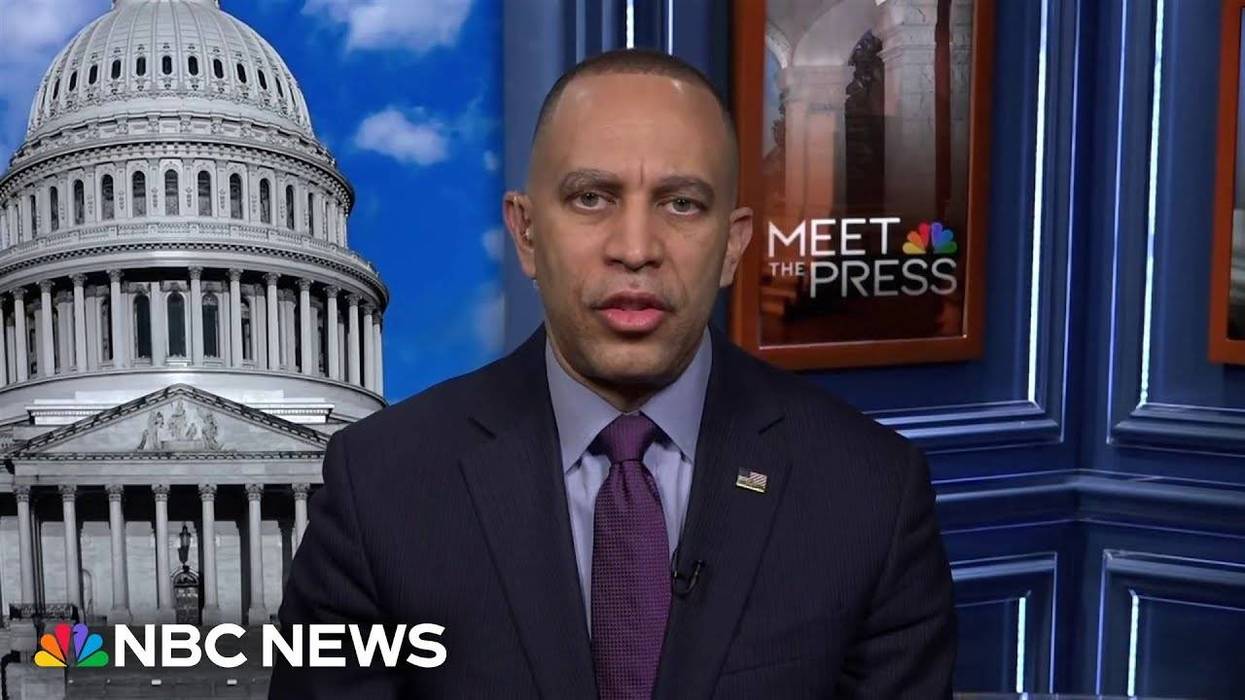
Democratic House Majority Leader Hakeem Jeffries of New York sparked fresh outrage Sunday by saying he does not currently support Medicare for All legislation in Congress, a damning admission at a time when party voters—clamoring for bolder positions from leadership and a willingness to fight for the working class—are overwhelming in favor of proposals that would provide universal healthcare coverage for every person in the United States at a lower cost than the current system.
Appearing on Sunday's "Meet the Press," Jeffries was asked by host Kristen Welker—who noted his previous backing of such proposals from 2013 to 2021—if he would put Medicare for All legislation in the House up for a vote if Democrat's win back the majority in November, Jeffries first tried to dodge the question by putting his focus on the shortcomings of the Republicans, who gutted have Medicaid and attacked Affordable Healthcare Act subsidies during President Donald Trump's second term.
But pressed by Welker if he "personally" supports Medicare for All at this time, Jeffries said, "No," explaining that "it’s not legislation that I currently am co-sponsoring or that I support."
WELKER: As Democratic leader in the House, would you vote for or against Medicare for All?
JEFFRIES: It's not legislation that I currently am co-sponsoring or that I support, but I support the notion we've got to find a path forward to fix our broken healthcare system pic.twitter.com/U8UZ4TqSZQ
— Aaron Rupar (@atrupar) August 16, 2026
The remarks were hardly surprising, but landed hard for critics, who quickly pointed out that a new CBS/YouGov poll released Sunday showed—as survey after survey has also documented—that hunger for Medicare for All among Democratic voters is remarkably high.
As Common Dreams reported last week, a recent Yale University study found that Medicare for All, as drafted in a bill by Sen. Bernie Sanders (I-Vt.), would save over 114,000 lives annually and $1 trillion per year in US healthcare spending.
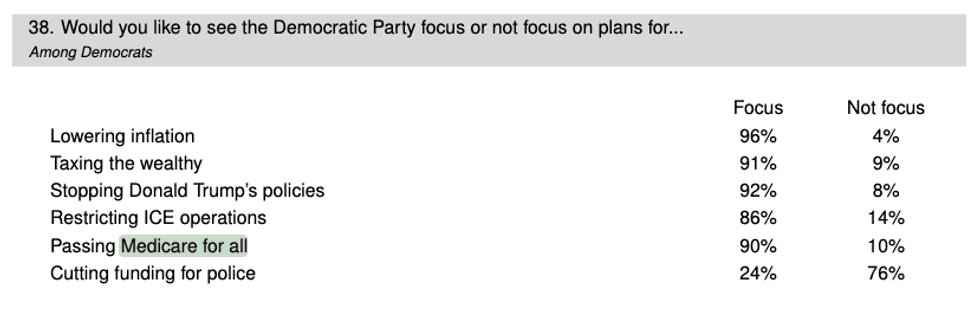
In the poll, conducted between Aug. 12-14, a full 90% of Democratic voters said they would "like to see the Democratic Party focus on plans for passing Medicare for All," compared to just 10% who said it should not be a focus.
"A reminder that the vast majority of Democrats across the country support Medicare for All," said progressive journalist Mehdi Hasan in response to Jeffries' answer on the question. "This man is so out of touch with his party. How is he their leader?"
The Lever's David Sirota also issued a rebuke, explaining that Jeffries' comments, juxtaposed with the CBS/YouGov poll, show exactly "why Democratic voters are so enraged."
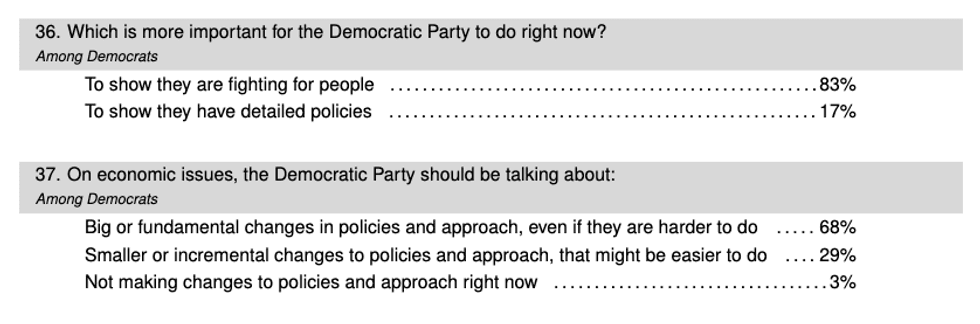
Also notable from the poll were responses to two questions that preceded the question about the specific policies Democrats should focus on.
Asked if it was more important for the Democratic Party to "show they are fighting for people" or that "they have detailed policies," 83% said it was more important for Democrats to show they are fighting, while just 17% said detailed policies were more important. Similarly, when it came to economic issues, voters—by a 68% to 29% margin—said they'd prefer "big or fundamental changes in policies and approach, even if they are harder to do" compared to those who wanted "smaller or incremental changes to policies and approach, that might be easier to do."
Appearing after Jeffries on "Meet the Press," Rep. Ro Khanna (D-Calif.), a top ally of Sanders and a current co-sponsor of the Medicare for All Bill introduced earlier this year in the House, disagreed with the Minority Leader's position.
"Medicare for All is arguably the most important priority," Khanna said. "It would save money, and it would save lives. Look, there was just a Yale study that came out. It would save $1 trillion in terms of costs, in terms of health care."
Asked by Welker if he was "disappointed" in Jeffries' remarks, Khanna said that while "I respect the difference" of opinion, "I will say this: it needs to have a vote on the House floor."
"The majority of the House Democrats are going to support it," he continued. "It is one of the most important policies if you actually believe in saving lives and in helping increase wages for working-class Americans. You talk to folks, and they’ll say, 'The biggest thing that pushes me into bankruptcy is if someone gets cancer. And I can’t afford the bills.' And even people who have insurance, look at how many premiums have been increasing. This would save money for ordinary Americans. And it would increase their wages. It’s the single biggest roadblock in our economic system hurting working families."
In a social media post on Sunday, Sanders—while not mentioning the latest comments by Jeffries—said, "Our current healthcare system is broken. Progressives understand healthcare must be a human right, guaranteed to all, not a source of billions in profits for insurance and drug companies.
Our current healthcare system is broken.
Progressives understand healthcare must be a human right, guaranteed to all, not a source of billions in profits for insurance and drug companies.
A recent poll showed 64% of Americans want Medicare for All. They’re right. Let’s do it. pic.twitter.com/NFwOUk0QKB
— Bernie Sanders (@BernieSanders) August 16, 2026
"A recent poll showed 64% of Americans want Medicare for All," added Sanders. "They’re right. Let’s do it."
"The only reason Blanche is AG is because he will cross any ethical/legal line to defend Trump," said one Democratic senator.
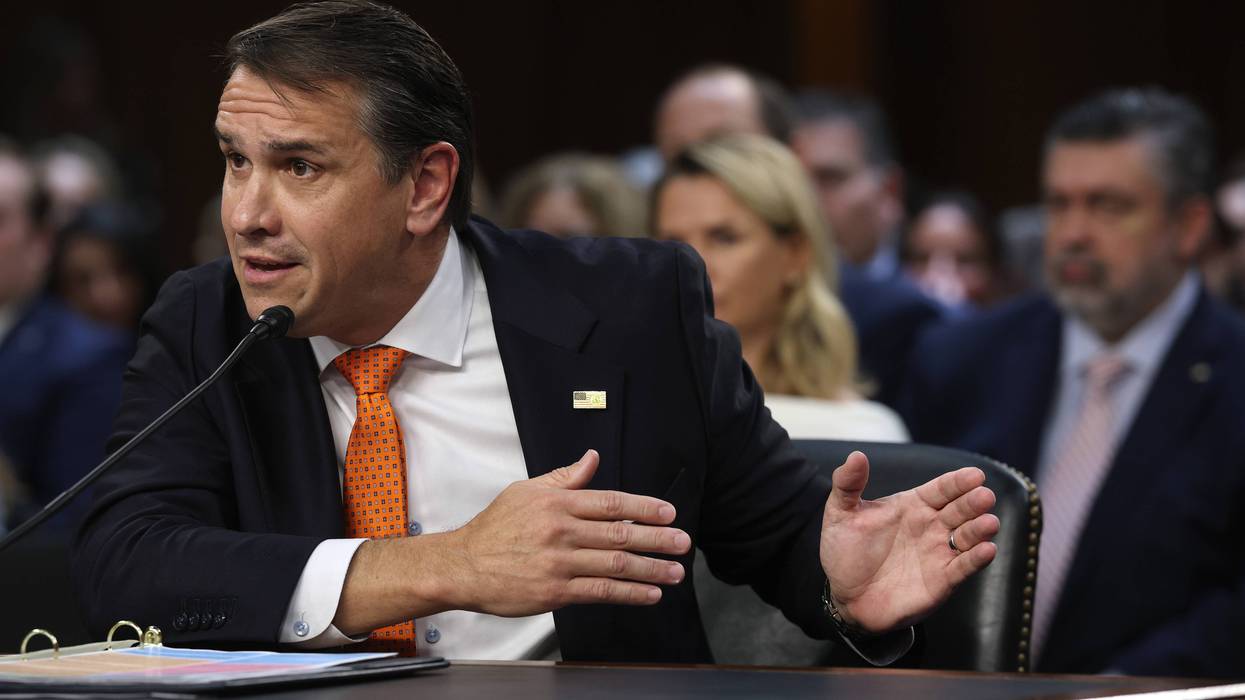
US Attorney General Todd Blanche refused on Sunday to pledge that his Justice Department would "act independently of the White House," underscoring critics' warnings that Blanche is running the nation's top law enforcement agency as if it were President Donald Trump's personal legal office.
"No, I’m not going to pledge that. And no attorney general should ever pledge that," Blanche, who previously worked as Trump's personal lawyer, said during an appearance on NBC's "Meet the Press."
Blanche went on to suggest, absurdly, that prioritizing independence at the DOJ would mean declining to do anything that aligns with the president's stated goals.
"If I were to pledge I will be independent of the White House, what that means is that if President Trump says, 'I want the Department of Justice to go after every violent criminal in this country,' which is what he has said, what you’re saying to me is I should say, 'No, sir, I’m not going to do it,'" said Blanche, who was confirmed as attorney general earlier this month.
WELKER: Can you pledge the DOJ will always act independently of the White House?
BLANCHE: No, I'm not going to pledge that, and no attorney general ever should
WELKER: So if the president asked you do to something that you feel crosses an ethical or legal line, would you do it?… pic.twitter.com/vPrJdnAQ9l
— Aaron Rupar (@atrupar) August 16, 2026
Blanche insisted that Trump "never has" and "never will" ask him to do "something unethical" or unlawful, rejecting what he described as "this narrative... that the president’s going to pull me aside and ask me to do something illegal."
"There is this extraordinarily false narrative that the president wakes up in the morning and calls me and says, 'Todd, go prosecute X or Y.' He does not do that. He has never done that," Blanche said.
When Blanche was deputy attorney general under former AG Pam Bondi, Trump publicly pressured Bondi to pursue cases against former FBI Director James Comey, New York Attorney General Letitia James, and Democratic Sen. Adam Schiff of California. (Trump reportedly believed the Truth Social post he made castigating Bondi was a private message.)
Watchdog organizations and former Justice Department employees opposed Blanche's confirmation as attorney general on the grounds that he would put loyalty to Trump over all else.
“Since his confirmation as deputy attorney general, Todd Blanche has shown time and again that his guiding star is fealty to the president, not the Constitution,” said Stacey Young, the founder of Justice Connection who worked at the DOJ for 18 years.
Sen. Andy Kim (D-NJ) said Sunday that "the only reason Blanche is AG is because he will cross any ethical/legal line to defend Trump."
"He proved it as Trump's personal attorney. He proved it as deputy and acting AG," said Kim. "Now we are going to see even more unprecedented levels of corruption at the American people's expense."
Days after his confirmation—which was delayed as the Justice Department dragged its feet on abandoning a proposed slush fund for Trump allies—Blanche appeared at a political rally with the president and spoke favorably of Bruce Blakeman, the Republican challenging incumbent New York Gov. Kathy Hochul.
Democracy Docket noted that the rally "marked the second time Blanche has participated in a norm-shattering political event. Speaking at the Conservative Political Action Conference last year, Blanche downplayed fears over deploying federal agents to the polls this November."
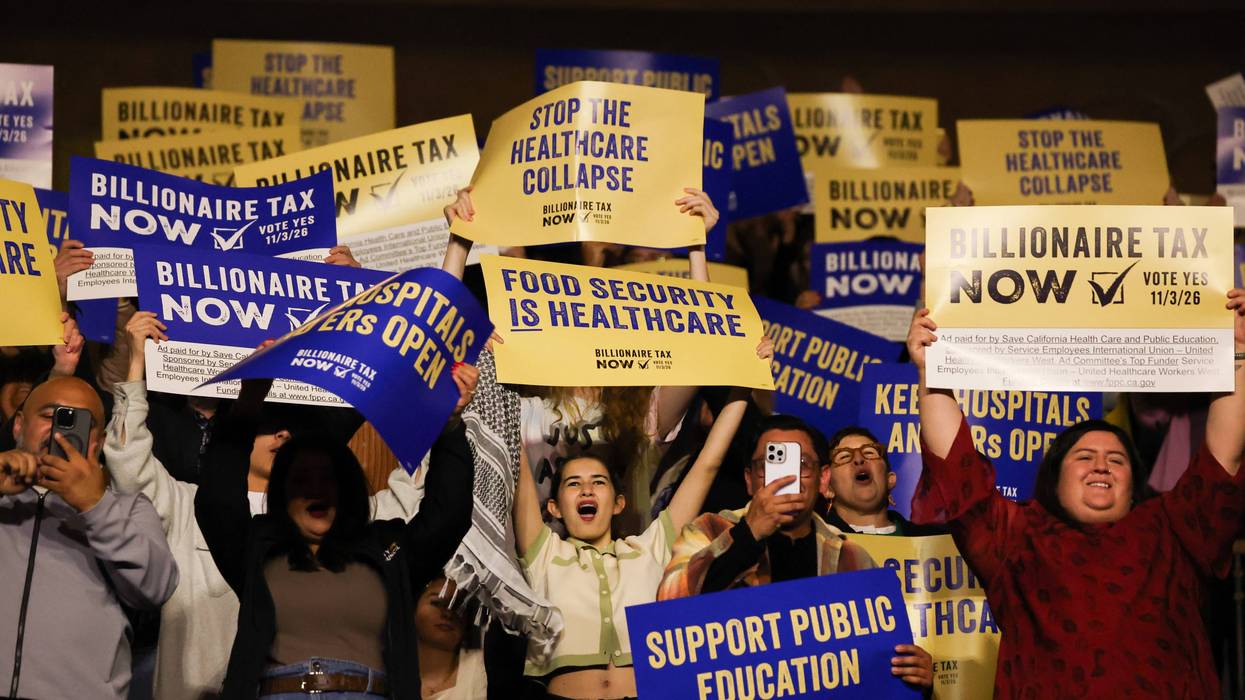
Google co-founder Sergey Brin, one of the richest men in the world, has spent more than $100 million backing a group seeking to stop a popular California ballot initiative that would impose a one-time tax on the wealth of the state's billionaires.
New filings reported by The Los Angeles Times detail Brin's role in funding Building a Better California, which is pushing two ballot measures that would undercut and potentially nullify the proposed billionaire wealth tax. Building a Better California is also spending directly against the proposed tax, pumping at least $5 million into "no" efforts.
If passed, revenue from the 5% billionaire wealth tax would be used to offset federal Medicaid cuts and bolster the state's education system. The proposal will be on California's November ballot as Proposition 40, and the two billionaire-backed initiatives are Propositions 41 and 42.
Debru Carthan, the vice president of Service Employees International Union-United Healthcare Workers West, said in a statement that "California billionaire Sergey Brin would rather spend $100 million to fund a shady opposition campaign than simply pay his fair share in taxes so millions of Californians don’t lose their healthcare."
"That’s shameful," Carthan added. "Billionaires already pay much lower tax rates than what working families pay out of every paycheck."
The Sergey Brin group Building a Better California is officially opposing the California billionaires tax — donating $5 million to the “No” push to defeat it. pic.twitter.com/GsP2h9ZhXR
— Teddy Schleifer (@teddyschleifer) August 16, 2026
Proposition 40 has been endorsed by the California Federation of Labor Unions, the California Nurses Association, and the California Democratic Party, as well as prominent progressive lawmakers such as Sen. Bernie Sanders (I-Vt.) and Rep. Ro Khanna (D-Calif.).
But the measure has drawn opposition from powerful forces in California, including Gov. Gavin Newsom, the California Chamber of Commerce, and the California Teachers Association.
Brin is not the only billionaire financing efforts to defeat the proposed wealth tax in California, which is home to more billionaires than any other US state. Ripple Labs co-founder Chris Larsen, PayPal co-founder Peter Thiel, and venture capitalist Ron Conway have also spent against the ballot initiative.
Economists Emmanuel Saez and Gabriel Zucman have estimated that, between 2019 and 2025, California's billionaires paid on average just 0.26% of their wealth each year in state income taxes.
"For the very richest individuals, the effective burden was even lower. The four wealthiest Californians—Mr. Brin, Mr. Huang, Mr. Page and Mr. Zuckerberg—paid an average of just 0.07% of their wealth annually in California income tax over that period," Saez and Zucman wrote. "This trailblazing wealth tax would be a small (for the ultrawealthy) but important (for everyone else) step toward raising needed tax revenue and curbing the state’s runaway inequality."
"Israel has committed a genocide in Gaza, and we should have the courage to say so," said the California Democrat.
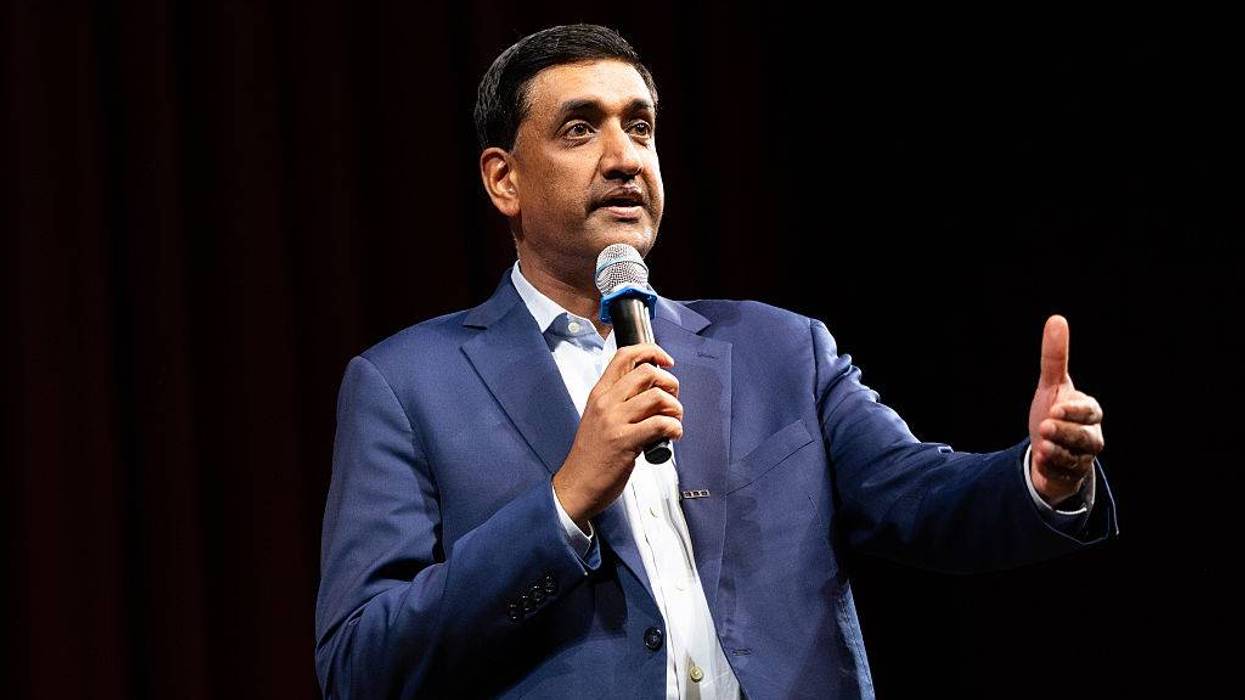
Congressman Ro Khanna said in a speech at the Democratic National Committee's summer meeting on Saturday that the party must support cutting off military assistance to Israel, pointing to the country's ongoing genocidal assault on the Gaza Strip and imposition of an "apartheid system" in the West Bank.
Khanna (D-Calif.), who is considering a presidential run in 2028, told DNC members gathered in Austin, Texas that "Israel has committed a genocide in Gaza, and we should have the courage to say so." The congressman's remark was met with enthusiastic applause.
Khanna, who also said the Hamas-led October 7, 2023 attack on Israel "must be condemned unequivocally," cited his recent trip to the illegally occupied West Bank, where the lawmaker was detained by armed settlers and the Israeli military.
"Zero aid to Israel," Khanna declared Saturday. "No military sales of weapons used to kill civilians. And let me be clear: If our party cannot stand for these principles, it will never convince a generation that watched the horrors of Gaza on their iPhones that we mean what we say about justice."
Khanna's remarks came after the DNC approved by voice vote a package of resolutions that included one calling for full enforcement of the so-called Leahy Laws, which prohibit the transfer of US weaponry to governments credibly accused of human rights violations.
A United Nations commission said last month that "even after the October 2025 ceasefire, children continue to be killed and seriously injured, with continued disregard by Israel for the ceasefire and for the protection owed to Palestinian children under international law."
Recent polling has found that an overwhelming majority of Democratic voters oppose US military aid to Israel, but their representatives in Congress remain divided on the matter. In late July, more than half of the House Democratic caucus—including Minority Leader Hakeem Jeffries (D-NY)—voted against an amendment backed by Khanna that would have cut off $3.3 billion in US assistance to Israel, which has repeatedly used American weapons to commit atrocities against Palestinians.

Lebanese Prime Minister Nawaf Salam issued a statement Saturday condemning Israel's latest deadly bombings in southern Lebanon, attacks that killed nearly a dozen people, including several children.
Salam rejected the Israeli government's insistence that it was targeting a Hezbollah "military compound," saying, "The seven martyrs of the Israeli airstrike on the town of Ansar are not 'military infrastructure,' nor are the children and women killed in it military targets."
"The responsibility for dealing with any military structures, if they exist on Lebanese territory, lies exclusively with the Lebanese state, through the Lebanese army and its legitimate institutions, and their existence does not grant Israel the right to violate Lebanese territory or endanger civilians," said Salam, who warned that the new strikes threaten to derail tenuous steps toward a diplomatic resolution.
"Israel must halt this escalation," Salam said. "For the security of our people and their right to life on their land are not subject to negotiation or bargaining."
Israeli Prime Minister Benjamin Netanyahu and Defense Minister Israel Katz have said their country's military won't end its illegal occupation of and attacks on southern Lebanon until Hezbollah disarms.
"We will cleanse this area and ensure the security of the northern residents [of Israel]," Katz said earlier this week, referring to southern Lebanon.
On Friday, Michel Issa, the US ambassador to Lebanon, echoed the Israeli government's message.
"Tell Hezbollah that as soon as it hands over its weapons, everything will stop," said Issa.
The Associated Press reported on Saturday that Israel struck "a home on the edge of the village of Ansar" and bombed the village of Deir al-Zahrani, killing 11 people total. Three children were killed by the Israeli airstrikes and two were wounded.
Hezbollah called the Israeli strikes "a fully fledged crime" and said that "the responsibility for this persistent aggression and violation of Lebanon's sovereignty lies with the enemy government and the United States, which provides it with support and cover."
"The Americans are partners with the Israeli enemy in its crimes and massacres against Lebanon," the group added.
In late June, the Republican-controlled US House of Representatives voted down a war powers resolution that would have halted American military participation in Israel's assault on Lebanon. More than 20 Democrats joined Republicans in voting against the measure.

"We have never seen financial conflicts or corruption of this magnitude."
The Office of the Comptroller of the Currency, a regulatory agency whose leader was chosen by President Donald Trump, granted preliminary approval on Friday to World Liberty Financial's application for a federal bank charter.
World Liberty Financial is a crypto venture launched in 2024 by the president's two eldest sons, Donald Trump Jr. and Eric Trump, and several partners. The firm's website states that WLF is 38% owned by "an entity affiliated with Donald J. Trump and certain of his family members."
WLF applied for a US bank charter in January, drawing alarm from lawmakers and watchdogs who said the review process would be rife with conflicts of interest. "We have never seen financial conflicts or corruption of this magnitude," Sen. Elizabeth Warren (D-Mass.), the top Democrat on the Senate Banking Committee, said at the time.
The OCC, headed by Jonathan Gould, announced the approval decision in a letter published Friday. WLF's application was assessed by career OCC staff, the agency said.
"The Office of the Comptroller of the Currency (OCC) has reviewed your application to establish a new national trust bank, which will engage in operations of a trust company and activities related thereto, including fiduciary activities, with the title of World Liberty Trust Company, National Association," the letter states. "The OCC hereby grants preliminary conditional approval of your charter application upon determining that your proposal meets certain regulatory and policy requirements."
In response to the news, Warren wrote on social media that "this is the most brazen act of self-dealing our financial system has ever seen."
Reuters reported that the charter, if finalized, would allow World Liberty's "to directly issue its USD1 stablecoin, as well as custody the US dollar assets backing it, both of which are now handled by a business partner, BitGo."
"Hoping to capitalize on the Trump administration’s crypto-friendly stance, the industry has been knocking on the OCC’s door for such charters," Reuters noted. "They allow crypto companies to hold assets on behalf of clients nationwide under a single federal charter, as well as to provide other settlement and asset servicing functions—making it easier to court major institutional clients. Other crypto firms, including Ripple and Circle, have received preliminary approval for such charters under Comptroller Jonathan Gould."
World Liberty Financial welcomed the OCC's preliminary approval as "a milestone in a multi-step chartering process." The firm said in a press release that the newly formed bank's board would be chaired by Zach Witkoff, the son of Trump's special envoy to the Middle East.
Last year, Trump reaped around $527 million in proceeds from token sales by WLF, according to financial disclosures released in late June.
"They are making sure they are rich beyond their wildest dreams long after Trump departs the White House (if he departs the White House)," journalist Mehdi Hasan wrote in response to the OCC decision. "It's so openly and nakedly and obviously corrupt, I'm not sure it can be overstated."
"Trump's right. His economy is a win for Wall Street. Meanwhile, while the rich get richer, millions of Americans cannot afford the basic necessities of life."
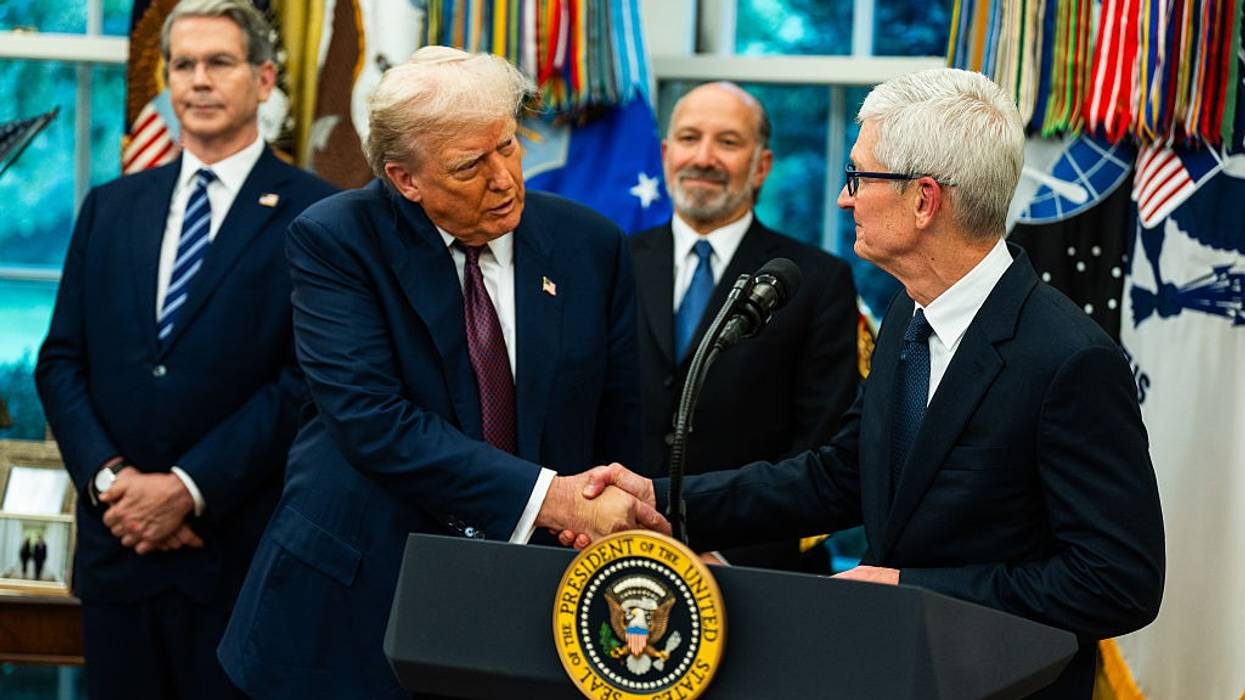
President Donald Trump on Friday said that the US economy is "doing unbelievably from the standpoint of Wall Street," bragging about record equity prices as job and wage growth remain stagnant and millions of Americans struggle to afford groceries.
In remarks to reporters, Trump hailed what he described as "the best market in history" as the S&P 500 index notched its third consecutive week of gains and hovered near its all-time high. The president, a prolific trader who has personally profited from the stock market's performance, said surging equities are "good for 401(k)s"—retirement accounts that a growing share of Americans are tapping to cover emergency expenses amid a worsening cost-of-living crisis.
"Trump's right. His economy is a win for Wall Street," Sen. Bernie Sanders (I-Vt.) said in response to the president. "Meanwhile, while the rich get richer, millions of Americans cannot afford the basic necessities of life—food, housing, healthcare, and a decent retirement."
The Alliance for Retired Americans, an advocacy group with more than 4 million members across the US, expressed astonishment at Trump's rosy and narrow assessment of the economy, which the White House posted on its official YouTube page.
"Can't make it up," the group wrote on social media. "We don't live on Wall Street. How is the economy working for you?"
Trump's comments came the same day that new data showed US consumer sentiment has fallen in August after two consecutive months of improvement, with Americans' outlook on the nation's economic conditions worsening across the political spectrum.
Last week, the Labor Department published figures showing that the US economy shed 23,000 jobs in July, wage growth decelerated, and the unemployment rate fell slightly as more people left the workforce.
Despite Trump's promise to bring them down, prices remain elevated across the economy, driven in part by the president's illegal war against Iran. Research published last month by the Urban Institute found that American families are increasingly relying on savings and credit—including buy now, pay later programs—to meet their grocery needs.
Americans are also facing what The Century Foundation and Protect Borrowers describe as "a worsening utility debt crisis."
"Energy bills have increased three times faster than the rate of inflation while Trump has been president," the groups wrote in an analysis published last month. "The national average monthly utility bill reached $280 in early 2026, a 12% increase since the end of 2024, just before the second Trump administration took office."
Meanwhile, corporate profits are booming under Trump, with the pharmaceutical industry, Big Oil, and other sectors posting banner earnings.
"Second quarter earnings for S&P 500 companies are on pace to rise 50% year over year, the highest growth rate since the second quarter of 2021," Yahoo Finance reported.