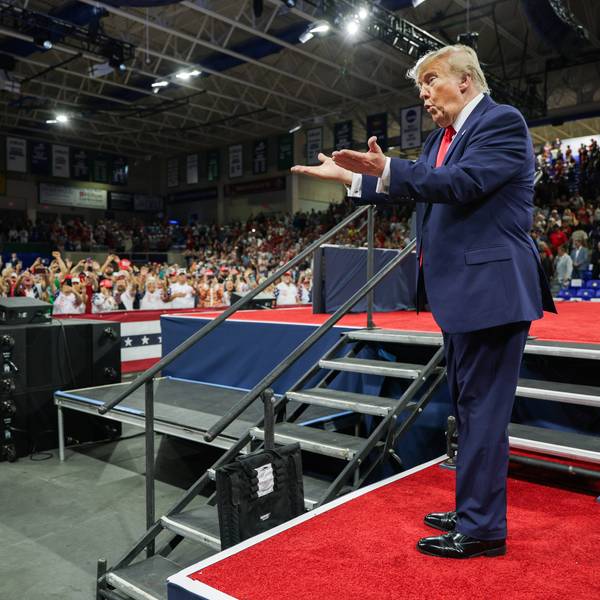

US President Donald Trump prepares to board Air Force One after leaving game 3 of the NBA Finals at Madison Square Garden on June 8, 2026 in New York City.
Fears of Escalation After Trump Says US Must ‘Respond’ to Iran Downing Apache Helicopter
"We... worry deeply that US retaliatory strikes will trigger another destabilizing military exchange that has no winners," said the National Iranian American Committee.
President Donald Trump said the US military would "respond" after Iran reportedly took down an Army Apache helicopter on Tuesday, raising fears of yet more escalation amid collapsing ceasefire talks.
"I have just been informed by our Great Military that last night the Iranians shot down one of our highly sophisticated Apache Helicopters while patrolling over the Strait of Hormuz," the president wrote on Truth Social. "There were two pilots involved, both are safe and uninjured. Nevertheless, the United States must, of necessity, respond to this attack."
The Iranian state-owned outlet PressTV acknowledged that the aircraft had gone down, describing it as coming amid "Iran's decisive retaliation against Washington's incessant violations of a ceasefire with the Islamic Republic," though it did not clarify whether it had been shot down or had gone down for a different reason.
US Central Command said on Tuesday morning that "the cause of the incident is under investigation."
It is the first known instance in which an Apache, one of the most powerful aircraft in the US arsenal, was downed since the US and Israel attacked Iran in late February. Two US officials told CNN that it was brought down by an Iranian drone.
The US has deployed Apache and other aircraft as part of its effort to escort vessels through the Strait of Hormuz, where Iran has blocked most maritime traffic in retaliation for the US launching the war, dramatically spiking global oil and gas prices. The US has also enacted its own naval blockade of Iranian ports.
The downing of the aircraft comes amid Israel's escalating attacks on Lebanon, which Iran has described as a red line for ceasefire negotiations.
After trading fire over the weekend, Israel and Iran agreed to pause their attacks against one another after Trump begged them to "stop shooting." But Iran warned that if Israel continues its devastating attacks on Lebanon, in violation of a recent ceasefire, it would continue firing.
On Tuesday, Israel issued yet another forced evacuation order for all the residents of Tyre, Lebanon's fourth largest city before pummeling it with strikes, killing at least eight people and injuring another 32, according to the Lebanese Health Ministry.
Israel claimed last week that militants from the Iranian-backed militia Hezbollah were hiding out there, but according to Reuters, it did so "without providing evidence."
Doctors Without Borders (MSF), which was forced to suspend its operations in the city and nearby areas due to the attacks, denounced Israel's "forced displacement practices," which have left more than 1 million residents of Lebanon displaced from their homes.
The National Iranian American Council warned of further escalation on Tuesday after the downing of the American helicopter, saying it jeopardized the prospects for peace.
"Military escalation amid the ceasefire became normalized via Israel’s military operations in Lebanon and the US imposition of a blockade," the group said in a statement posted to social media on Tuesday. "Now, the tempo of stresses to the ceasefire is increasing at an alarming rate."
"We are thankful that the helicopter pilots survived last night’s military exchange that unfolded in the Strait of Hormuz, yet worry deeply that US retaliatory strikes will trigger another destabilizing military exchange that has no winners," the group continued. "An eye for an eye makes the whole world blind. We must choose peace or be condemned to more disastrous war."
We are at a crossroads
This country and this world are at a monumental crossroads. In a few short weeks, US voters will have an opportunity to beat back the forces of fascism and confront the billionaires who are rigging the economy, our media system, and our democracy, making it increasingly impossible for ordinary people to get by. We’re not just talking about the election. We’re talking about what must be done once these fascist elements are vanquished from power. We need a bolder set of solutions than what either major party has so far been willing to offer and a working-class movement ready to fight like hell for it. Trump didn't emerge from nowhere. The conditions that fueled MAGA authoritarianism were created by decades of radical neoliberal economic policies and a corrupt political system dominated by corporate interests. They slashed taxes on the super-rich, promising that the benefits would trickle down. They said giveaways to the corporate titans would make life more affordable for the rest of us. It was all bullshit. And when a bitter, betrayed populace searches for someone to blame, right-wing demagogues have little trouble finding scapegoats. People know when they're being lied to, but you won't hear any of this from the corporate media. Only independent journalism—powered and funded by people who believe in building a better world—can deliver truly trustworthy daily news. Our Fall Campaign is underway, and we need your help. To power our newsroom through the rest of the year, we need to raise $125,000 by midnight on October 31. So if you share our vision, please contribute whatever you can to sustain our work. |
President Donald Trump said the US military would "respond" after Iran reportedly took down an Army Apache helicopter on Tuesday, raising fears of yet more escalation amid collapsing ceasefire talks.
"I have just been informed by our Great Military that last night the Iranians shot down one of our highly sophisticated Apache Helicopters while patrolling over the Strait of Hormuz," the president wrote on Truth Social. "There were two pilots involved, both are safe and uninjured. Nevertheless, the United States must, of necessity, respond to this attack."
The Iranian state-owned outlet PressTV acknowledged that the aircraft had gone down, describing it as coming amid "Iran's decisive retaliation against Washington's incessant violations of a ceasefire with the Islamic Republic," though it did not clarify whether it had been shot down or had gone down for a different reason.
US Central Command said on Tuesday morning that "the cause of the incident is under investigation."
It is the first known instance in which an Apache, one of the most powerful aircraft in the US arsenal, was downed since the US and Israel attacked Iran in late February. Two US officials told CNN that it was brought down by an Iranian drone.
The US has deployed Apache and other aircraft as part of its effort to escort vessels through the Strait of Hormuz, where Iran has blocked most maritime traffic in retaliation for the US launching the war, dramatically spiking global oil and gas prices. The US has also enacted its own naval blockade of Iranian ports.
The downing of the aircraft comes amid Israel's escalating attacks on Lebanon, which Iran has described as a red line for ceasefire negotiations.
After trading fire over the weekend, Israel and Iran agreed to pause their attacks against one another after Trump begged them to "stop shooting." But Iran warned that if Israel continues its devastating attacks on Lebanon, in violation of a recent ceasefire, it would continue firing.
On Tuesday, Israel issued yet another forced evacuation order for all the residents of Tyre, Lebanon's fourth largest city before pummeling it with strikes, killing at least eight people and injuring another 32, according to the Lebanese Health Ministry.
Israel claimed last week that militants from the Iranian-backed militia Hezbollah were hiding out there, but according to Reuters, it did so "without providing evidence."
Doctors Without Borders (MSF), which was forced to suspend its operations in the city and nearby areas due to the attacks, denounced Israel's "forced displacement practices," which have left more than 1 million residents of Lebanon displaced from their homes.
The National Iranian American Council warned of further escalation on Tuesday after the downing of the American helicopter, saying it jeopardized the prospects for peace.
"Military escalation amid the ceasefire became normalized via Israel’s military operations in Lebanon and the US imposition of a blockade," the group said in a statement posted to social media on Tuesday. "Now, the tempo of stresses to the ceasefire is increasing at an alarming rate."
"We are thankful that the helicopter pilots survived last night’s military exchange that unfolded in the Strait of Hormuz, yet worry deeply that US retaliatory strikes will trigger another destabilizing military exchange that has no winners," the group continued. "An eye for an eye makes the whole world blind. We must choose peace or be condemned to more disastrous war."
President Donald Trump said the US military would "respond" after Iran reportedly took down an Army Apache helicopter on Tuesday, raising fears of yet more escalation amid collapsing ceasefire talks.
"I have just been informed by our Great Military that last night the Iranians shot down one of our highly sophisticated Apache Helicopters while patrolling over the Strait of Hormuz," the president wrote on Truth Social. "There were two pilots involved, both are safe and uninjured. Nevertheless, the United States must, of necessity, respond to this attack."
The Iranian state-owned outlet PressTV acknowledged that the aircraft had gone down, describing it as coming amid "Iran's decisive retaliation against Washington's incessant violations of a ceasefire with the Islamic Republic," though it did not clarify whether it had been shot down or had gone down for a different reason.
US Central Command said on Tuesday morning that "the cause of the incident is under investigation."
It is the first known instance in which an Apache, one of the most powerful aircraft in the US arsenal, was downed since the US and Israel attacked Iran in late February. Two US officials told CNN that it was brought down by an Iranian drone.
The US has deployed Apache and other aircraft as part of its effort to escort vessels through the Strait of Hormuz, where Iran has blocked most maritime traffic in retaliation for the US launching the war, dramatically spiking global oil and gas prices. The US has also enacted its own naval blockade of Iranian ports.
The downing of the aircraft comes amid Israel's escalating attacks on Lebanon, which Iran has described as a red line for ceasefire negotiations.
After trading fire over the weekend, Israel and Iran agreed to pause their attacks against one another after Trump begged them to "stop shooting." But Iran warned that if Israel continues its devastating attacks on Lebanon, in violation of a recent ceasefire, it would continue firing.
On Tuesday, Israel issued yet another forced evacuation order for all the residents of Tyre, Lebanon's fourth largest city before pummeling it with strikes, killing at least eight people and injuring another 32, according to the Lebanese Health Ministry.
Israel claimed last week that militants from the Iranian-backed militia Hezbollah were hiding out there, but according to Reuters, it did so "without providing evidence."
Doctors Without Borders (MSF), which was forced to suspend its operations in the city and nearby areas due to the attacks, denounced Israel's "forced displacement practices," which have left more than 1 million residents of Lebanon displaced from their homes.
The National Iranian American Council warned of further escalation on Tuesday after the downing of the American helicopter, saying it jeopardized the prospects for peace.
"Military escalation amid the ceasefire became normalized via Israel’s military operations in Lebanon and the US imposition of a blockade," the group said in a statement posted to social media on Tuesday. "Now, the tempo of stresses to the ceasefire is increasing at an alarming rate."
"We are thankful that the helicopter pilots survived last night’s military exchange that unfolded in the Strait of Hormuz, yet worry deeply that US retaliatory strikes will trigger another destabilizing military exchange that has no winners," the group continued. "An eye for an eye makes the whole world blind. We must choose peace or be condemned to more disastrous war."