SUBSCRIBE TO OUR FREE NEWSLETTER
Daily news & progressive opinion—funded by the people, not the corporations—delivered straight to your inbox.
5
#000000
#FFFFFF
To donate by check, phone, or other method, see our More Ways to Give page.
Daily news & progressive opinion—funded by the people, not the corporations—delivered straight to your inbox.
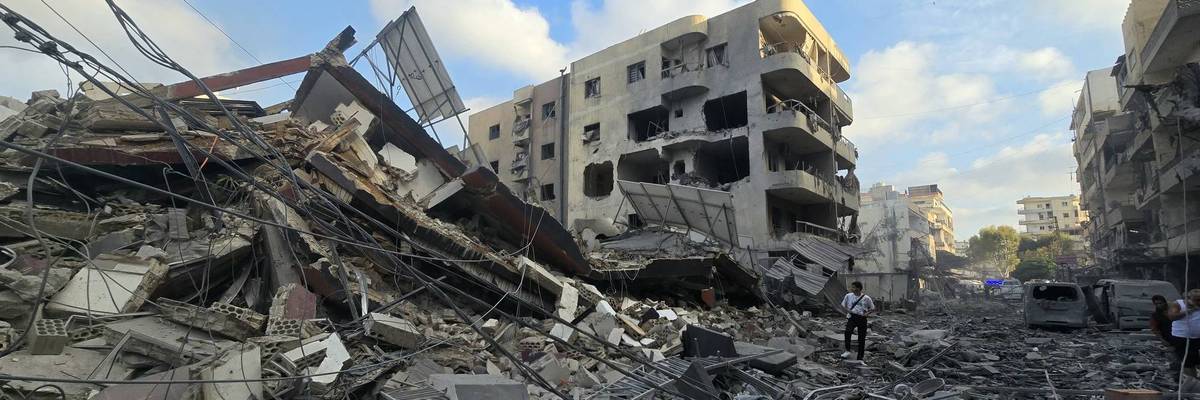
People gather at the site of an Israeli strike that hit near a hospital in the southern Lebanese city of Tyre on June 1, 2026.
"Israel is doing everything it can to derail diplomacy by turning southern Lebanon into another Gaza," said one foreign policy expert.
Shortly after reporting emerged Monday that Iran was suspending talks with the United States over Israel's ramped up assault on Lebanon, President Donald Trump claimed that Israeli forces headed toward Beirut have "turned back" and that Hezbollah has agreed that "all shooting will stop" following separate phone calls with representatives from the two warring sides.
Since Trump and Israeli Prime Minister Benjamin Netanyahu began bombing Iran on February 28, Iranian officials and global experts have repeatedly accused the Israeli government of trying to sabotage any path to peace.
Iran's Tasnim News Agency reported Monday that "given the continuation of the Israeli regime's attacks in Lebanon, and considering that Lebanon had been one of the preconditions for a ceasefire—which has now been violated on all fronts, including Lebanon—the Iranian negotiating team is suspending 'talks and exchanges of texts through mediators.'"
According to Islamic Revolutionary Guard Corps-affiliated news agency, the IRGC said in a statement that Iran considers "the crossing of red lines in Lebanon and Gaza to mean direct war and the imposition of costs on its national security and the Islamic Resistance," and in response, it will "undertake defensive operations through unconventional measures, opening new fronts and maintaining the Strait of Hormuz equation."
Iran has responded to the US-Israeli assault by restricting traffic through the waterway, a key trade route, particularly for fossil fuels and fertilizer. As oil prices around the world have soared, Trump has imposed a naval blockade that he has maintained despite the April ceasefire agreement—which Israel initially claimed did not include Lebanon.
In a brief phone call on Monday, Trump told NBC News that he had not been informed of Iran's reported decision to suspend negotiations over Israel's escalation in Lebanon, but "I think it's fine if they're done talking."
"It's an appropriate thing to say, because they're better negotiators than they are fighters... But they haven't informed us of that," he continued. "It doesn't mean we're going to go and start dropping bombs all over there."
That comment notably came after the Trump administration launched new strikes against Iran over the weekend, and the Iranians attacked US military installations in the Middle East.
"We'll keep the blockade," Trump told NBC. "If they don't want to talk, that's OK with me. I think it's fine. I don't particularly want to talk either. We talk too much."
However, shortly after that, Trump said on his Truth Social platform that he "had a very productive call" with Netanyahu, "and there will be no Troops going to Beirut, and any Troops that are on their way, have already been turned back."
"Likewise, through highly placed Representatives, I had a very good call with Hezbollah, and they agreed that all shooting will stop—That Israel will not attack them, and they will not attack Israel," Trump continued. Less than 15 minutes later, he added that "talks are continuing, at a rapid pace, with the Islamic Republic of Iran."
While Iran's leadership had not publicly confirmed that talks were halted on Monday, Iranian Foreign Minister Abbas Araghchi wrote on social media that "the ceasefire between Iran and the US is unequivocally a ceasefire on all fronts, including in Lebanon. Its violation on one front is a violation of the ceasefire on all fronts. The US and Israel are responsible for the consequences of any violation."
Iran's chief negotiator, Parliament Speaker Mohammad Bagher Ghalibaf, similarly said: "The naval blockade and escalation of war crimes in Lebanon by the genocidal Zionist regime are clear evidence of US noncompliance with the ceasefire. Every choice has a price, and the bill comes due. It will all fall into place."
Responding to Israel "dramatically escalating its military campaign" in southern Lebanon and Tasnim's reporting on negotiations, Sina Toossi, a senior nonresident fellow at the Center for International Policy in Washington, DC, concluded that "the Iranian message is increasingly clear: no Lebanon ceasefire, no broader framework, and potentially no talks at all."
"The talks are in a vicious cycle: progress, escalation, backtracking," he noted. "Many in Iran suspect Trump is trying to bring down the 'floor' for oil prices ahead of more war. And Israel is doing everything it can to derail diplomacy by turning southern Lebanon into another Gaza."
The "Gaza playbook" Israel is now using in Lebanon, Toossi said, features "scorched-earth tactics, mass displacement, and the ethnic cleansing" of its neighboring nation.
Other experts also pointed to Gaza, where Israel is widely accused of pursuing a genocide against Palestinians in the besieged exclave. Calling out Reuters reporting on Israel's escalation in Lebanon, Arab Center Washington DC fellow Assal Rad said that "like 'targeting Hamas' in Gaza, 'Hezbollah-controlled' is used to justify Israel flattening entire neighborhoods in Lebanon. This isn't journalism, it's stenography."
"This is what Israel's total destruction of southern Lebanon looks like, deliberately destroying people’s homes so they have nothing to return to," she added, sharing satellite images of the destruction.
Mohamad Safa, who earlier this year resigned as a representative for the nongovernmental organization Patriotic Vision Association at the United Nations, on Monday accused Israel of "committing another genocide in real time in Lebanon with complete impunity."
Former US Department of Defense adviser Jasmine El-Gamal, who now leads the consulting firm Averos Strategies, said early Monday: "Early in the Iran war, I warned that US and Israeli interests would inevitably diverge and that President Trump would have to make a choice: to actually put America first, or to continue to allow Netanyahu to threaten our interests. Lebanon is the epitome of this choice."
Dear Common Dreams reader, It’s been nearly 30 years since I co-founded Common Dreams with my late wife, Lina Newhouser. We had the radical notion that journalism should serve the public good, not corporate profits. It was clear to us from the outset what it would take to build such a project. No paid advertisements. No corporate sponsors. No millionaire publisher telling us what to think or do. Many people said we wouldn't last a year, but we proved those doubters wrong. Together with a tremendous team of journalists and dedicated staff, we built an independent media outlet free from the constraints of profits and corporate control. Our mission has always been simple: To inform. To inspire. To ignite change for the common good. Building Common Dreams was not easy. Our survival was never guaranteed. When you take on the most powerful forces—Wall Street greed, fossil fuel industry destruction, Big Tech lobbyists, and uber-rich oligarchs who have spent billions upon billions rigging the economy and democracy in their favor—the only bulwark you have is supporters who believe in your work. But here’s the urgent message from me today. It's never been this bad out there. And it's never been this hard to keep us going. At the very moment Common Dreams is most needed, the threats we face are intensifying. We need your support now more than ever. We don't accept corporate advertising and never will. We don't have a paywall because we don't think people should be blocked from critical news based on their ability to pay. Everything we do is funded by the donations of readers like you. When everyone does the little they can afford, we are strong. But if that support retreats or dries up, so do we. Will you donate now to make sure Common Dreams not only survives but thrives? —Craig Brown, Co-founder |
Shortly after reporting emerged Monday that Iran was suspending talks with the United States over Israel's ramped up assault on Lebanon, President Donald Trump claimed that Israeli forces headed toward Beirut have "turned back" and that Hezbollah has agreed that "all shooting will stop" following separate phone calls with representatives from the two warring sides.
Since Trump and Israeli Prime Minister Benjamin Netanyahu began bombing Iran on February 28, Iranian officials and global experts have repeatedly accused the Israeli government of trying to sabotage any path to peace.
Iran's Tasnim News Agency reported Monday that "given the continuation of the Israeli regime's attacks in Lebanon, and considering that Lebanon had been one of the preconditions for a ceasefire—which has now been violated on all fronts, including Lebanon—the Iranian negotiating team is suspending 'talks and exchanges of texts through mediators.'"
According to Islamic Revolutionary Guard Corps-affiliated news agency, the IRGC said in a statement that Iran considers "the crossing of red lines in Lebanon and Gaza to mean direct war and the imposition of costs on its national security and the Islamic Resistance," and in response, it will "undertake defensive operations through unconventional measures, opening new fronts and maintaining the Strait of Hormuz equation."
Iran has responded to the US-Israeli assault by restricting traffic through the waterway, a key trade route, particularly for fossil fuels and fertilizer. As oil prices around the world have soared, Trump has imposed a naval blockade that he has maintained despite the April ceasefire agreement—which Israel initially claimed did not include Lebanon.
In a brief phone call on Monday, Trump told NBC News that he had not been informed of Iran's reported decision to suspend negotiations over Israel's escalation in Lebanon, but "I think it's fine if they're done talking."
"It's an appropriate thing to say, because they're better negotiators than they are fighters... But they haven't informed us of that," he continued. "It doesn't mean we're going to go and start dropping bombs all over there."
That comment notably came after the Trump administration launched new strikes against Iran over the weekend, and the Iranians attacked US military installations in the Middle East.
"We'll keep the blockade," Trump told NBC. "If they don't want to talk, that's OK with me. I think it's fine. I don't particularly want to talk either. We talk too much."
However, shortly after that, Trump said on his Truth Social platform that he "had a very productive call" with Netanyahu, "and there will be no Troops going to Beirut, and any Troops that are on their way, have already been turned back."
"Likewise, through highly placed Representatives, I had a very good call with Hezbollah, and they agreed that all shooting will stop—That Israel will not attack them, and they will not attack Israel," Trump continued. Less than 15 minutes later, he added that "talks are continuing, at a rapid pace, with the Islamic Republic of Iran."
While Iran's leadership had not publicly confirmed that talks were halted on Monday, Iranian Foreign Minister Abbas Araghchi wrote on social media that "the ceasefire between Iran and the US is unequivocally a ceasefire on all fronts, including in Lebanon. Its violation on one front is a violation of the ceasefire on all fronts. The US and Israel are responsible for the consequences of any violation."
Iran's chief negotiator, Parliament Speaker Mohammad Bagher Ghalibaf, similarly said: "The naval blockade and escalation of war crimes in Lebanon by the genocidal Zionist regime are clear evidence of US noncompliance with the ceasefire. Every choice has a price, and the bill comes due. It will all fall into place."
Responding to Israel "dramatically escalating its military campaign" in southern Lebanon and Tasnim's reporting on negotiations, Sina Toossi, a senior nonresident fellow at the Center for International Policy in Washington, DC, concluded that "the Iranian message is increasingly clear: no Lebanon ceasefire, no broader framework, and potentially no talks at all."
"The talks are in a vicious cycle: progress, escalation, backtracking," he noted. "Many in Iran suspect Trump is trying to bring down the 'floor' for oil prices ahead of more war. And Israel is doing everything it can to derail diplomacy by turning southern Lebanon into another Gaza."
The "Gaza playbook" Israel is now using in Lebanon, Toossi said, features "scorched-earth tactics, mass displacement, and the ethnic cleansing" of its neighboring nation.
Other experts also pointed to Gaza, where Israel is widely accused of pursuing a genocide against Palestinians in the besieged exclave. Calling out Reuters reporting on Israel's escalation in Lebanon, Arab Center Washington DC fellow Assal Rad said that "like 'targeting Hamas' in Gaza, 'Hezbollah-controlled' is used to justify Israel flattening entire neighborhoods in Lebanon. This isn't journalism, it's stenography."
"This is what Israel's total destruction of southern Lebanon looks like, deliberately destroying people’s homes so they have nothing to return to," she added, sharing satellite images of the destruction.
Mohamad Safa, who earlier this year resigned as a representative for the nongovernmental organization Patriotic Vision Association at the United Nations, on Monday accused Israel of "committing another genocide in real time in Lebanon with complete impunity."
Former US Department of Defense adviser Jasmine El-Gamal, who now leads the consulting firm Averos Strategies, said early Monday: "Early in the Iran war, I warned that US and Israeli interests would inevitably diverge and that President Trump would have to make a choice: to actually put America first, or to continue to allow Netanyahu to threaten our interests. Lebanon is the epitome of this choice."
Shortly after reporting emerged Monday that Iran was suspending talks with the United States over Israel's ramped up assault on Lebanon, President Donald Trump claimed that Israeli forces headed toward Beirut have "turned back" and that Hezbollah has agreed that "all shooting will stop" following separate phone calls with representatives from the two warring sides.
Since Trump and Israeli Prime Minister Benjamin Netanyahu began bombing Iran on February 28, Iranian officials and global experts have repeatedly accused the Israeli government of trying to sabotage any path to peace.
Iran's Tasnim News Agency reported Monday that "given the continuation of the Israeli regime's attacks in Lebanon, and considering that Lebanon had been one of the preconditions for a ceasefire—which has now been violated on all fronts, including Lebanon—the Iranian negotiating team is suspending 'talks and exchanges of texts through mediators.'"
According to Islamic Revolutionary Guard Corps-affiliated news agency, the IRGC said in a statement that Iran considers "the crossing of red lines in Lebanon and Gaza to mean direct war and the imposition of costs on its national security and the Islamic Resistance," and in response, it will "undertake defensive operations through unconventional measures, opening new fronts and maintaining the Strait of Hormuz equation."
Iran has responded to the US-Israeli assault by restricting traffic through the waterway, a key trade route, particularly for fossil fuels and fertilizer. As oil prices around the world have soared, Trump has imposed a naval blockade that he has maintained despite the April ceasefire agreement—which Israel initially claimed did not include Lebanon.
In a brief phone call on Monday, Trump told NBC News that he had not been informed of Iran's reported decision to suspend negotiations over Israel's escalation in Lebanon, but "I think it's fine if they're done talking."
"It's an appropriate thing to say, because they're better negotiators than they are fighters... But they haven't informed us of that," he continued. "It doesn't mean we're going to go and start dropping bombs all over there."
That comment notably came after the Trump administration launched new strikes against Iran over the weekend, and the Iranians attacked US military installations in the Middle East.
"We'll keep the blockade," Trump told NBC. "If they don't want to talk, that's OK with me. I think it's fine. I don't particularly want to talk either. We talk too much."
However, shortly after that, Trump said on his Truth Social platform that he "had a very productive call" with Netanyahu, "and there will be no Troops going to Beirut, and any Troops that are on their way, have already been turned back."
"Likewise, through highly placed Representatives, I had a very good call with Hezbollah, and they agreed that all shooting will stop—That Israel will not attack them, and they will not attack Israel," Trump continued. Less than 15 minutes later, he added that "talks are continuing, at a rapid pace, with the Islamic Republic of Iran."
While Iran's leadership had not publicly confirmed that talks were halted on Monday, Iranian Foreign Minister Abbas Araghchi wrote on social media that "the ceasefire between Iran and the US is unequivocally a ceasefire on all fronts, including in Lebanon. Its violation on one front is a violation of the ceasefire on all fronts. The US and Israel are responsible for the consequences of any violation."
Iran's chief negotiator, Parliament Speaker Mohammad Bagher Ghalibaf, similarly said: "The naval blockade and escalation of war crimes in Lebanon by the genocidal Zionist regime are clear evidence of US noncompliance with the ceasefire. Every choice has a price, and the bill comes due. It will all fall into place."
Responding to Israel "dramatically escalating its military campaign" in southern Lebanon and Tasnim's reporting on negotiations, Sina Toossi, a senior nonresident fellow at the Center for International Policy in Washington, DC, concluded that "the Iranian message is increasingly clear: no Lebanon ceasefire, no broader framework, and potentially no talks at all."
"The talks are in a vicious cycle: progress, escalation, backtracking," he noted. "Many in Iran suspect Trump is trying to bring down the 'floor' for oil prices ahead of more war. And Israel is doing everything it can to derail diplomacy by turning southern Lebanon into another Gaza."
The "Gaza playbook" Israel is now using in Lebanon, Toossi said, features "scorched-earth tactics, mass displacement, and the ethnic cleansing" of its neighboring nation.
Other experts also pointed to Gaza, where Israel is widely accused of pursuing a genocide against Palestinians in the besieged exclave. Calling out Reuters reporting on Israel's escalation in Lebanon, Arab Center Washington DC fellow Assal Rad said that "like 'targeting Hamas' in Gaza, 'Hezbollah-controlled' is used to justify Israel flattening entire neighborhoods in Lebanon. This isn't journalism, it's stenography."
"This is what Israel's total destruction of southern Lebanon looks like, deliberately destroying people’s homes so they have nothing to return to," she added, sharing satellite images of the destruction.
Mohamad Safa, who earlier this year resigned as a representative for the nongovernmental organization Patriotic Vision Association at the United Nations, on Monday accused Israel of "committing another genocide in real time in Lebanon with complete impunity."
Former US Department of Defense adviser Jasmine El-Gamal, who now leads the consulting firm Averos Strategies, said early Monday: "Early in the Iran war, I warned that US and Israeli interests would inevitably diverge and that President Trump would have to make a choice: to actually put America first, or to continue to allow Netanyahu to threaten our interests. Lebanon is the epitome of this choice."