5
#000000
#FFFFFF
To donate by check, phone, or other method, see our More Ways to Give page.
Daily news & progressive opinion—funded by the people, not the corporations—delivered straight to your inbox.
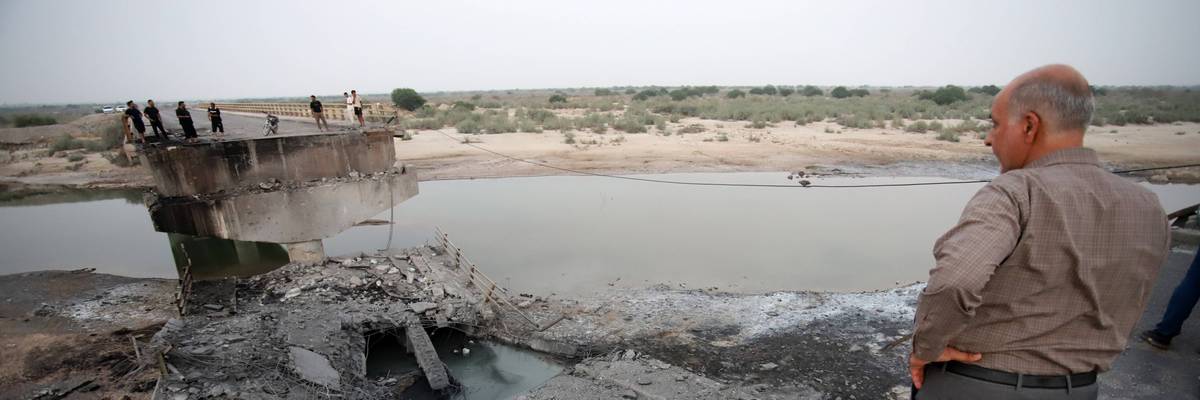
A bridge destroyed by a US attack is seen in Iran's Hormozgan province on July 19, 2026.
"We may be approaching the most significant escalation in the US-Iran confrontation since February," warned one analyst.
US President Donald Trump is reportedly planning to expand his illegal, historically unpopular war in Iran as the prospects of a diplomatic resolution crumble, with the American military bombarding the Middle East nation for the ninth consecutive night on Sunday.
An unnamed US official told The Washington Post on Sunday that the Trump administration is "planning for a wider war" in Iran, though the official warned that US forces likely lack the weapons capacity to "safely sustain operations." The official said they don't believe that "the White House is aware of that."
The anonymous official's comments corroborated reporting last week indicating that Trump, who has not sought or received congressional authorization for the Iran war, is leaning toward expanding the assault, possibly with ground forces.
"Trump hosted a Situation Room meeting Tuesday evening to discuss the potential seizure of Kharg Island and other territory along the Strait of Hormuz using US troops, as well as the potential bombing of a tunnel complex at Pickaxe Mountain, a nuclear-linked site the US has yet to target," The Wall Street Journal reported. "Expanding airstrikes against more targets in Iran, including energy sites, also remains a possibility."
Trump, who claimed in late March that the war was just "two or three weeks" away from being over, has repeatedly declined to rule out deploying American ground forces to Iran. Over the weekend, three US troops were killed in the region—two by an Iranian ballistic missile attack in Jordan, and another during a "controlled detonation of unexploded ordnance" in Iraq.
"We feel very badly," Trump said of the deaths, which brought the total number of US personnel killed during the Iran war to 17. Thousands of Iranians have been killed and millions displaced by the US-led assault.
Pentagon leaders have not publicly briefed the American people or the press on the status of the war in over two months. Earlier this month, Trump declared that a ceasefire deal with Iran which sought to pave the way for a negotiated resolution to the war was "over."
The US Central Command said late Sunday that American forces "targeted Iranian military command centers, air defense and coastal surveillance sites, maritime capabilities, missile and drone launch sites, and communications networks" during its latest wave of airstrikes. The US military has also targeted bridges, power facilities, and other civilian infrastructure during recent attacks, prompting Iranian retaliatory strikes on American installations in the region.
"This dynamic creates the possibility of dangerous strategic miscalculation on all sides," the National Iranian American Council warned on Sunday. "Policymakers in Washington and regional capitals may underestimate Iran’s willingness to absorb sustained losses. Conversely, Iranian leaders may underestimate the willingness of the United States and its partners to sustain a prolonged military campaign if they conclude that Tehran is deliberately regionalizing the conflict."
Hamidreza Azizi, a visiting fellow at the German Institute for International and Security Affairs, argued that recent US attacks along Iran's southern coastline "increasingly suggest a gradual but persistent US movement toward a possible ground operation in southern Iran."
"If such an approach exists, it would go well beyond earlier ideas centered on seizing Kharg Island to cut off Iran’s oil exports or occupying islands overlooking the Strait [of Hormuz] to secure maritime traffic," Azizi wrote. "However, given the length of Iran’s southern coastline—roughly 1,800 kilometers—and the country’s considerable strategic depth, establishing comprehensive control would likely require hundreds of thousands of troops."
"Current indicators suggest that we may be approaching the most significant escalation in the US-Iran confrontation since February," Azizi added.
Dear Common Dreams reader, It’s been nearly 30 years since I co-founded Common Dreams with my late wife, Lina Newhouser. We had the radical notion that journalism should serve the public good, not corporate profits. It was clear to us from the outset what it would take to build such a project. No paid advertisements. No corporate sponsors. No millionaire publisher telling us what to think or do. Many people said we wouldn't last a year, but we proved those doubters wrong. Together with a tremendous team of journalists and dedicated staff, we built an independent media outlet free from the constraints of profits and corporate control. Our mission has always been simple: To inform. To inspire. To ignite change for the common good. Building Common Dreams was not easy. Our survival was never guaranteed. When you take on the most powerful forces—Wall Street greed, fossil fuel industry destruction, Big Tech lobbyists, and uber-rich oligarchs who have spent billions upon billions rigging the economy and democracy in their favor—the only bulwark you have is supporters who believe in your work. But here’s the urgent message from me today. It's never been this bad out there. And it's never been this hard to keep us going. At the very moment Common Dreams is most needed, the threats we face are intensifying. We need your support now more than ever. We don't accept corporate advertising and never will. We don't have a paywall because we don't think people should be blocked from critical news based on their ability to pay. Everything we do is funded by the donations of readers like you. When everyone does the little they can afford, we are strong. But if that support retreats or dries up, so do we. Will you donate now to make sure Common Dreams not only survives but thrives? —Craig Brown, Co-founder |
US President Donald Trump is reportedly planning to expand his illegal, historically unpopular war in Iran as the prospects of a diplomatic resolution crumble, with the American military bombarding the Middle East nation for the ninth consecutive night on Sunday.
An unnamed US official told The Washington Post on Sunday that the Trump administration is "planning for a wider war" in Iran, though the official warned that US forces likely lack the weapons capacity to "safely sustain operations." The official said they don't believe that "the White House is aware of that."
The anonymous official's comments corroborated reporting last week indicating that Trump, who has not sought or received congressional authorization for the Iran war, is leaning toward expanding the assault, possibly with ground forces.
"Trump hosted a Situation Room meeting Tuesday evening to discuss the potential seizure of Kharg Island and other territory along the Strait of Hormuz using US troops, as well as the potential bombing of a tunnel complex at Pickaxe Mountain, a nuclear-linked site the US has yet to target," The Wall Street Journal reported. "Expanding airstrikes against more targets in Iran, including energy sites, also remains a possibility."
Trump, who claimed in late March that the war was just "two or three weeks" away from being over, has repeatedly declined to rule out deploying American ground forces to Iran. Over the weekend, three US troops were killed in the region—two by an Iranian ballistic missile attack in Jordan, and another during a "controlled detonation of unexploded ordnance" in Iraq.
"We feel very badly," Trump said of the deaths, which brought the total number of US personnel killed during the Iran war to 17. Thousands of Iranians have been killed and millions displaced by the US-led assault.
Pentagon leaders have not publicly briefed the American people or the press on the status of the war in over two months. Earlier this month, Trump declared that a ceasefire deal with Iran which sought to pave the way for a negotiated resolution to the war was "over."
The US Central Command said late Sunday that American forces "targeted Iranian military command centers, air defense and coastal surveillance sites, maritime capabilities, missile and drone launch sites, and communications networks" during its latest wave of airstrikes. The US military has also targeted bridges, power facilities, and other civilian infrastructure during recent attacks, prompting Iranian retaliatory strikes on American installations in the region.
"This dynamic creates the possibility of dangerous strategic miscalculation on all sides," the National Iranian American Council warned on Sunday. "Policymakers in Washington and regional capitals may underestimate Iran’s willingness to absorb sustained losses. Conversely, Iranian leaders may underestimate the willingness of the United States and its partners to sustain a prolonged military campaign if they conclude that Tehran is deliberately regionalizing the conflict."
Hamidreza Azizi, a visiting fellow at the German Institute for International and Security Affairs, argued that recent US attacks along Iran's southern coastline "increasingly suggest a gradual but persistent US movement toward a possible ground operation in southern Iran."
"If such an approach exists, it would go well beyond earlier ideas centered on seizing Kharg Island to cut off Iran’s oil exports or occupying islands overlooking the Strait [of Hormuz] to secure maritime traffic," Azizi wrote. "However, given the length of Iran’s southern coastline—roughly 1,800 kilometers—and the country’s considerable strategic depth, establishing comprehensive control would likely require hundreds of thousands of troops."
"Current indicators suggest that we may be approaching the most significant escalation in the US-Iran confrontation since February," Azizi added.
US President Donald Trump is reportedly planning to expand his illegal, historically unpopular war in Iran as the prospects of a diplomatic resolution crumble, with the American military bombarding the Middle East nation for the ninth consecutive night on Sunday.
An unnamed US official told The Washington Post on Sunday that the Trump administration is "planning for a wider war" in Iran, though the official warned that US forces likely lack the weapons capacity to "safely sustain operations." The official said they don't believe that "the White House is aware of that."
The anonymous official's comments corroborated reporting last week indicating that Trump, who has not sought or received congressional authorization for the Iran war, is leaning toward expanding the assault, possibly with ground forces.
"Trump hosted a Situation Room meeting Tuesday evening to discuss the potential seizure of Kharg Island and other territory along the Strait of Hormuz using US troops, as well as the potential bombing of a tunnel complex at Pickaxe Mountain, a nuclear-linked site the US has yet to target," The Wall Street Journal reported. "Expanding airstrikes against more targets in Iran, including energy sites, also remains a possibility."
Trump, who claimed in late March that the war was just "two or three weeks" away from being over, has repeatedly declined to rule out deploying American ground forces to Iran. Over the weekend, three US troops were killed in the region—two by an Iranian ballistic missile attack in Jordan, and another during a "controlled detonation of unexploded ordnance" in Iraq.
"We feel very badly," Trump said of the deaths, which brought the total number of US personnel killed during the Iran war to 17. Thousands of Iranians have been killed and millions displaced by the US-led assault.
Pentagon leaders have not publicly briefed the American people or the press on the status of the war in over two months. Earlier this month, Trump declared that a ceasefire deal with Iran which sought to pave the way for a negotiated resolution to the war was "over."
The US Central Command said late Sunday that American forces "targeted Iranian military command centers, air defense and coastal surveillance sites, maritime capabilities, missile and drone launch sites, and communications networks" during its latest wave of airstrikes. The US military has also targeted bridges, power facilities, and other civilian infrastructure during recent attacks, prompting Iranian retaliatory strikes on American installations in the region.
"This dynamic creates the possibility of dangerous strategic miscalculation on all sides," the National Iranian American Council warned on Sunday. "Policymakers in Washington and regional capitals may underestimate Iran’s willingness to absorb sustained losses. Conversely, Iranian leaders may underestimate the willingness of the United States and its partners to sustain a prolonged military campaign if they conclude that Tehran is deliberately regionalizing the conflict."
Hamidreza Azizi, a visiting fellow at the German Institute for International and Security Affairs, argued that recent US attacks along Iran's southern coastline "increasingly suggest a gradual but persistent US movement toward a possible ground operation in southern Iran."
"If such an approach exists, it would go well beyond earlier ideas centered on seizing Kharg Island to cut off Iran’s oil exports or occupying islands overlooking the Strait [of Hormuz] to secure maritime traffic," Azizi wrote. "However, given the length of Iran’s southern coastline—roughly 1,800 kilometers—and the country’s considerable strategic depth, establishing comprehensive control would likely require hundreds of thousands of troops."
"Current indicators suggest that we may be approaching the most significant escalation in the US-Iran confrontation since February," Azizi added.