SUBSCRIBE TO OUR FREE NEWSLETTER
Daily news & progressive opinion—funded by the people, not the corporations—delivered straight to your inbox.
5
#000000
#FFFFFF
To donate by check, phone, or other method, see our More Ways to Give page.
Daily news & progressive opinion—funded by the people, not the corporations—delivered straight to your inbox.
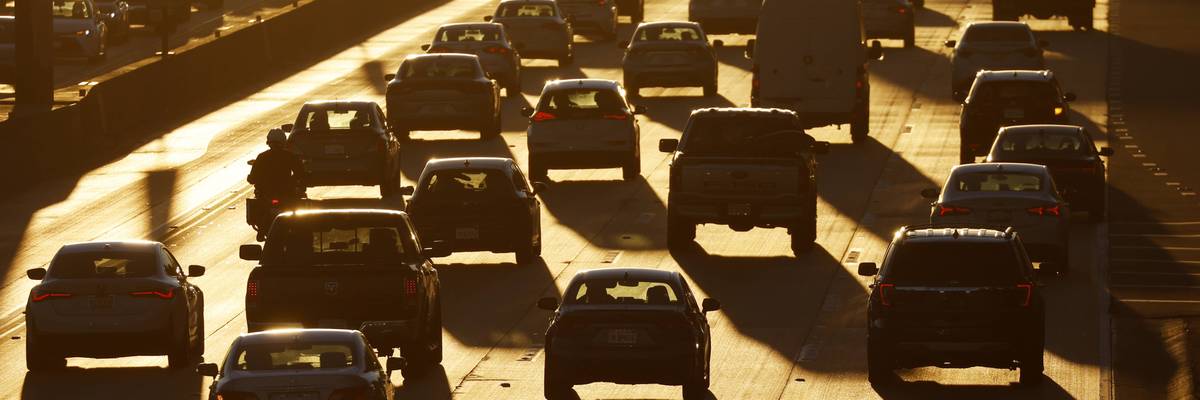
Traffic backs up on Interstate 405 during the morning commute at sunrise on January 15, 2026, in Los Angeles, California.
One environmental advocate said the Trump administration's rollback of fuel efficiency standards "will mean wasted gas, more air pollution, and higher costs for Americans who are already struggling with high fuel prices."
A coalition of environmental groups filed a lawsuit Friday seeking to block the Trump administration's rollback of fuel efficiency standards, which they called a "giveaway" to the oil and auto industries.
Earlier this week, the US Department of Transportation finalized a rule weakening Corporate Average Fuel Economy (CAFE) standards, which require automakers to increase the fuel efficiency of their vehicles each year.
The Biden administration required annual fuel-efficiency improvements aimed at bringing the average for new vehicles to 50.4 miles per gallon by 2031. Under the Trump administration’s new rule, the 2031 requirement would fall below the 35.4 mpg already achieved by the 2024 fleet, according to the National Highway Traffic Safety Administration's (NHTSA) own analysis.
NHTSA estimated that as a result of the rule change, Americans will consume roughly 122 billion more gallons of gas by 2050 than they would have under the old standards, increasing average lifetime fuel costs by more than $1,600 per vehicle—more than the roughly $1,300 the administration has claimed they'll save on average in upfront vehicle costs.
It is also projected to add about 1 billion additional metric tons of CO2 emissions by 2050 compared with retaining the previous standards—equivalent to more than six months' worth of emissions from the entire US transportation sector.
“Oil companies will profit from less efficient cars, but drivers will take a hit to their wallets and our kids will breathe dirtier air," said David Pettit, an attorney at the Center for Biological Diversity’s (CBD) Climate Law Institute. "We’ll all pay the price for more tailpipe pollutants spewing everywhere from playgrounds to wild places. We’re asking the courts to put a stop to this callous giveaway to Big Oil and Big Auto.”
CBD was joined by the Conservation Law Foundation, Environmental Defense Fund, Public Citizen, and Sierra Club, which filed a petition on Friday to ask an appeals court to review the rule change. They argue that the rollback is illegal because federal law requires NHTSA to set fuel-economy standards at the “maximum feasible” level manufacturers can achieve.
“The Trump administration’s rollback will mean wasted gas, more air pollution, and higher costs for Americans who are already struggling with high fuel prices,” said Andy Su, senior transportation attorney at Environmental Defense Fund. “We’re going to court to oppose this dangerous U-turn away from decades of successful work to make our cars more efficient and less expensive to drive.”
Dear Common Dreams reader, It’s been nearly 30 years since I co-founded Common Dreams with my late wife, Lina Newhouser. We had the radical notion that journalism should serve the public good, not corporate profits. It was clear to us from the outset what it would take to build such a project. No paid advertisements. No corporate sponsors. No millionaire publisher telling us what to think or do. Many people said we wouldn't last a year, but we proved those doubters wrong. Together with a tremendous team of journalists and dedicated staff, we built an independent media outlet free from the constraints of profits and corporate control. Our mission has always been simple: To inform. To inspire. To ignite change for the common good. Building Common Dreams was not easy. Our survival was never guaranteed. When you take on the most powerful forces—Wall Street greed, fossil fuel industry destruction, Big Tech lobbyists, and uber-rich oligarchs who have spent billions upon billions rigging the economy and democracy in their favor—the only bulwark you have is supporters who believe in your work. But here’s the urgent message from me today. It's never been this bad out there. And it's never been this hard to keep us going. At the very moment Common Dreams is most needed, the threats we face are intensifying. We need your support now more than ever. We don't accept corporate advertising and never will. We don't have a paywall because we don't think people should be blocked from critical news based on their ability to pay. Everything we do is funded by the donations of readers like you. When everyone does the little they can afford, we are strong. But if that support retreats or dries up, so do we. Will you donate now to make sure Common Dreams not only survives but thrives? —Craig Brown, Co-founder |
A coalition of environmental groups filed a lawsuit Friday seeking to block the Trump administration's rollback of fuel efficiency standards, which they called a "giveaway" to the oil and auto industries.
Earlier this week, the US Department of Transportation finalized a rule weakening Corporate Average Fuel Economy (CAFE) standards, which require automakers to increase the fuel efficiency of their vehicles each year.
The Biden administration required annual fuel-efficiency improvements aimed at bringing the average for new vehicles to 50.4 miles per gallon by 2031. Under the Trump administration’s new rule, the 2031 requirement would fall below the 35.4 mpg already achieved by the 2024 fleet, according to the National Highway Traffic Safety Administration's (NHTSA) own analysis.
NHTSA estimated that as a result of the rule change, Americans will consume roughly 122 billion more gallons of gas by 2050 than they would have under the old standards, increasing average lifetime fuel costs by more than $1,600 per vehicle—more than the roughly $1,300 the administration has claimed they'll save on average in upfront vehicle costs.
It is also projected to add about 1 billion additional metric tons of CO2 emissions by 2050 compared with retaining the previous standards—equivalent to more than six months' worth of emissions from the entire US transportation sector.
“Oil companies will profit from less efficient cars, but drivers will take a hit to their wallets and our kids will breathe dirtier air," said David Pettit, an attorney at the Center for Biological Diversity’s (CBD) Climate Law Institute. "We’ll all pay the price for more tailpipe pollutants spewing everywhere from playgrounds to wild places. We’re asking the courts to put a stop to this callous giveaway to Big Oil and Big Auto.”
CBD was joined by the Conservation Law Foundation, Environmental Defense Fund, Public Citizen, and Sierra Club, which filed a petition on Friday to ask an appeals court to review the rule change. They argue that the rollback is illegal because federal law requires NHTSA to set fuel-economy standards at the “maximum feasible” level manufacturers can achieve.
“The Trump administration’s rollback will mean wasted gas, more air pollution, and higher costs for Americans who are already struggling with high fuel prices,” said Andy Su, senior transportation attorney at Environmental Defense Fund. “We’re going to court to oppose this dangerous U-turn away from decades of successful work to make our cars more efficient and less expensive to drive.”
A coalition of environmental groups filed a lawsuit Friday seeking to block the Trump administration's rollback of fuel efficiency standards, which they called a "giveaway" to the oil and auto industries.
Earlier this week, the US Department of Transportation finalized a rule weakening Corporate Average Fuel Economy (CAFE) standards, which require automakers to increase the fuel efficiency of their vehicles each year.
The Biden administration required annual fuel-efficiency improvements aimed at bringing the average for new vehicles to 50.4 miles per gallon by 2031. Under the Trump administration’s new rule, the 2031 requirement would fall below the 35.4 mpg already achieved by the 2024 fleet, according to the National Highway Traffic Safety Administration's (NHTSA) own analysis.
NHTSA estimated that as a result of the rule change, Americans will consume roughly 122 billion more gallons of gas by 2050 than they would have under the old standards, increasing average lifetime fuel costs by more than $1,600 per vehicle—more than the roughly $1,300 the administration has claimed they'll save on average in upfront vehicle costs.
It is also projected to add about 1 billion additional metric tons of CO2 emissions by 2050 compared with retaining the previous standards—equivalent to more than six months' worth of emissions from the entire US transportation sector.
“Oil companies will profit from less efficient cars, but drivers will take a hit to their wallets and our kids will breathe dirtier air," said David Pettit, an attorney at the Center for Biological Diversity’s (CBD) Climate Law Institute. "We’ll all pay the price for more tailpipe pollutants spewing everywhere from playgrounds to wild places. We’re asking the courts to put a stop to this callous giveaway to Big Oil and Big Auto.”
CBD was joined by the Conservation Law Foundation, Environmental Defense Fund, Public Citizen, and Sierra Club, which filed a petition on Friday to ask an appeals court to review the rule change. They argue that the rollback is illegal because federal law requires NHTSA to set fuel-economy standards at the “maximum feasible” level manufacturers can achieve.
“The Trump administration’s rollback will mean wasted gas, more air pollution, and higher costs for Americans who are already struggling with high fuel prices,” said Andy Su, senior transportation attorney at Environmental Defense Fund. “We’re going to court to oppose this dangerous U-turn away from decades of successful work to make our cars more efficient and less expensive to drive.”