

SUBSCRIBE TO OUR FREE NEWSLETTER
Daily news & progressive opinion—funded by the people, not the corporations—delivered straight to your inbox.
5
#000000
#FFFFFF
To donate by check, phone, or other method, see our More Ways to Give page.
Daily news & progressive opinion—funded by the people, not the corporations—delivered straight to your inbox.
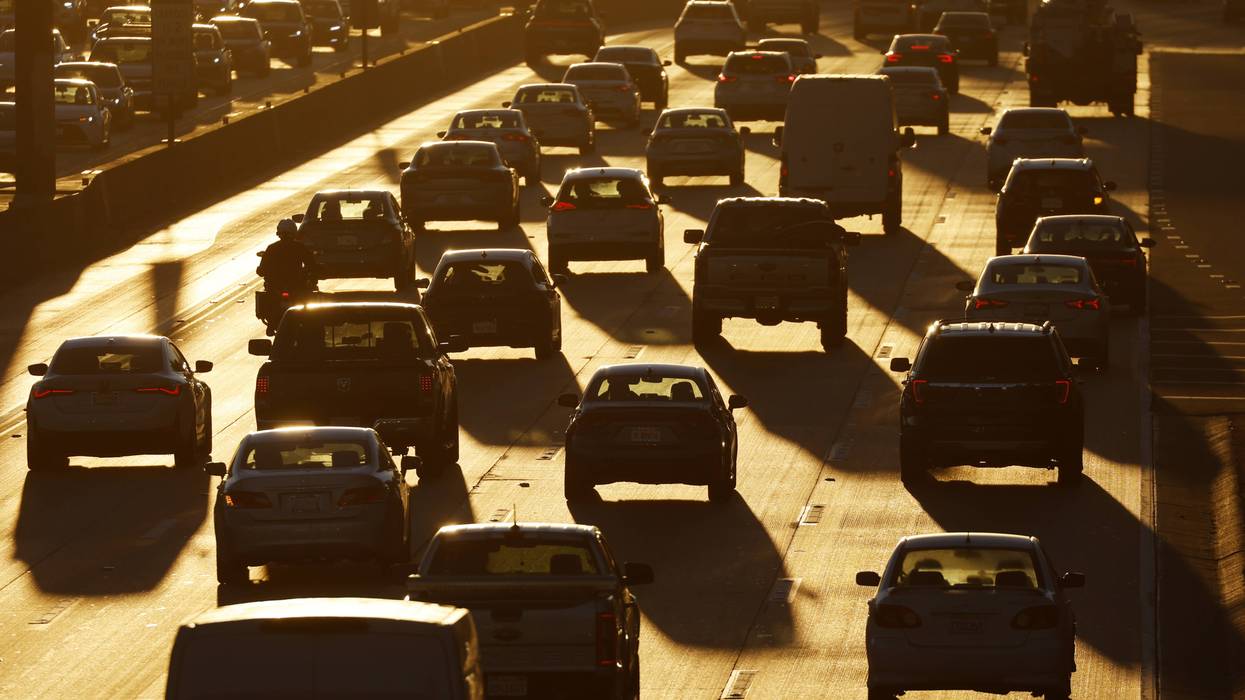
One environmental advocate said the Trump administration's rollback of fuel efficiency standards "will mean wasted gas, more air pollution, and higher costs for Americans who are already struggling with high fuel prices."
A coalition of environmental groups filed a lawsuit Friday seeking to block the Trump administration's rollback of fuel efficiency standards, which they called a "giveaway" to the oil and auto industries.
Earlier this week, the US Department of Transportation finalized a rule weakening Corporate Average Fuel Economy (CAFE) standards, which require automakers to increase the fuel efficiency of their vehicles each year.
The Biden administration required annual fuel-efficiency improvements aimed at bringing the average for new vehicles to 50.4 miles per gallon by 2031. Under the Trump administration’s new rule, the 2031 requirement would fall below the 35.4 mpg already achieved by the 2024 fleet, according to the National Highway Traffic Safety Administration's (NHTSA) own analysis.
NHTSA estimated that as a result of the rule change, Americans will consume roughly 122 billion more gallons of gas by 2050 than they would have under the old standards, increasing average lifetime fuel costs by more than $1,600 per vehicle—more than the roughly $1,300 the administration has claimed they'll save on average in upfront vehicle costs.
It is also projected to add about 1 billion additional metric tons of CO2 emissions by 2050 compared with retaining the previous standards—equivalent to more than six months' worth of emissions from the entire US transportation sector.
“Oil companies will profit from less efficient cars, but drivers will take a hit to their wallets and our kids will breathe dirtier air," said David Pettit, an attorney at the Center for Biological Diversity’s (CBD) Climate Law Institute. "We’ll all pay the price for more tailpipe pollutants spewing everywhere from playgrounds to wild places. We’re asking the courts to put a stop to this callous giveaway to Big Oil and Big Auto.”
CBD was joined by the Conservation Law Foundation, Environmental Defense Fund, Public Citizen, and Sierra Club, which filed a petition on Friday to ask an appeals court to review the rule change. They argue that the rollback is illegal because federal law requires NHTSA to set fuel-economy standards at the “maximum feasible” level manufacturers can achieve.
“The Trump administration’s rollback will mean wasted gas, more air pollution, and higher costs for Americans who are already struggling with high fuel prices,” said Andy Su, senior transportation attorney at Environmental Defense Fund. “We’re going to court to oppose this dangerous U-turn away from decades of successful work to make our cars more efficient and less expensive to drive.”
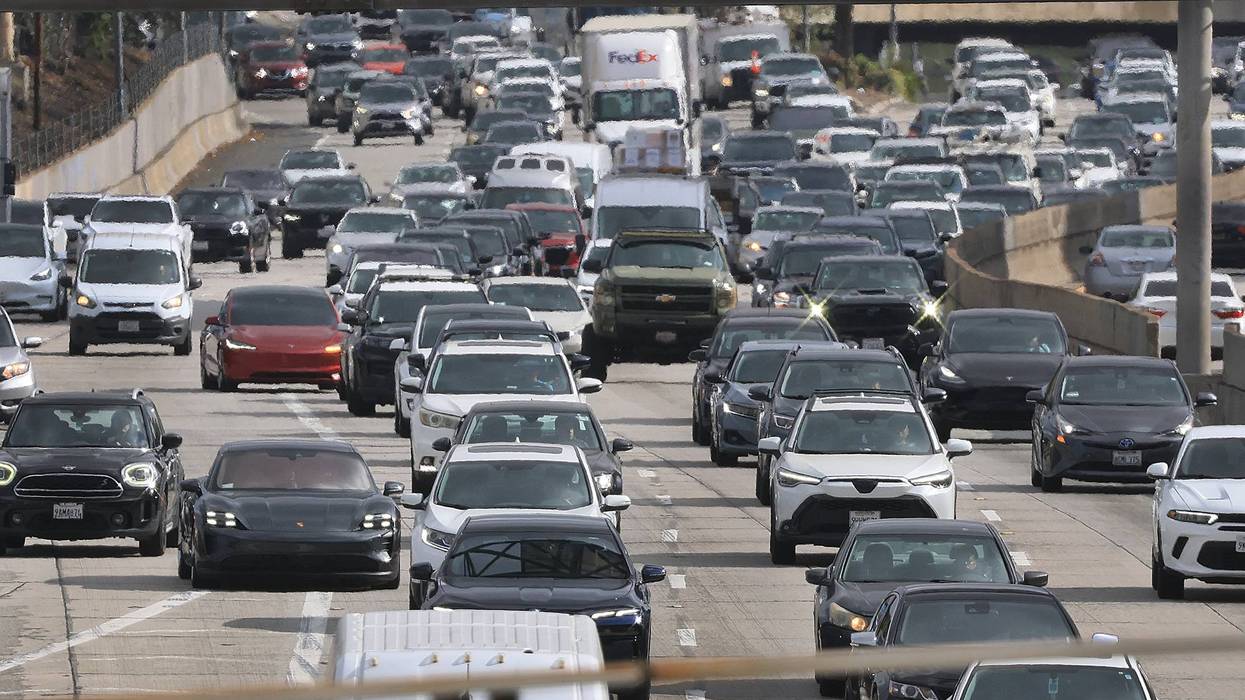
"Oil companies will get a windfall from gutting the fuel economy standards, but the rest of us are going to be handing over more of our hard-earned paychecks to fill up the tank," said one environmental lawyer.
Scientists and environmental advocates are warning that the Trump administration's rollback of fuel economy standards for cars and trucks will not only lead to more pollution but also hurt cash-strapped consumers already reeling from gas price spikes.
The administration announced on Monday that it was weakening the Corporate Average Fuel Economy (CAFE) standards, which require automakers to increase the fuel efficiency of their vehicles each year.
Biden administration rules required a 2% annual increase in fuel-efficiency standards, with the goal of bringing most vehicles to an average of 50.4 miles per gallon by 2031. Under President Donald Trump, the annual target has been reduced to just a 1% improvement each year, meaning five years from now the average car would be required to get just under 34.9 mpg.
The Department of Transportation, which finalized the rule, has argued that efficiency standards put an unnecessary burden on carmakers and has projected that lowering them will “reduce the average cost of a new vehicle by $1,300 for American families" and "save the American people $138 billion over the next five years."
Transportation Secretary Sean Duffy described the Biden-era increase as one that "forced automakers to produce more expensive electric vehicles that American families didn’t want."
But Dave Cooke, senior vehicles analyst for the Union of Concerned Scientists’ (UCS) Clean Transportation Program, argues that rather than being a benefit to consumers, “the federal government’s decision to gut fuel economy standards is a handout to automakers and oil companies that will strap American consumers already struggling with an affordability crisis.”
His group has estimated that since CAFE standards were first introduced in 2010, they have saved auto owners about $321 billion at the gas pump. And over just the past seven months, during which Trump's war with Iran has caused gas prices to soar around the country, UCS estimates that consumers have saved $32 billion.
"Any small reduction in upfront vehicle costs will be outweighed by higher fuel expenses," Cooke said.
The National Highway Traffic Safety Administration (NHTSA) itself estimated in an impact analysis for the rule days ago that, as a result of the rule change, Americans will consume roughly 122 billion more gallons of gas than they would under the 2024 standards, resulting in average lifetime fuel costs of more than $1,600 more per vehicle—more than the administration estimates consumers will save by buying cheaper cars.
Transportation already accounted for about 17% of average US household spending in 2024, the latest year for which the Bureau of Labor Statistics has published data. Meanwhile, as the war with Iran has driven up costs, oil companies are reporting record profits. The top eight brought in nearly $93 billion in earnings in the second quarter of this year alone, according to an analysis by The Guardian.
"Oil companies will get a windfall from gutting the fuel economy standards, but the rest of us are going to be handing over more of our hard-earned paychecks to fill up the tank," said Atid Kimelman, an attorney at the NRDC.
Americans won't just spend more money; they'll also produce way more planet-heating greenhouse gases. The standards being rolled back were projected by NHTSA to prevent about 659 million metric tons of carbon dioxide, 825,000 metric tons of methane, and roughly 24,000 metric tons of nitrous oxide emissions through 2050.
The Center for Biological Diversity pointed out that the US is already the world's largest oil guzzler, accounting for 20% of global use, and that transportation is the No. 1 consumer of that oil.
"This move spells short- and long-term disaster for people’s health, the planet, and even US automakers who’ll sit on the sidelines while clean cars advance around the world," said Dan Becker, the director of the group's Safe Climate Transport Campaign. "This standard was the biggest single step any nation has taken to save gas, money at the pump, and auto pollution.”
Matthew Davis, vice president of federal policy for the League of Conservation Voters, emphasized that fuel efficiency standards are popular with the American public. A nationwide survey last month by the Global Strategy Group found that 73% of voters nationwide said they'd support "reestablishing fuel efficiency standards for cars and trucks."
"It is no secret that Trump promised handouts to Big Oil in exchange for campaign spending," Davis said, "and he is delivering for those billionaire CEOs and polluters while he hurts working families, American manufacturing competitiveness, public health, and the environment at every turn.”
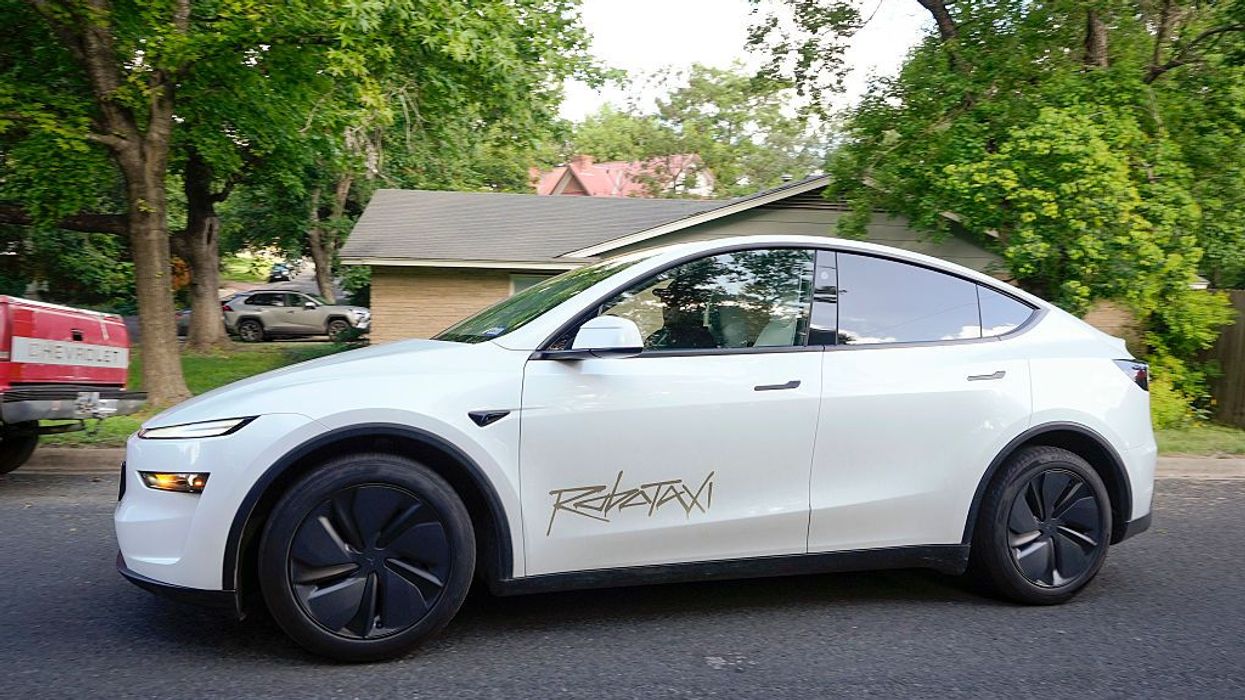
The new data comes as Tesla is removing human safety monitors from its driverless taxi fleet.
Proponents of driverless cars often tout them as a safer alternative to cars with human drivers—but such claims don't appear to be holding up so far in the case of Tesla's Robotaxis.
A Monday report from Elektrek found that Tesla Robotaxis are crashing much more frequently than cars driven by humans, as the company has now reported eight crashes of its driverless taxi fleet in Austin, Texas to the National Highway Traffic Safety Administration since July.
Elektrek also crunched some numbers based on data released by Tesla last month and estimated that the Tesla Robotaxis are involved in a crash for every 40,000 miles they drive. For comparison, the publication reported, cars driven by humans crash about once every 500,000 miles, meaning the Robotaxis so far have crashed 12.5 times more frequently than human-driven cars.
All of the Robotaxi crashes so far have occurred with human safety monitors—who have been trained to take control of the car in the event of a software error—present in the vehicles.
This is significant because, as TechCrunch reported on Monday, Tesla is starting to send out its Robotaxi fleet without safety monitors.
TechCrunch noted that "the removal of the human safety monitors brings the company a critical step closer to its goal of launching a real commercial Robotaxi service," but also said it "will most likely ramp up the scrutiny on Tesla’s ongoing testing in Austin, doubly so when the company starts offering rides in the empty cars."
Tesla's bet on Robotaxis has grown more important given that its vehicle sales in the US and around the world have been dropping significantly so far this year, in part due to a boycott campaign inspired by outrage over CEO Elon Musk's support for far-right political parties.
According to a report from Reuters, the most recent data from car software company Cox Automotive shows that US Tesla sales dropped to a four-year low last month. The news agency also pointed out that Tesla now "is offering financing deals as low as 0% on the Standard Model Y," which is "a sign of weak demand."
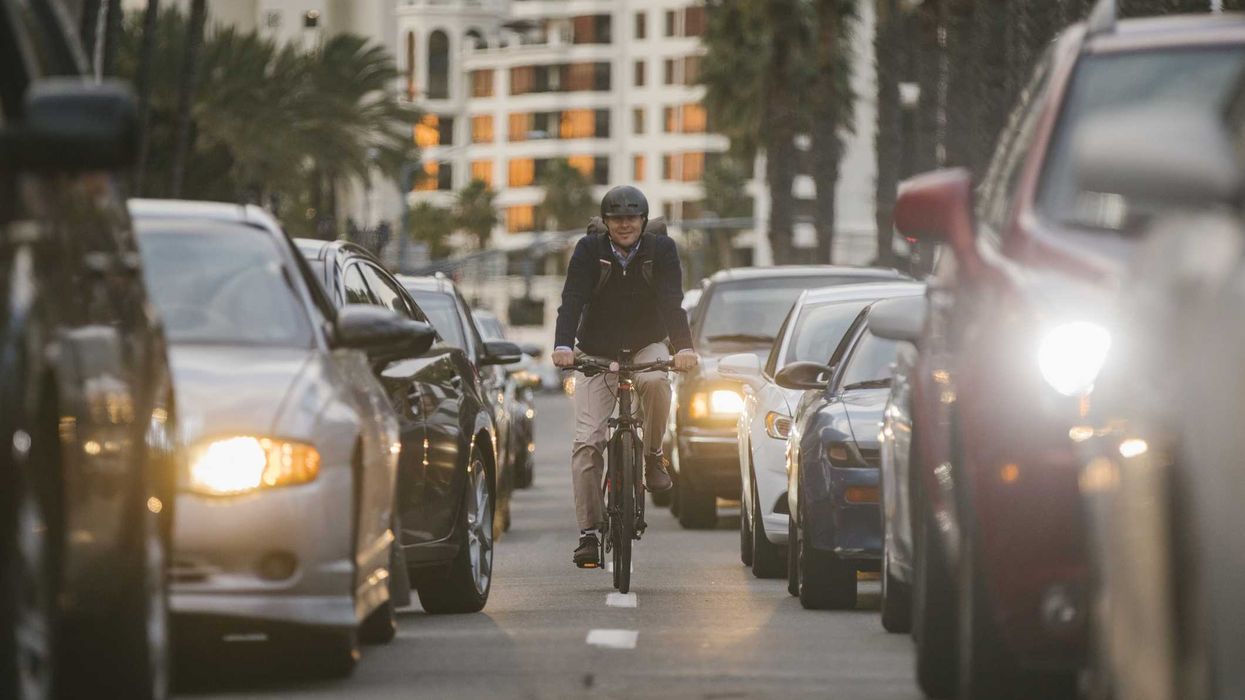
More than 7,148 pedestrians were killed by personal motor vehicles in 2024, just shy of a 40-year high. Meanwhile, travelers are much more likely to die in cars than on public transit.
The US Department of Transportation began earlier this month to rescind federal funding for local projects across the country to improve street safety and add pedestrian trails and bike lanes, because they were deemed "hostile" to cars.
A report Monday in Bloomberg cited several examples of multimillion-dollar grants being axed beginning on September 9, all with the same rationale:
A San Diego County road improvement project including bike lanes “appears to reduce lane capacity and a road diet that is hostile to motor vehicles,” a US Department of Transportation official wrote, rescinding a $1.2 million grant it awarded nearly a year ago.
In Fairfield, Alabama, converting street lanes to trail space on Vinesville Road was also deemed “hostile” to cars, and “counter to DOT’s priority of preserving or increasing roadway capacity for motor vehicles.”
Officials in Boston got a similar explanation, as the Trump administration pulled back a previously awarded grant to improve walking, biking, and transit in the city’s Mattapan Square neighborhood in a way that would change the “current auto-centric configuration.” Another grant to improve safety at intersections in the city was terminated, the DOT said, because it could “impede vehicle capacity and speed.”
These are just a few of the projects cancelled in recent weeks by the Trump administration. According to StreetsBlog, others included a 44-mile walking trail along the Naugatuck River in Connecticut, which the administration reportedly stripped funding from because it did not "promote vehicular travel," and new miles of rail trail in Albuquerque for which DOT said funding would be reallocated to "'car-focused' projects instead."
The cuts are part of a broader effort by the Trump administration to slash discretionary federal grants under the Bipartisan Infrastructure Act signed by former President Joe Biden in 2021.
These include the RAISE infrastructure grant and Safe Streets and Roads for All programs, for which Congress has allocated a combined $2.5 billion annually to expand public transportation and address the US's worsening epidemic of pedestrian deaths.
Data published in July by the group Transportation for America revealed that the Trump administration has been implementing funds for safety grants at about 10% of the speed of the Biden administration.
According to a report published in July by the Governors Highway Safety Association, US drivers struck and killed 7,148 pedestrians in 2024, "enough to fill more than 30 Boeing 737 jets at maximum capacity." Though fatalities have decreased slightly from a 40-year peak in 2022, the number of fatalities last year was 20% higher than in 2016.
Research has overwhelmingly shown that adding bicycle and pedestrian lanes to streets can reduce these fatalities. Even the DOT's own Federal Highway Administration website recommends introducing "Road Diets" that reduce four-lane intersections to three lanes, making room for pedestrian refuge islands and bike lanes to serve as a "buffer" between automobile traffic and sidewalks.
According to the website, "studies indicate a 19 to 47% reduction in overall crashes when a Road Diet is installed on a previously four-lane undivided facility as well as a decrease in crashes involving drivers under 35 years of age and over 65 years of age."
Car crash fatalities are also up in general, according to preliminary data from the Department of Transportation: 39,345 were killed in motor accidents in 2024 compared with 32,744 a decade prior, a 20% increase.
Despite this, the Trump administration has made its preference for maximizing car travel abundantly clear. Trump has attempted to block California from constructing a massive new high-speed rail line from Los Angeles to San Francisco and has tried to stymie New York's wildly successful congestion pricing program.
Citing isolated cases of subway and train crime, he and other members of the Republican Party often paint public transit as excessively dangerous.
In one interview on Fox News in May, Transportation Secretary Sean Duffy ranted that, "if you're liberal, they want you to take public transportation." While stating that he was "OK with public transportation," he said, "the problem is that it's dirty. You have criminals. It's homeless shelters. It's insane asylums. It's a work ground for the criminal element of the city to prey upon the good people."
However, data show that between 2007 and 2023, deaths from automobile accidents were 100 times more likely than deaths on buses and 20 times more likely than on passenger trains.
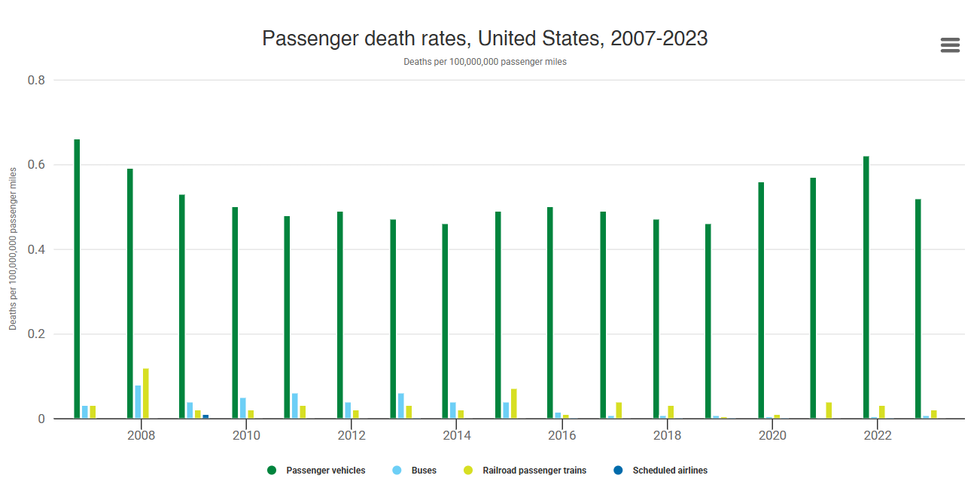 Data: Highway passenger deaths from the Fatality Analysis Reporting System (FARS) data. Railroad passenger deaths from the Federal Railroad Administration. Airline passenger deaths from the National Transportation Safety Board (NTSB). Passenger miles estimates from the Bureau of Transportation Statistics. All other figures are estimates from the National Safety Council. (Graphic: National Safety Council)
That hostility extends toward efforts to expand bicycle usage. In March, Duffy announced that the department would "review" all grants related to green infrastructure, including bike lanes, which was characterized as an effort to combat the previous president's attempts to reduce US transportation's carbon footprint.
Grant criteria sent to communities for the Safe Streets and Roads for All program explicitly warned communities that if "the applicant included infrastructure [resulting in] reducing lane capacity for vehicles," the application would be "viewed less favorably by the department."
When asked about this decision at a panel the next month, StreetsBlog reported that Duffy "grimaced and grumbled the word 'bikes' like it was an expletive, before repeating a string of corrosive myths about bike lanes that are all too common among people who only get around by car," including that they supposedly increase traffic congestion.
Many of the communities that have lost funding for their projects say they are still going to move ahead with them in some capacity. However, they argue that the government providing funds to improve road safety should be common sense.
Rick Dunne, the executive director of the Naugatuck Valley Council of Governments, stated that the effort to build a trail along the river will continue, even without the funding. But he expressed bewilderment at the administration's statement that investing in highway travel would better serve residents' "quality of life."
“Look, if your definition of improving quality of life is promoting vehicular travel, that's just, on its face, bad. Increase vehicle travel, increase pollution, increase safety risks,” Dunne told the CT Post. “Taking this money from this project, putting it into highway travel, is in no way going to increase economic efficiency. I don't see how you argue that it improves the quality of life of Americans, or the residents of this valley.”
"These bipartisan investments need to start flowing immediately," the top Democrat on the Senate Appropriations Committee said of the GAO finding as a lawsuit over the funding got a boost from green groups.
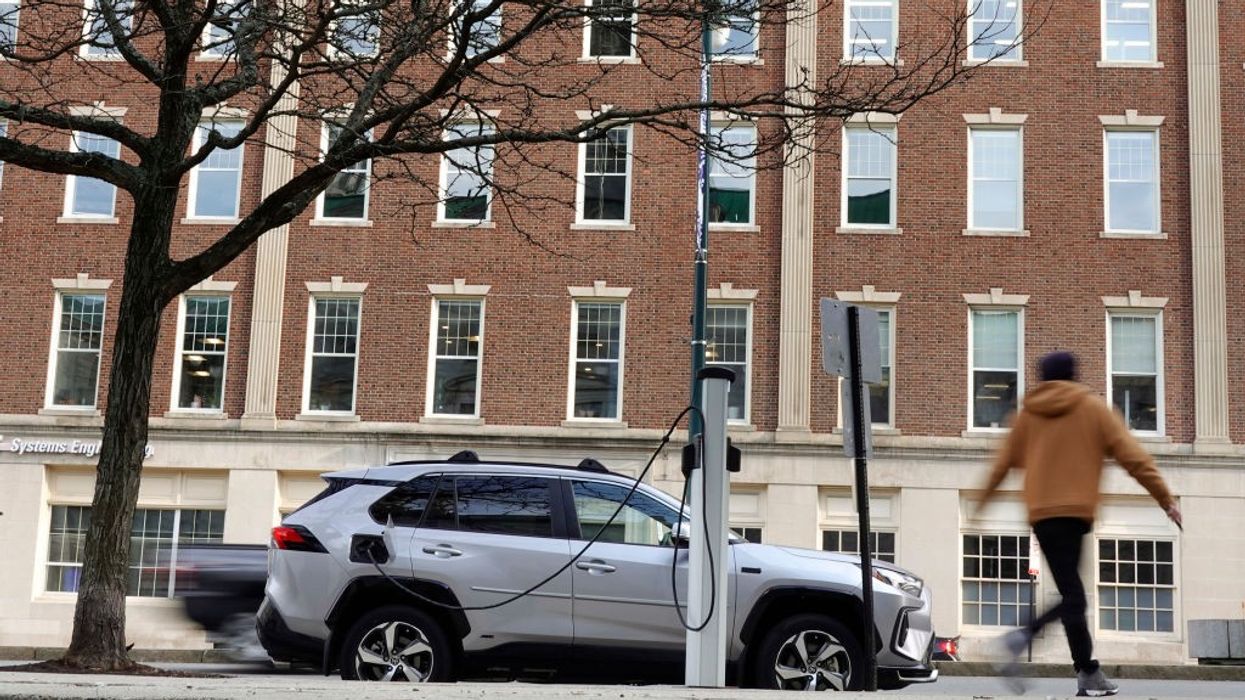
Key congressional Democrats on Thursday welcomed a government watchdog's finding that the Trump administration unlawfully withheld appropriated funds for building electric vehicle charging infrastructure across the United States‚ a decision that came as advocacy groups joined a related lawsuit filed by state attorneys general.
Shortly after returning to office in January, President Donald Trump issued an executive order directing agencies to pause disbursement of funds appropriated under the Inflation Reduction Act and the bipartisan Infrastructure Investment and Jobs Act, specifically mentioning the National Electric Vehicle Infrastructure (NEVI) Formula Program.
In response, the U.S. Department of Transportation (DOT) and one of its agencies, the Federal Highway Administration, in February canceled previously issued guidance for the NEVI program and suspended plans that states had submitted for grant money—which led to calls for Congress to stand up to the administration's "illegal attempts to halt legally mandated funding."
The Government Accountability Office (GAO) said in its Thursday decision that the department violated the Impoundment Control Act: "DOT is not authorized to withhold these funds from expenditure and DOT must continue to carry out the statutory requirements of the program. While DOT cannot withhold these funds under the ICA, DOT could propose funds for rescission or otherwise propose legislation to make changes to the NEVI Formula Program for consideration by Congress."
"The Trump administration didn't just break the law—it shortchanged the American people."
Politico reported that "the GAO could issue similar rulings in the coming months, as the independent, nonpartisan watchdog agency works through at least 39 investigations into whether the Trump administration violated the Impoundment Control Act. GAO rulings are nonbinding but could influence Congress' response to... Trump's freezing of billions of dollars lawmakers intended to flow to specific programs and projects, as well as the many ongoing lawsuits challenging the president's tactics."
In a Thursday statement about the GAO findings, U.S. Senate Appropriations Committee Vice Chair Patty Murray (D-Wash.) said, "This legal decision affirms what we've long known: The president is breaking the law to block funding Congress passed on a bipartisan basis and that is owed to the American people—simply because he disagrees with it. This plain fact is unacceptable—and it cannot stand any longer."
"Congress passed the Bipartisan Infrastructure Law by wide margins and specifically provided funding for every state to build out a network of chargers for the electric vehicles that families are increasingly turning to and that are being made right here in America, she continued. "These investments should be getting out the door—creating new jobs and helping Americans get where they need to go without interruption—but President Trump has illegally choked this funding off."
"These bipartisan investments need to start flowing immediately—as do the hundreds of billions of dollars in other investments President Trump is holding up," she added, taking aim at his Office of Management and Budget (OMB) director. "I don't care about Russ Vought's personal interpretation of our spending laws; the Constitution is clear, and President Trump simply does not have the power of the purse—Congress does."
House Budget Committee Ranking Member Brendan Boyle (D-Pa.) released a similar statement welcoming the GAO's new legal opinion that "the Trump administration broke the law when it blocked funding that Congress had already approved."
"That money was supposed to build and maintain a nationwide EV charging network—and with it, create good-paying jobs in communities across the country," he stressed. "Instead, the administration stalled economic growth, delayed critical infrastructure, and undermined job creation—all without a shred of legal authority."
"This wasn't just a legal violation. It was an economic setback for American workers, and a direct hit to the communities counting on these investments," Boyle added. "The Trump administration didn't just break the law—it shortchanged the American people."
According to Politico, while the DOT could not be reached for comment, an OMB spokesperson called GAO's opinion "wrong" and said the department is "appropriately using the authority granted to it by statute to review state plans."
Standing up for cleaner vehicles and clean air. @sierraclub.org @climatesolutions.org @earthjustice.org and allies sue Trump Admin for illegally impounding funds that Congress appropriated for EV charging. www.sierraclub.org/press-releas...
[image or embed]
— Ross Macfarlane (@rossmacfarlane.bsky.social) May 22, 2025 at 3:53 PM
The attorneys general of 16 states and the District of Columbia disagree, and have filed a lawsuit in the U.S. District Court for the Western District of Washington. The Sierra Club, CleanAIRE N.C., Climate Solutions, Earthjustice, Natural Resources Defense Council, Plug In America, the Southern Alliance for Clean Energy, the Southern Environmental Law Center, and the West End Revitalization Association joined that legal challenge on Thursday.
" Donald Trump is trying to cut jobs, increase pollution, and endanger our health. We refuse to let him," said Sierra Club executive director Ben Jealous in a statement. "NEVI benefits everyone, whether you drive an EV or not, and the only people who benefit from blocking it are Big Oil and auto executives seeking to keep us hooked on fossil fuel-powered cars, while communities in every corner of the country lose out on infrastructure investments in our growing clean energy economy."
"The NEVI program is working and states are legally entitled to the money allocated to them by Congress," Jealous added. "Once again, we are taking the Trump administration to court over its reckless and illegal actions."
"The public has a right to know that their tax dollars are being spent in the public's best interest and not to benefit a government employee's financial interests," according to a recent ethics complaint filed by the Campaign Legal Center.
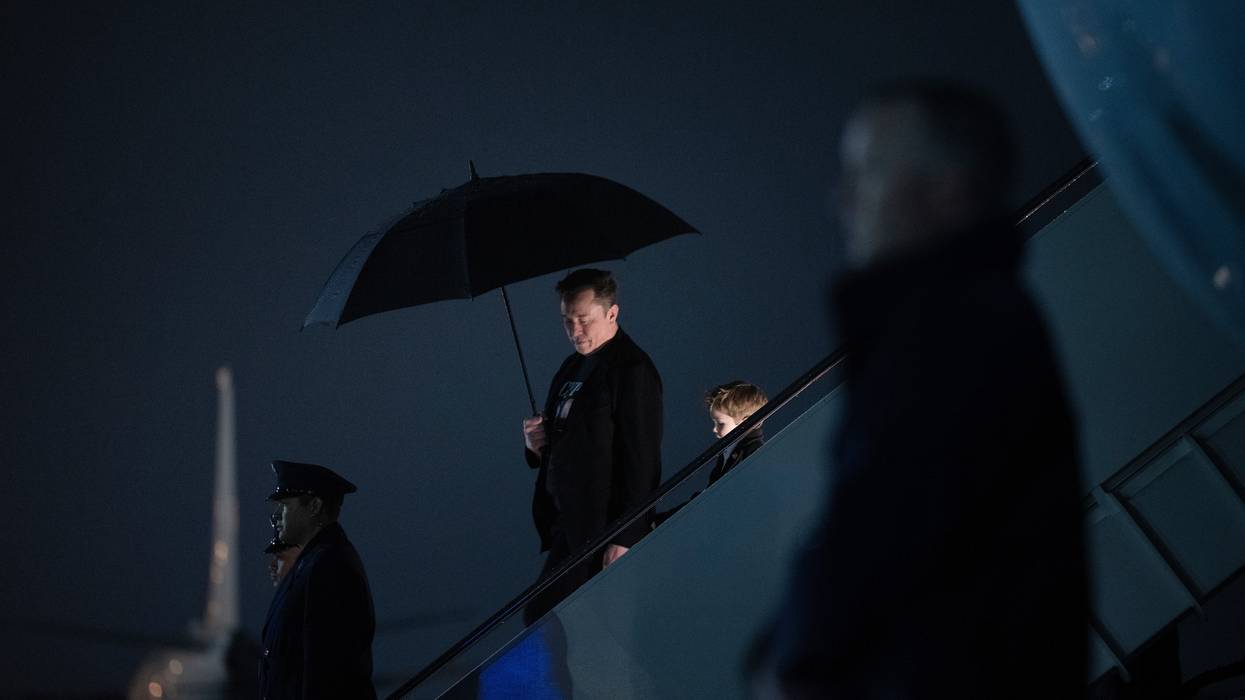
The drum beat for a federal probe into whether billionaire and GOP donor Elon Musk violated conflict of interest law through his dealings with the U.S. Federal Aviation Administration is growing louder following reporting that technology from Musk's Starlink, the satellite network developed by its company SpaceX, will be involved in upgrading the FAA air traffic control system.
On Monday, a group of Democratic senators sent a letter to Attorney General Pam Bondi and Acting Inspector General at the Transportation Department, Mitch Behm, demanding an investigation into whether Musk's activities at the FAA have violated the criminal conflict of interest statute. The letter was first reported by The Guardian on Monday.
"We are concerned that Musk... may be using his government role to benefit his own private company," the senators wrote.
The letter, sent by Sens. Chris Van Hollen (D-Md.), Richard Blumenthal (D-Conn.) and Elizabeth Warren (D-Mass.) cites coverage from The Washington Post, which in late February reported that the FAA was considering canceling a $2.4 billion Verizon contract to upgrade the FAA's communication system "that serves as the backbone of the nation's air traffic control system" and award the work to Starlink, citing unnamed sources.
The letter follows an ethics complaint, filed last week by the nonpartisan legal group Campaign Legal Center (CLC) to Behm, also asking for an investigation into whether the FAA's business transactions with Starlink "are improper due to violations of the criminal conflict of interest law."
Both the letter from the Democratic senators and the CLC complaint cite a section of federal statute that prohibits government employees—including special government employees, which is Musk's designation—from "participat[ing] personally and substantially" in any "particular matter[s]" in which the employee, their spouse, their companies, or other business partners have any "financial interest."
"Public reports establish that the FAA began using Starlink services and considering contracts with the company in response to Musk's requests," according to the letter from CLC. "The public has a right to know that their tax dollars are being spent in the public's best interest and not to benefit a government employee's financial interests."
In early February, Musk—who has been deputized by U.S. President Trump to pursue cuts to government spending and personnel—said that his so-called Department of Government Efficiency(DOGE) will "aim to make rapid safety upgrades to the air traffic control system."
According to Bloomberg, a SpaceX engineer arrived at the FAA headquarters in late February to "deliver what he described as a directive from his boss Elon Musk: The agency will immediately start work on a program to deploy thousands of the company's Starlink satellite terminals to support the national airspace system."
"There is no effort or intent for Starlink to 'take over' any existing contract," SpaceX wrote on X in early March. The company said it is working in coordination with another prime contractor for the FAA's telecommunications infrastructure "to test the use of Starlink as one piece of the infrastructure upgrades so badly needed along with fiber, wireless, and other technologies."
Per Bloomberg, the FAA is already testing or actively using multiple Starlink terminals.
The CLC letter argues that reporting provides evidence that "the FAA's business relationship with Starlink is tainted by Musk's influence. Musk is a government official with broad authority who acts with direct support from the president. With this authority and support, he has openly criticized the FAA's contractors while directing the agency to test and use his company's services."
This "establish[es] a possible criminal conflict of interest violation, and an [Office of Inspector General] investigation is needed to determine whether the facts constitute a legal violation," per the CLC letter.
The requests to probe Musk's business connections to the FAA come as the U.S. has dealt with a series of plane crashes and accidents, which in some cases have been deadly, and has invited scrutiny of the country's air traffic control system.
John P. Pelissero, the director of a government ethics program at Santa Clara University, told the Post that it appears that "because of Musk's current position in DOGE and his closeness to Trump he and his company are getting an advantage and getting a contract," speaking of the potential Verizon contract cancellation.
"Who's looking out for the public interest here when you get the person who's cutting budgets and personnel from the FAA, suddenly trying to benefit from still another government contract?" Pelissero said, according to the Post.
Rep. Jerry Nadler of New York called the U.S. Department of Transportation's rationale for terminating tolling approval for the program "utterly baseless and frankly, laughable."
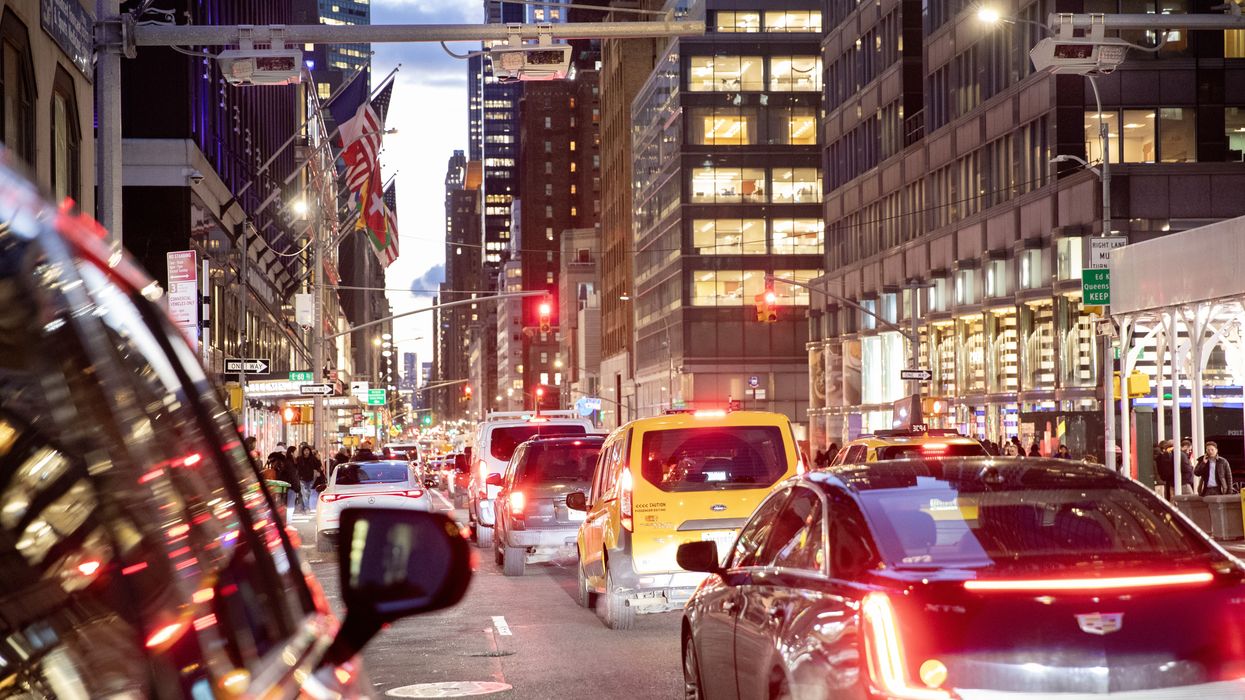
The Trump administration on Wednesday notified New York Gov. Kathy Hochul that it is moving to terminate New York City's congestion pricing program, a tolling scheme launched earlier this year that levies a $9 fee on most drivers entering Manhattan below 60th Street.
The program, which is slated to generate $15 billion in revenue for New York City's mass transit system, was a hard-fought victory for environmental groups, mass transit advocates, and New York's Metropolitan Transportation Authority (MTA). New York State Lawmakers approved the initiative in 2019 after which point it entered a multiyear federal approvals process.
Congestion pricing has been opposed by various groups and public figures, including the New Jersey governor, the labor union the United Federation of Teachers, and some lawmakers who represent voters in outer boroughs and the suburbs.
Democratic leaders in New York have vowed to fight the Trump administration's move and the MTA has already filed a lawsuit in federal court challenging the order.
In a letter to Hochul, Transportation Secretary Sean Duffy wrote that he and U.S. President Donald Trump have concerns about congestion pricing's impact on residents that use the tolled roads and that, in a reversal of a determination made by the previous administration in late November, the scheme is "not eligible" under the Federal Highway Administration's Value Pricing Pilot Program. By rescinding the agreement signed under the pilot program, the administration is aiming to effectively end the initiative's tolling authority.
Duffy called the program a "slap in the face to working-class Americans and small business owners," and separately, U.S. President Donald Trump took to his social media platform Truth Social on Wednesday to celebrate, writing: "CONGESTION PRICING IS DEAD. Manhattan, and all of New York, is SAVED. LONG LIVE THE KING!"
In response to the administration's aims to shut down the program, Hochul said Wednesday that "public transit is the lifeblood of New York City and critical to our economic future—as a New Yorker, like President Trump, knows very well."
"We are a nation of laws, not ruled by a king... We'll see you in court," said the Democratic governor, who was widely criticized for halting congestion pricing last year before it had launched. The program later did move ahead with cheaper tolls.
MTA chairman and CEO Janno Lieber said in a Wednesday statement that "it's mystifying that after four years and 4,000 pages of federally supervised environmental review—and barely three months after giving final approval to the Congestion Relief Program—[U.S. Department of Transportation] would seek to totally reverse course."
Rep. Jerry Nadler (D-N.Y.) called the arguments made in Duffy's letter "utterly baseless and frankly, laughable."
"The notion of revoking approval for a federal initiative of this magnitude is nearly without precedent. I firmly believe that there is no legal basis for the President to unilaterally halt this program," he said.
Rep. Dan Goldman (D-N.Y.) called Trump's rationale for the move "hypocritical and groundless"
According to The New York Times, legal experts have doubts about whether the federal government can shut down congestion pricing.
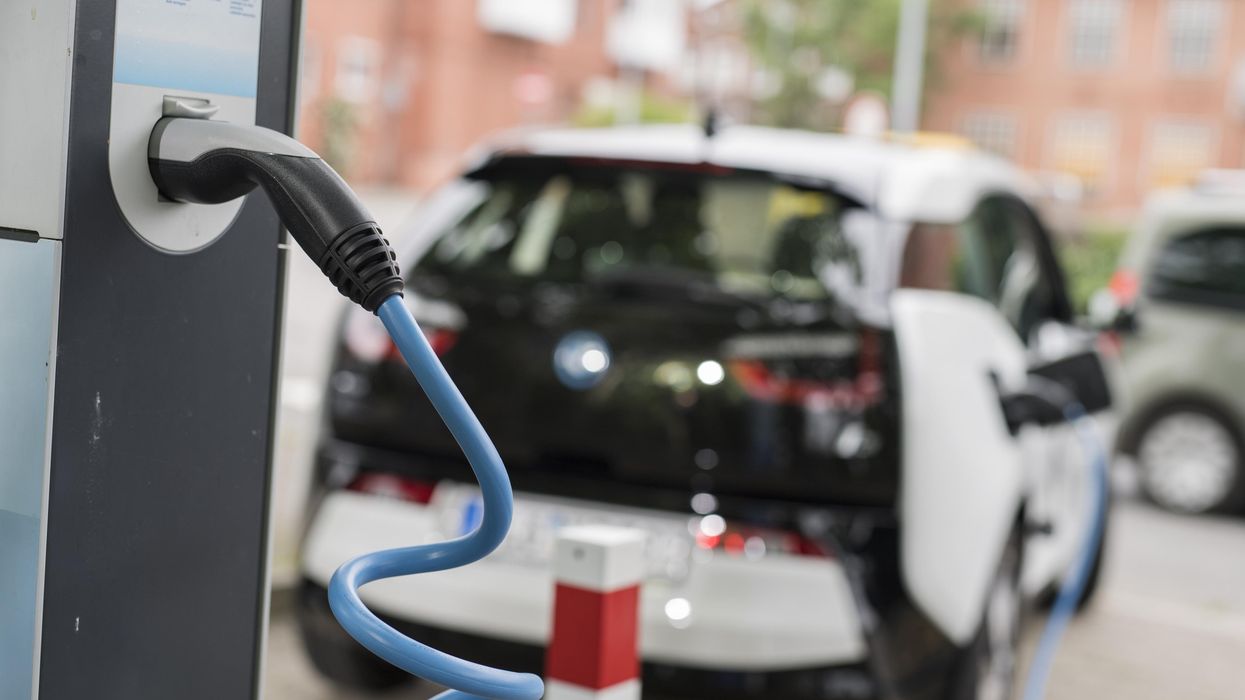
"Freezing these EV charging funds is yet another one of the Trump administration's unsound and illegal moves," said one climate advocate.
Climate campaigners are blasting the Trump administration's move to halt a $5 billion initiative to build electric vehicle chargers along highways across the United States and calling on Congress to fight back against the attack on the grant program from the 2021 bipartisan infrastructure law.
The National Electric Vehicle Infrastructure (NEVI) Formula Program was established by the Infrastructure Investment and Jobs Act. Natural Resources Defense Council's Beth Hammon said in a Friday statement that "on a bipartisan basis, Congress funded this program to build a new vehicle charging network nationwide. The Trump administration does not have the authority to halt it capriciously."
Hammon, a senior vehicle charging advocate at the group, warned that "stopping funding midstream will result in chaos and delays in states across the nation. It will throw state efforts into turmoil, wreak havoc with the companies that install the chargers, and risk the jobs of their workers. The only winner from this chaos is the oil industry."
"This should not stand. Courts have already blocked the Trump administration's other illegal attempts to halt legally mandated funding," she added. "Congress needs to stand up for itself: This move and many others from the Trump administration steals away its constitutionally established spending authority."
Katherine García, director of the Sierra Club's Clean Transportation for All campaign, similarly declared Friday that "freezing these EV charging funds is yet another one of the Trump administration's unsound and illegal moves. This is an attack on bipartisan funding that Congress approved years ago and is driving investment and innovation in every state, with Texas as the largest beneficiary."
"Throwing out states' plans, which were carefully built together with business, utilities, and communities, only hurts America's growing clean energy economy," she stressed. "The NEVI program has helped the U.S. build out the infrastructure needed to support our nation's necessary transition to pollution-free vehicles. More electric vehicle charging means better public health, reduced climate emissions, good-paying green jobs, and healthier communities."
President Donald Trump has taken various anti-climate actions since Inauguration Day—declaring a "national energy emergency," ditching the Paris agreement again, and enabling new liquefied natural gas exports. One executive order calls for "terminating the Green New Deal," and directs agencies to pause disbursement of funds appropriated through the Inflation Reduction Act and the 2021 law, specifically mentioning the NEVI program.
Trump targeted the initiative despite his ties to Tesla CEO Elon Musk, head of the president's destructive Department of Government Efficiency. Wired reported that the billionaire's "electric automobile company has been a recipient of $31 million in awards from the NEVI program, according to a database maintained by transportation officials, accounting for 6% of the money awarded so far."
The Federal Highway Administration on Thursday sent a letter—first reported by InsideEVs—informing state transportation departments that "the new leadership of the Department of Transportation (U.S. DOT) has decided to review the policies underlying the implementation of the NEVI Formula Program," and, as a result, "is also immediately suspending the approval of all" state deployment plans previously greenlit by the Biden administration.
As Heatmap detailed:
According to Paren, an EV charging data analytics firm that has been closely following the rollout of the NEVI program, states are legally entitled to spend roughly $3.27 billion on NEVI. That accounts for plans approved for fiscal years 2022 through 2025. To date, states have awarded about $615 million of the funds to just under 1,000 projects—with 10% of those projects being led by Tesla.
The letter says states will still be able to get reimbursed for expenses related to previously awarded projects, "in order to not disrupt current financial commitments." But the more than $2.6 billion that has not been awarded will be frozen.
The outlet noted that advocates expected Trump's attacks on the program won't survive legal challenges.
"This should be carefully scrutinized by states and the legal community," said Justin Balik, the senior state program director for Evergreen Action, "as it looks like an attempt to sabotage the program based on ideology that's dressed up in bureaucratic language about plan and guidance revisions."
Andrew Rogers, a former deputy administrator and chief counsel of the Federal Highway Administration, told Wired that "there is no legal basis for funds that have been apportioned to states to build projects being 'decertified' based on policy."
Paren chief analyst Loren McDonald also doesn't think that the Trump administration can legally suspend the program.
"I'm assuming the lawsuits from states will start soon, and this will go to court and Congress," McDonald told Politico. "But the Trump [administration] will succeed in just causing havoc and slowing things down for a while."
Already, Alabama, Oklahoma, Missouri, Rhode Island, Ohio, and Nebraska have put their NEVI programs on hold.
Whether Congress—particuarly Democrats, who are the minority party in both chambers—will fight back is unclear. Hill Heat's Brad Johnson pointed out on the social media platform Bluesky that two dozen members of the Senate Democratic Caucus voted with Republicans to confirm Trump's DOT chief, Sean Duffy.
After 24 Senate Democrats joined all GOP to confirm climate denier Sean Duffy as Transportation Secretary, he illegally called for the shut down of the National Electric Vehicle Charging Program, established by the Bipartisan Infrastructure Law.
[image or embed]
— Brad Johnson ( @climatebrad.hillheat.com) February 6, 2025 at 11:36 PM
As Common Dreams reported last month, right after Duffy was confirmed, the secretary directed DOT staff to immediately begin the process of rescinding or replacing former President Joe Biden's clean car pollution standards.
"These commonsense, popular fuel economy standards save drivers money at the pump and reduce dangerous pollution from vehicles," Sierra Club's García said at the time. "Sean Duffy is selling American families out to Big Oil, burdening us with higher fuel prices and more polluting gas-guzzlers that harm our health."

"He seems to not believe that climate change is caused by human activity," one researcher said of the nominee. "(Transportation is the greatest source of greenhouse gas emissions in the U.S.)"
U.S. President-elect Donald Trump on Monday announced Sean Duffy as his nominee to lead the Department of Transportation—the second Fox News host he has named as a presumptive Cabinet secretary, after picking Pete Hegseth as the future Pentagon chief.
Like the ex-president, Duffy is a former reality television star who shifted into politics. He was initially known for MTV's "The Real World: Boston" and "Road Rules: All Stars," then spent eight years as district attorney of Ashland County, Wisconsin.
Duffy was then elected to represent Wisconsin as a Republican congressman. After resigning from the U.S. House of Representatives in 2019, Duffy joined Fox the following year. His wife, Rachel Campos-Duffy, is also part of the network.
Trump said in a lengthy statement that "during his time in Congress, Sean was a respected voice and communicator in the Republican Conference, advocating for Fiscal Responsibility, Economic Growth, and Rural Development. Admired across the aisle, Sean worked with Democrats to clear extensive Legislative hurdles to build the largest road and bridge project in Minnesota History."
"As a member of the House Financial Services Committee, Sean played a key role in shaping and strengthening Economic policies, and ensuring Transparency and Accountability in Government programs," he continued. "Sean's leadership extended to championing the needs of families, farmers, and small businesses, especially in rural communities."
"He will prioritize Excellence, Competence, Competitiveness, and Beauty when rebuilding America's highways, tunnels, bridges, and airports," Trump added. "He will ensure our ports and dams serve our Economy without compromising our National Security, and he will make our skies safe again by eliminating DEI for pilots and air traffic controllers."
DEI—or diversity, equity, and inclusion—is a term used to describe policies that promote including people of various backgrounds. In recent years, Republicans at all levels of politics have taken aim at such policies, often used by employers and universities.
"Trump is using Fox as a staffing agency. Duffy is the sixth announced administration pick that works or worked at the network," Media Matters for America senior fellow Matthew Gertz said Monday. "Duffy's transportation experience—outside of 'Road Rules'—includes blaming Boeing's ills on DEI."
In a series of social media posts, Yonah Freemark, senior research associate at the Urban Institute's Metropolitan Housing and Communities Policy Center, said that "I am having a hard time finding experience in transportation for Sean Duffy."
Freemark highlighted that based on Duffy's voting record in Congress, he has a 2% lifetime score from the League of Conservation Voters—even lower than the group's 14% score for Lee Zeldin, the former Republican congressman from New York whom Trump has chosen to lead the Environmental Protection Agency.
"He seems to not believe that climate change is caused by human activity," Freemark said of Duffy. "(Transportation is the greatest source of greenhouse gas emissions in the U.S.)"
To actually become transportation secretary, Duffy must be confirmed by the Senate, which is set to be controlled by Republicans—unless Trump goes through with his threats to force through Cabinet members via recess appointments.
As The Associated Press reported Monday:
The Transportation Department oversees the nation's complex transportation system, including pipelines, railroads, cars, trucks, and transit systems as well as federal funding for highways.
The department includes the National Highway Traffic Safety Administration, which regulates automakers, including Elon Musk's Tesla. The department sets fuel economy standards for cars and trucks and regulates the airline industry through the Federal Aviation Administration, one of its agencies.
Musk, the richest person on the planet, put significant resources toward electing Trump and has often been seen with him since Election Day. The president-elect announced last week that Musk will co-lead the not-yet-created Department of Government Efficiency with fellow billionaire and campaign supporter Vivek Ramaswamy.

While celebrating the forthcoming review, campaigners also argued that "Secretary of Transportation Pete Buttigieg should put a new rule in place that restores the ban on LNG by rail once and for all."
Green groups on Friday applauded as the Biden administration suspended a Trump-era rule allowing liquefied natural gas to be transported by train, delivering another blow to New Fortress Energy's proposal to ship climate-wrecking LNG by rail from Wyalusing, Pennsylvania to Gibbstown, New Jersey.
The Pipeline and Hazardous Materials Safety Administration (PHMSA)—in coordination with the Federal Railroad Administration, another U.S. Department of Transportation (DOT) agency—announced in the Federal Register on Friday that it is amending the Hazardous Materials Regulations (HMR) to suspend authorization of LNG rail transportation.
PHMSA had previously finalized the rule in June 2020, complying with an April 2019 executive order from then-President Donald Trump, who went on a deregulatory spree during his four years in office and is now seeking a second term in 2024.
Rail transportation of LNG has not yet occurred "and there is considerable uncertainty regarding whether any would occur in the time it takes for PHMSA to consider potential modifications to existing, pertinent HMR requirements," the DOT agency noted. The suspension "guarantees no such transportation will occur before its companion rulemaking has concluded or June 30, 2025, whichever is earlier."
Food & Water Watch New Jersey state director Matt Smith said that "suspending the outrageously dangerous Trump bomb train rule is a welcome relief to the communities that would be turned into sacrifice zones for a billionaire hedge fund tycoon to bet big on dirty gas exports. The victory goes to the powerful grassroots movement fighting back against the dangerous New Fortress export scheme and the enormous climate threat associated with the expansion of fracking and LNG."
The suspension follows the DOT in April denying New Fortress' permit request for an export facility on the Delaware River in Gibbstown—a move that Smith had said at the time was "long overdue, and provides some measure of protection for the communities across South Jersey."
Smith stressed Friday that "this victory can, and must, go deeper. The Biden administration should take action to eliminate the threat of fracked gas bomb trains entirely, and it must do more to stop new fossil fuel projects across the country."
The administration of Democratic New Jersey Gov. Phil Murphy "must do more to stop the dirty energy projects that are being proposed across the state," he added. "If our political leaders believe their own rhetoric about the climate crisis, then they must take appropriate action—and that begins by stopping new fossil fuel proposals immediately."
Natural Resources Defense Council senior attorney Kimberly Ong similarly celebrated the development—particularly for frontline communities of the New Fortress project—while also calling for additional action by the Biden administration.
"People of Pennsylvania and New Jersey living near key rail lines would have faced damage to their health, families, and homes in the event of a derailment," Ong said. "After pausing the rule, Secretary of Transportation Pete Buttigieg should put a new rule in place that restores the ban on LNG by rail once and for all. That would finally put an end to the threat to communities around Gibbstown and other communities targeted by similar dangerous projects."
"New Fortress Energy's proposed LNG project endangers nearly 2 million people living near truck and rail transport routes," she pointed out. "LNG is a volatile substance that can lead to fires and even explosions. The rail disaster in East Palestine, Ohio earlier this year underscores how serious a train derailment involving hazardous substances can be."
The February derailment and resulting environmental and public health concerns in Ohio have generated nationwide calls for stricter rail safety policies and inspired the introduction of multiple bills in Congress.