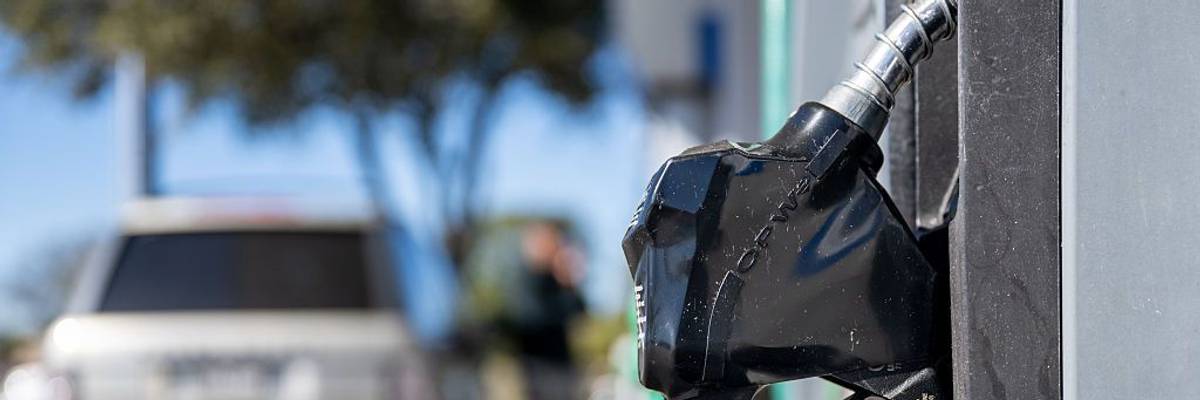
A gas pump is seen on November 26, 2025 in Austin, Texas.
Trump Ripped for Multilevel Stupidity of Scrapping Automobile Efficiency Standards
"In one stroke, Trump is worsening three of our nation’s most vexing problems," said one critic.
President Donald Trump's administration drew criticism from climate advocates on Wednesday for taking a hatchet to fuel efficiency standards aimed at reducing US gas consumption and mitigating the damage done by human-made climate change.
The National Highway Traffic Safety Administration (NHTSA) has proposed slashing former President Joe Biden's fuel economy requirements for new cars down from 50.4 miles per gallon down to just 34.5 miles per gallon on average by 2031.
NHTSA claims that the change in fuel-efficiency standards would slash up-front costs to cars by roughly $900, although it acknowledges that this would also increase US gasoline consumption, which could mean higher prices at the gas pump.
The move has the support of America's major automobile manufacturers, who said the new rules would give them more flexibility. Ford CEO Jim Farley, for instance, told the Washington Post that the rule change means that the auto industry "can make real progress on carbon emissions and energy efficiency while still giving customers choice and affordability."
Many environmental advocates were quick to hammer Trump for making what they described as a shortsighted policy decision that cost Americans more over the long run in terms of both higher gas prices and carbon emissions.
Kathy Harris, director of clean vehicles at the Natural Resources Defense Council, said that Trump is "sticking drivers with higher costs at the pump, all to benefit the oil industry" and predicted that "drivers will be paying hundreds of dollars more at the pump every year if these rules are put in place."
The rule change also drew a scathing review from Dan Becker, director of the Center for Biological Diversity's Safe Climate Transport Campaign, who said that the Trump administration's actions were self-destructive on a number of levels.
"In one stroke, Trump is worsening three of our nation’s most vexing problems: the thirst for oil, high gas pump costs, and global warming," he said. "Trump’s action will feed America’s destructive use of oil, while hamstringing us in the green tech race against Chinese and other foreign carmakers. The auto industry will use this rule to drive itself back into a familiar ditch, failing to compete."
The move on fuel-efficiency standards wasn't the only climate-related policy move the administration made this week, as Bloomberg reported on Tuesday that the US Department of Energy also began unwinding a Biden-era program aimed at decarbonizing the building sector by allowing for the certification of "zero emissions" buildings.
Amneh Minkara, deputy director of Sierra Club's Clean Heat Campaign, said that repealing this program was particularly nonsensical since it was a voluntary standard that "did not place any additional burden on builders or owners," and instead represented "a clear way to meet consumer demand for pollution-free buildings."
"Defining what makes a building ‘zero emissions’ gives consumers certainty that when builders or sellers say a building is clean that it actually meets a specific set of criteria," Minkara emphasized. "It also would reduce energy waste, at a time when energy demand is at an all-time high, and lead to lower utility bills."
We are at a crossroads
This country and this world are at a monumental crossroads. In a few short weeks, US voters will have an opportunity to beat back the forces of fascism and confront the billionaires who are rigging the economy, our media system, and our democracy, making it increasingly impossible for ordinary people to get by. We’re not just talking about the election. We’re talking about what must be done once these fascist elements are vanquished from power. We need a bolder set of solutions than what either major party has so far been willing to offer and a working-class movement ready to fight like hell for it. Trump didn't emerge from nowhere. The conditions that fueled MAGA authoritarianism were created by decades of radical neoliberal economic policies and a corrupt political system dominated by corporate interests. They slashed taxes on the super-rich, promising that the benefits would trickle down. They said giveaways to the corporate titans would make life more affordable for the rest of us. It was all bullshit. And when a bitter, betrayed populace searches for someone to blame, right-wing demagogues have little trouble finding scapegoats. People know when they're being lied to, but you won't hear any of this from the corporate media. Only independent journalism—powered and funded by people who believe in building a better world—can deliver truly trustworthy daily news. Our Fall Campaign is underway, and we need your help. To power our newsroom through the rest of the year, we need to raise $125,000 by midnight on October 31. So if you share our vision, please contribute whatever you can to sustain our work. |
President Donald Trump's administration drew criticism from climate advocates on Wednesday for taking a hatchet to fuel efficiency standards aimed at reducing US gas consumption and mitigating the damage done by human-made climate change.
The National Highway Traffic Safety Administration (NHTSA) has proposed slashing former President Joe Biden's fuel economy requirements for new cars down from 50.4 miles per gallon down to just 34.5 miles per gallon on average by 2031.
NHTSA claims that the change in fuel-efficiency standards would slash up-front costs to cars by roughly $900, although it acknowledges that this would also increase US gasoline consumption, which could mean higher prices at the gas pump.
The move has the support of America's major automobile manufacturers, who said the new rules would give them more flexibility. Ford CEO Jim Farley, for instance, told the Washington Post that the rule change means that the auto industry "can make real progress on carbon emissions and energy efficiency while still giving customers choice and affordability."
Many environmental advocates were quick to hammer Trump for making what they described as a shortsighted policy decision that cost Americans more over the long run in terms of both higher gas prices and carbon emissions.
Kathy Harris, director of clean vehicles at the Natural Resources Defense Council, said that Trump is "sticking drivers with higher costs at the pump, all to benefit the oil industry" and predicted that "drivers will be paying hundreds of dollars more at the pump every year if these rules are put in place."
The rule change also drew a scathing review from Dan Becker, director of the Center for Biological Diversity's Safe Climate Transport Campaign, who said that the Trump administration's actions were self-destructive on a number of levels.
"In one stroke, Trump is worsening three of our nation’s most vexing problems: the thirst for oil, high gas pump costs, and global warming," he said. "Trump’s action will feed America’s destructive use of oil, while hamstringing us in the green tech race against Chinese and other foreign carmakers. The auto industry will use this rule to drive itself back into a familiar ditch, failing to compete."
The move on fuel-efficiency standards wasn't the only climate-related policy move the administration made this week, as Bloomberg reported on Tuesday that the US Department of Energy also began unwinding a Biden-era program aimed at decarbonizing the building sector by allowing for the certification of "zero emissions" buildings.
Amneh Minkara, deputy director of Sierra Club's Clean Heat Campaign, said that repealing this program was particularly nonsensical since it was a voluntary standard that "did not place any additional burden on builders or owners," and instead represented "a clear way to meet consumer demand for pollution-free buildings."
"Defining what makes a building ‘zero emissions’ gives consumers certainty that when builders or sellers say a building is clean that it actually meets a specific set of criteria," Minkara emphasized. "It also would reduce energy waste, at a time when energy demand is at an all-time high, and lead to lower utility bills."
- Toyota Exposed for Funding Climate Denialism Designed to Slow EV Transition ›
- Trump’s Cabinet of Planet-Wreckers Are Destroying What They’ve Sworn to Protect ›
- Trump’s Roll Back of Vehicle Standards Will Boost Big Oil at US Drivers’ Expense ›
- Opinion | Will Oil-Loving Trump Go Down as the Greenest President in History? | Common Dreams ›
- Opinion | Trump's Epic Stupidity Could Kill Millions of People | Common Dreams ›
President Donald Trump's administration drew criticism from climate advocates on Wednesday for taking a hatchet to fuel efficiency standards aimed at reducing US gas consumption and mitigating the damage done by human-made climate change.
The National Highway Traffic Safety Administration (NHTSA) has proposed slashing former President Joe Biden's fuel economy requirements for new cars down from 50.4 miles per gallon down to just 34.5 miles per gallon on average by 2031.
NHTSA claims that the change in fuel-efficiency standards would slash up-front costs to cars by roughly $900, although it acknowledges that this would also increase US gasoline consumption, which could mean higher prices at the gas pump.
The move has the support of America's major automobile manufacturers, who said the new rules would give them more flexibility. Ford CEO Jim Farley, for instance, told the Washington Post that the rule change means that the auto industry "can make real progress on carbon emissions and energy efficiency while still giving customers choice and affordability."
Many environmental advocates were quick to hammer Trump for making what they described as a shortsighted policy decision that cost Americans more over the long run in terms of both higher gas prices and carbon emissions.
Kathy Harris, director of clean vehicles at the Natural Resources Defense Council, said that Trump is "sticking drivers with higher costs at the pump, all to benefit the oil industry" and predicted that "drivers will be paying hundreds of dollars more at the pump every year if these rules are put in place."
The rule change also drew a scathing review from Dan Becker, director of the Center for Biological Diversity's Safe Climate Transport Campaign, who said that the Trump administration's actions were self-destructive on a number of levels.
"In one stroke, Trump is worsening three of our nation’s most vexing problems: the thirst for oil, high gas pump costs, and global warming," he said. "Trump’s action will feed America’s destructive use of oil, while hamstringing us in the green tech race against Chinese and other foreign carmakers. The auto industry will use this rule to drive itself back into a familiar ditch, failing to compete."
The move on fuel-efficiency standards wasn't the only climate-related policy move the administration made this week, as Bloomberg reported on Tuesday that the US Department of Energy also began unwinding a Biden-era program aimed at decarbonizing the building sector by allowing for the certification of "zero emissions" buildings.
Amneh Minkara, deputy director of Sierra Club's Clean Heat Campaign, said that repealing this program was particularly nonsensical since it was a voluntary standard that "did not place any additional burden on builders or owners," and instead represented "a clear way to meet consumer demand for pollution-free buildings."
"Defining what makes a building ‘zero emissions’ gives consumers certainty that when builders or sellers say a building is clean that it actually meets a specific set of criteria," Minkara emphasized. "It also would reduce energy waste, at a time when energy demand is at an all-time high, and lead to lower utility bills."
- Toyota Exposed for Funding Climate Denialism Designed to Slow EV Transition ›
- Trump’s Cabinet of Planet-Wreckers Are Destroying What They’ve Sworn to Protect ›
- Trump’s Roll Back of Vehicle Standards Will Boost Big Oil at US Drivers’ Expense ›
- Opinion | Will Oil-Loving Trump Go Down as the Greenest President in History? | Common Dreams ›
- Opinion | Trump's Epic Stupidity Could Kill Millions of People | Common Dreams ›