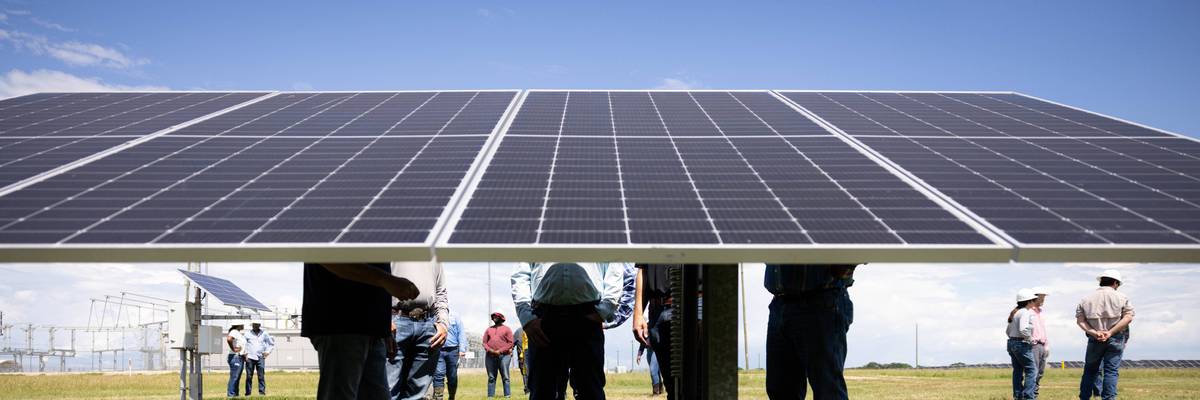
Landowners, educators, and government employees learn about grazing sheep and growing hay under solar panels during a tour of a Solar Stampede site in Saltillo, Texas on May 28, 2026.
Despite Trump’s War on Clean Energy, Renewables Have Added 34 Times More Capacity Than Fossil Fuels and Nuclear
“Clearly, the White House has bet on the wrong horse.”
The Trump administration has waged a multifront war on clean energy during the president's second term. But according to newly published government data, it hasn't worked.
Over the past 18 months, despite the administration’s best efforts, solar, wind, and battery storage added nearly 89 gigawatts of capacity—more than 30 times the growth of fossil fuels and nuclear power combined.
That is according to an analysis of new data from the US Energy Information Administration (EIA) released Monday by the nonprofit SUN DAY Campaign, which tracks federal renewable energy data.
From February 2025 through July 2026, utility solar capacity—large-scale projects that provide electricity to power grids—rose 33% over the previous year compared with the same time during 2025, while wind capacity rose 8%. The storage capacity for batteries, meanwhile, roughly doubled.
By contrast, US coal capacity dropped by 2.4%. Natural gas capacity rose by just 1.5%, while the capacity for fossil fuels and nuclear power combined rose by just 0.3%.
At the start of the second Trump administration, renewables accounted for a combined 22.3% share of US electrical generation. Eighteen months later, they now account for 29%.
“Over the last 18 months, the Trump administration has used every conceivable trick to delay, hinder, or cancel new clean energy projects,” said the SUN DAY Campaign’s executive director, Ken Bossong.
This has included an effective ban on wind development, a repeal of clean-energy tax credits in last year's Republican budget law, a rollback of electric vehicle subsidies, and the cancellation of solar grants, as well as a host of policies meant to ramp up the production of oil, coal, and gas.
The growth of solar and wind reflects an economic reality that Trump has struggled to reverse: Wind and solar are among the cheapest sources of new electricity in much of the country, according to data from the EIA, which expects solar to remain the fastest-growing US source of power generation through 2027.
"Clearly," Bossong said, "the White House has bet on the wrong horse.”
We are at a crossroads
This country and this world are at a monumental crossroads. In a few short weeks, US voters will have an opportunity to beat back the forces of fascism and confront the billionaires who are rigging the economy, our media system, and our democracy, making it increasingly impossible for ordinary people to get by. We’re not just talking about the election. We’re talking about what must be done once these fascist elements are vanquished from power. We need a bolder set of solutions than what either major party has so far been willing to offer and a working-class movement ready to fight like hell for it. Trump didn't emerge from nowhere. The conditions that fueled MAGA authoritarianism were created by decades of radical neoliberal economic policies and a corrupt political system dominated by corporate interests. They slashed taxes on the super-rich, promising that the benefits would trickle down. They said giveaways to the corporate titans would make life more affordable for the rest of us. It was all bullshit. And when a bitter, betrayed populace searches for someone to blame, right-wing demagogues have little trouble finding scapegoats. People know when they're being lied to, but you won't hear any of this from the corporate media. Only independent journalism—powered and funded by people who believe in building a better world—can deliver truly trustworthy daily news. Our Fall Campaign is underway, and we need your help. To power our newsroom through the rest of the year, we need to raise $125,000 by midnight on October 31. So if you share our vision, please contribute whatever you can to sustain our work. |
The Trump administration has waged a multifront war on clean energy during the president's second term. But according to newly published government data, it hasn't worked.
Over the past 18 months, despite the administration’s best efforts, solar, wind, and battery storage added nearly 89 gigawatts of capacity—more than 30 times the growth of fossil fuels and nuclear power combined.
That is according to an analysis of new data from the US Energy Information Administration (EIA) released Monday by the nonprofit SUN DAY Campaign, which tracks federal renewable energy data.
From February 2025 through July 2026, utility solar capacity—large-scale projects that provide electricity to power grids—rose 33% over the previous year compared with the same time during 2025, while wind capacity rose 8%. The storage capacity for batteries, meanwhile, roughly doubled.
By contrast, US coal capacity dropped by 2.4%. Natural gas capacity rose by just 1.5%, while the capacity for fossil fuels and nuclear power combined rose by just 0.3%.
At the start of the second Trump administration, renewables accounted for a combined 22.3% share of US electrical generation. Eighteen months later, they now account for 29%.
“Over the last 18 months, the Trump administration has used every conceivable trick to delay, hinder, or cancel new clean energy projects,” said the SUN DAY Campaign’s executive director, Ken Bossong.
This has included an effective ban on wind development, a repeal of clean-energy tax credits in last year's Republican budget law, a rollback of electric vehicle subsidies, and the cancellation of solar grants, as well as a host of policies meant to ramp up the production of oil, coal, and gas.
The growth of solar and wind reflects an economic reality that Trump has struggled to reverse: Wind and solar are among the cheapest sources of new electricity in much of the country, according to data from the EIA, which expects solar to remain the fastest-growing US source of power generation through 2027.
"Clearly," Bossong said, "the White House has bet on the wrong horse.”