

SUBSCRIBE TO OUR FREE NEWSLETTER
Daily news & progressive opinion—funded by the people, not the corporations—delivered straight to your inbox.
5
#000000
#FFFFFF
To donate by check, phone, or other method, see our More Ways to Give page.
Daily news & progressive opinion—funded by the people, not the corporations—delivered straight to your inbox.
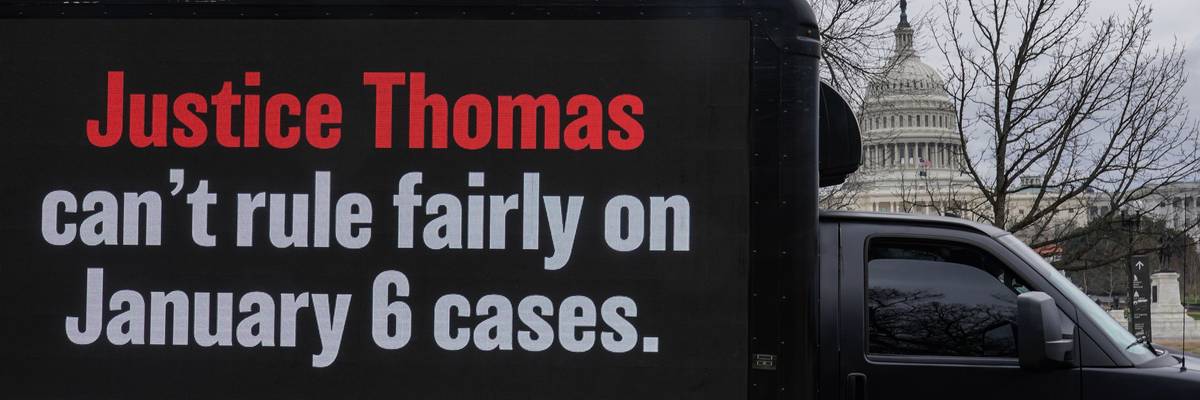
"Ginni Thomas' involvement in the seditious conspiracy that led to the January 6 insurrection is a bald-faced conflict of interest," argued one watchdog.
U.S. Supreme Court Justice Clarence Thomas, who once went a full decade without speaking during oral arguments, asked the first question Thursday as the high court heard a case challenging former President Donald Trump's eligibility to run for a second White House term.
But Thomas, whose initial question focused on whether the 14th Amendment is "self-executing," shouldn't even be involved in the case, progressive watchdogs and other observers argued, given his wife Ginni's role in far-right efforts to overturn the results of the 2020 election—an effort that culminated in the January 6, 2021 insurrection.
"The Supreme Court is facing its most significant electoral test since Bush v. Gore. The stakes are high, and the American people should be able to trust that this case will be decided without outside influence," Tishan Weerasooriya, senior associate of policy and political affairs at Stand Up America, said in a statement shortly before oral arguments kicked off Thursday.
"Justice Thomas should recuse himself from this monumental case," Weerasooriya added. "Ginni Thomas' involvement in the seditious conspiracy that led to the January 6 insurrection is a bald-faced conflict of interest. If Thomas refuses, it will not only be a blatant denial of impartial review but also a rejection of Chief Justice [John] Roberts' recently issued Code of Conduct."
That code states that "a justice should disqualify himself or herself in a proceeding in which the justice's impartiality might reasonably be questioned." A University of Massachusetts at Amherst survey released Wednesday found that 64% of U.S. voters believe Thomas should recuse from any case related to the 2020 election given his wife's role in trying to subvert the results.
Will Bunch, a columnist for the Philadelphia Inquirer, argued that Thomas' failure to recuse from the case on Trump's eligibility "is a giant middle finger to American democracy."
"It's no wonder public trust in the court is terrible. Corrupt Thomas should resign."
The case in question, Trump v. Anderson, stems from the Colorado Supreme Court's December ruling that Trump engaged in insurrection and is thus disqualified from running for federal office again under Section 3 of the 14th Amendment. Trump quickly appealed the decision to the U.S. Supreme Court, which agreed to an expedited review of the case amid the 2024 presidential primaries.
Just over a week after the Colorado Supreme Court handed down its ruling, Maine's secretary of state moved to disqualify Trump from the 2024 primary ballot—a decision that was paused by a state judge pending the U.S. Supreme Court's ruling in Trump v. Anderson.
As oral arguments in the case proceeded Thursday, Rep. Bill Pascrell Jr. (D-N.J.) wrote that "Clarence Thomas is participating in a Supreme Court hearing today on Donald Trump's eligibility after trying to overthrow the government even though Thomas' wife conspired to help Trump."
"It's no wonder public trust in the court is terrible," Pascrell continued. "Corrupt Thomas should resign."
Citizens for Responsibility and Ethics in Washington (CREW), which filed an amicus brief in Trump v. Anderson supporting the former president's disqualification, noted in an analysis released earlier this week that Colorado and Maine are "the only two states that have substantively grappled with whether the 14th Amendment bars Trump from the ballot and reached a final decision based on the merits."
"Other individuals and groups have brought ballot eligibility challenges in other states across the country, some of which are pending and many of which have failed," CREW observed. "None of the cases that have been dismissed reached the stage where a court heard evidence and ruled on the merits, which includes questions of whether Trump is an insurrectionist and whether the 14th Amendment applies in his case."
Dear Common Dreams reader, It’s been nearly 30 years since I co-founded Common Dreams with my late wife, Lina Newhouser. We had the radical notion that journalism should serve the public good, not corporate profits. It was clear to us from the outset what it would take to build such a project. No paid advertisements. No corporate sponsors. No millionaire publisher telling us what to think or do. Many people said we wouldn't last a year, but we proved those doubters wrong. Together with a tremendous team of journalists and dedicated staff, we built an independent media outlet free from the constraints of profits and corporate control. Our mission has always been simple: To inform. To inspire. To ignite change for the common good. Building Common Dreams was not easy. Our survival was never guaranteed. When you take on the most powerful forces—Wall Street greed, fossil fuel industry destruction, Big Tech lobbyists, and uber-rich oligarchs who have spent billions upon billions rigging the economy and democracy in their favor—the only bulwark you have is supporters who believe in your work. But here’s the urgent message from me today. It's never been this bad out there. And it's never been this hard to keep us going. At the very moment Common Dreams is most needed, the threats we face are intensifying. We need your support now more than ever. We don't accept corporate advertising and never will. We don't have a paywall because we don't think people should be blocked from critical news based on their ability to pay. Everything we do is funded by the donations of readers like you. When everyone does the little they can afford, we are strong. But if that support retreats or dries up, so do we. Will you donate now to make sure Common Dreams not only survives but thrives? —Craig Brown, Co-founder |
U.S. Supreme Court Justice Clarence Thomas, who once went a full decade without speaking during oral arguments, asked the first question Thursday as the high court heard a case challenging former President Donald Trump's eligibility to run for a second White House term.
But Thomas, whose initial question focused on whether the 14th Amendment is "self-executing," shouldn't even be involved in the case, progressive watchdogs and other observers argued, given his wife Ginni's role in far-right efforts to overturn the results of the 2020 election—an effort that culminated in the January 6, 2021 insurrection.
"The Supreme Court is facing its most significant electoral test since Bush v. Gore. The stakes are high, and the American people should be able to trust that this case will be decided without outside influence," Tishan Weerasooriya, senior associate of policy and political affairs at Stand Up America, said in a statement shortly before oral arguments kicked off Thursday.
"Justice Thomas should recuse himself from this monumental case," Weerasooriya added. "Ginni Thomas' involvement in the seditious conspiracy that led to the January 6 insurrection is a bald-faced conflict of interest. If Thomas refuses, it will not only be a blatant denial of impartial review but also a rejection of Chief Justice [John] Roberts' recently issued Code of Conduct."
That code states that "a justice should disqualify himself or herself in a proceeding in which the justice's impartiality might reasonably be questioned." A University of Massachusetts at Amherst survey released Wednesday found that 64% of U.S. voters believe Thomas should recuse from any case related to the 2020 election given his wife's role in trying to subvert the results.
Will Bunch, a columnist for the Philadelphia Inquirer, argued that Thomas' failure to recuse from the case on Trump's eligibility "is a giant middle finger to American democracy."
"It's no wonder public trust in the court is terrible. Corrupt Thomas should resign."
The case in question, Trump v. Anderson, stems from the Colorado Supreme Court's December ruling that Trump engaged in insurrection and is thus disqualified from running for federal office again under Section 3 of the 14th Amendment. Trump quickly appealed the decision to the U.S. Supreme Court, which agreed to an expedited review of the case amid the 2024 presidential primaries.
Just over a week after the Colorado Supreme Court handed down its ruling, Maine's secretary of state moved to disqualify Trump from the 2024 primary ballot—a decision that was paused by a state judge pending the U.S. Supreme Court's ruling in Trump v. Anderson.
As oral arguments in the case proceeded Thursday, Rep. Bill Pascrell Jr. (D-N.J.) wrote that "Clarence Thomas is participating in a Supreme Court hearing today on Donald Trump's eligibility after trying to overthrow the government even though Thomas' wife conspired to help Trump."
"It's no wonder public trust in the court is terrible," Pascrell continued. "Corrupt Thomas should resign."
Citizens for Responsibility and Ethics in Washington (CREW), which filed an amicus brief in Trump v. Anderson supporting the former president's disqualification, noted in an analysis released earlier this week that Colorado and Maine are "the only two states that have substantively grappled with whether the 14th Amendment bars Trump from the ballot and reached a final decision based on the merits."
"Other individuals and groups have brought ballot eligibility challenges in other states across the country, some of which are pending and many of which have failed," CREW observed. "None of the cases that have been dismissed reached the stage where a court heard evidence and ruled on the merits, which includes questions of whether Trump is an insurrectionist and whether the 14th Amendment applies in his case."
U.S. Supreme Court Justice Clarence Thomas, who once went a full decade without speaking during oral arguments, asked the first question Thursday as the high court heard a case challenging former President Donald Trump's eligibility to run for a second White House term.
But Thomas, whose initial question focused on whether the 14th Amendment is "self-executing," shouldn't even be involved in the case, progressive watchdogs and other observers argued, given his wife Ginni's role in far-right efforts to overturn the results of the 2020 election—an effort that culminated in the January 6, 2021 insurrection.
"The Supreme Court is facing its most significant electoral test since Bush v. Gore. The stakes are high, and the American people should be able to trust that this case will be decided without outside influence," Tishan Weerasooriya, senior associate of policy and political affairs at Stand Up America, said in a statement shortly before oral arguments kicked off Thursday.
"Justice Thomas should recuse himself from this monumental case," Weerasooriya added. "Ginni Thomas' involvement in the seditious conspiracy that led to the January 6 insurrection is a bald-faced conflict of interest. If Thomas refuses, it will not only be a blatant denial of impartial review but also a rejection of Chief Justice [John] Roberts' recently issued Code of Conduct."
That code states that "a justice should disqualify himself or herself in a proceeding in which the justice's impartiality might reasonably be questioned." A University of Massachusetts at Amherst survey released Wednesday found that 64% of U.S. voters believe Thomas should recuse from any case related to the 2020 election given his wife's role in trying to subvert the results.
Will Bunch, a columnist for the Philadelphia Inquirer, argued that Thomas' failure to recuse from the case on Trump's eligibility "is a giant middle finger to American democracy."
"It's no wonder public trust in the court is terrible. Corrupt Thomas should resign."
The case in question, Trump v. Anderson, stems from the Colorado Supreme Court's December ruling that Trump engaged in insurrection and is thus disqualified from running for federal office again under Section 3 of the 14th Amendment. Trump quickly appealed the decision to the U.S. Supreme Court, which agreed to an expedited review of the case amid the 2024 presidential primaries.
Just over a week after the Colorado Supreme Court handed down its ruling, Maine's secretary of state moved to disqualify Trump from the 2024 primary ballot—a decision that was paused by a state judge pending the U.S. Supreme Court's ruling in Trump v. Anderson.
As oral arguments in the case proceeded Thursday, Rep. Bill Pascrell Jr. (D-N.J.) wrote that "Clarence Thomas is participating in a Supreme Court hearing today on Donald Trump's eligibility after trying to overthrow the government even though Thomas' wife conspired to help Trump."
"It's no wonder public trust in the court is terrible," Pascrell continued. "Corrupt Thomas should resign."
Citizens for Responsibility and Ethics in Washington (CREW), which filed an amicus brief in Trump v. Anderson supporting the former president's disqualification, noted in an analysis released earlier this week that Colorado and Maine are "the only two states that have substantively grappled with whether the 14th Amendment bars Trump from the ballot and reached a final decision based on the merits."
"Other individuals and groups have brought ballot eligibility challenges in other states across the country, some of which are pending and many of which have failed," CREW observed. "None of the cases that have been dismissed reached the stage where a court heard evidence and ruled on the merits, which includes questions of whether Trump is an insurrectionist and whether the 14th Amendment applies in his case."

