SUBSCRIBE TO OUR FREE NEWSLETTER
Daily news & progressive opinion—funded by the people, not the corporations—delivered straight to your inbox.
5
#000000
#FFFFFF
To donate by check, phone, or other method, see our More Ways to Give page.
Daily news & progressive opinion—funded by the people, not the corporations—delivered straight to your inbox.
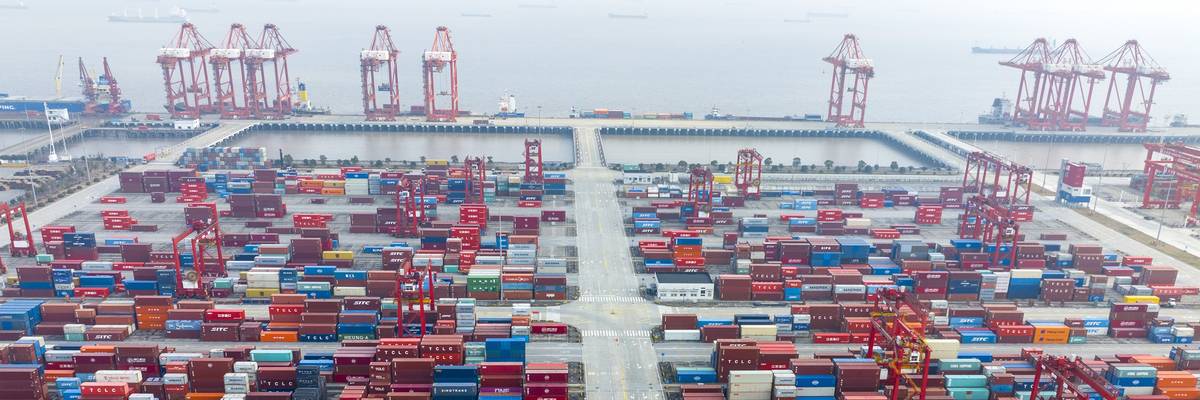
Aerial view of shipping containers sitting stacked at the Taicang Port on February 3, 2025 in Suzhou, Jiangsu Province of China.
"The reality is that it's about tax cuts for the rich, paid for by import taxes on the American working and middle class," said Justin Wolfers, a professor of economics and public policy at the University of Michigan.
With 10% tariffs on all goods from China now in effect, economist Justin Wolfers wrote on X Sunday that U.S. President Donald Trump's "tariff-for-tax cut swap" is aimed at getting working Americans to foot the bill for his promised tax cuts.
The so-called "swap" is "very cleverly disguised populist policy that sounds like it's all about beating up on China to help American workers," wrote Wolfers, a professor of economics and public policy at the University of Michigan. "The reality is that it's about tax cuts for the rich, paid for by import taxes on the American working and middle class," he said.
The costs of tariffs, which are a form of tax applied on imports and can be used to support homegrown industries that employ American workers, are largely passed on to American consumers.
China has responded to Trump's tariffs by levying 15% tariffs on U.S. coal, liquefied natural gas, and other products. Tit-for-tat tariffs with China were a feature of the first Trump administration and many of the protectionist measures Trump imposed against China were continued under former President Joe Biden.
Trump has pushed for using revenue from higher tariffs to fund an extension of his tax cuts, according to Reuters.
"Instead of taxing our citizens to enrich other countries, we will tariff and tax foreign countries to enrich our citizens. For this purpose, we are establishing the External Revenue Service to collect all tariffs, duties and revenues. It will be massive amounts of money pouring into our treasury coming from foreign sources," Trump said during his inaugural address.
The Congressional Budget Office estimated in spring 2024 that extending the expiring provisions of Trump's 2017 Tax Cuts and Jobs Act would cost $4.6 trillion over 10 years.
When Trump announced the 10% tariffs on China, he also signed executive orders mandating 25% tariffs on both Mexico and Canada, each of which were able to strike a deal that delayed the imposition of those tariffs.
Following the initial announcement of the suite of tariffs against China, Mexico, and Canada, Rep. Greg Casar (D-Texas), the chair of the Congressional Progressive Caucus, wrote that "instead of using tariffs to protect U.S. jobs, Trump is on an ego trip and is using tariffs to pursue petty fights with other nations while raising prices on Americans."
Meanwhile, more tariffs may be coming. Trump said while speaking with reporters on Sunday that he will impose a 25% tariff on aluminum and steel imports on Monday, according to multiple outlets.
"Any steel coming into the United States is going to have a 25% tariff," Trump said. "Aluminum too," he said, according to NBC News.
He also said that he plans to announce reciprocal tariffs on "every country" this week, per NBC News.
While Trump did not single out China when announcing his intention to impose tariffs on steel and aluminum, China—which is currently flooding non-U.S. markets with its steel and aluminum exports—is "at the heart" of these new promised tariffs from Trump, according to The New York Times.
Dear Common Dreams reader, It’s been nearly 30 years since I co-founded Common Dreams with my late wife, Lina Newhouser. We had the radical notion that journalism should serve the public good, not corporate profits. It was clear to us from the outset what it would take to build such a project. No paid advertisements. No corporate sponsors. No millionaire publisher telling us what to think or do. Many people said we wouldn't last a year, but we proved those doubters wrong. Together with a tremendous team of journalists and dedicated staff, we built an independent media outlet free from the constraints of profits and corporate control. Our mission has always been simple: To inform. To inspire. To ignite change for the common good. Building Common Dreams was not easy. Our survival was never guaranteed. When you take on the most powerful forces—Wall Street greed, fossil fuel industry destruction, Big Tech lobbyists, and uber-rich oligarchs who have spent billions upon billions rigging the economy and democracy in their favor—the only bulwark you have is supporters who believe in your work. But here’s the urgent message from me today. It's never been this bad out there. And it's never been this hard to keep us going. At the very moment Common Dreams is most needed, the threats we face are intensifying. We need your support now more than ever. We don't accept corporate advertising and never will. We don't have a paywall because we don't think people should be blocked from critical news based on their ability to pay. Everything we do is funded by the donations of readers like you. When everyone does the little they can afford, we are strong. But if that support retreats or dries up, so do we. Will you donate now to make sure Common Dreams not only survives but thrives? —Craig Brown, Co-founder |
With 10% tariffs on all goods from China now in effect, economist Justin Wolfers wrote on X Sunday that U.S. President Donald Trump's "tariff-for-tax cut swap" is aimed at getting working Americans to foot the bill for his promised tax cuts.
The so-called "swap" is "very cleverly disguised populist policy that sounds like it's all about beating up on China to help American workers," wrote Wolfers, a professor of economics and public policy at the University of Michigan. "The reality is that it's about tax cuts for the rich, paid for by import taxes on the American working and middle class," he said.
The costs of tariffs, which are a form of tax applied on imports and can be used to support homegrown industries that employ American workers, are largely passed on to American consumers.
China has responded to Trump's tariffs by levying 15% tariffs on U.S. coal, liquefied natural gas, and other products. Tit-for-tat tariffs with China were a feature of the first Trump administration and many of the protectionist measures Trump imposed against China were continued under former President Joe Biden.
Trump has pushed for using revenue from higher tariffs to fund an extension of his tax cuts, according to Reuters.
"Instead of taxing our citizens to enrich other countries, we will tariff and tax foreign countries to enrich our citizens. For this purpose, we are establishing the External Revenue Service to collect all tariffs, duties and revenues. It will be massive amounts of money pouring into our treasury coming from foreign sources," Trump said during his inaugural address.
The Congressional Budget Office estimated in spring 2024 that extending the expiring provisions of Trump's 2017 Tax Cuts and Jobs Act would cost $4.6 trillion over 10 years.
When Trump announced the 10% tariffs on China, he also signed executive orders mandating 25% tariffs on both Mexico and Canada, each of which were able to strike a deal that delayed the imposition of those tariffs.
Following the initial announcement of the suite of tariffs against China, Mexico, and Canada, Rep. Greg Casar (D-Texas), the chair of the Congressional Progressive Caucus, wrote that "instead of using tariffs to protect U.S. jobs, Trump is on an ego trip and is using tariffs to pursue petty fights with other nations while raising prices on Americans."
Meanwhile, more tariffs may be coming. Trump said while speaking with reporters on Sunday that he will impose a 25% tariff on aluminum and steel imports on Monday, according to multiple outlets.
"Any steel coming into the United States is going to have a 25% tariff," Trump said. "Aluminum too," he said, according to NBC News.
He also said that he plans to announce reciprocal tariffs on "every country" this week, per NBC News.
While Trump did not single out China when announcing his intention to impose tariffs on steel and aluminum, China—which is currently flooding non-U.S. markets with its steel and aluminum exports—is "at the heart" of these new promised tariffs from Trump, according to The New York Times.
With 10% tariffs on all goods from China now in effect, economist Justin Wolfers wrote on X Sunday that U.S. President Donald Trump's "tariff-for-tax cut swap" is aimed at getting working Americans to foot the bill for his promised tax cuts.
The so-called "swap" is "very cleverly disguised populist policy that sounds like it's all about beating up on China to help American workers," wrote Wolfers, a professor of economics and public policy at the University of Michigan. "The reality is that it's about tax cuts for the rich, paid for by import taxes on the American working and middle class," he said.
The costs of tariffs, which are a form of tax applied on imports and can be used to support homegrown industries that employ American workers, are largely passed on to American consumers.
China has responded to Trump's tariffs by levying 15% tariffs on U.S. coal, liquefied natural gas, and other products. Tit-for-tat tariffs with China were a feature of the first Trump administration and many of the protectionist measures Trump imposed against China were continued under former President Joe Biden.
Trump has pushed for using revenue from higher tariffs to fund an extension of his tax cuts, according to Reuters.
"Instead of taxing our citizens to enrich other countries, we will tariff and tax foreign countries to enrich our citizens. For this purpose, we are establishing the External Revenue Service to collect all tariffs, duties and revenues. It will be massive amounts of money pouring into our treasury coming from foreign sources," Trump said during his inaugural address.
The Congressional Budget Office estimated in spring 2024 that extending the expiring provisions of Trump's 2017 Tax Cuts and Jobs Act would cost $4.6 trillion over 10 years.
When Trump announced the 10% tariffs on China, he also signed executive orders mandating 25% tariffs on both Mexico and Canada, each of which were able to strike a deal that delayed the imposition of those tariffs.
Following the initial announcement of the suite of tariffs against China, Mexico, and Canada, Rep. Greg Casar (D-Texas), the chair of the Congressional Progressive Caucus, wrote that "instead of using tariffs to protect U.S. jobs, Trump is on an ego trip and is using tariffs to pursue petty fights with other nations while raising prices on Americans."
Meanwhile, more tariffs may be coming. Trump said while speaking with reporters on Sunday that he will impose a 25% tariff on aluminum and steel imports on Monday, according to multiple outlets.
"Any steel coming into the United States is going to have a 25% tariff," Trump said. "Aluminum too," he said, according to NBC News.
He also said that he plans to announce reciprocal tariffs on "every country" this week, per NBC News.
While Trump did not single out China when announcing his intention to impose tariffs on steel and aluminum, China—which is currently flooding non-U.S. markets with its steel and aluminum exports—is "at the heart" of these new promised tariffs from Trump, according to The New York Times.