
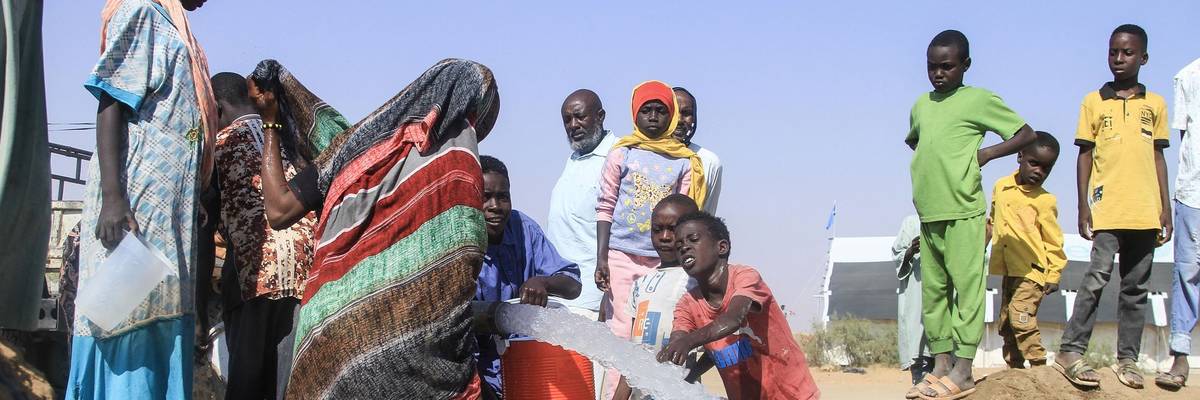
Sudanese people fill cans with water at the Al-Afad camp for displaced people in the town of Al-Dabba, northern Sudan on November 21, 2025.
Doctors Without Borders Says Trump Aid Cuts Fueling Humanitarian Catastrophe in Sudan
"War is driving Sudan’s needs; funding cuts are shrinking the response."
The renowned humanitarian group Doctors Without Borders said Tuesday that the Trump administration's destruction of the US Agency for International Development has contributed to the collapse of the war-torn nation's healthcare system, forcing clinics to close and leaving millions of people without access to lifesaving treatment.
The organization, known internationally as Médecins Sans Frontières (MSF), said the closure of USAID last year at the behest of President Donald Trump and the world's richest man, Elon Musk, left many healthcare providers in Sudan "unable to find alternative funding to continue providing services," leaving facilities with no option but to shut down in the midst of a worsening humanitarian catastrophe.
"War is driving Sudan’s needs; funding cuts are shrinking the response,” Muhammad Ibrahim, MSF's head of mission in Sudan, said in a statement on Tuesday. “MSF’s work in Sudan is privately funded. But when funding disappears from other health services, clinics close, patients have fewer places to go, and pressure shifts to the facilities that remain, including ours.”
MSF said its hospital in Um Rakuba, a refugee camp in eastern Sudan, is now "the only lifeline left" for locals and refugees.
"The cuts here go well beyond healthcare," emphasized Fabrizio Locuratolo, MSF humanitarian affairs manager. "Food rations are shrinking and protection programs are being dismantled, pulling away the last safety nets and leaving refugees completely exposed.”
The dismantling of USAID by Musk's wrecking crew at the so-called US Department of Government Efficiency has already killed hundreds of thousands of people—most of them children—according to experts tracking the impacts on humanitarian aid around the world. Musk and the Trump administration have continued to deny that the aid cuts have killed any children.
A study published in The Lancet earlier this year estimated that the gutting of USAID—whose surviving programs were mostly transferred to the US State Department—could result in more than 14 million additional deaths by the end of the decade. The US Department of Agriculture took over USAID's Food for Peace program—and subsequently omitted Sudan from the list of countries that would receive shipments of US grain.
MSF said Tuesday that "just as health providers faced the impending removal of US support, many European governments also reduced their assistance to people in Sudan."
The results have been horrific. MSF said that "malaria and malnutrition cases are already rising despite limited rainfall, ahead of the peak of the rainy season—and we expect numbers to increase as the rain intensifies."
"In August, our teams admitted 191 children under five with severe malnutrition to our inpatient feeding center, and nearly 22% also tested positive for malaria," the group said Tuesday. "The UN reports that 825,000 children under five are expected to suffer severe acute malnutrition and 19.5 million people faced crisis-level hunger earlier this year. Yet the UN’s $2.87 billion response plan is barely 41 per cent funded, and 37 per cent of Sudan’s health facilities are estimated to be completely out of service."
"As world leaders gather at the UN General Assembly, governments and institutional donors must protect funding for essential health services in Sudan and provide flexible transitional financing where facilities are at risk of closure," the organization pleaded.
We are at a crossroads
This country and this world are at a monumental crossroads. In a few short weeks, US voters will have an opportunity to beat back the forces of fascism and confront the billionaires who are rigging the economy, our media system, and our democracy, making it increasingly impossible for ordinary people to get by. We’re not just talking about the election. We’re talking about what must be done once these fascist elements are vanquished from power. We need a bolder set of solutions than what either major party has so far been willing to offer and a working-class movement ready to fight like hell for it. Trump didn't emerge from nowhere. The conditions that fueled MAGA authoritarianism were created by decades of radical neoliberal economic policies and a corrupt political system dominated by corporate interests. They slashed taxes on the super-rich, promising that the benefits would trickle down. They said giveaways to the corporate titans would make life more affordable for the rest of us. It was all bullshit. And when a bitter, betrayed populace searches for someone to blame, right-wing demagogues have little trouble finding scapegoats. People know when they're being lied to, but you won't hear any of this from the corporate media. Only independent journalism—powered and funded by people who believe in building a better world—can deliver truly trustworthy daily news. Our Fall Campaign is underway, and we need your help. To power our newsroom through the rest of the year, we need to raise $125,000 by midnight on October 31. So if you share our vision, please contribute whatever you can to sustain our work. |
The renowned humanitarian group Doctors Without Borders said Tuesday that the Trump administration's destruction of the US Agency for International Development has contributed to the collapse of the war-torn nation's healthcare system, forcing clinics to close and leaving millions of people without access to lifesaving treatment.
The organization, known internationally as Médecins Sans Frontières (MSF), said the closure of USAID last year at the behest of President Donald Trump and the world's richest man, Elon Musk, left many healthcare providers in Sudan "unable to find alternative funding to continue providing services," leaving facilities with no option but to shut down in the midst of a worsening humanitarian catastrophe.
"War is driving Sudan’s needs; funding cuts are shrinking the response,” Muhammad Ibrahim, MSF's head of mission in Sudan, said in a statement on Tuesday. “MSF’s work in Sudan is privately funded. But when funding disappears from other health services, clinics close, patients have fewer places to go, and pressure shifts to the facilities that remain, including ours.”
MSF said its hospital in Um Rakuba, a refugee camp in eastern Sudan, is now "the only lifeline left" for locals and refugees.
"The cuts here go well beyond healthcare," emphasized Fabrizio Locuratolo, MSF humanitarian affairs manager. "Food rations are shrinking and protection programs are being dismantled, pulling away the last safety nets and leaving refugees completely exposed.”
The dismantling of USAID by Musk's wrecking crew at the so-called US Department of Government Efficiency has already killed hundreds of thousands of people—most of them children—according to experts tracking the impacts on humanitarian aid around the world. Musk and the Trump administration have continued to deny that the aid cuts have killed any children.
A study published in The Lancet earlier this year estimated that the gutting of USAID—whose surviving programs were mostly transferred to the US State Department—could result in more than 14 million additional deaths by the end of the decade. The US Department of Agriculture took over USAID's Food for Peace program—and subsequently omitted Sudan from the list of countries that would receive shipments of US grain.
MSF said Tuesday that "just as health providers faced the impending removal of US support, many European governments also reduced their assistance to people in Sudan."
The results have been horrific. MSF said that "malaria and malnutrition cases are already rising despite limited rainfall, ahead of the peak of the rainy season—and we expect numbers to increase as the rain intensifies."
"In August, our teams admitted 191 children under five with severe malnutrition to our inpatient feeding center, and nearly 22% also tested positive for malaria," the group said Tuesday. "The UN reports that 825,000 children under five are expected to suffer severe acute malnutrition and 19.5 million people faced crisis-level hunger earlier this year. Yet the UN’s $2.87 billion response plan is barely 41 per cent funded, and 37 per cent of Sudan’s health facilities are estimated to be completely out of service."
"As world leaders gather at the UN General Assembly, governments and institutional donors must protect funding for essential health services in Sudan and provide flexible transitional financing where facilities are at risk of closure," the organization pleaded.
The renowned humanitarian group Doctors Without Borders said Tuesday that the Trump administration's destruction of the US Agency for International Development has contributed to the collapse of the war-torn nation's healthcare system, forcing clinics to close and leaving millions of people without access to lifesaving treatment.
The organization, known internationally as Médecins Sans Frontières (MSF), said the closure of USAID last year at the behest of President Donald Trump and the world's richest man, Elon Musk, left many healthcare providers in Sudan "unable to find alternative funding to continue providing services," leaving facilities with no option but to shut down in the midst of a worsening humanitarian catastrophe.
"War is driving Sudan’s needs; funding cuts are shrinking the response,” Muhammad Ibrahim, MSF's head of mission in Sudan, said in a statement on Tuesday. “MSF’s work in Sudan is privately funded. But when funding disappears from other health services, clinics close, patients have fewer places to go, and pressure shifts to the facilities that remain, including ours.”
MSF said its hospital in Um Rakuba, a refugee camp in eastern Sudan, is now "the only lifeline left" for locals and refugees.
"The cuts here go well beyond healthcare," emphasized Fabrizio Locuratolo, MSF humanitarian affairs manager. "Food rations are shrinking and protection programs are being dismantled, pulling away the last safety nets and leaving refugees completely exposed.”
The dismantling of USAID by Musk's wrecking crew at the so-called US Department of Government Efficiency has already killed hundreds of thousands of people—most of them children—according to experts tracking the impacts on humanitarian aid around the world. Musk and the Trump administration have continued to deny that the aid cuts have killed any children.
A study published in The Lancet earlier this year estimated that the gutting of USAID—whose surviving programs were mostly transferred to the US State Department—could result in more than 14 million additional deaths by the end of the decade. The US Department of Agriculture took over USAID's Food for Peace program—and subsequently omitted Sudan from the list of countries that would receive shipments of US grain.
MSF said Tuesday that "just as health providers faced the impending removal of US support, many European governments also reduced their assistance to people in Sudan."
The results have been horrific. MSF said that "malaria and malnutrition cases are already rising despite limited rainfall, ahead of the peak of the rainy season—and we expect numbers to increase as the rain intensifies."
"In August, our teams admitted 191 children under five with severe malnutrition to our inpatient feeding center, and nearly 22% also tested positive for malaria," the group said Tuesday. "The UN reports that 825,000 children under five are expected to suffer severe acute malnutrition and 19.5 million people faced crisis-level hunger earlier this year. Yet the UN’s $2.87 billion response plan is barely 41 per cent funded, and 37 per cent of Sudan’s health facilities are estimated to be completely out of service."
"As world leaders gather at the UN General Assembly, governments and institutional donors must protect funding for essential health services in Sudan and provide flexible transitional financing where facilities are at risk of closure," the organization pleaded.