SUBSCRIBE TO OUR FREE NEWSLETTER
Daily news & progressive opinion—funded by the people, not the corporations—delivered straight to your inbox.
5
#000000
#FFFFFF
To donate by check, phone, or other method, see our More Ways to Give page.
Daily news & progressive opinion—funded by the people, not the corporations—delivered straight to your inbox.
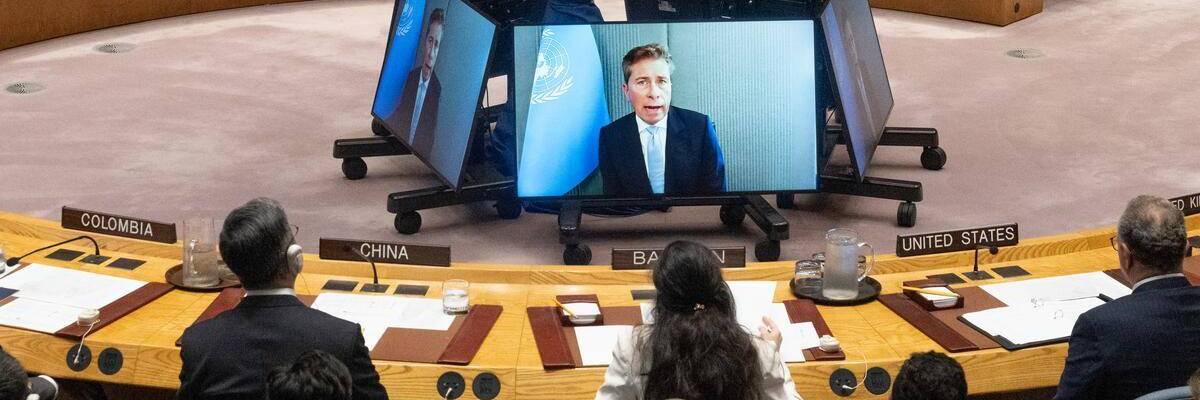
Tom Fletcher, United Nations under-secretary-general for humanitarian affairs and emergency relief coordinator, briefs the UN Security Council meeting on the situation in the Sudan and South Sudan on August 25, 2026.
"Humanitarians are seizing every opportunity to reach those in need. But we need protection for civilians. We need de-escalation."
Over three years into a civil war in Sudan, the humanitarian crisis is getting worse in the African nation due to "a lack of action" by the international community, a United Nations leader told the UN Security Council on Monday.
The war between the government's Sudanese Armed Forces and a paramilitary group called the Rapid Support Forces (RSF) began in April 2023. Now, "more than two-thirds of the people of Sudan are in desperate need of lifesaving support," said Tom Fletcher, UN under-secretary-general for humanitarian affairs and emergency relief coordinator.
"Humanitarians are seizing every opportunity to reach those in need. But we need protection for civilians. We need de-escalation," Fletcher stressed, detailing efforts to provide aid throughout the country. "Across Sudan, our teams navigate frontlines, drone attacks, insecurity, and bureaucratic red tape."
"I usually end these briefings with three asks: Uphold international humanitarian law, fund the response, and help end the conflict. But today I won't because this council has heard those asks again and again," he explained. "Instead, the ask is that we not have another meeting where the council simply describes the problem."
According to Fletcher: "Sudan does not suffer from a lack of analysis. It suffers from a lack of action. The people of Sudan need food, water, and medicine. Yet the world sends drones, weapons, and mercenaries. The people of Sudan need sustained, courageous diplomacy. Yet the world is too often indifferent and distracted. The people of Sudan need peace and dignity. Yet others use Sudan's land and people as pieces in a regional struggle for power, gold, and pride."
"This council is not powerless," he emphasized. "The international community is not powerless. The tragedy of Sudan is not that we do not know what to do. It is that we have not yet found the will to do it."
Fletcher also pointed to remarks to the Security Council from Rosemary DiCarlo, under-secretary-general for political and peacebuilding affairs, who noted the deadly impact of drones and that the true death toll "is likely to be in the hundreds of thousands."
Roughly 13 million people have been displaced, making it hard to tally deaths, but "brutal mass killings and atrocities, abductions of women and girls, and mass rapes are recurring patterns," DiCarlo said, declaring that "the consequences of this conflict will be long-lasting and should shock us all."
The Security Council meeting came less than three weeks before a two-decade-old Darfur arms embargo is set to expire, absent a new agreement. The US envoy in attendance, Massad Boulos, called for broadening the embargo to cover all of Sudan.
"The United States has put forward a strong resolution that provides for four key things," he said, including "expanding the arms embargo across the entire territory of Sudan," applying the restrictions to all armed parties, making clear that it applies to drones, and strengthening surveillance of violations.
Earlier this month, US Sen. Chris Van Hollen (D-Md.) led 20 senators in demanding that the Trump administration go beyond denouncing Sudan's paramilitary group and take "concrete action" to prevent more mass atrocities. They wrote that "these actions should include ceasing certain US arms sales to external actors that are fueling this war, including the United Arab Emirates, which continues to arm the RSF."
Dear Common Dreams reader, It’s been nearly 30 years since I co-founded Common Dreams with my late wife, Lina Newhouser. We had the radical notion that journalism should serve the public good, not corporate profits. It was clear to us from the outset what it would take to build such a project. No paid advertisements. No corporate sponsors. No millionaire publisher telling us what to think or do. Many people said we wouldn't last a year, but we proved those doubters wrong. Together with a tremendous team of journalists and dedicated staff, we built an independent media outlet free from the constraints of profits and corporate control. Our mission has always been simple: To inform. To inspire. To ignite change for the common good. Building Common Dreams was not easy. Our survival was never guaranteed. When you take on the most powerful forces—Wall Street greed, fossil fuel industry destruction, Big Tech lobbyists, and uber-rich oligarchs who have spent billions upon billions rigging the economy and democracy in their favor—the only bulwark you have is supporters who believe in your work. But here’s the urgent message from me today. It's never been this bad out there. And it's never been this hard to keep us going. At the very moment Common Dreams is most needed, the threats we face are intensifying. We need your support now more than ever. We don't accept corporate advertising and never will. We don't have a paywall because we don't think people should be blocked from critical news based on their ability to pay. Everything we do is funded by the donations of readers like you. When everyone does the little they can afford, we are strong. But if that support retreats or dries up, so do we. Will you donate now to make sure Common Dreams not only survives but thrives? —Craig Brown, Co-founder |
Over three years into a civil war in Sudan, the humanitarian crisis is getting worse in the African nation due to "a lack of action" by the international community, a United Nations leader told the UN Security Council on Monday.
The war between the government's Sudanese Armed Forces and a paramilitary group called the Rapid Support Forces (RSF) began in April 2023. Now, "more than two-thirds of the people of Sudan are in desperate need of lifesaving support," said Tom Fletcher, UN under-secretary-general for humanitarian affairs and emergency relief coordinator.
"Humanitarians are seizing every opportunity to reach those in need. But we need protection for civilians. We need de-escalation," Fletcher stressed, detailing efforts to provide aid throughout the country. "Across Sudan, our teams navigate frontlines, drone attacks, insecurity, and bureaucratic red tape."
"I usually end these briefings with three asks: Uphold international humanitarian law, fund the response, and help end the conflict. But today I won't because this council has heard those asks again and again," he explained. "Instead, the ask is that we not have another meeting where the council simply describes the problem."
According to Fletcher: "Sudan does not suffer from a lack of analysis. It suffers from a lack of action. The people of Sudan need food, water, and medicine. Yet the world sends drones, weapons, and mercenaries. The people of Sudan need sustained, courageous diplomacy. Yet the world is too often indifferent and distracted. The people of Sudan need peace and dignity. Yet others use Sudan's land and people as pieces in a regional struggle for power, gold, and pride."
"This council is not powerless," he emphasized. "The international community is not powerless. The tragedy of Sudan is not that we do not know what to do. It is that we have not yet found the will to do it."
Fletcher also pointed to remarks to the Security Council from Rosemary DiCarlo, under-secretary-general for political and peacebuilding affairs, who noted the deadly impact of drones and that the true death toll "is likely to be in the hundreds of thousands."
Roughly 13 million people have been displaced, making it hard to tally deaths, but "brutal mass killings and atrocities, abductions of women and girls, and mass rapes are recurring patterns," DiCarlo said, declaring that "the consequences of this conflict will be long-lasting and should shock us all."
The Security Council meeting came less than three weeks before a two-decade-old Darfur arms embargo is set to expire, absent a new agreement. The US envoy in attendance, Massad Boulos, called for broadening the embargo to cover all of Sudan.
"The United States has put forward a strong resolution that provides for four key things," he said, including "expanding the arms embargo across the entire territory of Sudan," applying the restrictions to all armed parties, making clear that it applies to drones, and strengthening surveillance of violations.
Earlier this month, US Sen. Chris Van Hollen (D-Md.) led 20 senators in demanding that the Trump administration go beyond denouncing Sudan's paramilitary group and take "concrete action" to prevent more mass atrocities. They wrote that "these actions should include ceasing certain US arms sales to external actors that are fueling this war, including the United Arab Emirates, which continues to arm the RSF."
Over three years into a civil war in Sudan, the humanitarian crisis is getting worse in the African nation due to "a lack of action" by the international community, a United Nations leader told the UN Security Council on Monday.
The war between the government's Sudanese Armed Forces and a paramilitary group called the Rapid Support Forces (RSF) began in April 2023. Now, "more than two-thirds of the people of Sudan are in desperate need of lifesaving support," said Tom Fletcher, UN under-secretary-general for humanitarian affairs and emergency relief coordinator.
"Humanitarians are seizing every opportunity to reach those in need. But we need protection for civilians. We need de-escalation," Fletcher stressed, detailing efforts to provide aid throughout the country. "Across Sudan, our teams navigate frontlines, drone attacks, insecurity, and bureaucratic red tape."
"I usually end these briefings with three asks: Uphold international humanitarian law, fund the response, and help end the conflict. But today I won't because this council has heard those asks again and again," he explained. "Instead, the ask is that we not have another meeting where the council simply describes the problem."
According to Fletcher: "Sudan does not suffer from a lack of analysis. It suffers from a lack of action. The people of Sudan need food, water, and medicine. Yet the world sends drones, weapons, and mercenaries. The people of Sudan need sustained, courageous diplomacy. Yet the world is too often indifferent and distracted. The people of Sudan need peace and dignity. Yet others use Sudan's land and people as pieces in a regional struggle for power, gold, and pride."
"This council is not powerless," he emphasized. "The international community is not powerless. The tragedy of Sudan is not that we do not know what to do. It is that we have not yet found the will to do it."
Fletcher also pointed to remarks to the Security Council from Rosemary DiCarlo, under-secretary-general for political and peacebuilding affairs, who noted the deadly impact of drones and that the true death toll "is likely to be in the hundreds of thousands."
Roughly 13 million people have been displaced, making it hard to tally deaths, but "brutal mass killings and atrocities, abductions of women and girls, and mass rapes are recurring patterns," DiCarlo said, declaring that "the consequences of this conflict will be long-lasting and should shock us all."
The Security Council meeting came less than three weeks before a two-decade-old Darfur arms embargo is set to expire, absent a new agreement. The US envoy in attendance, Massad Boulos, called for broadening the embargo to cover all of Sudan.
"The United States has put forward a strong resolution that provides for four key things," he said, including "expanding the arms embargo across the entire territory of Sudan," applying the restrictions to all armed parties, making clear that it applies to drones, and strengthening surveillance of violations.
Earlier this month, US Sen. Chris Van Hollen (D-Md.) led 20 senators in demanding that the Trump administration go beyond denouncing Sudan's paramilitary group and take "concrete action" to prevent more mass atrocities. They wrote that "these actions should include ceasing certain US arms sales to external actors that are fueling this war, including the United Arab Emirates, which continues to arm the RSF."