SUBSCRIBE TO OUR FREE NEWSLETTER
Daily news & progressive opinion—funded by the people, not the corporations—delivered straight to your inbox.
5
#000000
#FFFFFF
To donate by check, phone, or other method, see our More Ways to Give page.
Daily news & progressive opinion—funded by the people, not the corporations—delivered straight to your inbox.
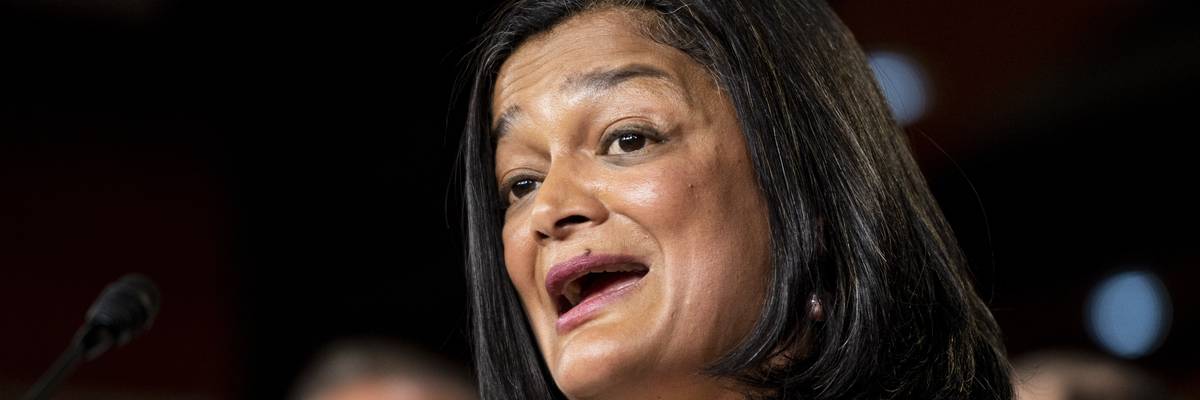
Rep. Pramila Jayapal (D-Wash.) participates in the news conference in the Capitol on June 16, 2021.
Agencies have used their subpoena power "to surveil, intimidate, and suppress the free speech of ordinary citizens and even the free press," said the Democrats.
Under the Trump administration, said Rep. Pramila Jayapal and Sen. Ron Wyden this week, federal agencies' use of subpoena power to surveil Americans has become "institutionalized" in what the two Democrats called "brazen abuses of authority."
Jayapal (Wash.) and Wyden (Ore.) wrote to US Supreme Court Chief Justice John Roberts and the acting comptroller general of the Government Accountability Office (GAO), Orice Brown, regarding what they called federal agencies’ decades-long practice of attempting "to coerce indefinite silence from private companies that receive subpoenas for customer information."
While federal agencies have the congressionally vested authority to serve companies and service providers with administrative subpoeanas when they are seeking information about the provider's customer or client, the recipient generally maintains the "First Amendment right to notify their customers of the demand, allowing the actual targets of the subpoenas the opportunity to assert their own legal rights or challenge the demand in court," wrote Jayapal and Wyden.
If secrecy is required in a specific case, the agency can apply to a court for a time-limited nondisclosure order, but in the vast majority of cases, the lawmakers said in a statement, "the agencies may not gag recipients of subpoenas."
That appears to have changed under the Trump administration.
Wyden and Jayapal pointed to one incident from July 8, 2025, when Harvard University received three immigration subpoeanas from US Immigration and Customs Enforcement (ICE) regarding international students, which contained "boilerplate requests for silence."'
"The absurdity of this secrecy demand was demonstrated the very next day, when the Department of Homeland Security (DHS) issued a press release celebrating the very enforcement action it had just directed Harvard to keep secret," wrote the lawmakers.
Homeland Security Investigations (HSI), which operates under ICE, has summons authority only for records relating to customs issues such as illegal imports or unpaid customs dues.
However, HSI has used its subpoena power "to surveil, intimidate, and suppress the free speech of ordinary citizens and even the free press"—in one case trying to reveal the identity of an anonymous Instagram user who had criticized and publicized ICE operations, according to the lawmakers.
Earlier this week, The Guardian reported that HSI had used the subpoenas to secretly obtain six months' worth of phone records for Georgia Fort, a Minneapolis-based journalist who, along with former CNN anchor Don Lemon, was arrested in January for covering an anti-ICE protest at a church.
While the secrecy demands that come with subpoenas "carry no force of law," said the lawmakers, "their coercive effect is extremely successful. This leaves customers entirely in the dark about government incursions into their personal data."
Jayapal and Wyden noted that federal agencies were demanding secrecy from subpoenaed companies and third parties for decades before President Donald Trump took office.
For over four decades, they said, the Department of Justice (DOJ) "has treated extra-legal gag requests as standard operating procedure,
regularly instructing the recipients of grand jury subpoenas not to disclose the government's demands."
"Given the severe, asymmetric power dynamics between federal law enforcement and civilian businesses—particularly when the subpoena recipient is a business operating within a highly regulated industry—many corporate legal departments will naturally read an official prosecutorial 'request' for silence as an implied command, choosing compliance over risking scrutiny from federal regulators," wrote Wyden and Jayapal. "This coercive silence is particularly insidious because it targets corporate policies intended to protect consumers. For nearly every American industry, including telecommunications, technology, and healthcare, Congress has neither required nor prohibited notice of subpoenas. Absent a court order or statute saying otherwise, notice to customers is a protected exercise of free speech that furthers government transparency and customer privacy."
The lawmakers called on the GAO to conduct a comprehensive audit of the DOJ and DHS as well as the agencies they oversee regarding their use of gag requests in subpoenas.
Such an audit would "help ensure that agencies do not abuse their subpoena authorities at the expense of privacy and free speech rights," said Jayapal and Wyden.
Dear Common Dreams reader, It’s been nearly 30 years since I co-founded Common Dreams with my late wife, Lina Newhouser. We had the radical notion that journalism should serve the public good, not corporate profits. It was clear to us from the outset what it would take to build such a project. No paid advertisements. No corporate sponsors. No millionaire publisher telling us what to think or do. Many people said we wouldn't last a year, but we proved those doubters wrong. Together with a tremendous team of journalists and dedicated staff, we built an independent media outlet free from the constraints of profits and corporate control. Our mission has always been simple: To inform. To inspire. To ignite change for the common good. Building Common Dreams was not easy. Our survival was never guaranteed. When you take on the most powerful forces—Wall Street greed, fossil fuel industry destruction, Big Tech lobbyists, and uber-rich oligarchs who have spent billions upon billions rigging the economy and democracy in their favor—the only bulwark you have is supporters who believe in your work. But here’s the urgent message from me today. It's never been this bad out there. And it's never been this hard to keep us going. At the very moment Common Dreams is most needed, the threats we face are intensifying. We need your support now more than ever. We don't accept corporate advertising and never will. We don't have a paywall because we don't think people should be blocked from critical news based on their ability to pay. Everything we do is funded by the donations of readers like you. When everyone does the little they can afford, we are strong. But if that support retreats or dries up, so do we. Will you donate now to make sure Common Dreams not only survives but thrives? —Craig Brown, Co-founder |
Under the Trump administration, said Rep. Pramila Jayapal and Sen. Ron Wyden this week, federal agencies' use of subpoena power to surveil Americans has become "institutionalized" in what the two Democrats called "brazen abuses of authority."
Jayapal (Wash.) and Wyden (Ore.) wrote to US Supreme Court Chief Justice John Roberts and the acting comptroller general of the Government Accountability Office (GAO), Orice Brown, regarding what they called federal agencies’ decades-long practice of attempting "to coerce indefinite silence from private companies that receive subpoenas for customer information."
While federal agencies have the congressionally vested authority to serve companies and service providers with administrative subpoeanas when they are seeking information about the provider's customer or client, the recipient generally maintains the "First Amendment right to notify their customers of the demand, allowing the actual targets of the subpoenas the opportunity to assert their own legal rights or challenge the demand in court," wrote Jayapal and Wyden.
If secrecy is required in a specific case, the agency can apply to a court for a time-limited nondisclosure order, but in the vast majority of cases, the lawmakers said in a statement, "the agencies may not gag recipients of subpoenas."
That appears to have changed under the Trump administration.
Wyden and Jayapal pointed to one incident from July 8, 2025, when Harvard University received three immigration subpoeanas from US Immigration and Customs Enforcement (ICE) regarding international students, which contained "boilerplate requests for silence."'
"The absurdity of this secrecy demand was demonstrated the very next day, when the Department of Homeland Security (DHS) issued a press release celebrating the very enforcement action it had just directed Harvard to keep secret," wrote the lawmakers.
Homeland Security Investigations (HSI), which operates under ICE, has summons authority only for records relating to customs issues such as illegal imports or unpaid customs dues.
However, HSI has used its subpoena power "to surveil, intimidate, and suppress the free speech of ordinary citizens and even the free press"—in one case trying to reveal the identity of an anonymous Instagram user who had criticized and publicized ICE operations, according to the lawmakers.
Earlier this week, The Guardian reported that HSI had used the subpoenas to secretly obtain six months' worth of phone records for Georgia Fort, a Minneapolis-based journalist who, along with former CNN anchor Don Lemon, was arrested in January for covering an anti-ICE protest at a church.
While the secrecy demands that come with subpoenas "carry no force of law," said the lawmakers, "their coercive effect is extremely successful. This leaves customers entirely in the dark about government incursions into their personal data."
Jayapal and Wyden noted that federal agencies were demanding secrecy from subpoenaed companies and third parties for decades before President Donald Trump took office.
For over four decades, they said, the Department of Justice (DOJ) "has treated extra-legal gag requests as standard operating procedure,
regularly instructing the recipients of grand jury subpoenas not to disclose the government's demands."
"Given the severe, asymmetric power dynamics between federal law enforcement and civilian businesses—particularly when the subpoena recipient is a business operating within a highly regulated industry—many corporate legal departments will naturally read an official prosecutorial 'request' for silence as an implied command, choosing compliance over risking scrutiny from federal regulators," wrote Wyden and Jayapal. "This coercive silence is particularly insidious because it targets corporate policies intended to protect consumers. For nearly every American industry, including telecommunications, technology, and healthcare, Congress has neither required nor prohibited notice of subpoenas. Absent a court order or statute saying otherwise, notice to customers is a protected exercise of free speech that furthers government transparency and customer privacy."
The lawmakers called on the GAO to conduct a comprehensive audit of the DOJ and DHS as well as the agencies they oversee regarding their use of gag requests in subpoenas.
Such an audit would "help ensure that agencies do not abuse their subpoena authorities at the expense of privacy and free speech rights," said Jayapal and Wyden.
Under the Trump administration, said Rep. Pramila Jayapal and Sen. Ron Wyden this week, federal agencies' use of subpoena power to surveil Americans has become "institutionalized" in what the two Democrats called "brazen abuses of authority."
Jayapal (Wash.) and Wyden (Ore.) wrote to US Supreme Court Chief Justice John Roberts and the acting comptroller general of the Government Accountability Office (GAO), Orice Brown, regarding what they called federal agencies’ decades-long practice of attempting "to coerce indefinite silence from private companies that receive subpoenas for customer information."
While federal agencies have the congressionally vested authority to serve companies and service providers with administrative subpoeanas when they are seeking information about the provider's customer or client, the recipient generally maintains the "First Amendment right to notify their customers of the demand, allowing the actual targets of the subpoenas the opportunity to assert their own legal rights or challenge the demand in court," wrote Jayapal and Wyden.
If secrecy is required in a specific case, the agency can apply to a court for a time-limited nondisclosure order, but in the vast majority of cases, the lawmakers said in a statement, "the agencies may not gag recipients of subpoenas."
That appears to have changed under the Trump administration.
Wyden and Jayapal pointed to one incident from July 8, 2025, when Harvard University received three immigration subpoeanas from US Immigration and Customs Enforcement (ICE) regarding international students, which contained "boilerplate requests for silence."'
"The absurdity of this secrecy demand was demonstrated the very next day, when the Department of Homeland Security (DHS) issued a press release celebrating the very enforcement action it had just directed Harvard to keep secret," wrote the lawmakers.
Homeland Security Investigations (HSI), which operates under ICE, has summons authority only for records relating to customs issues such as illegal imports or unpaid customs dues.
However, HSI has used its subpoena power "to surveil, intimidate, and suppress the free speech of ordinary citizens and even the free press"—in one case trying to reveal the identity of an anonymous Instagram user who had criticized and publicized ICE operations, according to the lawmakers.
Earlier this week, The Guardian reported that HSI had used the subpoenas to secretly obtain six months' worth of phone records for Georgia Fort, a Minneapolis-based journalist who, along with former CNN anchor Don Lemon, was arrested in January for covering an anti-ICE protest at a church.
While the secrecy demands that come with subpoenas "carry no force of law," said the lawmakers, "their coercive effect is extremely successful. This leaves customers entirely in the dark about government incursions into their personal data."
Jayapal and Wyden noted that federal agencies were demanding secrecy from subpoenaed companies and third parties for decades before President Donald Trump took office.
For over four decades, they said, the Department of Justice (DOJ) "has treated extra-legal gag requests as standard operating procedure,
regularly instructing the recipients of grand jury subpoenas not to disclose the government's demands."
"Given the severe, asymmetric power dynamics between federal law enforcement and civilian businesses—particularly when the subpoena recipient is a business operating within a highly regulated industry—many corporate legal departments will naturally read an official prosecutorial 'request' for silence as an implied command, choosing compliance over risking scrutiny from federal regulators," wrote Wyden and Jayapal. "This coercive silence is particularly insidious because it targets corporate policies intended to protect consumers. For nearly every American industry, including telecommunications, technology, and healthcare, Congress has neither required nor prohibited notice of subpoenas. Absent a court order or statute saying otherwise, notice to customers is a protected exercise of free speech that furthers government transparency and customer privacy."
The lawmakers called on the GAO to conduct a comprehensive audit of the DOJ and DHS as well as the agencies they oversee regarding their use of gag requests in subpoenas.
Such an audit would "help ensure that agencies do not abuse their subpoena authorities at the expense of privacy and free speech rights," said Jayapal and Wyden.