5
#000000
#FFFFFF
To donate by check, phone, or other method, see our More Ways to Give page.
Daily news & progressive opinion—funded by the people, not the corporations—delivered straight to your inbox.
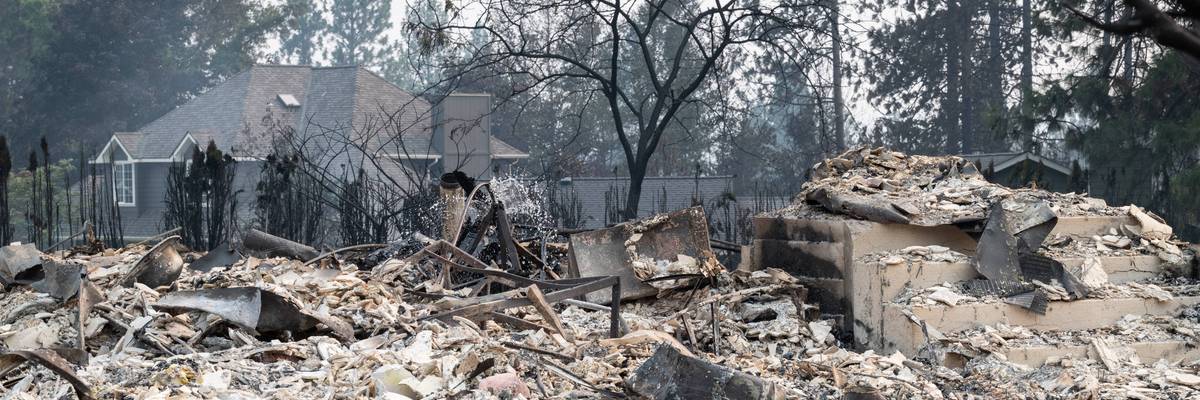
The rubble of a burned out residential home smolders in the Balboa neighborhood of Spokane, Washington, on August 2, 2026.
"The fossil fuel industry may not have struck the match, but the climate crisis they drove has loaded our landscapes with tinder," said an environmental activist.
Over 60,000 people were ordered to evacuate the Spokane area over the weekend as it was devastated by what Democratic Washington Sen. Maria Cantwell called the “top fire” in a nation currently being scorched by climate-fueled blazes.
Illustrating how the climate crisis is already impacting lives and communities across the country and the globe, three raging fires reportedly consumed over 600 structures as of Sunday, including homes and businesses, and reduced entire streets to their foundations.
At a briefing on Sunday afternoon, officials said more than 250,000 acres were burning across Washington, but reported no deaths or injuries.
Spokane Mayor Lisa Brown called it "the worst natural disaster our region has faced."
Democratic Gov. Bob Ferguson has requested assistance from the Federal Emergency Management Agency (FEMA), which is under the Trump administration's Department of Homeland Security (DHS).
Sen. Patty Murray (D-Wash.) wrote on social media that she had spoken with Homeland Security Secretary Markwayne Mullin and that he “made clear the federal government will do everything it can to support response and recovery,” though President Donald Trump has previously intervened to block disaster aid to Democrat-led states.
While the fires moderated over the weekend, on Monday they remained largely uncontained and continued to spread due to dry conditions from recent severe droughts in the region, exacerbated by rising global temperatures.
"This is climate change playing out live in real time," said meteorologist and Climate Central journalist Shel Winkley in a video about the Spokane fires.
Warmer temperatures, he explained, have caused a vicious cycle of "weather whiplash" in which greater winter rainfall facilitates plant growth before harsher summer heat domes suck moisture from these plants, turning them into a tinderbox.
“Northeastern Washington and central Oregon now see at least three more weeks of fire weather days each year than they did just back in the 1970s,” Winkley said. “More fire weather days means more chances for a spark, any spark, to turn into this.”
The blazes are part of a nationwide trend, with wildfires this year more severe on average than in previous years. Over the past decade, the average annual acreage burned in the US was more than double the average of the late 1980s and early 1990s, according to data from the National Interagency Fire Center.
Last week, an Oxfam analysis of data published in the journal Nature found that emissions from just five oil companies—BP, Chevron, ExxonMobil, Shell, and TotalEnergies—were sufficient to cause around 1 in 4 heatwaves reported globally between 2000 and 2023—"heatwaves that would have been virtually impossible without human-made climate change."
Using S&P Capital Trucost data, the group estimated that Big Oil was responsible for more than $60 billion in environmental damage last year.
But as costs fall on the public, oil companies like Chevron and ExxonMobil have reported record profits of $12.1 billion and $14.5 billion over the past quarter, in part due to global oil price spikes driven by Trump's war with Iran.
"The fossil fuel industry may not have struck the match, but the climate crisis they drove has loaded our landscapes with tinder," said Clémence Dubois, the campaigns director for the environmental group 350.org. "Chevron and Exxon are profiteering from a model of distraction, leaving ordinary people to pay the price with higher bills and devastating impacts such as these fires. These profits feel almost criminal.“
Jay Inslee, Washington's former Democratic governor and a longtime advocate for policies to combat the climate crisis, said on Sunday that his friend, a legislator from Spokane, had been forced to flee his home due to the fires.
“Climate change isn’t some faraway threat,” Inslee said. “It’s happening right now, to our neighbors and friends. We have to fight for them."
Dear Common Dreams reader, It’s been nearly 30 years since I co-founded Common Dreams with my late wife, Lina Newhouser. We had the radical notion that journalism should serve the public good, not corporate profits. It was clear to us from the outset what it would take to build such a project. No paid advertisements. No corporate sponsors. No millionaire publisher telling us what to think or do. Many people said we wouldn't last a year, but we proved those doubters wrong. Together with a tremendous team of journalists and dedicated staff, we built an independent media outlet free from the constraints of profits and corporate control. Our mission has always been simple: To inform. To inspire. To ignite change for the common good. Building Common Dreams was not easy. Our survival was never guaranteed. When you take on the most powerful forces—Wall Street greed, fossil fuel industry destruction, Big Tech lobbyists, and uber-rich oligarchs who have spent billions upon billions rigging the economy and democracy in their favor—the only bulwark you have is supporters who believe in your work. But here’s the urgent message from me today. It's never been this bad out there. And it's never been this hard to keep us going. At the very moment Common Dreams is most needed, the threats we face are intensifying. We need your support now more than ever. We don't accept corporate advertising and never will. We don't have a paywall because we don't think people should be blocked from critical news based on their ability to pay. Everything we do is funded by the donations of readers like you. When everyone does the little they can afford, we are strong. But if that support retreats or dries up, so do we. Will you donate now to make sure Common Dreams not only survives but thrives? —Craig Brown, Co-founder |
Over 60,000 people were ordered to evacuate the Spokane area over the weekend as it was devastated by what Democratic Washington Sen. Maria Cantwell called the “top fire” in a nation currently being scorched by climate-fueled blazes.
Illustrating how the climate crisis is already impacting lives and communities across the country and the globe, three raging fires reportedly consumed over 600 structures as of Sunday, including homes and businesses, and reduced entire streets to their foundations.
At a briefing on Sunday afternoon, officials said more than 250,000 acres were burning across Washington, but reported no deaths or injuries.
Spokane Mayor Lisa Brown called it "the worst natural disaster our region has faced."
Democratic Gov. Bob Ferguson has requested assistance from the Federal Emergency Management Agency (FEMA), which is under the Trump administration's Department of Homeland Security (DHS).
Sen. Patty Murray (D-Wash.) wrote on social media that she had spoken with Homeland Security Secretary Markwayne Mullin and that he “made clear the federal government will do everything it can to support response and recovery,” though President Donald Trump has previously intervened to block disaster aid to Democrat-led states.
While the fires moderated over the weekend, on Monday they remained largely uncontained and continued to spread due to dry conditions from recent severe droughts in the region, exacerbated by rising global temperatures.
"This is climate change playing out live in real time," said meteorologist and Climate Central journalist Shel Winkley in a video about the Spokane fires.
Warmer temperatures, he explained, have caused a vicious cycle of "weather whiplash" in which greater winter rainfall facilitates plant growth before harsher summer heat domes suck moisture from these plants, turning them into a tinderbox.
“Northeastern Washington and central Oregon now see at least three more weeks of fire weather days each year than they did just back in the 1970s,” Winkley said. “More fire weather days means more chances for a spark, any spark, to turn into this.”
The blazes are part of a nationwide trend, with wildfires this year more severe on average than in previous years. Over the past decade, the average annual acreage burned in the US was more than double the average of the late 1980s and early 1990s, according to data from the National Interagency Fire Center.
Last week, an Oxfam analysis of data published in the journal Nature found that emissions from just five oil companies—BP, Chevron, ExxonMobil, Shell, and TotalEnergies—were sufficient to cause around 1 in 4 heatwaves reported globally between 2000 and 2023—"heatwaves that would have been virtually impossible without human-made climate change."
Using S&P Capital Trucost data, the group estimated that Big Oil was responsible for more than $60 billion in environmental damage last year.
But as costs fall on the public, oil companies like Chevron and ExxonMobil have reported record profits of $12.1 billion and $14.5 billion over the past quarter, in part due to global oil price spikes driven by Trump's war with Iran.
"The fossil fuel industry may not have struck the match, but the climate crisis they drove has loaded our landscapes with tinder," said Clémence Dubois, the campaigns director for the environmental group 350.org. "Chevron and Exxon are profiteering from a model of distraction, leaving ordinary people to pay the price with higher bills and devastating impacts such as these fires. These profits feel almost criminal.“
Jay Inslee, Washington's former Democratic governor and a longtime advocate for policies to combat the climate crisis, said on Sunday that his friend, a legislator from Spokane, had been forced to flee his home due to the fires.
“Climate change isn’t some faraway threat,” Inslee said. “It’s happening right now, to our neighbors and friends. We have to fight for them."
Over 60,000 people were ordered to evacuate the Spokane area over the weekend as it was devastated by what Democratic Washington Sen. Maria Cantwell called the “top fire” in a nation currently being scorched by climate-fueled blazes.
Illustrating how the climate crisis is already impacting lives and communities across the country and the globe, three raging fires reportedly consumed over 600 structures as of Sunday, including homes and businesses, and reduced entire streets to their foundations.
At a briefing on Sunday afternoon, officials said more than 250,000 acres were burning across Washington, but reported no deaths or injuries.
Spokane Mayor Lisa Brown called it "the worst natural disaster our region has faced."
Democratic Gov. Bob Ferguson has requested assistance from the Federal Emergency Management Agency (FEMA), which is under the Trump administration's Department of Homeland Security (DHS).
Sen. Patty Murray (D-Wash.) wrote on social media that she had spoken with Homeland Security Secretary Markwayne Mullin and that he “made clear the federal government will do everything it can to support response and recovery,” though President Donald Trump has previously intervened to block disaster aid to Democrat-led states.
While the fires moderated over the weekend, on Monday they remained largely uncontained and continued to spread due to dry conditions from recent severe droughts in the region, exacerbated by rising global temperatures.
"This is climate change playing out live in real time," said meteorologist and Climate Central journalist Shel Winkley in a video about the Spokane fires.
Warmer temperatures, he explained, have caused a vicious cycle of "weather whiplash" in which greater winter rainfall facilitates plant growth before harsher summer heat domes suck moisture from these plants, turning them into a tinderbox.
“Northeastern Washington and central Oregon now see at least three more weeks of fire weather days each year than they did just back in the 1970s,” Winkley said. “More fire weather days means more chances for a spark, any spark, to turn into this.”
The blazes are part of a nationwide trend, with wildfires this year more severe on average than in previous years. Over the past decade, the average annual acreage burned in the US was more than double the average of the late 1980s and early 1990s, according to data from the National Interagency Fire Center.
Last week, an Oxfam analysis of data published in the journal Nature found that emissions from just five oil companies—BP, Chevron, ExxonMobil, Shell, and TotalEnergies—were sufficient to cause around 1 in 4 heatwaves reported globally between 2000 and 2023—"heatwaves that would have been virtually impossible without human-made climate change."
Using S&P Capital Trucost data, the group estimated that Big Oil was responsible for more than $60 billion in environmental damage last year.
But as costs fall on the public, oil companies like Chevron and ExxonMobil have reported record profits of $12.1 billion and $14.5 billion over the past quarter, in part due to global oil price spikes driven by Trump's war with Iran.
"The fossil fuel industry may not have struck the match, but the climate crisis they drove has loaded our landscapes with tinder," said Clémence Dubois, the campaigns director for the environmental group 350.org. "Chevron and Exxon are profiteering from a model of distraction, leaving ordinary people to pay the price with higher bills and devastating impacts such as these fires. These profits feel almost criminal.“
Jay Inslee, Washington's former Democratic governor and a longtime advocate for policies to combat the climate crisis, said on Sunday that his friend, a legislator from Spokane, had been forced to flee his home due to the fires.
“Climate change isn’t some faraway threat,” Inslee said. “It’s happening right now, to our neighbors and friends. We have to fight for them."