SUBSCRIBE TO OUR FREE NEWSLETTER
Daily news & progressive opinion—funded by the people, not the corporations—delivered straight to your inbox.
5
#000000
#FFFFFF
To donate by check, phone, or other method, see our More Ways to Give page.
Daily news & progressive opinion—funded by the people, not the corporations—delivered straight to your inbox.
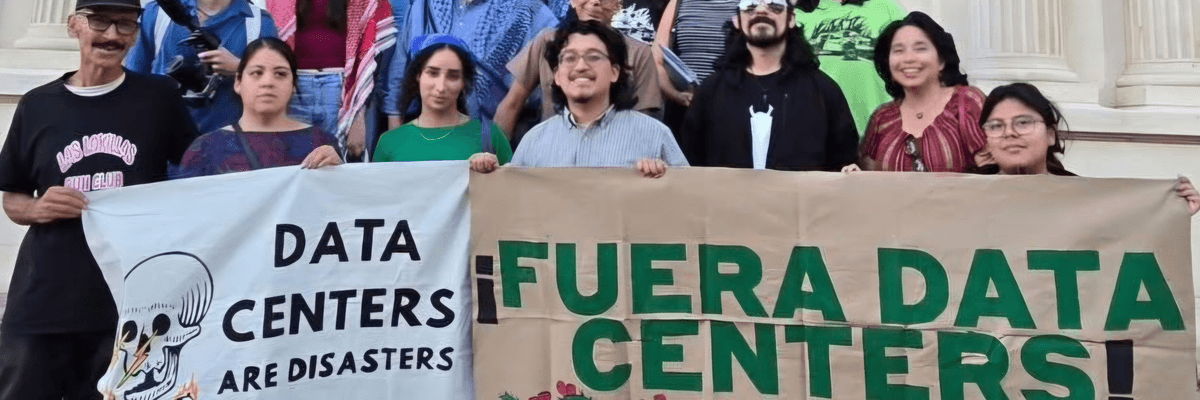
People protest a proposed SpaceX data center and gas-fired power plant in Brownsville, Texas on November 4, 2026.
"I hate the way they are taking advantage of Texas, and that stops when I'm governor," Democratic Texas Gov.-elect Gina Hinojosa said of AI companies' proliferating data centers.
Elon Musk, the world's wealthiest person, is seeking a property tax break for a proposed $24 billion SpaceX data center and gas-fired power plant in South Texas, where residents are mobilizing against the multicentibillionaire's expanding industrial footprint.
Politico reported Tuesday that commissioners in the border town of Starbase—which has around 500 residents and was incorporated in 2021 via a petition from SpaceX employees—is set to consider a proposed property tax abatement and economic development agreement for the company's facilities during a December 9 meeting. Two of the town's three commissioners are also SpaceX employees.
The data center and power plant project would occupy more than 400 acres near the Port of Brownsville, on land that the city of Brownsville agreed to de-annex in August at SpaceX's request.
In that deal, Brownsville agreed to remove 444.45 acres from its jurisdiction in exchange for SpaceX contributing up to $220 million toward regional water and wastewater infrastructure. The deal includes an initial $40 million payment and six subsequent quarterly payouts of $30 million.
Disannexation became a critical issue following Brownsville commissioners' unanimous vote last week in favor of a 90-day moratorium on permits for data center construction.
According to KRGV, SpaceX vice president Sheila McCorkle told Brownsville's six commissioners the company wanted the land removed from the city's jurisdiction to allow infrastructure development "quicker and more economically" than if it remained part of Brownsville. McCorkle also touted the move as an opportunity to boost growth and help the water supply in the Lower Rio Grande Valley, a semi-arid region suffering a severe water crisis.
That crisis is largely due to overconsumption of water—a resource data centers require in massive quantities. SpaceX has projected that its Starbase operations will eventually require approximately 2 million gallons of water per day.
Many local residents oppose both the proposed tax break and the data center/power plant project.
"Please pass a full 180-day data center moratorium. And please remember that this is supposed to be a community-led environmental task force," South Texas Environmental Justice Center co-founder Bekah Hinojosa told commissioners during a November 4 Brownsville City Commission meeting.
"You need to make sure that you're taking every possible step to ensure meaningful public input throughout this data center moratorium," she continued. "We don't know what SpaceX is building on the 444 acres. It's frankly terrifying."
Attorney Jacqueline Morales told the commissioners: "The moratorium will not make us forget that you de-annexed 444 acres of land to SpaceX, which is now building a data center. This community has been sounding the alarm for months, only for this commission to ignore us and pretend like it knows better."
"You either work to protect residents of Brownsville or you don't," Morales added. "There is no middle ground here."
The Brownsville dispute is part of the nationwide backlash against data centers, which consume enormous quantities of electricity and water while frequently seeking taxpayer-funded incentives.
Musk has met similar resistance in Louisiana, where Republican Gov. Jeff Landry's administration has offered SpaceX an estimated $27.5 billion incentive package to construct a massive launch facility on 125,000 acres of coastal land in Vermilion Parish. According to the Louisiana Illuminator, nearly $24 billion of the package consists of a 25-year property tax exemption.
The proposed deal has outraged many local residents, more than 1,000 of whom submitted comments to the Federal Aviation Administration expressing concerns about the project's environmental consequences, including damage to fragile wetlands, wildlife habitats, and the rapidly eroding Louisiana coastline.
"I'm not anti-SpaceX," small farmer Karol Bourque told The Current in September. "It's all the secrecy, the NDAs, the laws protecting all these powerful people and companies."
Ironically, Musk relocated SpaceX and other companies from California to Texas in recent years, seeking lower taxes and less regulation. During the 2026 midterm election cycle, he reportedly spent around $224 million supporting Texas Republican candidates and political committees, including Ken Paxton for the US Senate and Greg Abbott for governor.
Both lost amid Democrats' historic "blue tsunami." Democratic Sen.-elect James Talarico has explicitly targeted Musk's extreme wealth.
"We should tax trillionaires out of existence," he declared last year, warning that "the reason poverty exists in the wealthiest country on earth isn't because we can't feed the poor—it's because we can't satisfy the rich."
Abbott was beaten by Democrat Gina Hinojosa, who has called for a moratorium on new data center approvals and has pledged to end the enormous tax giveaways offered to the artificial intelligence industry.
"When I am governor I will issue a moratorium—a ban—on all data center approvals until laws can be passed by the Legislature to protect Texans," Hinojosa said in October.
She also pledged to end the enormous tax giveaways offered to the artificial intelligence industry.
"It is not that I hate data centers. I hate the way they are taking advantage of Texas, and that stops when I'm governor," she said.
Democrats also won control of the Texas House of Representatives. But even before the "blue tsunami," momentum was building in Austin to reverse the state’s formerly welcoming approach to AI data centers. Republican and Democratic lawmakers alike have signaled support for rolling back tax breaks for the industry in the upcoming legislative session. Monday marked the opening of the bill-filing period ahead of the session, which is scheduled to begin on January 12.
Among the proposals, state Sen. Judith Zaffirini (D-21) introduced legislation barring counties and other local governments from granting property tax abatements to data center operators. Two additional bills filed in the Texas House would eliminate sales tax exemptions on electricity consumed by data centers and restrict counties’ ability to enter into nondisclosure agreements with the companies.
This country and this world are at a monumental crossroads. US voters have an opportunity to beat back the forces of fascism and confront the billionaires who are rigging the economy, our media system, and our democracy, making it increasingly impossible for ordinary people to get by. We’re not just talking about the election. We’re talking about what must be done once these fascist elements are vanquished from power. We need a bolder set of solutions than what either major party has so far been willing to offer and a working-class movement ready to fight like hell for it. Trump didn't emerge from nowhere. The conditions that fueled MAGA authoritarianism were created by decades of radical neoliberal economic policies and a corrupt political system dominated by corporate interests. They slashed taxes on the super-rich, promising that the benefits would trickle down. They said giveaways to the corporate titans would make life more affordable for the rest of us. It was all bullshit. And when a bitter, betrayed populace searches for someone to blame, right-wing demagogues have little trouble finding scapegoats. People know when they're being lied to, but you won't hear any of this from the corporate media. Only independent journalism—powered and funded by people who believe in building a better world—can deliver truly trustworthy daily news. If you share our vision, please contribute whatever you can to sustain our work. |
Elon Musk, the world's wealthiest person, is seeking a property tax break for a proposed $24 billion SpaceX data center and gas-fired power plant in South Texas, where residents are mobilizing against the multicentibillionaire's expanding industrial footprint.
Politico reported Tuesday that commissioners in the border town of Starbase—which has around 500 residents and was incorporated in 2021 via a petition from SpaceX employees—is set to consider a proposed property tax abatement and economic development agreement for the company's facilities during a December 9 meeting. Two of the town's three commissioners are also SpaceX employees.
The data center and power plant project would occupy more than 400 acres near the Port of Brownsville, on land that the city of Brownsville agreed to de-annex in August at SpaceX's request.
In that deal, Brownsville agreed to remove 444.45 acres from its jurisdiction in exchange for SpaceX contributing up to $220 million toward regional water and wastewater infrastructure. The deal includes an initial $40 million payment and six subsequent quarterly payouts of $30 million.
Disannexation became a critical issue following Brownsville commissioners' unanimous vote last week in favor of a 90-day moratorium on permits for data center construction.
According to KRGV, SpaceX vice president Sheila McCorkle told Brownsville's six commissioners the company wanted the land removed from the city's jurisdiction to allow infrastructure development "quicker and more economically" than if it remained part of Brownsville. McCorkle also touted the move as an opportunity to boost growth and help the water supply in the Lower Rio Grande Valley, a semi-arid region suffering a severe water crisis.
That crisis is largely due to overconsumption of water—a resource data centers require in massive quantities. SpaceX has projected that its Starbase operations will eventually require approximately 2 million gallons of water per day.
Many local residents oppose both the proposed tax break and the data center/power plant project.
"Please pass a full 180-day data center moratorium. And please remember that this is supposed to be a community-led environmental task force," South Texas Environmental Justice Center co-founder Bekah Hinojosa told commissioners during a November 4 Brownsville City Commission meeting.
"You need to make sure that you're taking every possible step to ensure meaningful public input throughout this data center moratorium," she continued. "We don't know what SpaceX is building on the 444 acres. It's frankly terrifying."
Attorney Jacqueline Morales told the commissioners: "The moratorium will not make us forget that you de-annexed 444 acres of land to SpaceX, which is now building a data center. This community has been sounding the alarm for months, only for this commission to ignore us and pretend like it knows better."
"You either work to protect residents of Brownsville or you don't," Morales added. "There is no middle ground here."
The Brownsville dispute is part of the nationwide backlash against data centers, which consume enormous quantities of electricity and water while frequently seeking taxpayer-funded incentives.
Musk has met similar resistance in Louisiana, where Republican Gov. Jeff Landry's administration has offered SpaceX an estimated $27.5 billion incentive package to construct a massive launch facility on 125,000 acres of coastal land in Vermilion Parish. According to the Louisiana Illuminator, nearly $24 billion of the package consists of a 25-year property tax exemption.
The proposed deal has outraged many local residents, more than 1,000 of whom submitted comments to the Federal Aviation Administration expressing concerns about the project's environmental consequences, including damage to fragile wetlands, wildlife habitats, and the rapidly eroding Louisiana coastline.
"I'm not anti-SpaceX," small farmer Karol Bourque told The Current in September. "It's all the secrecy, the NDAs, the laws protecting all these powerful people and companies."
Ironically, Musk relocated SpaceX and other companies from California to Texas in recent years, seeking lower taxes and less regulation. During the 2026 midterm election cycle, he reportedly spent around $224 million supporting Texas Republican candidates and political committees, including Ken Paxton for the US Senate and Greg Abbott for governor.
Both lost amid Democrats' historic "blue tsunami." Democratic Sen.-elect James Talarico has explicitly targeted Musk's extreme wealth.
"We should tax trillionaires out of existence," he declared last year, warning that "the reason poverty exists in the wealthiest country on earth isn't because we can't feed the poor—it's because we can't satisfy the rich."
Abbott was beaten by Democrat Gina Hinojosa, who has called for a moratorium on new data center approvals and has pledged to end the enormous tax giveaways offered to the artificial intelligence industry.
"When I am governor I will issue a moratorium—a ban—on all data center approvals until laws can be passed by the Legislature to protect Texans," Hinojosa said in October.
She also pledged to end the enormous tax giveaways offered to the artificial intelligence industry.
"It is not that I hate data centers. I hate the way they are taking advantage of Texas, and that stops when I'm governor," she said.
Democrats also won control of the Texas House of Representatives. But even before the "blue tsunami," momentum was building in Austin to reverse the state’s formerly welcoming approach to AI data centers. Republican and Democratic lawmakers alike have signaled support for rolling back tax breaks for the industry in the upcoming legislative session. Monday marked the opening of the bill-filing period ahead of the session, which is scheduled to begin on January 12.
Among the proposals, state Sen. Judith Zaffirini (D-21) introduced legislation barring counties and other local governments from granting property tax abatements to data center operators. Two additional bills filed in the Texas House would eliminate sales tax exemptions on electricity consumed by data centers and restrict counties’ ability to enter into nondisclosure agreements with the companies.