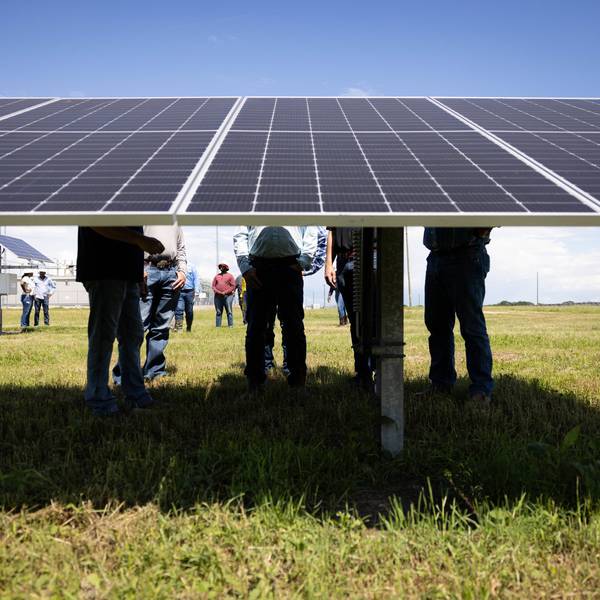


Landowners, educators, and government employees stand under solar panels during a tour of a Solar Stampede site in Saltillo, Texas on May 28, 2026.
Despite Trump's Relentless Attack on Renewables, Solar Surpassed Coal Energy in US for First Time in May
"Solar is cheaper, cleaner, more reliable," said Rep. Jared Huffman. "Trump needs to end his war on clean energy and get on board with what’s best for America."
Since taking office 16 months ago, President Donald Trump has gone to extreme lengths to try to reverse the undeniable trend in the direction of solar power and away from expensive, planet-heating coal—but two new reports reveal how, despite Trump's relentless efforts, Americans are using renewable solar energy to power their homes and businesses more than ever.
The global energy think tank Ember revealed Wednesday that in May, for the first ever, solar supplied more of the United States' electricity than coal, at 12.8%. Coal dropped to its fourth-lowest point last month, delivering just 12.2% of electricity. Solar also became the third-largest source of electricity in May, behind gas and nuclear power.
The previous month, coal hit an all-time low, according to data from the US Energy Information Administration analyzed by Ember.
Another report from the Solar Energy Industries Association (SEIA) and the analytics firm Wood Mackenzie found that solar and battery storage accounted for 91% of all new energy generation capacity in the first quarter of 2026.
The news comes a week after Trump announced $700 million in new funding for the nation's coal industry, some of which is planned for the building of two brand-new coal-fired plants, which would be the first to be built in the US in 13 years.
US Rep. Jared Huffman (D-Calif.) compared Trump's latest effort to "lighting $700 million taxpayer dollars on fire," but emphasized that "the proof is there."
"Solar is cheaper, cleaner, more reliable," he said. "Trump needs to end his war on clean energy and get on board with what’s best for America."
Last week's announcement is one of numerous steps Trump has taken to prop up coal, one of the fossil fuels that scientists warn are heating the planet and increasingly causing destructive extreme weather events.
In February the president ordered the Pentagon to sign taxpayer-funded contracts with coal plants that otherwise would have been retired in the coming years, to provide electricity to military installations.
The Department of Energy also pledged $625 million to "expand and reinvigorate America’s coal industry," an effort that has run into opposition even from the industry itself. In Colorado, two utilities, Tri-State Generation and Transmission Association and the Platte River Power Authority, which co-own a coal-fired plant the administration has demanded stay in operation, filed a petition earlier this year asking the DOE to allow them to close the facility, saying they've built solar and wind farms and that being forced to buy coal and maintain the plant amounts to a violation of the US Constitution's takings clause.
While demanding that coal production continues, Trump has taken direct aim at the booming solar industry—canceling projects and terminating $7 billion in funding for an affordable renewable energy program.
On the online news show "Breaking Points," Ryan Grim noted that solar and wind power surged in the first quarter before Trump joined Israel in waging war on Iran, a decision that sent oil prices skyrocketing.
"I would imagine the second quarter is going to see 98%" of energy generating capacity coming from solar power, said Grim.
Despite the political attacks and regulatory slowdowns... solar and storage were still 91% of all new grid capacity added in Q1.
Why? "Because solar is cheaper."
Breaking Point's @RyanGrim and @emilyjashinsky explain👇 pic.twitter.com/lhppEVqAR1
— Solar and Storage Industry (@SEIA) June 11, 2026
"Who out there is like, 'You know, what we need to do is invest deeply in building out our fossil fuel infrastructure' at this point?" he said.
We are at a crossroads
This country and this world are at a monumental crossroads. In a few short weeks, US voters will have an opportunity to beat back the forces of fascism and confront the billionaires who are rigging the economy, our media system, and our democracy, making it increasingly impossible for ordinary people to get by. We’re not just talking about the election. We’re talking about what must be done once these fascist elements are vanquished from power. We need a bolder set of solutions than what either major party has so far been willing to offer and a working-class movement ready to fight like hell for it. Trump didn't emerge from nowhere. The conditions that fueled MAGA authoritarianism were created by decades of radical neoliberal economic policies and a corrupt political system dominated by corporate interests. They slashed taxes on the super-rich, promising that the benefits would trickle down. They said giveaways to the corporate titans would make life more affordable for the rest of us. It was all bullshit. And when a bitter, betrayed populace searches for someone to blame, right-wing demagogues have little trouble finding scapegoats. People know when they're being lied to, but you won't hear any of this from the corporate media. Only independent journalism—powered and funded by people who believe in building a better world—can deliver truly trustworthy daily news. Our Fall Campaign is underway, and we need your help. To power our newsroom through the rest of the year, we need to raise $125,000 by midnight on October 31. So if you share our vision, please contribute whatever you can to sustain our work. |
Since taking office 16 months ago, President Donald Trump has gone to extreme lengths to try to reverse the undeniable trend in the direction of solar power and away from expensive, planet-heating coal—but two new reports reveal how, despite Trump's relentless efforts, Americans are using renewable solar energy to power their homes and businesses more than ever.
The global energy think tank Ember revealed Wednesday that in May, for the first ever, solar supplied more of the United States' electricity than coal, at 12.8%. Coal dropped to its fourth-lowest point last month, delivering just 12.2% of electricity. Solar also became the third-largest source of electricity in May, behind gas and nuclear power.
The previous month, coal hit an all-time low, according to data from the US Energy Information Administration analyzed by Ember.
Another report from the Solar Energy Industries Association (SEIA) and the analytics firm Wood Mackenzie found that solar and battery storage accounted for 91% of all new energy generation capacity in the first quarter of 2026.
The news comes a week after Trump announced $700 million in new funding for the nation's coal industry, some of which is planned for the building of two brand-new coal-fired plants, which would be the first to be built in the US in 13 years.
US Rep. Jared Huffman (D-Calif.) compared Trump's latest effort to "lighting $700 million taxpayer dollars on fire," but emphasized that "the proof is there."
"Solar is cheaper, cleaner, more reliable," he said. "Trump needs to end his war on clean energy and get on board with what’s best for America."
Last week's announcement is one of numerous steps Trump has taken to prop up coal, one of the fossil fuels that scientists warn are heating the planet and increasingly causing destructive extreme weather events.
In February the president ordered the Pentagon to sign taxpayer-funded contracts with coal plants that otherwise would have been retired in the coming years, to provide electricity to military installations.
The Department of Energy also pledged $625 million to "expand and reinvigorate America’s coal industry," an effort that has run into opposition even from the industry itself. In Colorado, two utilities, Tri-State Generation and Transmission Association and the Platte River Power Authority, which co-own a coal-fired plant the administration has demanded stay in operation, filed a petition earlier this year asking the DOE to allow them to close the facility, saying they've built solar and wind farms and that being forced to buy coal and maintain the plant amounts to a violation of the US Constitution's takings clause.
While demanding that coal production continues, Trump has taken direct aim at the booming solar industry—canceling projects and terminating $7 billion in funding for an affordable renewable energy program.
On the online news show "Breaking Points," Ryan Grim noted that solar and wind power surged in the first quarter before Trump joined Israel in waging war on Iran, a decision that sent oil prices skyrocketing.
"I would imagine the second quarter is going to see 98%" of energy generating capacity coming from solar power, said Grim.
Despite the political attacks and regulatory slowdowns... solar and storage were still 91% of all new grid capacity added in Q1.
Why? "Because solar is cheaper."
Breaking Point's @RyanGrim and @emilyjashinsky explain👇 pic.twitter.com/lhppEVqAR1
— Solar and Storage Industry (@SEIA) June 11, 2026
"Who out there is like, 'You know, what we need to do is invest deeply in building out our fossil fuel infrastructure' at this point?" he said.
- 'Dumbest People in History': Critics Shred Trump Energy Department Comments on Wind, Solar ›
- 'Major Power Milestone': US Green Groups Cheer Wind, Solar Overtaking Coal ›
- Renewables Surging Worldwide—But Going Backward in US Under Trump ›
- Trump Accused of ‘Mugging’ Americans as War on Clean Energy Set to Cost US Economy $55 Billion a Year | Common Dreams ›
- Renewables Surge Despite Trump Cuts, With Solar as Top May Power Source in 2 States | Common Dreams ›
Since taking office 16 months ago, President Donald Trump has gone to extreme lengths to try to reverse the undeniable trend in the direction of solar power and away from expensive, planet-heating coal—but two new reports reveal how, despite Trump's relentless efforts, Americans are using renewable solar energy to power their homes and businesses more than ever.
The global energy think tank Ember revealed Wednesday that in May, for the first ever, solar supplied more of the United States' electricity than coal, at 12.8%. Coal dropped to its fourth-lowest point last month, delivering just 12.2% of electricity. Solar also became the third-largest source of electricity in May, behind gas and nuclear power.
The previous month, coal hit an all-time low, according to data from the US Energy Information Administration analyzed by Ember.
Another report from the Solar Energy Industries Association (SEIA) and the analytics firm Wood Mackenzie found that solar and battery storage accounted for 91% of all new energy generation capacity in the first quarter of 2026.
The news comes a week after Trump announced $700 million in new funding for the nation's coal industry, some of which is planned for the building of two brand-new coal-fired plants, which would be the first to be built in the US in 13 years.
US Rep. Jared Huffman (D-Calif.) compared Trump's latest effort to "lighting $700 million taxpayer dollars on fire," but emphasized that "the proof is there."
"Solar is cheaper, cleaner, more reliable," he said. "Trump needs to end his war on clean energy and get on board with what’s best for America."
Last week's announcement is one of numerous steps Trump has taken to prop up coal, one of the fossil fuels that scientists warn are heating the planet and increasingly causing destructive extreme weather events.
In February the president ordered the Pentagon to sign taxpayer-funded contracts with coal plants that otherwise would have been retired in the coming years, to provide electricity to military installations.
The Department of Energy also pledged $625 million to "expand and reinvigorate America’s coal industry," an effort that has run into opposition even from the industry itself. In Colorado, two utilities, Tri-State Generation and Transmission Association and the Platte River Power Authority, which co-own a coal-fired plant the administration has demanded stay in operation, filed a petition earlier this year asking the DOE to allow them to close the facility, saying they've built solar and wind farms and that being forced to buy coal and maintain the plant amounts to a violation of the US Constitution's takings clause.
While demanding that coal production continues, Trump has taken direct aim at the booming solar industry—canceling projects and terminating $7 billion in funding for an affordable renewable energy program.
On the online news show "Breaking Points," Ryan Grim noted that solar and wind power surged in the first quarter before Trump joined Israel in waging war on Iran, a decision that sent oil prices skyrocketing.
"I would imagine the second quarter is going to see 98%" of energy generating capacity coming from solar power, said Grim.
Despite the political attacks and regulatory slowdowns... solar and storage were still 91% of all new grid capacity added in Q1.
Why? "Because solar is cheaper."
Breaking Point's @RyanGrim and @emilyjashinsky explain👇 pic.twitter.com/lhppEVqAR1
— Solar and Storage Industry (@SEIA) June 11, 2026
"Who out there is like, 'You know, what we need to do is invest deeply in building out our fossil fuel infrastructure' at this point?" he said.
- 'Dumbest People in History': Critics Shred Trump Energy Department Comments on Wind, Solar ›
- 'Major Power Milestone': US Green Groups Cheer Wind, Solar Overtaking Coal ›
- Renewables Surging Worldwide—But Going Backward in US Under Trump ›
- Trump Accused of ‘Mugging’ Americans as War on Clean Energy Set to Cost US Economy $55 Billion a Year | Common Dreams ›
- Renewables Surge Despite Trump Cuts, With Solar as Top May Power Source in 2 States | Common Dreams ›