SUBSCRIBE TO OUR FREE NEWSLETTER
Daily news & progressive opinion—funded by the people, not the corporations—delivered straight to your inbox.
5
#000000
#FFFFFF
To donate by check, phone, or other method, see our More Ways to Give page.
Daily news & progressive opinion—funded by the people, not the corporations—delivered straight to your inbox.
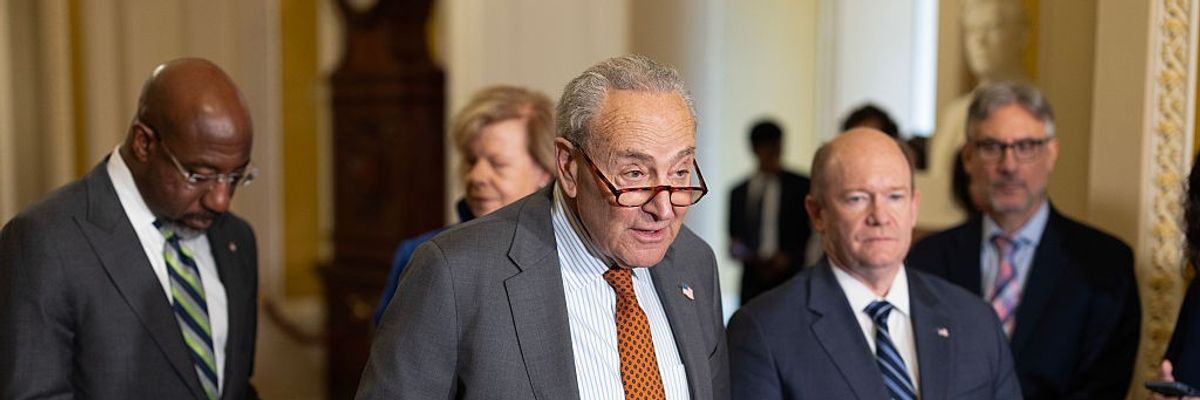
Senate Minority Leader Charles Schumer (D-NY) speaks to the press after his policy luncheons at the US Captiol on May 20, 2025 in Washington, DC.
By voting to overrule the Senate parliamentarian last week, the chamber's Republicans handed their political opponents a procedural weapon that could be used to hold off or even kill the House-passed reconciliation package that's central to President Donald Trump's legislative agenda.
The question is: Will Senate Democrats take advantage?
Last Thursday, Senate Republicans used the filibuster-proof Congressional Review Act (CRA) to approve a resolution revoking a federal waiver that allowed California to set tougher vehicle pollution standards. In doing so, the GOP majority ignored the parliamentarian's determination that the waiver did not qualify as a rule subject to the CRA.
Both before and after the vote, Senate Democrats warned their Republican colleagues that the move could come back to bite them in the future.
"Is this really the path we want to go down?" Sen. Sheldon Whitehouse (D-R.I.) asked in a floor speech earlier this month. "A future Democratic administration could submit every oil and gas lease issued since 1996 as a rule, as the subject of disapproval resolutions... Is it worth going nuclear, knowing full well the Pandora's Box this would open?"
The American Prospect's David Dayen wrote Wednesday that because the Senate "operates largely on precedent," Republicans' vote effectively means that "virtually any action the executive branch takes could be construed as a rule, and therefore subject to fast-track congressional review."
"For this reason, Democrats could subject the Senate to time-consuming resolution votes repeatedly, to such a degree that the Senate would not have time to do anything else for the rest of this session of Congress," Dayen wrote. "In other words, Democrats could respond to the waiver vote by paralyzing the Senate, and stopping the giant Trump tax bill from ever reaching the floor."
While Democrats are in the Senate minority, it only takes 30 senators to force a CRA resolution of disapproval to the floor of the upper chamber. Under CRA procedures, "any senator may make a nondebatable motion to proceed to consider the disapproval resolution on the floor." If that privileged motion is approved, the disapproval resolution would be subject to up to 10 hours of debate.
"The bottom line is this: If you found something like 1,000 current or former agency actions—a reasonable number considering all the work executive branch agencies do—you would probably have enough to keep the Senate debating and voting on CRA resolutions through the duration of this Congress," Dayen wrote. "Given the high stakes of the budget bill—soaring inequality as benefits for the poor are slashed to finance tax cuts for the rich—every tool at Senate Democrats' disposal should be employed. Republicans just handed them a big one."
As Dayen pointed out, Senate Democrats—including Minority Leader Chuck Schumer (D-N.Y.)—are aware of the hugely disruptive potential of the precedent set by their Republican counterparts.
In a May 1 letter to top Senate Republicans, Schumer and 19 other Democrats warned that if the GOP moved ahead with their plan to bypass the parliamentarian, "the CRA could be weaponized to retroactively invalidate decades of agency actions—including adjudications, permits, and licensing decisions that were never previously considered 'rules'—and effectively hijack the Senate floor."
It's far from clear that Democrats would be open to exploiting the procedural loophole Republicans created, even as members of the minority party face growing pressure from their base to fight back more aggressively against the Trump-GOP agenda—which includes catastrophic cuts to Medicaid, federal nutrition assistance, and green energy programs.
In a piece for the Prospect earlier this month, former House Oversight Committee staffer Todd Phillips outlined the potential CRA strategy. Asked by the Prospect on Wednesday, Phillips said he had not yet received any response on the idea from congressional Democrats.
"But we know they're aware of it; they have said it out loud," wrote Dayen on Wednesday. "They could start the campaign any day now."
Dear Common Dreams reader, It’s been nearly 30 years since I co-founded Common Dreams with my late wife, Lina Newhouser. We had the radical notion that journalism should serve the public good, not corporate profits. It was clear to us from the outset what it would take to build such a project. No paid advertisements. No corporate sponsors. No millionaire publisher telling us what to think or do. Many people said we wouldn't last a year, but we proved those doubters wrong. Together with a tremendous team of journalists and dedicated staff, we built an independent media outlet free from the constraints of profits and corporate control. Our mission has always been simple: To inform. To inspire. To ignite change for the common good. Building Common Dreams was not easy. Our survival was never guaranteed. When you take on the most powerful forces—Wall Street greed, fossil fuel industry destruction, Big Tech lobbyists, and uber-rich oligarchs who have spent billions upon billions rigging the economy and democracy in their favor—the only bulwark you have is supporters who believe in your work. But here’s the urgent message from me today. It's never been this bad out there. And it's never been this hard to keep us going. At the very moment Common Dreams is most needed, the threats we face are intensifying. We need your support now more than ever. We don't accept corporate advertising and never will. We don't have a paywall because we don't think people should be blocked from critical news based on their ability to pay. Everything we do is funded by the donations of readers like you. When everyone does the little they can afford, we are strong. But if that support retreats or dries up, so do we. Will you donate now to make sure Common Dreams not only survives but thrives? —Craig Brown, Co-founder |
By voting to overrule the Senate parliamentarian last week, the chamber's Republicans handed their political opponents a procedural weapon that could be used to hold off or even kill the House-passed reconciliation package that's central to President Donald Trump's legislative agenda.
The question is: Will Senate Democrats take advantage?
Last Thursday, Senate Republicans used the filibuster-proof Congressional Review Act (CRA) to approve a resolution revoking a federal waiver that allowed California to set tougher vehicle pollution standards. In doing so, the GOP majority ignored the parliamentarian's determination that the waiver did not qualify as a rule subject to the CRA.
Both before and after the vote, Senate Democrats warned their Republican colleagues that the move could come back to bite them in the future.
"Is this really the path we want to go down?" Sen. Sheldon Whitehouse (D-R.I.) asked in a floor speech earlier this month. "A future Democratic administration could submit every oil and gas lease issued since 1996 as a rule, as the subject of disapproval resolutions... Is it worth going nuclear, knowing full well the Pandora's Box this would open?"
The American Prospect's David Dayen wrote Wednesday that because the Senate "operates largely on precedent," Republicans' vote effectively means that "virtually any action the executive branch takes could be construed as a rule, and therefore subject to fast-track congressional review."
"For this reason, Democrats could subject the Senate to time-consuming resolution votes repeatedly, to such a degree that the Senate would not have time to do anything else for the rest of this session of Congress," Dayen wrote. "In other words, Democrats could respond to the waiver vote by paralyzing the Senate, and stopping the giant Trump tax bill from ever reaching the floor."
While Democrats are in the Senate minority, it only takes 30 senators to force a CRA resolution of disapproval to the floor of the upper chamber. Under CRA procedures, "any senator may make a nondebatable motion to proceed to consider the disapproval resolution on the floor." If that privileged motion is approved, the disapproval resolution would be subject to up to 10 hours of debate.
"The bottom line is this: If you found something like 1,000 current or former agency actions—a reasonable number considering all the work executive branch agencies do—you would probably have enough to keep the Senate debating and voting on CRA resolutions through the duration of this Congress," Dayen wrote. "Given the high stakes of the budget bill—soaring inequality as benefits for the poor are slashed to finance tax cuts for the rich—every tool at Senate Democrats' disposal should be employed. Republicans just handed them a big one."
As Dayen pointed out, Senate Democrats—including Minority Leader Chuck Schumer (D-N.Y.)—are aware of the hugely disruptive potential of the precedent set by their Republican counterparts.
In a May 1 letter to top Senate Republicans, Schumer and 19 other Democrats warned that if the GOP moved ahead with their plan to bypass the parliamentarian, "the CRA could be weaponized to retroactively invalidate decades of agency actions—including adjudications, permits, and licensing decisions that were never previously considered 'rules'—and effectively hijack the Senate floor."
It's far from clear that Democrats would be open to exploiting the procedural loophole Republicans created, even as members of the minority party face growing pressure from their base to fight back more aggressively against the Trump-GOP agenda—which includes catastrophic cuts to Medicaid, federal nutrition assistance, and green energy programs.
In a piece for the Prospect earlier this month, former House Oversight Committee staffer Todd Phillips outlined the potential CRA strategy. Asked by the Prospect on Wednesday, Phillips said he had not yet received any response on the idea from congressional Democrats.
"But we know they're aware of it; they have said it out loud," wrote Dayen on Wednesday. "They could start the campaign any day now."
By voting to overrule the Senate parliamentarian last week, the chamber's Republicans handed their political opponents a procedural weapon that could be used to hold off or even kill the House-passed reconciliation package that's central to President Donald Trump's legislative agenda.
The question is: Will Senate Democrats take advantage?
Last Thursday, Senate Republicans used the filibuster-proof Congressional Review Act (CRA) to approve a resolution revoking a federal waiver that allowed California to set tougher vehicle pollution standards. In doing so, the GOP majority ignored the parliamentarian's determination that the waiver did not qualify as a rule subject to the CRA.
Both before and after the vote, Senate Democrats warned their Republican colleagues that the move could come back to bite them in the future.
"Is this really the path we want to go down?" Sen. Sheldon Whitehouse (D-R.I.) asked in a floor speech earlier this month. "A future Democratic administration could submit every oil and gas lease issued since 1996 as a rule, as the subject of disapproval resolutions... Is it worth going nuclear, knowing full well the Pandora's Box this would open?"
The American Prospect's David Dayen wrote Wednesday that because the Senate "operates largely on precedent," Republicans' vote effectively means that "virtually any action the executive branch takes could be construed as a rule, and therefore subject to fast-track congressional review."
"For this reason, Democrats could subject the Senate to time-consuming resolution votes repeatedly, to such a degree that the Senate would not have time to do anything else for the rest of this session of Congress," Dayen wrote. "In other words, Democrats could respond to the waiver vote by paralyzing the Senate, and stopping the giant Trump tax bill from ever reaching the floor."
While Democrats are in the Senate minority, it only takes 30 senators to force a CRA resolution of disapproval to the floor of the upper chamber. Under CRA procedures, "any senator may make a nondebatable motion to proceed to consider the disapproval resolution on the floor." If that privileged motion is approved, the disapproval resolution would be subject to up to 10 hours of debate.
"The bottom line is this: If you found something like 1,000 current or former agency actions—a reasonable number considering all the work executive branch agencies do—you would probably have enough to keep the Senate debating and voting on CRA resolutions through the duration of this Congress," Dayen wrote. "Given the high stakes of the budget bill—soaring inequality as benefits for the poor are slashed to finance tax cuts for the rich—every tool at Senate Democrats' disposal should be employed. Republicans just handed them a big one."
As Dayen pointed out, Senate Democrats—including Minority Leader Chuck Schumer (D-N.Y.)—are aware of the hugely disruptive potential of the precedent set by their Republican counterparts.
In a May 1 letter to top Senate Republicans, Schumer and 19 other Democrats warned that if the GOP moved ahead with their plan to bypass the parliamentarian, "the CRA could be weaponized to retroactively invalidate decades of agency actions—including adjudications, permits, and licensing decisions that were never previously considered 'rules'—and effectively hijack the Senate floor."
It's far from clear that Democrats would be open to exploiting the procedural loophole Republicans created, even as members of the minority party face growing pressure from their base to fight back more aggressively against the Trump-GOP agenda—which includes catastrophic cuts to Medicaid, federal nutrition assistance, and green energy programs.
In a piece for the Prospect earlier this month, former House Oversight Committee staffer Todd Phillips outlined the potential CRA strategy. Asked by the Prospect on Wednesday, Phillips said he had not yet received any response on the idea from congressional Democrats.
"But we know they're aware of it; they have said it out loud," wrote Dayen on Wednesday. "They could start the campaign any day now."