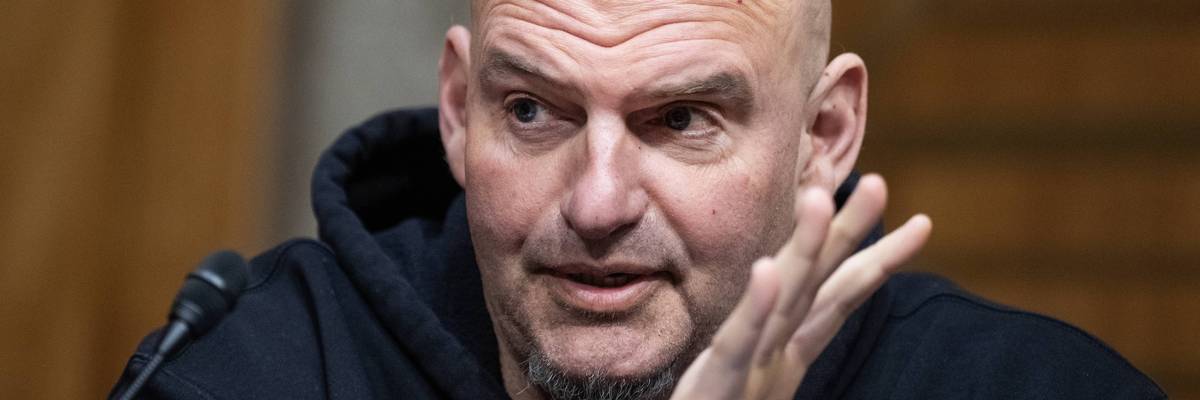
US Sen. John Fetterman (D-Pa.) is seen in the upper chamber on March 19, 2026 in Washington, DC.
(Photo by Tom Williams/CQ-Roll Call, Inc. via Getty Images)
Fetterman Helps GOP Senators Sink Democrat Effort to Block Trump War on Cuba
"The last thing working Americans need right now is another war," said the Senate's top Democrat.
Apr 28, 2026
The US Senate on Tuesday defeated a Democrat-led bid to stop President Donald Trump from following through on his threat to wage war on Cuba, whose long-suffering people are reeling from the American administration's tightened economic stranglehold.
Upper chamber lawmakers voted 51-47 on a procedural motion to block further debate Sen. Tim Kaine's (D-Va.) SJ Res. 124, "a joint resolution to direct the removal of United States armed forces from hostilities within or against the republic of Cuba that have not been authorized by Congress."
Republican Sens. Susan Collins of Maine and Rand Paul of Kentucky voted to advance the resolution, while John Fetterman of Pennsylvania joined his GOP colleagues in voting to sink the measure.
The vote effectively sidelines the measure, one of many failed attempts to curb Trump's ability to wage war on countries including Iran and Venezuela, as well as rein in his high seas boat bombing spree.
“The American people are not asking for another war," Sen. Ruben Gallego (D-Ariz.)—one of SJ Res. 124's dozen co-sponsors—said following Tuesday's vote. "They want us focused on building housing in Arizona, not bombing housing in Havana. They want us to lower the cost of healthcare not condemn a generation of veterans to a lifetime of hospital visits. They want us to make their lives more affordable, not spend their tax dollars on unnecessary wars."
Kaine called the GOP move "purely a regime change effort."
"Why do they want it? You'll have to ask them," he added. "What we're doing with respect to Cuba, if somebody was doing it to us, we would consider it an act of war. But because they don't pose a security threat to the United States, it's clearly an effort to change the regime."
Senate Minority Leader Chuck Schumer (D-NY), who also co-sponsored the resolution, said, "The last thing working Americans need right now is another war—let alone one that’s 90 miles south of the US."
Resolution co-sponsor Sen. Angela Alsobrooks (D-Md.) said on Bluesky after the vote, "A conflict with Cuba would cost hardworking Americans billions of dollars, deepen the humanitarian crisis in Cuba, and put American service members in harm’s way."
"The Constitution is clear: Only Congress has the authority to declare war," Alsobrooks added.
Trump has attacked seven countries since returning to office and 10 since the start of his first term—more than any other president.
The situation in Cuba is dire, as a result of both the 65-year US economic chokehold on the island and mismanaged central planning by its socialist rulers.
Trump has been ramping up military threats and economic pressure on Cuba, whose people were already suffering from generations of US sanctions. His administration's tightened embargo has severely restricted fuel imports, worsening an energy emergency in which blackouts have become the norm, threatening the lives of vulnerable Cubans—especially sick people and children.
The US president said that “we may stop by Cuba after we’re finished" with the illegal US-Israeli war of choice on Iran that’s killed thousands of people, including hundreds of children. Trump has also said that he believes he’ll “be having the honor of taking Cuba."
The United States already took Cuba once, during an 1898 war waged against Spain under highly dubious pretenses that ended with the US also acquiring Puerto Rico, the Philippines, and Guam—with Hawaii also annexed that year under the guise of security.
American presidents have been trying to force out Cuba's socialist government since shortly after the revolution that overthrew a US-backed dictatorship in 1959. US efforts have included carrying out or backing an armed invasion, terrorist attacks, assassination attempts, and other acts of aggression.
Cuba commits no such acts against the United States or anyone else, yet Trump added the country to the US State Sponsors of Terrorism list.
Following Tuesday's vote, Sen. Ed Markey (D-Mass.) said that "Trump should learn the law of holes: If you find yourself in one, stop digging."
"Instead of threatening that ‘Cuba is next,’ President Trump should remove his blockade against Cuba, which has devastated Havana’s economy and healthcare system, and has created a deepening humanitarian crisis," Markey added.
The United Nations General Assembly has overwhelmingly condemned the blockade 33 times since 1992.
“With its catastrophic Iran war of choice, the Trump administration has lost all credibility on issues of war and peace," Markey asserted. "The American people do not want yet another endless war that will only costs more lives and more taxpayer dollars, and undermine US security.”
Progressive International co-general coordinator David Adler warned Tuesday that "Trump is preparing military action against Cuba," calling the Senate vote possibly "the last chance for US Congress to stop it."
Urgent. It's never been this bad.
Dear Common Dreams reader, It’s been nearly 30 years since I co-founded Common Dreams with my late wife, Lina Newhouser. We had the radical notion that journalism should serve the public good, not corporate profits. It was clear to us from the outset what it would take to build such a project. No paid advertisements. No corporate sponsors. No millionaire publisher telling us what to think or do. Many people said we wouldn't last a year, but we proved those doubters wrong. Together with a tremendous team of journalists and dedicated staff, we built an independent media outlet free from the constraints of profits and corporate control. Our mission from the outset was simple. To inform. To inspire. To ignite change for the common good. Building Common Dreams was not easy. Our survival was never guaranteed. When you take on the most powerful forces—Wall Street greed, fossil fuel industry destruction, Big Tech lobbyists, and uber-rich oligarchs who have spent billions upon billions rigging the economy and democracy in their favor—the only bulwark you have is supporters who believe in your work. But here’s the urgent message from me today. It’s never been this bad out there. And it’s never been this hard to keep us going. At the very moment Common Dreams is most needed and doing some of its best and most important work, the threats we face are intensifying. Right now, with just four days to go in our Spring Campaign, we are not even halfway to our goal. When everyone does the little they can afford, we are strong. But if that support retreats or dries up, so do we. Can you make a gift right now to make sure Common Dreams not only survives but thrives? There is no backup plan or rainy day fund. There is only you. —Craig Brown, Co-founder |
Our work is licensed under Creative Commons (CC BY-NC-ND 3.0). Feel free to republish and share widely.
The US Senate on Tuesday defeated a Democrat-led bid to stop President Donald Trump from following through on his threat to wage war on Cuba, whose long-suffering people are reeling from the American administration's tightened economic stranglehold.
Upper chamber lawmakers voted 51-47 on a procedural motion to block further debate Sen. Tim Kaine's (D-Va.) SJ Res. 124, "a joint resolution to direct the removal of United States armed forces from hostilities within or against the republic of Cuba that have not been authorized by Congress."
Republican Sens. Susan Collins of Maine and Rand Paul of Kentucky voted to advance the resolution, while John Fetterman of Pennsylvania joined his GOP colleagues in voting to sink the measure.
The vote effectively sidelines the measure, one of many failed attempts to curb Trump's ability to wage war on countries including Iran and Venezuela, as well as rein in his high seas boat bombing spree.
“The American people are not asking for another war," Sen. Ruben Gallego (D-Ariz.)—one of SJ Res. 124's dozen co-sponsors—said following Tuesday's vote. "They want us focused on building housing in Arizona, not bombing housing in Havana. They want us to lower the cost of healthcare not condemn a generation of veterans to a lifetime of hospital visits. They want us to make their lives more affordable, not spend their tax dollars on unnecessary wars."
Kaine called the GOP move "purely a regime change effort."
"Why do they want it? You'll have to ask them," he added. "What we're doing with respect to Cuba, if somebody was doing it to us, we would consider it an act of war. But because they don't pose a security threat to the United States, it's clearly an effort to change the regime."
Senate Minority Leader Chuck Schumer (D-NY), who also co-sponsored the resolution, said, "The last thing working Americans need right now is another war—let alone one that’s 90 miles south of the US."
Resolution co-sponsor Sen. Angela Alsobrooks (D-Md.) said on Bluesky after the vote, "A conflict with Cuba would cost hardworking Americans billions of dollars, deepen the humanitarian crisis in Cuba, and put American service members in harm’s way."
"The Constitution is clear: Only Congress has the authority to declare war," Alsobrooks added.
Trump has attacked seven countries since returning to office and 10 since the start of his first term—more than any other president.
The situation in Cuba is dire, as a result of both the 65-year US economic chokehold on the island and mismanaged central planning by its socialist rulers.
Trump has been ramping up military threats and economic pressure on Cuba, whose people were already suffering from generations of US sanctions. His administration's tightened embargo has severely restricted fuel imports, worsening an energy emergency in which blackouts have become the norm, threatening the lives of vulnerable Cubans—especially sick people and children.
The US president said that “we may stop by Cuba after we’re finished" with the illegal US-Israeli war of choice on Iran that’s killed thousands of people, including hundreds of children. Trump has also said that he believes he’ll “be having the honor of taking Cuba."
The United States already took Cuba once, during an 1898 war waged against Spain under highly dubious pretenses that ended with the US also acquiring Puerto Rico, the Philippines, and Guam—with Hawaii also annexed that year under the guise of security.
American presidents have been trying to force out Cuba's socialist government since shortly after the revolution that overthrew a US-backed dictatorship in 1959. US efforts have included carrying out or backing an armed invasion, terrorist attacks, assassination attempts, and other acts of aggression.
Cuba commits no such acts against the United States or anyone else, yet Trump added the country to the US State Sponsors of Terrorism list.
Following Tuesday's vote, Sen. Ed Markey (D-Mass.) said that "Trump should learn the law of holes: If you find yourself in one, stop digging."
"Instead of threatening that ‘Cuba is next,’ President Trump should remove his blockade against Cuba, which has devastated Havana’s economy and healthcare system, and has created a deepening humanitarian crisis," Markey added.
The United Nations General Assembly has overwhelmingly condemned the blockade 33 times since 1992.
“With its catastrophic Iran war of choice, the Trump administration has lost all credibility on issues of war and peace," Markey asserted. "The American people do not want yet another endless war that will only costs more lives and more taxpayer dollars, and undermine US security.”
Progressive International co-general coordinator David Adler warned Tuesday that "Trump is preparing military action against Cuba," calling the Senate vote possibly "the last chance for US Congress to stop it."
The US Senate on Tuesday defeated a Democrat-led bid to stop President Donald Trump from following through on his threat to wage war on Cuba, whose long-suffering people are reeling from the American administration's tightened economic stranglehold.
Upper chamber lawmakers voted 51-47 on a procedural motion to block further debate Sen. Tim Kaine's (D-Va.) SJ Res. 124, "a joint resolution to direct the removal of United States armed forces from hostilities within or against the republic of Cuba that have not been authorized by Congress."
Republican Sens. Susan Collins of Maine and Rand Paul of Kentucky voted to advance the resolution, while John Fetterman of Pennsylvania joined his GOP colleagues in voting to sink the measure.
The vote effectively sidelines the measure, one of many failed attempts to curb Trump's ability to wage war on countries including Iran and Venezuela, as well as rein in his high seas boat bombing spree.
“The American people are not asking for another war," Sen. Ruben Gallego (D-Ariz.)—one of SJ Res. 124's dozen co-sponsors—said following Tuesday's vote. "They want us focused on building housing in Arizona, not bombing housing in Havana. They want us to lower the cost of healthcare not condemn a generation of veterans to a lifetime of hospital visits. They want us to make their lives more affordable, not spend their tax dollars on unnecessary wars."
Kaine called the GOP move "purely a regime change effort."
"Why do they want it? You'll have to ask them," he added. "What we're doing with respect to Cuba, if somebody was doing it to us, we would consider it an act of war. But because they don't pose a security threat to the United States, it's clearly an effort to change the regime."
Senate Minority Leader Chuck Schumer (D-NY), who also co-sponsored the resolution, said, "The last thing working Americans need right now is another war—let alone one that’s 90 miles south of the US."
Resolution co-sponsor Sen. Angela Alsobrooks (D-Md.) said on Bluesky after the vote, "A conflict with Cuba would cost hardworking Americans billions of dollars, deepen the humanitarian crisis in Cuba, and put American service members in harm’s way."
"The Constitution is clear: Only Congress has the authority to declare war," Alsobrooks added.
Trump has attacked seven countries since returning to office and 10 since the start of his first term—more than any other president.
The situation in Cuba is dire, as a result of both the 65-year US economic chokehold on the island and mismanaged central planning by its socialist rulers.
Trump has been ramping up military threats and economic pressure on Cuba, whose people were already suffering from generations of US sanctions. His administration's tightened embargo has severely restricted fuel imports, worsening an energy emergency in which blackouts have become the norm, threatening the lives of vulnerable Cubans—especially sick people and children.
The US president said that “we may stop by Cuba after we’re finished" with the illegal US-Israeli war of choice on Iran that’s killed thousands of people, including hundreds of children. Trump has also said that he believes he’ll “be having the honor of taking Cuba."
The United States already took Cuba once, during an 1898 war waged against Spain under highly dubious pretenses that ended with the US also acquiring Puerto Rico, the Philippines, and Guam—with Hawaii also annexed that year under the guise of security.
American presidents have been trying to force out Cuba's socialist government since shortly after the revolution that overthrew a US-backed dictatorship in 1959. US efforts have included carrying out or backing an armed invasion, terrorist attacks, assassination attempts, and other acts of aggression.
Cuba commits no such acts against the United States or anyone else, yet Trump added the country to the US State Sponsors of Terrorism list.
Following Tuesday's vote, Sen. Ed Markey (D-Mass.) said that "Trump should learn the law of holes: If you find yourself in one, stop digging."
"Instead of threatening that ‘Cuba is next,’ President Trump should remove his blockade against Cuba, which has devastated Havana’s economy and healthcare system, and has created a deepening humanitarian crisis," Markey added.
The United Nations General Assembly has overwhelmingly condemned the blockade 33 times since 1992.
“With its catastrophic Iran war of choice, the Trump administration has lost all credibility on issues of war and peace," Markey asserted. "The American people do not want yet another endless war that will only costs more lives and more taxpayer dollars, and undermine US security.”
Progressive International co-general coordinator David Adler warned Tuesday that "Trump is preparing military action against Cuba," calling the Senate vote possibly "the last chance for US Congress to stop it."
We've had enough. The 1% own and operate the corporate media. They are doing everything they can to defend the status quo, squash dissent and protect the wealthy and the powerful. The Common Dreams media model is different. We cover the news that matters to the 99%. Our mission? To inform. To inspire. To ignite change for the common good. How? Nonprofit. Independent. Reader-supported. Free to read. Free to republish. Free to share. With no advertising. No paywalls. No selling of your data. Thousands of small donations fund our newsroom and allow us to continue publishing. Can you chip in? We can't do it without you. Thank you.