SUBSCRIBE TO OUR FREE NEWSLETTER
Daily news & progressive opinion—funded by the people, not the corporations—delivered straight to your inbox.
5
#000000
#FFFFFF
To donate by check, phone, or other method, see our More Ways to Give page.
Daily news & progressive opinion—funded by the people, not the corporations—delivered straight to your inbox.
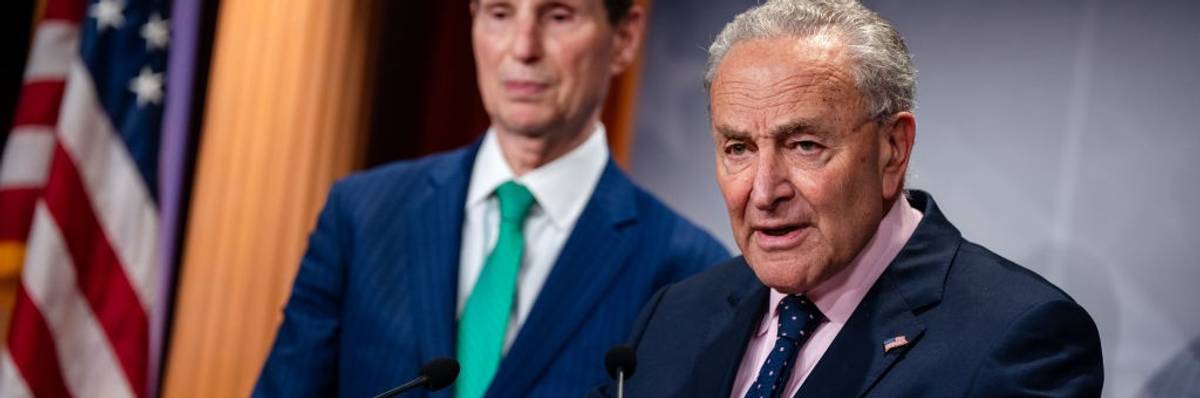
U.S. Senate Majority Leader Chuck Schumer (D-N.Y.) introduced the 'No Kings Act' on August 1, 2024.
"Congress has an obligation to act as a check and ensure that the president does not become a king," an expert said in praise of Schumer's move.
U.S. Senate Majority Leader Chuck Schumer on Thursday introduced legislation that would establish that the president and vice president don't have immunity from prosecution—an effort to overturn the Supreme Court's recent ruling in Trump v. United States that grants presidents broad immunity when they break the law.
The No Kings Act, which has 34 co-sponsors from the Senate's Democratic caucus, would stipulate that Congress, and not the Supreme Court, determines whom federal law applies to. It comes as the latest Democratic response to the July 1 ruling, decided 6-3 along ideological lines, that gave former president and current Republican nominee Donald Trump "absolute immunity" for "core" presidential duties and "presumptive immunity" for other official acts.
"Given the dangerous and consequential implications of the court's ruling, legislation would be the fastest and most efficient method to correcting the grave precedent the Trump ruling presented," Schumer (D-N.Y.) said in a statement.
"With this glaring and partisan overreach, Congress has an obligation—and a constitutional authority—to act as a check and balance to the judicial branch," he added.
Progressive advocacy group Public Citizen praised Schumer for introducing the bill.
"The framers of the Constitution never intended the executive branch to be immune from legal recourse, and they would have seen this decision as an invitation for presidents to become tyrants," Lisa Gilbert, the group's co-president, said in a statement. "Congress has an obligation to act as a check and ensure that the president does not become a king."
The Founders were explicit: no man in America shall be a king.
But the MAGA Supreme Court threw out centuries of precedent and anointed Trump and subsequent presidents as kings above the law.
That's why I'm introducing the No Kings Act to crack down on this dangerous precedent.
— Chuck Schumer (@SenSchumer) August 1, 2024
The Supreme Court's immunity decision caused outrage among Democrats, who viewed it as blatantly partisan—three of the six assenting justices were appointed by Trump, and all six were appointed by Republicans—and a threat to democracy, given the way it could erode accountability in the country's highest office. In dissent, Justice Sonia Sotomayor wrote that "the president is now king above the law."
The impact of the immunity ruling on the four criminal cases against Trump—he's been convicted in one and another has since been dismissed—is not fully clear but it's generally believed to strengthen his defense and complicate prosecutors' efforts.
Last week, Rep. Joseph Morelle (D-N.Y.) proposed a constitutional amendment to establish that "there is no immunity from criminal prosecution for an act on the grounds that such act was within the constitutional authority or official duties of an individual." The proposal has 70 Democratic co-sponsors.
On Monday, President Joe Biden, a Democrat, called for sweeping Supreme Court reforms—a monumental move that progressives had pushed him to make for years—in an op-ed in The Washington Post. He started his argument, which included a call for term limits and a constitutional amendment, by citing the immunity ruling. Vice President Kamala Harris, the presumptive Democratic nominee, quickly backed the plan.
None of these efforts have a strong chance of passage in the short term. Constitutional amendments generally require a two-thirds majority in Congress and ratification by three-fourths of state legislatures.
The No Kings Act wouldn't face such a high bar, but passage is unthinkable so long as the Republicans control the House of Representatives. Moreover, if passed, the Supreme Court would in all likelihood strike the bill down.
To forestall that issue, Schumer has written into the bill "jurisdiction stripping" measures that would remove the Supreme Court's authority to render the legislation unconstitutional, and allow only lower courts in the District of Columbia to handle a legal challenge. Such jurisdiction stripping has been seldom used in the past and would likely be highly controversial.
Jurisdiction stripping has never happened till it does, and is a false promise until it isn't. https://t.co/lGYfLxdyQs
— Samuel Moyn 🔭 (@samuelmoyn) August 1, 2024
Even if the Democrats don't see immediate legislative results, the messages that their proposals send could resonate with voters. Polling from Navigator Research released on Tuesday indicated that a solid majority of Americans disagreed with the Supreme Court's immunity decision.
Dear Common Dreams reader, It’s been nearly 30 years since I co-founded Common Dreams with my late wife, Lina Newhouser. We had the radical notion that journalism should serve the public good, not corporate profits. It was clear to us from the outset what it would take to build such a project. No paid advertisements. No corporate sponsors. No millionaire publisher telling us what to think or do. Many people said we wouldn't last a year, but we proved those doubters wrong. Together with a tremendous team of journalists and dedicated staff, we built an independent media outlet free from the constraints of profits and corporate control. Our mission has always been simple: To inform. To inspire. To ignite change for the common good. Building Common Dreams was not easy. Our survival was never guaranteed. When you take on the most powerful forces—Wall Street greed, fossil fuel industry destruction, Big Tech lobbyists, and uber-rich oligarchs who have spent billions upon billions rigging the economy and democracy in their favor—the only bulwark you have is supporters who believe in your work. But here’s the urgent message from me today. It's never been this bad out there. And it's never been this hard to keep us going. At the very moment Common Dreams is most needed, the threats we face are intensifying. We need your support now more than ever. We don't accept corporate advertising and never will. We don't have a paywall because we don't think people should be blocked from critical news based on their ability to pay. Everything we do is funded by the donations of readers like you. When everyone does the little they can afford, we are strong. But if that support retreats or dries up, so do we. Will you donate now to make sure Common Dreams not only survives but thrives? —Craig Brown, Co-founder |
U.S. Senate Majority Leader Chuck Schumer on Thursday introduced legislation that would establish that the president and vice president don't have immunity from prosecution—an effort to overturn the Supreme Court's recent ruling in Trump v. United States that grants presidents broad immunity when they break the law.
The No Kings Act, which has 34 co-sponsors from the Senate's Democratic caucus, would stipulate that Congress, and not the Supreme Court, determines whom federal law applies to. It comes as the latest Democratic response to the July 1 ruling, decided 6-3 along ideological lines, that gave former president and current Republican nominee Donald Trump "absolute immunity" for "core" presidential duties and "presumptive immunity" for other official acts.
"Given the dangerous and consequential implications of the court's ruling, legislation would be the fastest and most efficient method to correcting the grave precedent the Trump ruling presented," Schumer (D-N.Y.) said in a statement.
"With this glaring and partisan overreach, Congress has an obligation—and a constitutional authority—to act as a check and balance to the judicial branch," he added.
Progressive advocacy group Public Citizen praised Schumer for introducing the bill.
"The framers of the Constitution never intended the executive branch to be immune from legal recourse, and they would have seen this decision as an invitation for presidents to become tyrants," Lisa Gilbert, the group's co-president, said in a statement. "Congress has an obligation to act as a check and ensure that the president does not become a king."
The Founders were explicit: no man in America shall be a king.
But the MAGA Supreme Court threw out centuries of precedent and anointed Trump and subsequent presidents as kings above the law.
That's why I'm introducing the No Kings Act to crack down on this dangerous precedent.
— Chuck Schumer (@SenSchumer) August 1, 2024
The Supreme Court's immunity decision caused outrage among Democrats, who viewed it as blatantly partisan—three of the six assenting justices were appointed by Trump, and all six were appointed by Republicans—and a threat to democracy, given the way it could erode accountability in the country's highest office. In dissent, Justice Sonia Sotomayor wrote that "the president is now king above the law."
The impact of the immunity ruling on the four criminal cases against Trump—he's been convicted in one and another has since been dismissed—is not fully clear but it's generally believed to strengthen his defense and complicate prosecutors' efforts.
Last week, Rep. Joseph Morelle (D-N.Y.) proposed a constitutional amendment to establish that "there is no immunity from criminal prosecution for an act on the grounds that such act was within the constitutional authority or official duties of an individual." The proposal has 70 Democratic co-sponsors.
On Monday, President Joe Biden, a Democrat, called for sweeping Supreme Court reforms—a monumental move that progressives had pushed him to make for years—in an op-ed in The Washington Post. He started his argument, which included a call for term limits and a constitutional amendment, by citing the immunity ruling. Vice President Kamala Harris, the presumptive Democratic nominee, quickly backed the plan.
None of these efforts have a strong chance of passage in the short term. Constitutional amendments generally require a two-thirds majority in Congress and ratification by three-fourths of state legislatures.
The No Kings Act wouldn't face such a high bar, but passage is unthinkable so long as the Republicans control the House of Representatives. Moreover, if passed, the Supreme Court would in all likelihood strike the bill down.
To forestall that issue, Schumer has written into the bill "jurisdiction stripping" measures that would remove the Supreme Court's authority to render the legislation unconstitutional, and allow only lower courts in the District of Columbia to handle a legal challenge. Such jurisdiction stripping has been seldom used in the past and would likely be highly controversial.
Jurisdiction stripping has never happened till it does, and is a false promise until it isn't. https://t.co/lGYfLxdyQs
— Samuel Moyn 🔭 (@samuelmoyn) August 1, 2024
Even if the Democrats don't see immediate legislative results, the messages that their proposals send could resonate with voters. Polling from Navigator Research released on Tuesday indicated that a solid majority of Americans disagreed with the Supreme Court's immunity decision.
U.S. Senate Majority Leader Chuck Schumer on Thursday introduced legislation that would establish that the president and vice president don't have immunity from prosecution—an effort to overturn the Supreme Court's recent ruling in Trump v. United States that grants presidents broad immunity when they break the law.
The No Kings Act, which has 34 co-sponsors from the Senate's Democratic caucus, would stipulate that Congress, and not the Supreme Court, determines whom federal law applies to. It comes as the latest Democratic response to the July 1 ruling, decided 6-3 along ideological lines, that gave former president and current Republican nominee Donald Trump "absolute immunity" for "core" presidential duties and "presumptive immunity" for other official acts.
"Given the dangerous and consequential implications of the court's ruling, legislation would be the fastest and most efficient method to correcting the grave precedent the Trump ruling presented," Schumer (D-N.Y.) said in a statement.
"With this glaring and partisan overreach, Congress has an obligation—and a constitutional authority—to act as a check and balance to the judicial branch," he added.
Progressive advocacy group Public Citizen praised Schumer for introducing the bill.
"The framers of the Constitution never intended the executive branch to be immune from legal recourse, and they would have seen this decision as an invitation for presidents to become tyrants," Lisa Gilbert, the group's co-president, said in a statement. "Congress has an obligation to act as a check and ensure that the president does not become a king."
The Founders were explicit: no man in America shall be a king.
But the MAGA Supreme Court threw out centuries of precedent and anointed Trump and subsequent presidents as kings above the law.
That's why I'm introducing the No Kings Act to crack down on this dangerous precedent.
— Chuck Schumer (@SenSchumer) August 1, 2024
The Supreme Court's immunity decision caused outrage among Democrats, who viewed it as blatantly partisan—three of the six assenting justices were appointed by Trump, and all six were appointed by Republicans—and a threat to democracy, given the way it could erode accountability in the country's highest office. In dissent, Justice Sonia Sotomayor wrote that "the president is now king above the law."
The impact of the immunity ruling on the four criminal cases against Trump—he's been convicted in one and another has since been dismissed—is not fully clear but it's generally believed to strengthen his defense and complicate prosecutors' efforts.
Last week, Rep. Joseph Morelle (D-N.Y.) proposed a constitutional amendment to establish that "there is no immunity from criminal prosecution for an act on the grounds that such act was within the constitutional authority or official duties of an individual." The proposal has 70 Democratic co-sponsors.
On Monday, President Joe Biden, a Democrat, called for sweeping Supreme Court reforms—a monumental move that progressives had pushed him to make for years—in an op-ed in The Washington Post. He started his argument, which included a call for term limits and a constitutional amendment, by citing the immunity ruling. Vice President Kamala Harris, the presumptive Democratic nominee, quickly backed the plan.
None of these efforts have a strong chance of passage in the short term. Constitutional amendments generally require a two-thirds majority in Congress and ratification by three-fourths of state legislatures.
The No Kings Act wouldn't face such a high bar, but passage is unthinkable so long as the Republicans control the House of Representatives. Moreover, if passed, the Supreme Court would in all likelihood strike the bill down.
To forestall that issue, Schumer has written into the bill "jurisdiction stripping" measures that would remove the Supreme Court's authority to render the legislation unconstitutional, and allow only lower courts in the District of Columbia to handle a legal challenge. Such jurisdiction stripping has been seldom used in the past and would likely be highly controversial.
Jurisdiction stripping has never happened till it does, and is a false promise until it isn't. https://t.co/lGYfLxdyQs
— Samuel Moyn 🔭 (@samuelmoyn) August 1, 2024
Even if the Democrats don't see immediate legislative results, the messages that their proposals send could resonate with voters. Polling from Navigator Research released on Tuesday indicated that a solid majority of Americans disagreed with the Supreme Court's immunity decision.