5
#000000
#FFFFFF
To donate by check, phone, or other method, see our More Ways to Give page.
Daily news & progressive opinion—funded by the people, not the corporations—delivered straight to your inbox.
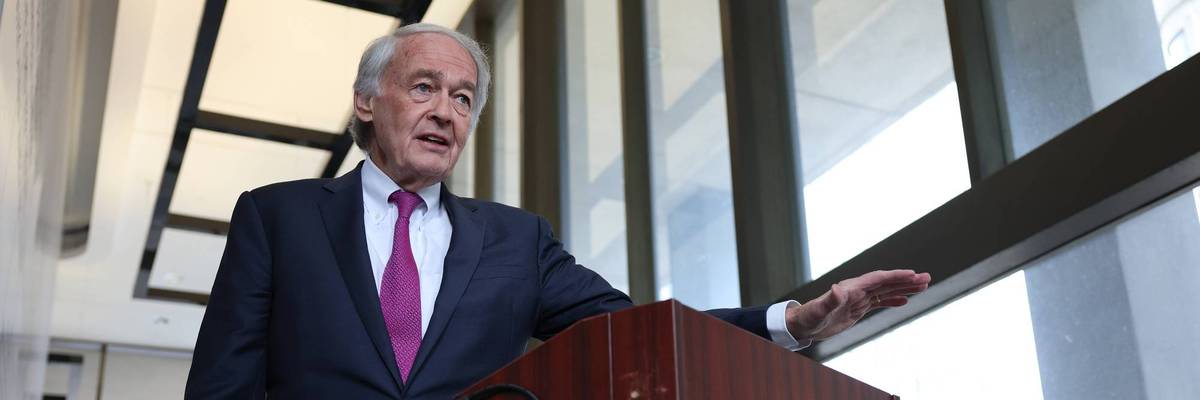
US Sen. Ed Markey (D-Mass.) speaks during a press conference held at the John F. Kennedy Federal Building in Boston, Massachusetts on February 17, 2025.
"We can't sleepwalk into a decision this consequential. The law gives Congress the power to review and block a deal like this, and the Senate will now have the chance to fulfill its statutory responsibility before it's too late."
US Sens. Ed Markey and Jeff Merkley on Thursday continued to push back against President Donald Trump's proposed nuclear energy agreement with Saudi Arabia, setting up a vote on legislation that could block the deal before it takes effect.
"Giving Saudi Arabia access to US civilian nuclear energy technology without ironclad protections to make sure it doesn't provide a foundation for a nuclear bomb is unacceptable," declared Merkley (D-Ore.), a senior member of the Senate Foreign Relations Committee who co-chairs the Nuclear Weapons and Arms Control Working Group with Markey (D-Mass.).
Under Section 123 of the Atomic Energy Act, Congress has 90 days of continuous session to review the deal. The pair of senators introduced a joint resolution of disapproval, on which the Senate is set to vote after November 29. The JRD would need to pass both GOP-controlled chambers by veto-proof majorities to actually block the agreement.
I refuse to let the U.S. sleepwalk into a dangerous nuclear deal with Saudi Arabia. The law gives Congress the power to review and block a deal like this.@markey.senate.gov and I are making sure the Senate fulfills that responsibility before it’s too late.
[image or embed]
— Senator Jeff Merkley (@merkley.senate.gov) October 15, 2026 at 12:37 PM
The senators are alarmed that Trump's agreement lacks a "gold standard" provision barring Saudi Arabia from reprocessing spent fuel or enriching uranium. They are also alarmed that the proposal doesn't require allowing International Atomic Energy Agency investigators to confirm that the nation is not trying to develop a nuclear weapon.
"It is essential that nations pursuing civilian energy programs agree to the 'gold standard' of restrictions on fuel reprocessing and enrichment and rigorous inspections to ensure that a nuclear energy program doesn't become a covert nuclear weapons program," Merkley argued. "We can't sleepwalk into a decision this consequential. The law gives Congress the power to review and block a deal like this, and the Senate will now have the chance to fulfill its statutory responsibility before it's too late."
The details of the agreement have concerned not only progressive senators, but also nuclear nonproliferation experts.
"The US-Saudi nuclear deal is about megatons, not megawatts. Trump should not be sharing nuclear bomb technology with a nation that US intelligence says may want nuclear weapons," said Markey. "This deal is the starting gun for a Middle East nuclear arms race. Congress must reject it."
The introduction came roughly a month after Markey and Merkley partnered with Sen. Bernie Sanders (I-Vt.) for another JRD designed to block a $5 billion conventional weapons sale to Saudi Arabia, which includes over 10,000 joint direct attack munition guidance kits and a similar number of "dumb bombs" that can be combined to create precision weapons.
"I am deeply concerned by the kingdom's human rights abuses, the security of the region as the war in Iran rages on, and the proxy war that is escalating between Iran and Saudi Arabia in Yemen," Markey said at the time. "Further escalation in the Saudi-Iran proxy war will worsen an already dire humanitarian catastrophe in Yemen and risks setting off a nuclear arms race between Iran and Saudi Arabia."
This country and this world are at a monumental crossroads. US voters have an opportunity to beat back the forces of fascism and confront the billionaires who are rigging the economy, our media system, and our democracy, making it increasingly impossible for ordinary people to get by. We’re not just talking about the election. We’re talking about what must be done once these fascist elements are vanquished from power. We need a bolder set of solutions than what either major party has so far been willing to offer and a working-class movement ready to fight like hell for it. Trump didn't emerge from nowhere. The conditions that fueled MAGA authoritarianism were created by decades of radical neoliberal economic policies and a corrupt political system dominated by corporate interests. They slashed taxes on the super-rich, promising that the benefits would trickle down. They said giveaways to the corporate titans would make life more affordable for the rest of us. It was all bullshit. And when a bitter, betrayed populace searches for someone to blame, right-wing demagogues have little trouble finding scapegoats. People know when they're being lied to, but you won't hear any of this from the corporate media. Only independent journalism—powered and funded by people who believe in building a better world—can deliver truly trustworthy daily news. If you share our vision, please contribute whatever you can to sustain our work. |
US Sens. Ed Markey and Jeff Merkley on Thursday continued to push back against President Donald Trump's proposed nuclear energy agreement with Saudi Arabia, setting up a vote on legislation that could block the deal before it takes effect.
"Giving Saudi Arabia access to US civilian nuclear energy technology without ironclad protections to make sure it doesn't provide a foundation for a nuclear bomb is unacceptable," declared Merkley (D-Ore.), a senior member of the Senate Foreign Relations Committee who co-chairs the Nuclear Weapons and Arms Control Working Group with Markey (D-Mass.).
Under Section 123 of the Atomic Energy Act, Congress has 90 days of continuous session to review the deal. The pair of senators introduced a joint resolution of disapproval, on which the Senate is set to vote after November 29. The JRD would need to pass both GOP-controlled chambers by veto-proof majorities to actually block the agreement.
I refuse to let the U.S. sleepwalk into a dangerous nuclear deal with Saudi Arabia. The law gives Congress the power to review and block a deal like this.@markey.senate.gov and I are making sure the Senate fulfills that responsibility before it’s too late.
[image or embed]
— Senator Jeff Merkley (@merkley.senate.gov) October 15, 2026 at 12:37 PM
The senators are alarmed that Trump's agreement lacks a "gold standard" provision barring Saudi Arabia from reprocessing spent fuel or enriching uranium. They are also alarmed that the proposal doesn't require allowing International Atomic Energy Agency investigators to confirm that the nation is not trying to develop a nuclear weapon.
"It is essential that nations pursuing civilian energy programs agree to the 'gold standard' of restrictions on fuel reprocessing and enrichment and rigorous inspections to ensure that a nuclear energy program doesn't become a covert nuclear weapons program," Merkley argued. "We can't sleepwalk into a decision this consequential. The law gives Congress the power to review and block a deal like this, and the Senate will now have the chance to fulfill its statutory responsibility before it's too late."
The details of the agreement have concerned not only progressive senators, but also nuclear nonproliferation experts.
"The US-Saudi nuclear deal is about megatons, not megawatts. Trump should not be sharing nuclear bomb technology with a nation that US intelligence says may want nuclear weapons," said Markey. "This deal is the starting gun for a Middle East nuclear arms race. Congress must reject it."
The introduction came roughly a month after Markey and Merkley partnered with Sen. Bernie Sanders (I-Vt.) for another JRD designed to block a $5 billion conventional weapons sale to Saudi Arabia, which includes over 10,000 joint direct attack munition guidance kits and a similar number of "dumb bombs" that can be combined to create precision weapons.
"I am deeply concerned by the kingdom's human rights abuses, the security of the region as the war in Iran rages on, and the proxy war that is escalating between Iran and Saudi Arabia in Yemen," Markey said at the time. "Further escalation in the Saudi-Iran proxy war will worsen an already dire humanitarian catastrophe in Yemen and risks setting off a nuclear arms race between Iran and Saudi Arabia."