SUBSCRIBE TO OUR FREE NEWSLETTER
Daily news & progressive opinion—funded by the people, not the corporations—delivered straight to your inbox.
5
#000000
#FFFFFF
To donate by check, phone, or other method, see our More Ways to Give page.
Daily news & progressive opinion—funded by the people, not the corporations—delivered straight to your inbox.
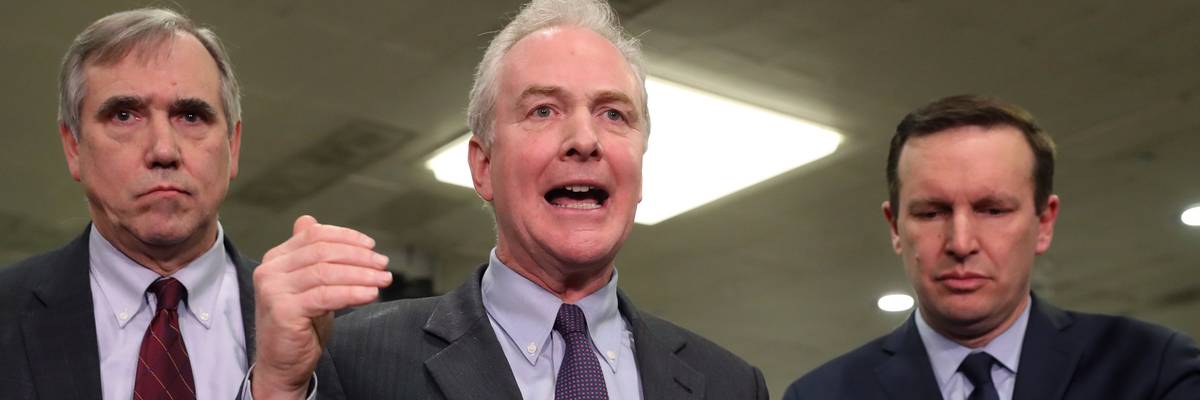
U.S. Sens. Chris Van Hollen (D-Md., center), Chris Murphy (D-Conn., right), and Jeff Merkley (D-Ore., left) are among the 20 senators urging President Joe Biden to "seriously consider" whether to pursue nuclear cooperation with Saudi Arabia.
"We should seriously consider whether it is in U.S. interests to help Saudi Arabia develop a domestic nuclear program," 19 Democratic senators and independent Bernie Sanders wrote.
Amid reports that Saudi Arabia is seeking United States support for its nuclear energy program—whose capacities critics fear could be utilized to develop nuclear weapons—a group of 20 U.S. senators on Wednesday urged President Joe Biden to "seriously consider" whether such a move is in the national interest as the administration brokers a possible normalization deal between the kingdom and Israel.
In addition to concerns over the fundamentalist monarchy's desire for a U.S. security guarantee as a condition for normalizing relations with apartheid Israel, as well as the future of a two-state solution in illegally occupied Palestine, the senators note in a letter to Biden that "the Saudi government is also reportedly seeking U.S. support to develop a civilian nuclear program, and to purchase more advanced U.S. weaponry."
"While we should seriously consider whether it is in U.S. interests to help Saudi Arabia develop a domestic nuclear program, we should always maintain the high bar of the 'gold standard' 123 Agreement and insist on adherence to the Additional Protocol," the senators wrote, referring to a provision of the Atomic Energy Act of 1954 requiring a country seeking a nuclear cooperation deal with the United States to commit to a set of nine nonproliferation criteria and expanded International Atomic Energy Agency (IAEA) inspections. The U.S. has entered into such agreements with more than two dozen countries, Taiwan, and the IAEA.
Citing "the devastating war in Yemen" waged by a U.S.-backed Saudi-led coalition for nearly eight years at the cost of more than 375,000 lives, the senators added that "the provision of more advanced weaponry to Saudi Arabia should be done with careful deliberation to ensure that such equipment only be used for truly defensive purposes and does not contribute to a regional arms race."
The lawmakers' letter was led by Democratic Sens. Chris Murphy (Conn.), Chris Van Hollen (Md.), Dick Durbin (Ill.), and Peter Welch (Vt.). Signatories include Sens. Bernie Sanders (I-Vt.), Elizabeth Warren (D-Mass.), John Fetterman (D-Pa.), Jeff Merkley (D-Ore.), Patty Murray (D-Wash.), and Ed Markey (D-Mass.).
As Center for Strategic & International Studies senior fellow Jane Nakano wrote last month:
The Saudi interest in acquiring nuclear power technology became publicly known around 2010, with a royal decree stipulating that "the development of atomic energy is essential to meet the kingdom's growing requirements for energy to generate electricity, produce desalinated water, and reduce reliance on depleting hydrocarbon resources." Also, having pledged to meet carbon neutrality by 2060, Saudi Arabia looks to nuclear as an important source of zero-emissions electricity.
In addition to the United States, China National Nuclear Corporation of China, Électricité de France of France, Rosatom of Russia, and Korea Electric Power Corporation of South Korea have been in discussions to land the contract to build two inaugural nuclear power units in Saudi Arabia.
"Saudi Arabia has been publicly interested in obtaining the capacity to enrich domestic uranium to establish the entire nuclear fuel cycle, including the production of yellowcake, low enriched uranium, and the manufacturing of nuclear fuel both for both domestic use and exporting," Nakano noted. "While economic diversification through the development of domestic uranium industry may be a genuine interest, Saudi leadership has also shown little opposition to turning nuclear power capacity into developing a nuclear weapon if it deemed necessary to acquire such capability."
"The ongoing Saudi resistance to the U.S. nonproliferation conditions has generated controversy, given Saudi Arabia acceded to the Nuclear Nonproliferation Treaty in 1988—i.e., the country is legally bound to not pursue nuclear weapons," she added.
However, Saudi Crown Prince Mohammed bin Salman (MBS) confirmed last month that if Iran develops a nuclear bomb, "we will have to get one."
Some experts are warning that Saudi Arabia could turn to China or even Russia to help fulfill its nuclear ambitions if it grows wary of U.S. conditions. Hassan Alshehri, a Saudi defense analyst and retired brigadier general, told Breaking Defense that "the West knows that Riyadh has a flexible compass that can guide it to other alternatives to acquire nuclear capabilities if Washington continues with its current negative stance."
Hasan Al Hasan, Middle East research fellow at the International Institute for Strategic Studies, told Breaking Defense that "if MBS and the Biden administration fail to reach an agreement on nuclear limits and security commitments... then Saudi Arabia will likely turn to other partners, notably China and Russia, for help with building the capabilities it needs to restore the balance of power with Iran."
Dear Common Dreams reader, It’s been nearly 30 years since I co-founded Common Dreams with my late wife, Lina Newhouser. We had the radical notion that journalism should serve the public good, not corporate profits. It was clear to us from the outset what it would take to build such a project. No paid advertisements. No corporate sponsors. No millionaire publisher telling us what to think or do. Many people said we wouldn't last a year, but we proved those doubters wrong. Together with a tremendous team of journalists and dedicated staff, we built an independent media outlet free from the constraints of profits and corporate control. Our mission has always been simple: To inform. To inspire. To ignite change for the common good. Building Common Dreams was not easy. Our survival was never guaranteed. When you take on the most powerful forces—Wall Street greed, fossil fuel industry destruction, Big Tech lobbyists, and uber-rich oligarchs who have spent billions upon billions rigging the economy and democracy in their favor—the only bulwark you have is supporters who believe in your work. But here’s the urgent message from me today. It's never been this bad out there. And it's never been this hard to keep us going. At the very moment Common Dreams is most needed, the threats we face are intensifying. We need your support now more than ever. We don't accept corporate advertising and never will. We don't have a paywall because we don't think people should be blocked from critical news based on their ability to pay. Everything we do is funded by the donations of readers like you. When everyone does the little they can afford, we are strong. But if that support retreats or dries up, so do we. Will you donate now to make sure Common Dreams not only survives but thrives? —Craig Brown, Co-founder |
Amid reports that Saudi Arabia is seeking United States support for its nuclear energy program—whose capacities critics fear could be utilized to develop nuclear weapons—a group of 20 U.S. senators on Wednesday urged President Joe Biden to "seriously consider" whether such a move is in the national interest as the administration brokers a possible normalization deal between the kingdom and Israel.
In addition to concerns over the fundamentalist monarchy's desire for a U.S. security guarantee as a condition for normalizing relations with apartheid Israel, as well as the future of a two-state solution in illegally occupied Palestine, the senators note in a letter to Biden that "the Saudi government is also reportedly seeking U.S. support to develop a civilian nuclear program, and to purchase more advanced U.S. weaponry."
"While we should seriously consider whether it is in U.S. interests to help Saudi Arabia develop a domestic nuclear program, we should always maintain the high bar of the 'gold standard' 123 Agreement and insist on adherence to the Additional Protocol," the senators wrote, referring to a provision of the Atomic Energy Act of 1954 requiring a country seeking a nuclear cooperation deal with the United States to commit to a set of nine nonproliferation criteria and expanded International Atomic Energy Agency (IAEA) inspections. The U.S. has entered into such agreements with more than two dozen countries, Taiwan, and the IAEA.
Citing "the devastating war in Yemen" waged by a U.S.-backed Saudi-led coalition for nearly eight years at the cost of more than 375,000 lives, the senators added that "the provision of more advanced weaponry to Saudi Arabia should be done with careful deliberation to ensure that such equipment only be used for truly defensive purposes and does not contribute to a regional arms race."
The lawmakers' letter was led by Democratic Sens. Chris Murphy (Conn.), Chris Van Hollen (Md.), Dick Durbin (Ill.), and Peter Welch (Vt.). Signatories include Sens. Bernie Sanders (I-Vt.), Elizabeth Warren (D-Mass.), John Fetterman (D-Pa.), Jeff Merkley (D-Ore.), Patty Murray (D-Wash.), and Ed Markey (D-Mass.).
As Center for Strategic & International Studies senior fellow Jane Nakano wrote last month:
The Saudi interest in acquiring nuclear power technology became publicly known around 2010, with a royal decree stipulating that "the development of atomic energy is essential to meet the kingdom's growing requirements for energy to generate electricity, produce desalinated water, and reduce reliance on depleting hydrocarbon resources." Also, having pledged to meet carbon neutrality by 2060, Saudi Arabia looks to nuclear as an important source of zero-emissions electricity.
In addition to the United States, China National Nuclear Corporation of China, Électricité de France of France, Rosatom of Russia, and Korea Electric Power Corporation of South Korea have been in discussions to land the contract to build two inaugural nuclear power units in Saudi Arabia.
"Saudi Arabia has been publicly interested in obtaining the capacity to enrich domestic uranium to establish the entire nuclear fuel cycle, including the production of yellowcake, low enriched uranium, and the manufacturing of nuclear fuel both for both domestic use and exporting," Nakano noted. "While economic diversification through the development of domestic uranium industry may be a genuine interest, Saudi leadership has also shown little opposition to turning nuclear power capacity into developing a nuclear weapon if it deemed necessary to acquire such capability."
"The ongoing Saudi resistance to the U.S. nonproliferation conditions has generated controversy, given Saudi Arabia acceded to the Nuclear Nonproliferation Treaty in 1988—i.e., the country is legally bound to not pursue nuclear weapons," she added.
However, Saudi Crown Prince Mohammed bin Salman (MBS) confirmed last month that if Iran develops a nuclear bomb, "we will have to get one."
Some experts are warning that Saudi Arabia could turn to China or even Russia to help fulfill its nuclear ambitions if it grows wary of U.S. conditions. Hassan Alshehri, a Saudi defense analyst and retired brigadier general, told Breaking Defense that "the West knows that Riyadh has a flexible compass that can guide it to other alternatives to acquire nuclear capabilities if Washington continues with its current negative stance."
Hasan Al Hasan, Middle East research fellow at the International Institute for Strategic Studies, told Breaking Defense that "if MBS and the Biden administration fail to reach an agreement on nuclear limits and security commitments... then Saudi Arabia will likely turn to other partners, notably China and Russia, for help with building the capabilities it needs to restore the balance of power with Iran."
Amid reports that Saudi Arabia is seeking United States support for its nuclear energy program—whose capacities critics fear could be utilized to develop nuclear weapons—a group of 20 U.S. senators on Wednesday urged President Joe Biden to "seriously consider" whether such a move is in the national interest as the administration brokers a possible normalization deal between the kingdom and Israel.
In addition to concerns over the fundamentalist monarchy's desire for a U.S. security guarantee as a condition for normalizing relations with apartheid Israel, as well as the future of a two-state solution in illegally occupied Palestine, the senators note in a letter to Biden that "the Saudi government is also reportedly seeking U.S. support to develop a civilian nuclear program, and to purchase more advanced U.S. weaponry."
"While we should seriously consider whether it is in U.S. interests to help Saudi Arabia develop a domestic nuclear program, we should always maintain the high bar of the 'gold standard' 123 Agreement and insist on adherence to the Additional Protocol," the senators wrote, referring to a provision of the Atomic Energy Act of 1954 requiring a country seeking a nuclear cooperation deal with the United States to commit to a set of nine nonproliferation criteria and expanded International Atomic Energy Agency (IAEA) inspections. The U.S. has entered into such agreements with more than two dozen countries, Taiwan, and the IAEA.
Citing "the devastating war in Yemen" waged by a U.S.-backed Saudi-led coalition for nearly eight years at the cost of more than 375,000 lives, the senators added that "the provision of more advanced weaponry to Saudi Arabia should be done with careful deliberation to ensure that such equipment only be used for truly defensive purposes and does not contribute to a regional arms race."
The lawmakers' letter was led by Democratic Sens. Chris Murphy (Conn.), Chris Van Hollen (Md.), Dick Durbin (Ill.), and Peter Welch (Vt.). Signatories include Sens. Bernie Sanders (I-Vt.), Elizabeth Warren (D-Mass.), John Fetterman (D-Pa.), Jeff Merkley (D-Ore.), Patty Murray (D-Wash.), and Ed Markey (D-Mass.).
As Center for Strategic & International Studies senior fellow Jane Nakano wrote last month:
The Saudi interest in acquiring nuclear power technology became publicly known around 2010, with a royal decree stipulating that "the development of atomic energy is essential to meet the kingdom's growing requirements for energy to generate electricity, produce desalinated water, and reduce reliance on depleting hydrocarbon resources." Also, having pledged to meet carbon neutrality by 2060, Saudi Arabia looks to nuclear as an important source of zero-emissions electricity.
In addition to the United States, China National Nuclear Corporation of China, Électricité de France of France, Rosatom of Russia, and Korea Electric Power Corporation of South Korea have been in discussions to land the contract to build two inaugural nuclear power units in Saudi Arabia.
"Saudi Arabia has been publicly interested in obtaining the capacity to enrich domestic uranium to establish the entire nuclear fuel cycle, including the production of yellowcake, low enriched uranium, and the manufacturing of nuclear fuel both for both domestic use and exporting," Nakano noted. "While economic diversification through the development of domestic uranium industry may be a genuine interest, Saudi leadership has also shown little opposition to turning nuclear power capacity into developing a nuclear weapon if it deemed necessary to acquire such capability."
"The ongoing Saudi resistance to the U.S. nonproliferation conditions has generated controversy, given Saudi Arabia acceded to the Nuclear Nonproliferation Treaty in 1988—i.e., the country is legally bound to not pursue nuclear weapons," she added.
However, Saudi Crown Prince Mohammed bin Salman (MBS) confirmed last month that if Iran develops a nuclear bomb, "we will have to get one."
Some experts are warning that Saudi Arabia could turn to China or even Russia to help fulfill its nuclear ambitions if it grows wary of U.S. conditions. Hassan Alshehri, a Saudi defense analyst and retired brigadier general, told Breaking Defense that "the West knows that Riyadh has a flexible compass that can guide it to other alternatives to acquire nuclear capabilities if Washington continues with its current negative stance."
Hasan Al Hasan, Middle East research fellow at the International Institute for Strategic Studies, told Breaking Defense that "if MBS and the Biden administration fail to reach an agreement on nuclear limits and security commitments... then Saudi Arabia will likely turn to other partners, notably China and Russia, for help with building the capabilities it needs to restore the balance of power with Iran."