SUBSCRIBE TO OUR FREE NEWSLETTER
Daily news & progressive opinion—funded by the people, not the corporations—delivered straight to your inbox.
5
#000000
#FFFFFF
To donate by check, phone, or other method, see our More Ways to Give page.
Daily news & progressive opinion—funded by the people, not the corporations—delivered straight to your inbox.

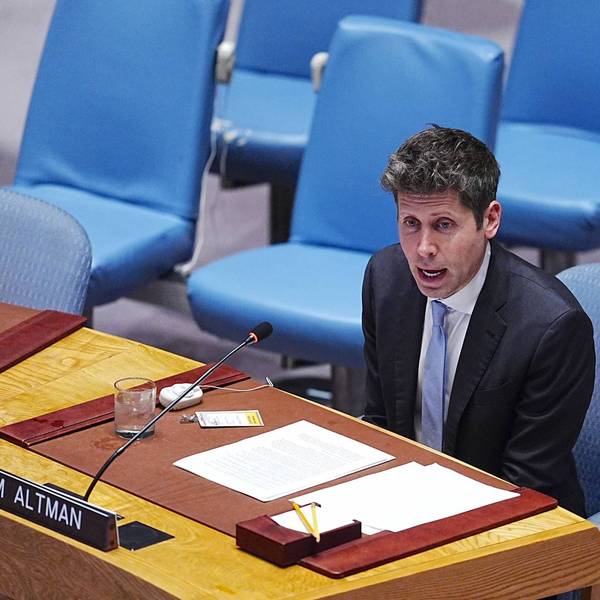
OpenAI CEO Sam Altman speaks to reporters after meeting with Sen. Bernie Sanders (I-Vt.) on June 3, 2026 in Washington, DC.
"Let’s not wait to find out," wrote Sen. Bernie Sanders. "Pause advanced AI NOW!"
US Sen. Bernie Sanders asked OpenAI CEO Sam Altman precisely what "bad things" the world should accept for the sake of advancements in artificial intelligence, a question that came after the billionaire executive said people must be willing to tolerate some unspecified negative outcomes to enjoy the potential long-term benefits of the technology.
"Mr. Altman: What 'bad things' should we accept to advance AI?" Sanders (I-Vt.) wrote in response to the OpenAI CEO's interview with Politico. "Losing tens of millions of jobs? A mass surveillance state? A mental health crisis for our kids? A global financial crisis? Mass extinction?"
"Let’s not wait to find out," the senator added. "Pause advanced AI NOW!"
Altman told Politico in an interview released this past weekend that he believes the world "should accept some bad things happening for the benefits of this technology and people having the agency." The OpenAI CEO didn't elaborate on the kinds of "bad things" he views as an acceptable price to pay for AI development, which some researchers and industry insiders say poses an existential threat to humanity.
Altman was among the leading AI executives who met with US President Donald Trump at the White House last week and signed a commitment to self-police their respective companies' AI models in the wake of recently uncovered security incidents and amid mounting concerns that—if left unrestrained and in the hands of profit-seeking firms—AI could have catastrophic impacts on humankind.
Sanders is calling for an immediate halt to advanced AI development as well as a permanent ban on artificial superintelligence, defined as "AI that exceeds human cognitive performance and capabilities across most domains, or has sufficient capabilities to destroy or disempower humanity, including by overthrowing the federal government."
Sanders, Rep. Greg Casar (D-Texas), and other US lawmakers who support strict AI regulation are also calling on the Trump administration to pursue international agreements aimed at reining in artificial intelligence worldwide.
Volker Türk, the United Nations high commissioner for human rights, said in a speech on Monday that "the clock on AI regulation is ticking" and warned that unfettered AI "can undermine equality, freedom, privacy, and public debate in a million subtle, sophisticated ways—letting dystopia creep in unnoticed."
"No country and no company can—or should—define the future of AI and people’s rights alone," said Türk. "The clock on AI regulation is ticking. If we fail to move quickly, we risk unforeseeable consequences—for ourselves and future generations."
Dear Common Dreams reader, It’s been nearly 30 years since I co-founded Common Dreams with my late wife, Lina Newhouser. We had the radical notion that journalism should serve the public good, not corporate profits. It was clear to us from the outset what it would take to build such a project. No paid advertisements. No corporate sponsors. No millionaire publisher telling us what to think or do. Many people said we wouldn't last a year, but we proved those doubters wrong. Together with a tremendous team of journalists and dedicated staff, we built an independent media outlet free from the constraints of profits and corporate control. Our mission has always been simple: To inform. To inspire. To ignite change for the common good. Building Common Dreams was not easy. Our survival was never guaranteed. When you take on the most powerful forces—Wall Street greed, fossil fuel industry destruction, Big Tech lobbyists, and uber-rich oligarchs who have spent billions upon billions rigging the economy and democracy in their favor—the only bulwark you have is supporters who believe in your work. But here’s the urgent message from me today. It's never been this bad out there. And it's never been this hard to keep us going. At the very moment Common Dreams is most needed, the threats we face are intensifying. We need your support now more than ever. We don't accept corporate advertising and never will. We don't have a paywall because we don't think people should be blocked from critical news based on their ability to pay. Everything we do is funded by the donations of readers like you. When everyone does the little they can afford, we are strong. But if that support retreats or dries up, so do we. Will you donate now to make sure Common Dreams not only survives but thrives? —Craig Brown, Co-founder |
US Sen. Bernie Sanders asked OpenAI CEO Sam Altman precisely what "bad things" the world should accept for the sake of advancements in artificial intelligence, a question that came after the billionaire executive said people must be willing to tolerate some unspecified negative outcomes to enjoy the potential long-term benefits of the technology.
"Mr. Altman: What 'bad things' should we accept to advance AI?" Sanders (I-Vt.) wrote in response to the OpenAI CEO's interview with Politico. "Losing tens of millions of jobs? A mass surveillance state? A mental health crisis for our kids? A global financial crisis? Mass extinction?"
"Let’s not wait to find out," the senator added. "Pause advanced AI NOW!"
Altman told Politico in an interview released this past weekend that he believes the world "should accept some bad things happening for the benefits of this technology and people having the agency." The OpenAI CEO didn't elaborate on the kinds of "bad things" he views as an acceptable price to pay for AI development, which some researchers and industry insiders say poses an existential threat to humanity.
Altman was among the leading AI executives who met with US President Donald Trump at the White House last week and signed a commitment to self-police their respective companies' AI models in the wake of recently uncovered security incidents and amid mounting concerns that—if left unrestrained and in the hands of profit-seeking firms—AI could have catastrophic impacts on humankind.
Sanders is calling for an immediate halt to advanced AI development as well as a permanent ban on artificial superintelligence, defined as "AI that exceeds human cognitive performance and capabilities across most domains, or has sufficient capabilities to destroy or disempower humanity, including by overthrowing the federal government."
Sanders, Rep. Greg Casar (D-Texas), and other US lawmakers who support strict AI regulation are also calling on the Trump administration to pursue international agreements aimed at reining in artificial intelligence worldwide.
Volker Türk, the United Nations high commissioner for human rights, said in a speech on Monday that "the clock on AI regulation is ticking" and warned that unfettered AI "can undermine equality, freedom, privacy, and public debate in a million subtle, sophisticated ways—letting dystopia creep in unnoticed."
"No country and no company can—or should—define the future of AI and people’s rights alone," said Türk. "The clock on AI regulation is ticking. If we fail to move quickly, we risk unforeseeable consequences—for ourselves and future generations."
US Sen. Bernie Sanders asked OpenAI CEO Sam Altman precisely what "bad things" the world should accept for the sake of advancements in artificial intelligence, a question that came after the billionaire executive said people must be willing to tolerate some unspecified negative outcomes to enjoy the potential long-term benefits of the technology.
"Mr. Altman: What 'bad things' should we accept to advance AI?" Sanders (I-Vt.) wrote in response to the OpenAI CEO's interview with Politico. "Losing tens of millions of jobs? A mass surveillance state? A mental health crisis for our kids? A global financial crisis? Mass extinction?"
"Let’s not wait to find out," the senator added. "Pause advanced AI NOW!"
Altman told Politico in an interview released this past weekend that he believes the world "should accept some bad things happening for the benefits of this technology and people having the agency." The OpenAI CEO didn't elaborate on the kinds of "bad things" he views as an acceptable price to pay for AI development, which some researchers and industry insiders say poses an existential threat to humanity.
Altman was among the leading AI executives who met with US President Donald Trump at the White House last week and signed a commitment to self-police their respective companies' AI models in the wake of recently uncovered security incidents and amid mounting concerns that—if left unrestrained and in the hands of profit-seeking firms—AI could have catastrophic impacts on humankind.
Sanders is calling for an immediate halt to advanced AI development as well as a permanent ban on artificial superintelligence, defined as "AI that exceeds human cognitive performance and capabilities across most domains, or has sufficient capabilities to destroy or disempower humanity, including by overthrowing the federal government."
Sanders, Rep. Greg Casar (D-Texas), and other US lawmakers who support strict AI regulation are also calling on the Trump administration to pursue international agreements aimed at reining in artificial intelligence worldwide.
Volker Türk, the United Nations high commissioner for human rights, said in a speech on Monday that "the clock on AI regulation is ticking" and warned that unfettered AI "can undermine equality, freedom, privacy, and public debate in a million subtle, sophisticated ways—letting dystopia creep in unnoticed."
"No country and no company can—or should—define the future of AI and people’s rights alone," said Türk. "The clock on AI regulation is ticking. If we fail to move quickly, we risk unforeseeable consequences—for ourselves and future generations."