SUBSCRIBE TO OUR FREE NEWSLETTER
Daily news & progressive opinion—funded by the people, not the corporations—delivered straight to your inbox.
5
#000000
#FFFFFF
To donate by check, phone, or other method, see our More Ways to Give page.
Daily news & progressive opinion—funded by the people, not the corporations—delivered straight to your inbox.
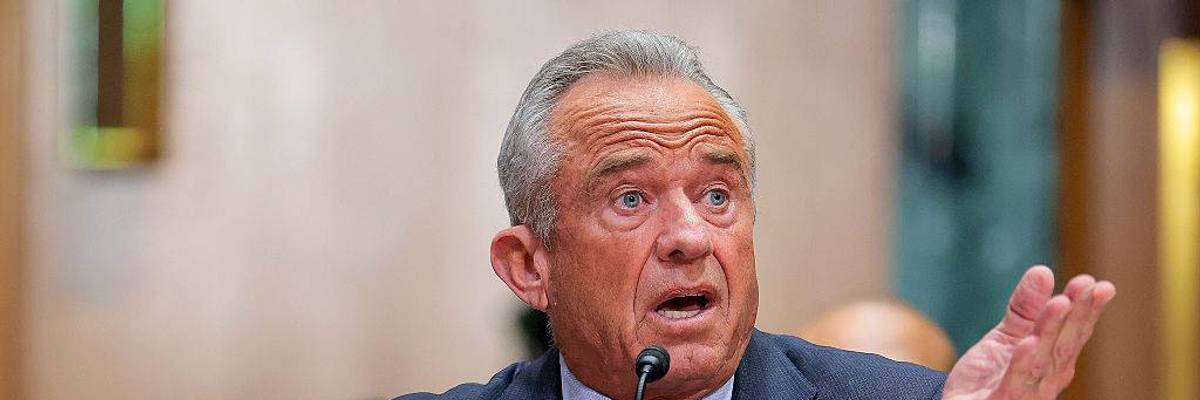
US Health and Human Services Secretary Robert F. Kennedy Jr. testifies during a Senate Finance Committee hearing on April 22, 2026 in Washington, DC.
Robert F. Kennedy Jr., the head of the US Health and Human Services Department, said he doesn't think the Republican Party's unprecedented cuts to food aid would have "that much effect."
US Health and Human Services Secretary Robert F. Kennedy Jr. on Wednesday dismissed the impact of massive food aid cuts signed into law last summer by President Donald Trump, saying he doesn't believe the cuts will have "that much effect" as new data showed at least 5 million people have lost assistance so far—including roughly 1.5 million children.
Speaking at a news conference on children's nutrition in Florida, Kennedy falsely claimed that "the only people kicked off of" the Supplemental Nutrition Assistance Program (SNAP) under the GOP budget law signed by Trump "were people who were not eligible for it," either "because their income is too high or because they were illegal aliens."
Kennedy's remarks came as a new analysis by the Center on Budget and Policy Priorities (CBPP) found that SNAP enrollment nationwide has fallen to a 17-year low following enactment of the Trump-GOP budget law, which will cut the program by around $190 billion over the next decade, enact stricter work reporting mandates, and require states to contribute a portion of benefit costs for the first time.
"'Not much effect?' Based on available data from 25 states, we estimate that well over 1.5 million kids nationwide have lost SNAP in the wake of the unprecedented cuts in the Republican reconciliation law," Katie Bergh, a policy analyst at CBPP, wrote in response to Kennedy's remarks. "Many of those kids and their families lost SNAP despite still being eligible."
Watch Kennedy's comments:
Q: “Are either of you concerned that the reduction in funding for SNAP and the reduction in eligibility for SNAP will reduce access to food for children and families?”
Sec. Kennedy: “I don't think it's gonna have that much effect.” pic.twitter.com/1h97NP6rcN
— BulwarkClips (@BulwarkClips) August 26, 2026
News reports, anecdotal accounts from impacted families, and expert assessments contradict Kennedy's insistence that only those who were no longer eligible for SNAP due to income or immigration status have lost benefits. An explosion of red tape due to the new work reporting requirements imposed by the Trump-GOP budget law has made it more difficult for eligible beneficiaries to continue receiving SNAP, forcing many to seek aid from food banks and take desperate measures—such as skipping meals and doses of medication—to make ends meet.
CBPP warned that the impacts of the cuts are likely to intensify once the budget law's provision shifting benefit costs to states takes full effect next year.
"The magnitude of the cost shift and the urgency surrounding error rates may incentivize states to take drastic measures to reduce their payment error rates quickly and cut program costs, even if it means delaying or improperly denying benefits to eligible people," the think tank said on Wednesday. "We’re likely seeing some of those initial effects in SNAP participation data."
A report published last month by a pair of food policy experts argued that the unprecedented assault on SNAP undercuts Kennedy's so-called "Make America Healthy Again" initiative, which purports to place nutrition "at the center of health."
“If we are serious about improving Americans’ health, we need policies that make healthy food more accessible, not less,” said Priya Fielding-Singh of George Washington University’s Global Food Institute. “Cutting off food assistance for millions of families undermines MAHA’s stated goals of improving diet quality and preventing chronic disease. Food security and public health go hand in hand.”
Dear Common Dreams reader, It’s been nearly 30 years since I co-founded Common Dreams with my late wife, Lina Newhouser. We had the radical notion that journalism should serve the public good, not corporate profits. It was clear to us from the outset what it would take to build such a project. No paid advertisements. No corporate sponsors. No millionaire publisher telling us what to think or do. Many people said we wouldn't last a year, but we proved those doubters wrong. Together with a tremendous team of journalists and dedicated staff, we built an independent media outlet free from the constraints of profits and corporate control. Our mission has always been simple: To inform. To inspire. To ignite change for the common good. Building Common Dreams was not easy. Our survival was never guaranteed. When you take on the most powerful forces—Wall Street greed, fossil fuel industry destruction, Big Tech lobbyists, and uber-rich oligarchs who have spent billions upon billions rigging the economy and democracy in their favor—the only bulwark you have is supporters who believe in your work. But here’s the urgent message from me today. It's never been this bad out there. And it's never been this hard to keep us going. At the very moment Common Dreams is most needed, the threats we face are intensifying. We need your support now more than ever. We don't accept corporate advertising and never will. We don't have a paywall because we don't think people should be blocked from critical news based on their ability to pay. Everything we do is funded by the donations of readers like you. When everyone does the little they can afford, we are strong. But if that support retreats or dries up, so do we. Will you donate now to make sure Common Dreams not only survives but thrives? —Craig Brown, Co-founder |
US Health and Human Services Secretary Robert F. Kennedy Jr. on Wednesday dismissed the impact of massive food aid cuts signed into law last summer by President Donald Trump, saying he doesn't believe the cuts will have "that much effect" as new data showed at least 5 million people have lost assistance so far—including roughly 1.5 million children.
Speaking at a news conference on children's nutrition in Florida, Kennedy falsely claimed that "the only people kicked off of" the Supplemental Nutrition Assistance Program (SNAP) under the GOP budget law signed by Trump "were people who were not eligible for it," either "because their income is too high or because they were illegal aliens."
Kennedy's remarks came as a new analysis by the Center on Budget and Policy Priorities (CBPP) found that SNAP enrollment nationwide has fallen to a 17-year low following enactment of the Trump-GOP budget law, which will cut the program by around $190 billion over the next decade, enact stricter work reporting mandates, and require states to contribute a portion of benefit costs for the first time.
"'Not much effect?' Based on available data from 25 states, we estimate that well over 1.5 million kids nationwide have lost SNAP in the wake of the unprecedented cuts in the Republican reconciliation law," Katie Bergh, a policy analyst at CBPP, wrote in response to Kennedy's remarks. "Many of those kids and their families lost SNAP despite still being eligible."
Watch Kennedy's comments:
Q: “Are either of you concerned that the reduction in funding for SNAP and the reduction in eligibility for SNAP will reduce access to food for children and families?”
Sec. Kennedy: “I don't think it's gonna have that much effect.” pic.twitter.com/1h97NP6rcN
— BulwarkClips (@BulwarkClips) August 26, 2026
News reports, anecdotal accounts from impacted families, and expert assessments contradict Kennedy's insistence that only those who were no longer eligible for SNAP due to income or immigration status have lost benefits. An explosion of red tape due to the new work reporting requirements imposed by the Trump-GOP budget law has made it more difficult for eligible beneficiaries to continue receiving SNAP, forcing many to seek aid from food banks and take desperate measures—such as skipping meals and doses of medication—to make ends meet.
CBPP warned that the impacts of the cuts are likely to intensify once the budget law's provision shifting benefit costs to states takes full effect next year.
"The magnitude of the cost shift and the urgency surrounding error rates may incentivize states to take drastic measures to reduce their payment error rates quickly and cut program costs, even if it means delaying or improperly denying benefits to eligible people," the think tank said on Wednesday. "We’re likely seeing some of those initial effects in SNAP participation data."
A report published last month by a pair of food policy experts argued that the unprecedented assault on SNAP undercuts Kennedy's so-called "Make America Healthy Again" initiative, which purports to place nutrition "at the center of health."
“If we are serious about improving Americans’ health, we need policies that make healthy food more accessible, not less,” said Priya Fielding-Singh of George Washington University’s Global Food Institute. “Cutting off food assistance for millions of families undermines MAHA’s stated goals of improving diet quality and preventing chronic disease. Food security and public health go hand in hand.”
US Health and Human Services Secretary Robert F. Kennedy Jr. on Wednesday dismissed the impact of massive food aid cuts signed into law last summer by President Donald Trump, saying he doesn't believe the cuts will have "that much effect" as new data showed at least 5 million people have lost assistance so far—including roughly 1.5 million children.
Speaking at a news conference on children's nutrition in Florida, Kennedy falsely claimed that "the only people kicked off of" the Supplemental Nutrition Assistance Program (SNAP) under the GOP budget law signed by Trump "were people who were not eligible for it," either "because their income is too high or because they were illegal aliens."
Kennedy's remarks came as a new analysis by the Center on Budget and Policy Priorities (CBPP) found that SNAP enrollment nationwide has fallen to a 17-year low following enactment of the Trump-GOP budget law, which will cut the program by around $190 billion over the next decade, enact stricter work reporting mandates, and require states to contribute a portion of benefit costs for the first time.
"'Not much effect?' Based on available data from 25 states, we estimate that well over 1.5 million kids nationwide have lost SNAP in the wake of the unprecedented cuts in the Republican reconciliation law," Katie Bergh, a policy analyst at CBPP, wrote in response to Kennedy's remarks. "Many of those kids and their families lost SNAP despite still being eligible."
Watch Kennedy's comments:
Q: “Are either of you concerned that the reduction in funding for SNAP and the reduction in eligibility for SNAP will reduce access to food for children and families?”
Sec. Kennedy: “I don't think it's gonna have that much effect.” pic.twitter.com/1h97NP6rcN
— BulwarkClips (@BulwarkClips) August 26, 2026
News reports, anecdotal accounts from impacted families, and expert assessments contradict Kennedy's insistence that only those who were no longer eligible for SNAP due to income or immigration status have lost benefits. An explosion of red tape due to the new work reporting requirements imposed by the Trump-GOP budget law has made it more difficult for eligible beneficiaries to continue receiving SNAP, forcing many to seek aid from food banks and take desperate measures—such as skipping meals and doses of medication—to make ends meet.
CBPP warned that the impacts of the cuts are likely to intensify once the budget law's provision shifting benefit costs to states takes full effect next year.
"The magnitude of the cost shift and the urgency surrounding error rates may incentivize states to take drastic measures to reduce their payment error rates quickly and cut program costs, even if it means delaying or improperly denying benefits to eligible people," the think tank said on Wednesday. "We’re likely seeing some of those initial effects in SNAP participation data."
A report published last month by a pair of food policy experts argued that the unprecedented assault on SNAP undercuts Kennedy's so-called "Make America Healthy Again" initiative, which purports to place nutrition "at the center of health."
“If we are serious about improving Americans’ health, we need policies that make healthy food more accessible, not less,” said Priya Fielding-Singh of George Washington University’s Global Food Institute. “Cutting off food assistance for millions of families undermines MAHA’s stated goals of improving diet quality and preventing chronic disease. Food security and public health go hand in hand.”