SUBSCRIBE TO OUR FREE NEWSLETTER
Daily news & progressive opinion—funded by the people, not the corporations—delivered straight to your inbox.
5
#000000
#FFFFFF
To donate by check, phone, or other method, see our More Ways to Give page.
Daily news & progressive opinion—funded by the people, not the corporations—delivered straight to your inbox.
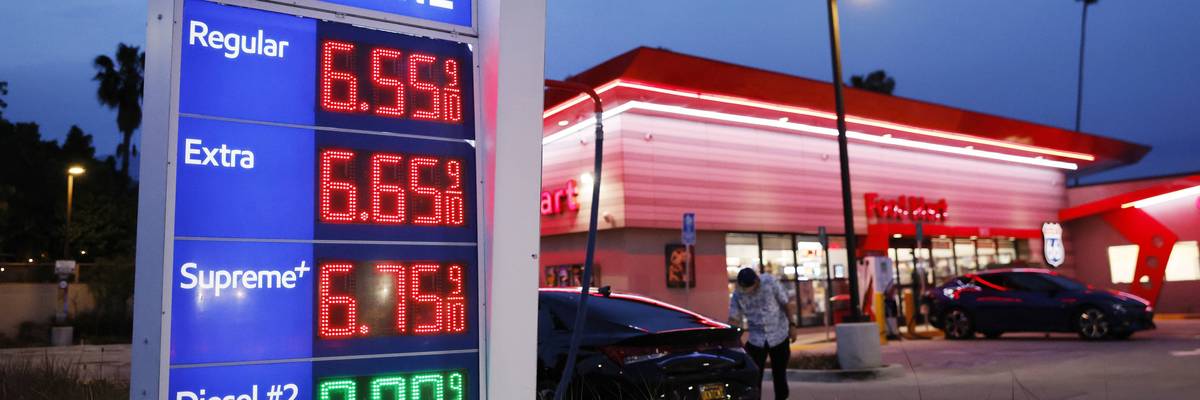
Gas prices are displayed at a Mobil gas station on March 30, 2026 in Pasadena, California.
“It is obscene that companies like TotalEnergies are making enormous profits from war, while ordinary people’s lives are being shattered and the world faces a spiraling economic crisis," said one campaigner.
As energy and finance officials from across the European Union prepared to review energy supply levels amid the US-Israeli war on Iran on Tuesday, campaigners from a leading climate action group renewed their call for officials to go further than just releasing oil reserves in order to keep costs down.
Oil giants that have benefited from the growing global energy crisis set off by the US-Israeli attacks and Iran's retaliatory closing of the Strait of Hormuz should be held to account for their "fossil fuel profiteering," said 350.org.
After a virtual meeting of energy ministers from the G7 countries on Monday, 350.org called on officials to tax the windfall profits of companies like France's TotalEnergies, which is estimated to have made $1 billion in profits in just the last month since Iran closed the strait in retaliation for the US and Israeli attacks.
Total has reportedly "monopolized" about 70 crude oil shipments from the UAE and Oman in the last month, as Murban crude prices surged from $70 to $170 per barrel.
As Common Dreams reported Monday, 350.org released an analysis showing that spiking oil and gas prices resulting from the US-Israeli war have cost consumers and businesses more than $100 billion in the past month.
“It is obscene that companies like TotalEnergies are making enormous profits from war, while ordinary people’s lives are being shattered and the world faces a spiraling economic crisis," said Fanny Petitbon, France team lead for 350.org. "At a time of such profound human suffering, no company should be allowed to exploit chaos and conflict for financial gain. The G7’s deafening silence on these windfall profits speaks volumes, signaling a failure to hold corporate greed accountable while the rest of the world pays the price.”
Revenues from taxing windfall profits could "be used to support vulnerable households, accelerate the transition to renewable energy, and fund recovery efforts in regions affected by conflict," said Petitbon.
“The principle is clear: extraordinary profits made in times of crisis should be redirected for the public good, not concentrated in the hands of a few," she said.
The ministers from the G7 countries—which include the United States, Canada, Japan, Britain, France, Germany, and Italy—met virtually to discuss how the war in Iran is affecting energy and commodity markets and inflation. They called on countries “to refrain from imposing unjustified export restrictions” on oil and gas, but did not announce any specific steps they plan to take.
"We stand ready to take all necessary measures in close coordination with our partners, including to preserve the stability and security of the energy market," the ministers said in a statement. "We recognize the importance of coordinated international action to mitigate spill overs and safeguard macroeconomic stability."
Earlier this month, the International Energy Agency coordinated the release of 400 million barrels of oil to mitigate the supply shortfall caused by the closing of the Strait of Hormuz, from which about one-fifth of the world's oil supply flows.
But gas prices across Europe have continued to rise by 70% nonetheless. In the US, the average price of gas rose to $4 per gallon on Tuesday for the first time since August 2022.
Brent crude oil, which cost about $70 per barrel before the war, has gone up to $119 per barrel, and analysts are projecting prices as high as $200 as the conflict continues.
Monday's virtual summit was held ahead of an emergency meeting of EU energy ministers, who were told by EU Energy Commissioner Dan Jørgensen in a letter Monday that they were "encouraged to make timely preparations in anticipation of a potentially prolonged disruption" of energy imports.
Jørgensen emphasized in a video posted on social media Monday that the growing energy crisis underscores how a transition away from oil and gas toward renewable sources is crucial for economies as well as the planet.
The crisis in the Middle East is affecting energy prices also here in Europe.
My message on what we must do to protect our citizens and businesses.
Now and in the future.
↓ pic.twitter.com/jiLmavxV8K
— Dan Jørgensen (@DanJoergensen) March 30, 2026
"We will need immediate targeted measures to combat this crisis, but all of these measures need to be in line with our long-term strategy, which is more renewables as fast as possible," said Jørgensen.
Dear Common Dreams reader, It’s been nearly 30 years since I co-founded Common Dreams with my late wife, Lina Newhouser. We had the radical notion that journalism should serve the public good, not corporate profits. It was clear to us from the outset what it would take to build such a project. No paid advertisements. No corporate sponsors. No millionaire publisher telling us what to think or do. Many people said we wouldn't last a year, but we proved those doubters wrong. Together with a tremendous team of journalists and dedicated staff, we built an independent media outlet free from the constraints of profits and corporate control. Our mission has always been simple: To inform. To inspire. To ignite change for the common good. Building Common Dreams was not easy. Our survival was never guaranteed. When you take on the most powerful forces—Wall Street greed, fossil fuel industry destruction, Big Tech lobbyists, and uber-rich oligarchs who have spent billions upon billions rigging the economy and democracy in their favor—the only bulwark you have is supporters who believe in your work. But here’s the urgent message from me today. It's never been this bad out there. And it's never been this hard to keep us going. At the very moment Common Dreams is most needed, the threats we face are intensifying. We need your support now more than ever. We don't accept corporate advertising and never will. We don't have a paywall because we don't think people should be blocked from critical news based on their ability to pay. Everything we do is funded by the donations of readers like you. When everyone does the little they can afford, we are strong. But if that support retreats or dries up, so do we. Will you donate now to make sure Common Dreams not only survives but thrives? —Craig Brown, Co-founder |
As energy and finance officials from across the European Union prepared to review energy supply levels amid the US-Israeli war on Iran on Tuesday, campaigners from a leading climate action group renewed their call for officials to go further than just releasing oil reserves in order to keep costs down.
Oil giants that have benefited from the growing global energy crisis set off by the US-Israeli attacks and Iran's retaliatory closing of the Strait of Hormuz should be held to account for their "fossil fuel profiteering," said 350.org.
After a virtual meeting of energy ministers from the G7 countries on Monday, 350.org called on officials to tax the windfall profits of companies like France's TotalEnergies, which is estimated to have made $1 billion in profits in just the last month since Iran closed the strait in retaliation for the US and Israeli attacks.
Total has reportedly "monopolized" about 70 crude oil shipments from the UAE and Oman in the last month, as Murban crude prices surged from $70 to $170 per barrel.
As Common Dreams reported Monday, 350.org released an analysis showing that spiking oil and gas prices resulting from the US-Israeli war have cost consumers and businesses more than $100 billion in the past month.
“It is obscene that companies like TotalEnergies are making enormous profits from war, while ordinary people’s lives are being shattered and the world faces a spiraling economic crisis," said Fanny Petitbon, France team lead for 350.org. "At a time of such profound human suffering, no company should be allowed to exploit chaos and conflict for financial gain. The G7’s deafening silence on these windfall profits speaks volumes, signaling a failure to hold corporate greed accountable while the rest of the world pays the price.”
Revenues from taxing windfall profits could "be used to support vulnerable households, accelerate the transition to renewable energy, and fund recovery efforts in regions affected by conflict," said Petitbon.
“The principle is clear: extraordinary profits made in times of crisis should be redirected for the public good, not concentrated in the hands of a few," she said.
The ministers from the G7 countries—which include the United States, Canada, Japan, Britain, France, Germany, and Italy—met virtually to discuss how the war in Iran is affecting energy and commodity markets and inflation. They called on countries “to refrain from imposing unjustified export restrictions” on oil and gas, but did not announce any specific steps they plan to take.
"We stand ready to take all necessary measures in close coordination with our partners, including to preserve the stability and security of the energy market," the ministers said in a statement. "We recognize the importance of coordinated international action to mitigate spill overs and safeguard macroeconomic stability."
Earlier this month, the International Energy Agency coordinated the release of 400 million barrels of oil to mitigate the supply shortfall caused by the closing of the Strait of Hormuz, from which about one-fifth of the world's oil supply flows.
But gas prices across Europe have continued to rise by 70% nonetheless. In the US, the average price of gas rose to $4 per gallon on Tuesday for the first time since August 2022.
Brent crude oil, which cost about $70 per barrel before the war, has gone up to $119 per barrel, and analysts are projecting prices as high as $200 as the conflict continues.
Monday's virtual summit was held ahead of an emergency meeting of EU energy ministers, who were told by EU Energy Commissioner Dan Jørgensen in a letter Monday that they were "encouraged to make timely preparations in anticipation of a potentially prolonged disruption" of energy imports.
Jørgensen emphasized in a video posted on social media Monday that the growing energy crisis underscores how a transition away from oil and gas toward renewable sources is crucial for economies as well as the planet.
The crisis in the Middle East is affecting energy prices also here in Europe.
My message on what we must do to protect our citizens and businesses.
Now and in the future.
↓ pic.twitter.com/jiLmavxV8K
— Dan Jørgensen (@DanJoergensen) March 30, 2026
"We will need immediate targeted measures to combat this crisis, but all of these measures need to be in line with our long-term strategy, which is more renewables as fast as possible," said Jørgensen.
As energy and finance officials from across the European Union prepared to review energy supply levels amid the US-Israeli war on Iran on Tuesday, campaigners from a leading climate action group renewed their call for officials to go further than just releasing oil reserves in order to keep costs down.
Oil giants that have benefited from the growing global energy crisis set off by the US-Israeli attacks and Iran's retaliatory closing of the Strait of Hormuz should be held to account for their "fossil fuel profiteering," said 350.org.
After a virtual meeting of energy ministers from the G7 countries on Monday, 350.org called on officials to tax the windfall profits of companies like France's TotalEnergies, which is estimated to have made $1 billion in profits in just the last month since Iran closed the strait in retaliation for the US and Israeli attacks.
Total has reportedly "monopolized" about 70 crude oil shipments from the UAE and Oman in the last month, as Murban crude prices surged from $70 to $170 per barrel.
As Common Dreams reported Monday, 350.org released an analysis showing that spiking oil and gas prices resulting from the US-Israeli war have cost consumers and businesses more than $100 billion in the past month.
“It is obscene that companies like TotalEnergies are making enormous profits from war, while ordinary people’s lives are being shattered and the world faces a spiraling economic crisis," said Fanny Petitbon, France team lead for 350.org. "At a time of such profound human suffering, no company should be allowed to exploit chaos and conflict for financial gain. The G7’s deafening silence on these windfall profits speaks volumes, signaling a failure to hold corporate greed accountable while the rest of the world pays the price.”
Revenues from taxing windfall profits could "be used to support vulnerable households, accelerate the transition to renewable energy, and fund recovery efforts in regions affected by conflict," said Petitbon.
“The principle is clear: extraordinary profits made in times of crisis should be redirected for the public good, not concentrated in the hands of a few," she said.
The ministers from the G7 countries—which include the United States, Canada, Japan, Britain, France, Germany, and Italy—met virtually to discuss how the war in Iran is affecting energy and commodity markets and inflation. They called on countries “to refrain from imposing unjustified export restrictions” on oil and gas, but did not announce any specific steps they plan to take.
"We stand ready to take all necessary measures in close coordination with our partners, including to preserve the stability and security of the energy market," the ministers said in a statement. "We recognize the importance of coordinated international action to mitigate spill overs and safeguard macroeconomic stability."
Earlier this month, the International Energy Agency coordinated the release of 400 million barrels of oil to mitigate the supply shortfall caused by the closing of the Strait of Hormuz, from which about one-fifth of the world's oil supply flows.
But gas prices across Europe have continued to rise by 70% nonetheless. In the US, the average price of gas rose to $4 per gallon on Tuesday for the first time since August 2022.
Brent crude oil, which cost about $70 per barrel before the war, has gone up to $119 per barrel, and analysts are projecting prices as high as $200 as the conflict continues.
Monday's virtual summit was held ahead of an emergency meeting of EU energy ministers, who were told by EU Energy Commissioner Dan Jørgensen in a letter Monday that they were "encouraged to make timely preparations in anticipation of a potentially prolonged disruption" of energy imports.
Jørgensen emphasized in a video posted on social media Monday that the growing energy crisis underscores how a transition away from oil and gas toward renewable sources is crucial for economies as well as the planet.
The crisis in the Middle East is affecting energy prices also here in Europe.
My message on what we must do to protect our citizens and businesses.
Now and in the future.
↓ pic.twitter.com/jiLmavxV8K
— Dan Jørgensen (@DanJoergensen) March 30, 2026
"We will need immediate targeted measures to combat this crisis, but all of these measures need to be in line with our long-term strategy, which is more renewables as fast as possible," said Jørgensen.