5
#000000
#FFFFFF
To donate by check, phone, or other method, see our More Ways to Give page.
Daily news & progressive opinion—funded by the people, not the corporations—delivered straight to your inbox.
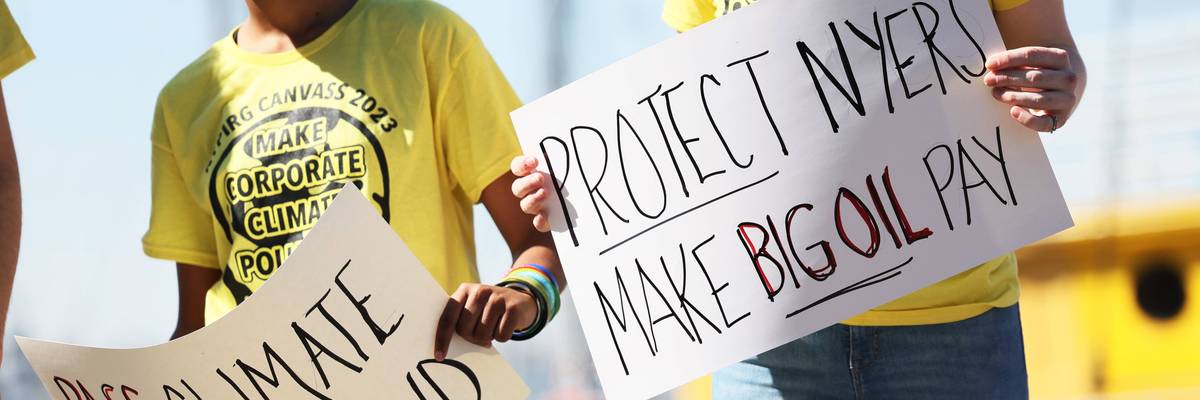
People hold signs during a press conference on the Climate Change Superfund Act at Pier 17 on May 26, 2023 in New York City.
“If allowed to stand, this wrongheaded ruling would shift $75 billion in planned climate-resilience funding from major fossil fuel polluters onto New York taxpayers,” said one advocate.
Climate advocates on Monday called on New York Attorney General Letitia James to appeal a ruling by a federal judge that found the state's superfund law, aimed at holding fossil fuel companies accountable for the weather disasters they cause, was unenforceable—"a bad decision," as campaigner Jamie Henn said, "based off a controversial ruling."
Henn, co-founder of 350.org and director of Fossil Free Media, said that "a cabal of Big Oil lawyers, Republican attorneys general, and Trump administration stooges just convinced a federal judge to strike down" the law, which was signed in 2024 by Democratic Gov. Kathy Hochul and would require oil and gas companies in New York to contribute about $3 billion annually—$75 billion total—to a superfund starting in 2028.
That sum would be divided among the companies according to their greenhouse gas emissions, which cause planetary heating and the hurricanes, flooding, and other extreme weather disasters that are associated with it.
Companies that have been found responsible for at least 1 billion tons of fossil fuel emissions between 2000-18 would be required to contribute to the fund, which would be used to rebuild infrastructure and help communities adapt to more frequent extreme weather events.
Chief Judge Brenda Sannes of the US District Court for the Northern District of New York ruled that a federal appeals court's earlier decision in City of New York v. Chevron Corp., in which the city's lawsuit against oil companies for climate damages was thrown out, was relevant to the Climate Change Superfund Act.
Sannes, who was appointed by former President Barack Obama, also said in her ruling that the state law is not authorized by the Clean Air Act and is preempted by federal law.
Henn said that after 22 Republican states joined industry groups and the US Chamber of Commerce in suing over the law, the judge "fell for Big Oil's argument that because of a precedent set by a controversial ruling involving the City of New York, the superfund program was preempted by the Clean Air Act."
"But that's bogus," said Henn. "The superfund program does nothing to regulate future emissions, it's just asking polluters to pay for a small share of the damages caused by their past pollution."
A judge in Vermont is expected to rule soon on the state's superfund law, which was the first in the nation. Sixteen states in all have proposed similar laws.
"This is far from the last word on the legality of climate superfund bills," said Henn.
Maya Golden-Krasner, deputy director of the Climate Law Institute at the Center for Biological Diversity, urged other states to "move forward with fair legislation that makes polluters pay for their damage."
"With the Trump administration gutting climate protections," she said, the campaign for superfund laws in states including California "is gaining momentum every day" despite the legal setback.
“If allowed to stand, this wrongheaded ruling would shift $75 billion in planned climate-resilience funding from major fossil fuel polluters onto New York taxpayers,” said Golden-Krasner.
Henn also said that the push to hold fossil fuel giants accountable for the damages their emissions cause "isn't going away."
"Eighty percent of voters think the fossil fuel industry should pay their fair share of climate damages," said Henn. "As disasters increase (and oil profits keep skyrocketing), the call to make polluters pay will only grow louder."
This country and this world are at a monumental crossroads. US voters have an opportunity to beat back the forces of fascism and confront the billionaires who are rigging the economy, our media system, and our democracy, making it increasingly impossible for ordinary people to get by. We’re not just talking about the election. We’re talking about what must be done once these fascist elements are vanquished from power. We need a bolder set of solutions than what either major party has so far been willing to offer and a working-class movement ready to fight like hell for it. Trump didn't emerge from nowhere. The conditions that fueled MAGA authoritarianism were created by decades of radical neoliberal economic policies and a corrupt political system dominated by corporate interests. They slashed taxes on the super-rich, promising that the benefits would trickle down. They said giveaways to the corporate titans would make life more affordable for the rest of us. It was all bullshit. And when a bitter, betrayed populace searches for someone to blame, right-wing demagogues have little trouble finding scapegoats. People know when they're being lied to, but you won't hear any of this from the corporate media. Only independent journalism—powered and funded by people who believe in building a better world—can deliver truly trustworthy daily news. If you share our vision, please contribute whatever you can to sustain our work. |
Climate advocates on Monday called on New York Attorney General Letitia James to appeal a ruling by a federal judge that found the state's superfund law, aimed at holding fossil fuel companies accountable for the weather disasters they cause, was unenforceable—"a bad decision," as campaigner Jamie Henn said, "based off a controversial ruling."
Henn, co-founder of 350.org and director of Fossil Free Media, said that "a cabal of Big Oil lawyers, Republican attorneys general, and Trump administration stooges just convinced a federal judge to strike down" the law, which was signed in 2024 by Democratic Gov. Kathy Hochul and would require oil and gas companies in New York to contribute about $3 billion annually—$75 billion total—to a superfund starting in 2028.
That sum would be divided among the companies according to their greenhouse gas emissions, which cause planetary heating and the hurricanes, flooding, and other extreme weather disasters that are associated with it.
Companies that have been found responsible for at least 1 billion tons of fossil fuel emissions between 2000-18 would be required to contribute to the fund, which would be used to rebuild infrastructure and help communities adapt to more frequent extreme weather events.
Chief Judge Brenda Sannes of the US District Court for the Northern District of New York ruled that a federal appeals court's earlier decision in City of New York v. Chevron Corp., in which the city's lawsuit against oil companies for climate damages was thrown out, was relevant to the Climate Change Superfund Act.
Sannes, who was appointed by former President Barack Obama, also said in her ruling that the state law is not authorized by the Clean Air Act and is preempted by federal law.
Henn said that after 22 Republican states joined industry groups and the US Chamber of Commerce in suing over the law, the judge "fell for Big Oil's argument that because of a precedent set by a controversial ruling involving the City of New York, the superfund program was preempted by the Clean Air Act."
"But that's bogus," said Henn. "The superfund program does nothing to regulate future emissions, it's just asking polluters to pay for a small share of the damages caused by their past pollution."
A judge in Vermont is expected to rule soon on the state's superfund law, which was the first in the nation. Sixteen states in all have proposed similar laws.
"This is far from the last word on the legality of climate superfund bills," said Henn.
Maya Golden-Krasner, deputy director of the Climate Law Institute at the Center for Biological Diversity, urged other states to "move forward with fair legislation that makes polluters pay for their damage."
"With the Trump administration gutting climate protections," she said, the campaign for superfund laws in states including California "is gaining momentum every day" despite the legal setback.
“If allowed to stand, this wrongheaded ruling would shift $75 billion in planned climate-resilience funding from major fossil fuel polluters onto New York taxpayers,” said Golden-Krasner.
Henn also said that the push to hold fossil fuel giants accountable for the damages their emissions cause "isn't going away."
"Eighty percent of voters think the fossil fuel industry should pay their fair share of climate damages," said Henn. "As disasters increase (and oil profits keep skyrocketing), the call to make polluters pay will only grow louder."