SUBSCRIBE TO OUR FREE NEWSLETTER
Daily news & progressive opinion—funded by the people, not the corporations—delivered straight to your inbox.
5
#000000
#FFFFFF
To donate by check, phone, or other method, see our More Ways to Give page.
Daily news & progressive opinion—funded by the people, not the corporations—delivered straight to your inbox.
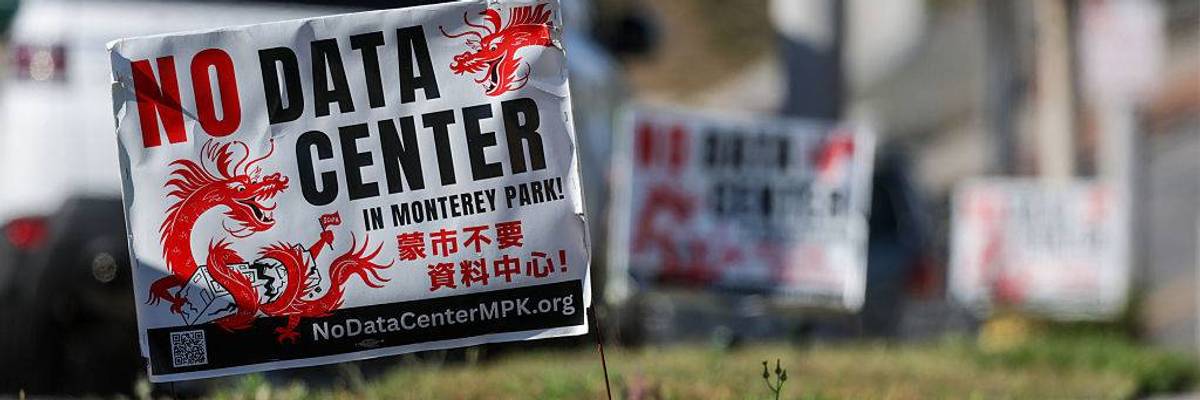
Anti-data center protest signs pepper front yards in a nearby residential neighborhood in Monterey Park, California on Wednesday, April 1, 2026.
"We hope that other communities will use the model set by residents here... as inspiration to stop data centers from encroaching in their backyard," said a Monterey Park city councilmember.
Voters in Monterey Park, California on Tuesday overwhelmingly approved a permanent ban on data centers within city limits, becoming the first city in the US to prohibit the power-hungry facilities via a ballot initiative.
In total, the anti-data center resolution passed with 86% voter support, with only 14% of voters opposed. The resolution's text said that a ban was necessary to "protect air quality, drinking water resources, and public health" and "prevent impacts to electricity and water rates."
Steven Kung, a leader of the local initiative, told ABC 7 Eyewitness News that the result was "a landslide victory."
Kung listed multiple reasons why residents in the city resoundingly rejected building data centers in their community.
"The noise pollution, the air pollution, the rise in the electricity rates," he said, "the deal just didn't make sense and it doesn't make sense for most, if not all, cities data centers go to."
In an interview with Politico, Monterey Park Mayor Elizabeth Yang predicted that her city would be far from the last to pass data center bans, noting data center projects have spurred protests across the country.
"A lot of the other cities that are facing data center proposals are going to follow suit," said Yang. "There's [a] bad reputation across the board, across the country, from other data centers that have been built in neighborhoods."
Monterey Park city councilmember Jose Sanchez expressed a similar sentiment, telling The Guardian that he hoped his city would become a inspiration to others.
"We hope that other communities will use the model set by residents here in Monterey Park," said Sanchez, "as inspiration to stop data centers from encroaching in their backyard."
Data centers have become political lightning rods in recent months, as residents across the country object to their massive resource consumption, which is leading to a major spike in utility bills, as well as the noise pollution they generate.
Sen. Bernie Sanders (I-Vt.) and Rep. Alexandria Ocasio-Cortez (D-NY) earlier this year introduced a bill that would impose a nationwide moratorium on AI data center construction “until strong national safeguards are in place to protect workers, consumers, and communities, defend privacy and civil rights, and ensure these technologies do not harm our environment."
A poll released on Wednesday by Public First showed US residents more opposed to data center construction than any nation in the world, with just 26% of Americans registering support for building more data centers.
This opposition isn't merely abstract, as it has caused major headaches for Big Tech firms that have been scrambling to increase their AI models' compute power.
As The Financial Times reported on Thursday, "dozens of projects collectively worth at least $156 billion have been blocked or stalled since 2025" thanks to local opposition to their development.
Dear Common Dreams reader, It’s been nearly 30 years since I co-founded Common Dreams with my late wife, Lina Newhouser. We had the radical notion that journalism should serve the public good, not corporate profits. It was clear to us from the outset what it would take to build such a project. No paid advertisements. No corporate sponsors. No millionaire publisher telling us what to think or do. Many people said we wouldn't last a year, but we proved those doubters wrong. Together with a tremendous team of journalists and dedicated staff, we built an independent media outlet free from the constraints of profits and corporate control. Our mission has always been simple: To inform. To inspire. To ignite change for the common good. Building Common Dreams was not easy. Our survival was never guaranteed. When you take on the most powerful forces—Wall Street greed, fossil fuel industry destruction, Big Tech lobbyists, and uber-rich oligarchs who have spent billions upon billions rigging the economy and democracy in their favor—the only bulwark you have is supporters who believe in your work. But here’s the urgent message from me today. It's never been this bad out there. And it's never been this hard to keep us going. At the very moment Common Dreams is most needed, the threats we face are intensifying. We need your support now more than ever. We don't accept corporate advertising and never will. We don't have a paywall because we don't think people should be blocked from critical news based on their ability to pay. Everything we do is funded by the donations of readers like you. When everyone does the little they can afford, we are strong. But if that support retreats or dries up, so do we. Will you donate now to make sure Common Dreams not only survives but thrives? —Craig Brown, Co-founder |
Voters in Monterey Park, California on Tuesday overwhelmingly approved a permanent ban on data centers within city limits, becoming the first city in the US to prohibit the power-hungry facilities via a ballot initiative.
In total, the anti-data center resolution passed with 86% voter support, with only 14% of voters opposed. The resolution's text said that a ban was necessary to "protect air quality, drinking water resources, and public health" and "prevent impacts to electricity and water rates."
Steven Kung, a leader of the local initiative, told ABC 7 Eyewitness News that the result was "a landslide victory."
Kung listed multiple reasons why residents in the city resoundingly rejected building data centers in their community.
"The noise pollution, the air pollution, the rise in the electricity rates," he said, "the deal just didn't make sense and it doesn't make sense for most, if not all, cities data centers go to."
In an interview with Politico, Monterey Park Mayor Elizabeth Yang predicted that her city would be far from the last to pass data center bans, noting data center projects have spurred protests across the country.
"A lot of the other cities that are facing data center proposals are going to follow suit," said Yang. "There's [a] bad reputation across the board, across the country, from other data centers that have been built in neighborhoods."
Monterey Park city councilmember Jose Sanchez expressed a similar sentiment, telling The Guardian that he hoped his city would become a inspiration to others.
"We hope that other communities will use the model set by residents here in Monterey Park," said Sanchez, "as inspiration to stop data centers from encroaching in their backyard."
Data centers have become political lightning rods in recent months, as residents across the country object to their massive resource consumption, which is leading to a major spike in utility bills, as well as the noise pollution they generate.
Sen. Bernie Sanders (I-Vt.) and Rep. Alexandria Ocasio-Cortez (D-NY) earlier this year introduced a bill that would impose a nationwide moratorium on AI data center construction “until strong national safeguards are in place to protect workers, consumers, and communities, defend privacy and civil rights, and ensure these technologies do not harm our environment."
A poll released on Wednesday by Public First showed US residents more opposed to data center construction than any nation in the world, with just 26% of Americans registering support for building more data centers.
This opposition isn't merely abstract, as it has caused major headaches for Big Tech firms that have been scrambling to increase their AI models' compute power.
As The Financial Times reported on Thursday, "dozens of projects collectively worth at least $156 billion have been blocked or stalled since 2025" thanks to local opposition to their development.
Voters in Monterey Park, California on Tuesday overwhelmingly approved a permanent ban on data centers within city limits, becoming the first city in the US to prohibit the power-hungry facilities via a ballot initiative.
In total, the anti-data center resolution passed with 86% voter support, with only 14% of voters opposed. The resolution's text said that a ban was necessary to "protect air quality, drinking water resources, and public health" and "prevent impacts to electricity and water rates."
Steven Kung, a leader of the local initiative, told ABC 7 Eyewitness News that the result was "a landslide victory."
Kung listed multiple reasons why residents in the city resoundingly rejected building data centers in their community.
"The noise pollution, the air pollution, the rise in the electricity rates," he said, "the deal just didn't make sense and it doesn't make sense for most, if not all, cities data centers go to."
In an interview with Politico, Monterey Park Mayor Elizabeth Yang predicted that her city would be far from the last to pass data center bans, noting data center projects have spurred protests across the country.
"A lot of the other cities that are facing data center proposals are going to follow suit," said Yang. "There's [a] bad reputation across the board, across the country, from other data centers that have been built in neighborhoods."
Monterey Park city councilmember Jose Sanchez expressed a similar sentiment, telling The Guardian that he hoped his city would become a inspiration to others.
"We hope that other communities will use the model set by residents here in Monterey Park," said Sanchez, "as inspiration to stop data centers from encroaching in their backyard."
Data centers have become political lightning rods in recent months, as residents across the country object to their massive resource consumption, which is leading to a major spike in utility bills, as well as the noise pollution they generate.
Sen. Bernie Sanders (I-Vt.) and Rep. Alexandria Ocasio-Cortez (D-NY) earlier this year introduced a bill that would impose a nationwide moratorium on AI data center construction “until strong national safeguards are in place to protect workers, consumers, and communities, defend privacy and civil rights, and ensure these technologies do not harm our environment."
A poll released on Wednesday by Public First showed US residents more opposed to data center construction than any nation in the world, with just 26% of Americans registering support for building more data centers.
This opposition isn't merely abstract, as it has caused major headaches for Big Tech firms that have been scrambling to increase their AI models' compute power.
As The Financial Times reported on Thursday, "dozens of projects collectively worth at least $156 billion have been blocked or stalled since 2025" thanks to local opposition to their development.