SUBSCRIBE TO OUR FREE NEWSLETTER
Daily news & progressive opinion—funded by the people, not the corporations—delivered straight to your inbox.
5
#000000
#FFFFFF
To donate by check, phone, or other method, see our More Ways to Give page.
Daily news & progressive opinion—funded by the people, not the corporations—delivered straight to your inbox.
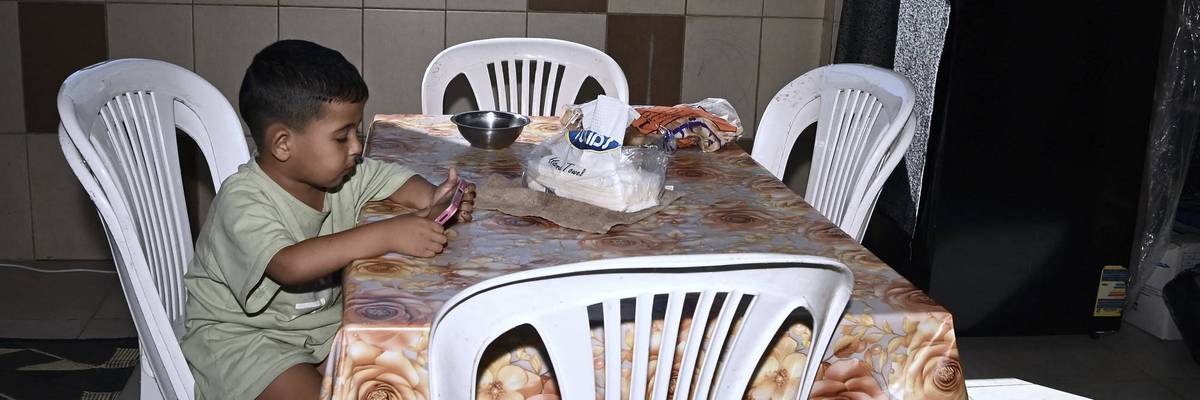
Four-year-old Ahmad looks at a phone while sitting at a table inside a one-room apartment at a makeshift refugee center at the Lebanese-German University in Tyre, Lebanon, on September 23, 2026.
After more than six months, 329,000 people in Lebanon remain displaced from their homes by Israel's occupation, one-third of whom are children.
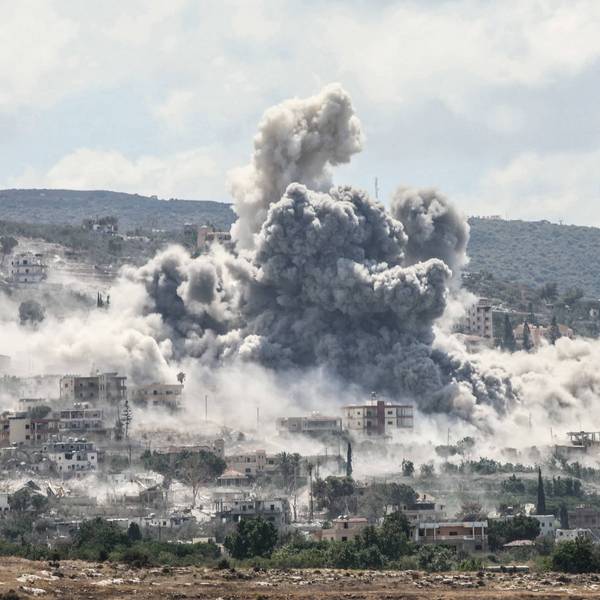
Israel's latest assault on Lebanon is inflicting widespread hunger, death, and injury on children across the country, according to a report out Wednesday from the United Nations Children's Fund.
Children go to bed hungry in at least one in five households, according to a survey conducted by UNICEF in July, while nearly a third are going without needed healthcare because their families are unable to afford it. Four in five households, the report says, have found it harder to afford basic necessities.
Nearly 17,000 people have been killed or injured since March. Among them are 261 children who've been killed and 1,056 who've been injured—and 12% of those injured now live with a disability.
Around 100,000 children are at risk of losing access to education. At least 436 schools have been damaged across the country, including 37 that were completely destroyed.
“Children and young people in Lebanon are being asked to bear a burden no child should have to carry,” said UNICEF Lebanon Representative Marcoluigi Corsi, who noted the report's finding that 770,000 children have suffered psychological distress over the past six months due to repeated exposure to violence, loss, and displacement.
Lebanon was already in the midst of an economic crisis that left many families poor. But the situation has grown markedly more severe since March, when Israel launched an ongoing occupation of southern Lebanon that has displaced more than 1.1 million people and unleashed punishing airstrikes across the country, including in densely populated civilian areas.
More than 329,000 of those displaced have yet to go home, and around one-third are children. Despite a ceasefire announced in April, Israeli officials have said that those ordered to leave their homes will not be allowed to return until they deem northern Israel "safe" from attacks by the militant group Hezbollah.
Israeli forces have systematically razed dozens of villages and farms in southern Lebanon, destroying tens of thousands of homes. As Al Jazeera reported earlier this week, Israel has predominantly demolished Shia villages while telling Christian villages they'll be spared so long as they stay neutral.
According to a June report by Amnesty International, about 6% of Lebanese territory is effectively under a "don't come back" order from Israel with residents barred indefinitely from returning home. Amnesty said the forced displacement and prevention of return in parts of southern Lebanon constitute unlawful transfer, a war crime.
Some Israeli leaders have discussed annexing the occupied portion of Lebanon and moving in Israeli settlers.
Earlier this week, Bezalel Smotrich—the Israeli finance minister who has overseen a historic surge of violent settlement expansion in the West Bank—said that he would "very much like to annex at least… up to the Litani [River] in Lebanon," extending the country's border into southern Lebanon.
Dear Common Dreams reader, It’s been nearly 30 years since I co-founded Common Dreams with my late wife, Lina Newhouser. We had the radical notion that journalism should serve the public good, not corporate profits. It was clear to us from the outset what it would take to build such a project. No paid advertisements. No corporate sponsors. No millionaire publisher telling us what to think or do. Many people said we wouldn't last a year, but we proved those doubters wrong. Together with a tremendous team of journalists and dedicated staff, we built an independent media outlet free from the constraints of profits and corporate control. Our mission has always been simple: To inform. To inspire. To ignite change for the common good. Building Common Dreams was not easy. Our survival was never guaranteed. When you take on the most powerful forces—Wall Street greed, fossil fuel industry destruction, Big Tech lobbyists, and uber-rich oligarchs who have spent billions upon billions rigging the economy and democracy in their favor—the only bulwark you have is supporters who believe in your work. But here’s the urgent message from me today. It's never been this bad out there. And it's never been this hard to keep us going. At the very moment Common Dreams is most needed, the threats we face are intensifying. We need your support now more than ever. We don't accept corporate advertising and never will. We don't have a paywall because we don't think people should be blocked from critical news based on their ability to pay. Everything we do is funded by the donations of readers like you. When everyone does the little they can afford, we are strong. But if that support retreats or dries up, so do we. Will you donate now to make sure Common Dreams not only survives but thrives? —Craig Brown, Co-founder |
Israel's latest assault on Lebanon is inflicting widespread hunger, death, and injury on children across the country, according to a report out Wednesday from the United Nations Children's Fund.
Children go to bed hungry in at least one in five households, according to a survey conducted by UNICEF in July, while nearly a third are going without needed healthcare because their families are unable to afford it. Four in five households, the report says, have found it harder to afford basic necessities.
Nearly 17,000 people have been killed or injured since March. Among them are 261 children who've been killed and 1,056 who've been injured—and 12% of those injured now live with a disability.
Around 100,000 children are at risk of losing access to education. At least 436 schools have been damaged across the country, including 37 that were completely destroyed.
“Children and young people in Lebanon are being asked to bear a burden no child should have to carry,” said UNICEF Lebanon Representative Marcoluigi Corsi, who noted the report's finding that 770,000 children have suffered psychological distress over the past six months due to repeated exposure to violence, loss, and displacement.
Lebanon was already in the midst of an economic crisis that left many families poor. But the situation has grown markedly more severe since March, when Israel launched an ongoing occupation of southern Lebanon that has displaced more than 1.1 million people and unleashed punishing airstrikes across the country, including in densely populated civilian areas.
More than 329,000 of those displaced have yet to go home, and around one-third are children. Despite a ceasefire announced in April, Israeli officials have said that those ordered to leave their homes will not be allowed to return until they deem northern Israel "safe" from attacks by the militant group Hezbollah.
Israeli forces have systematically razed dozens of villages and farms in southern Lebanon, destroying tens of thousands of homes. As Al Jazeera reported earlier this week, Israel has predominantly demolished Shia villages while telling Christian villages they'll be spared so long as they stay neutral.
According to a June report by Amnesty International, about 6% of Lebanese territory is effectively under a "don't come back" order from Israel with residents barred indefinitely from returning home. Amnesty said the forced displacement and prevention of return in parts of southern Lebanon constitute unlawful transfer, a war crime.
Some Israeli leaders have discussed annexing the occupied portion of Lebanon and moving in Israeli settlers.
Earlier this week, Bezalel Smotrich—the Israeli finance minister who has overseen a historic surge of violent settlement expansion in the West Bank—said that he would "very much like to annex at least… up to the Litani [River] in Lebanon," extending the country's border into southern Lebanon.
Israel's latest assault on Lebanon is inflicting widespread hunger, death, and injury on children across the country, according to a report out Wednesday from the United Nations Children's Fund.
Children go to bed hungry in at least one in five households, according to a survey conducted by UNICEF in July, while nearly a third are going without needed healthcare because their families are unable to afford it. Four in five households, the report says, have found it harder to afford basic necessities.
Nearly 17,000 people have been killed or injured since March. Among them are 261 children who've been killed and 1,056 who've been injured—and 12% of those injured now live with a disability.
Around 100,000 children are at risk of losing access to education. At least 436 schools have been damaged across the country, including 37 that were completely destroyed.
“Children and young people in Lebanon are being asked to bear a burden no child should have to carry,” said UNICEF Lebanon Representative Marcoluigi Corsi, who noted the report's finding that 770,000 children have suffered psychological distress over the past six months due to repeated exposure to violence, loss, and displacement.
Lebanon was already in the midst of an economic crisis that left many families poor. But the situation has grown markedly more severe since March, when Israel launched an ongoing occupation of southern Lebanon that has displaced more than 1.1 million people and unleashed punishing airstrikes across the country, including in densely populated civilian areas.
More than 329,000 of those displaced have yet to go home, and around one-third are children. Despite a ceasefire announced in April, Israeli officials have said that those ordered to leave their homes will not be allowed to return until they deem northern Israel "safe" from attacks by the militant group Hezbollah.
Israeli forces have systematically razed dozens of villages and farms in southern Lebanon, destroying tens of thousands of homes. As Al Jazeera reported earlier this week, Israel has predominantly demolished Shia villages while telling Christian villages they'll be spared so long as they stay neutral.
According to a June report by Amnesty International, about 6% of Lebanese territory is effectively under a "don't come back" order from Israel with residents barred indefinitely from returning home. Amnesty said the forced displacement and prevention of return in parts of southern Lebanon constitute unlawful transfer, a war crime.
Some Israeli leaders have discussed annexing the occupied portion of Lebanon and moving in Israeli settlers.
Earlier this week, Bezalel Smotrich—the Israeli finance minister who has overseen a historic surge of violent settlement expansion in the West Bank—said that he would "very much like to annex at least… up to the Litani [River] in Lebanon," extending the country's border into southern Lebanon.