

SUBSCRIBE TO OUR FREE NEWSLETTER
Daily news & progressive opinion—funded by the people, not the corporations—delivered straight to your inbox.
5
#000000
#FFFFFF
To donate by check, phone, or other method, see our More Ways to Give page.
Daily news & progressive opinion—funded by the people, not the corporations—delivered straight to your inbox.
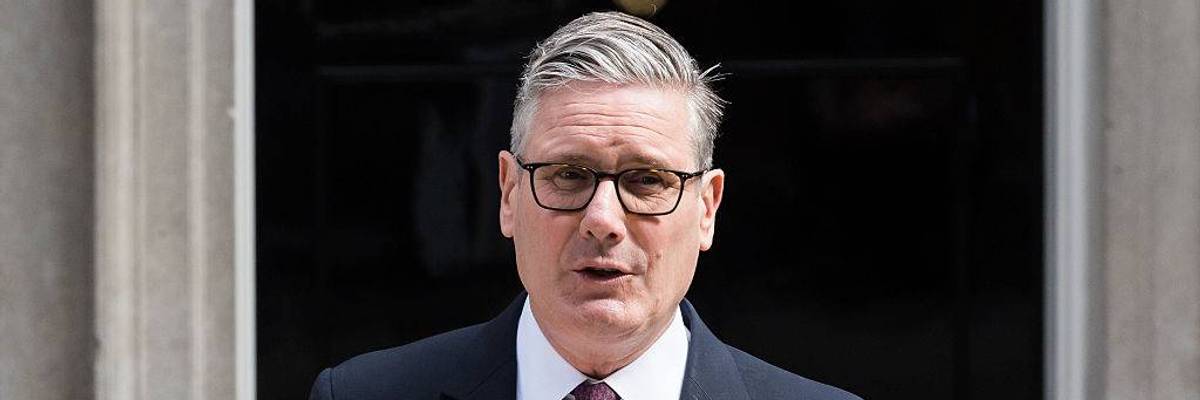
British Prime Minister Sir Keir Starmer gives a speech outside 10 Downing Street announcing his resignation in London, United Kingdom on June 22, 2026.
"Getting rid of Keir Starmer is not enough. We need to get rid of the politics he represents: corporate greed, anti-migrant rhetoric, and endless war," said former Labour leader Jeremy Corbyn.
UK Prime Minister Keir Starmer announced his resignation on Monday, less than two years after his Labour party swept into power in a landslide election.
In his resignation speech, Starmer said that he was stepping down because members of his party did not feel he was the best choice to lead them into the next general election, with polls showing the far-right anti-immigration Reform party currently on track to receive the most votes.
Starmer also said that whomever is chosen as his successor "will inherit a Britain that is far stronger and fairer than the one I inherited two years ago, better prepared for the challenges ahead and better able to ensure the Labour party secures a second term in office."
Starmer's progressive critics disputed this characterization of his governance, which they said has done little more than legitimize the far right.
Specifically, critics pointed to the Labour government's continued support of Israel in its genocidal assault on Gaza, its decision to proscribe Palestine Action as a terrorist group, and its efforts to court far-right voters by restricting immigration as some of its most destructive actions.
Former Labour leader Jeremy Corbyn said that Starmer had wasted the large majority that Labour had won and had done little if anything to improve the lives of the UK working class.
"Keir Starmer could have ended child poverty, homelessness and the grotesque levels of inequality in this country," Corbyn wrote. "Instead, he abandoned those in need, destroyed our civil liberties, and facilitated genocide in Gaza. That is how this prime minister will be remembered—and that is the legacy of moral and political bankruptcy he leaves behind."
Corbyn added that "getting rid of Keir Starmer is not enough," as "we need to get rid of the politics he represents: corporate greed, anti-migrant rhetoric, and endless war."
Member of Parliament Zarah Sultana, a former Labour MP who has since joined Corbyn's Your party, noted after watching the prime minister's speech that "the most emotion Keir Starmer has shown is over losing his job, not enabling the genocide of the Palestinian people."
"Good riddance," Sultana said. "His next stop should be The Hague."
Zack Polanski, leader of the Green party, predicted that Starmer's premiership would be remembered entirely negatively.
"Bills up. Wages too low," Polanski wrote, summarizing life in the UK under Starmer's leadership. "Record profits for oil and gas. Fifty richest families with more wealth than 50% of population. Shit in our rivers. Pensioners jailed for protesting. Migrants thrown under the bus. Supporting a genocide. That's Starmer's legacy."
Journalist Owen Jones delivered a similarly scathing assessment.
"Keir Starmer lied through his teeth to become Labour leader," Jones wrote. "He justified Israeli war crimes, arrested opponents of genocide, attacked pensioners, disabled people, and migrants, pocketed freebies, crushed dissent, and threw others under the bus to save himself. History damns him."
Economist Yanis Varoufakis delivered a lengthy rundown of Starmer's failures as prime minister, arguing he "was not merely a disappointment" but "a mendacious figure of ethical decrepitude, a man who won the Labour party leadership based on promises that he jettisoned five seconds after winning."
"History will remember Mr. Starmer as a man without conviction," Varoufakis wrote, "a prime minister who offers not a shred of honesty, but merely the cruel illusion of change. He is ethically decrepit because he had chosen, consciously, to abandon principle for power. And for that, history will indict him. Good riddance, I say."
Dear Common Dreams reader, It’s been nearly 30 years since I co-founded Common Dreams with my late wife, Lina Newhouser. We had the radical notion that journalism should serve the public good, not corporate profits. It was clear to us from the outset what it would take to build such a project. No paid advertisements. No corporate sponsors. No millionaire publisher telling us what to think or do. Many people said we wouldn't last a year, but we proved those doubters wrong. Together with a tremendous team of journalists and dedicated staff, we built an independent media outlet free from the constraints of profits and corporate control. Our mission has always been simple: To inform. To inspire. To ignite change for the common good. Building Common Dreams was not easy. Our survival was never guaranteed. When you take on the most powerful forces—Wall Street greed, fossil fuel industry destruction, Big Tech lobbyists, and uber-rich oligarchs who have spent billions upon billions rigging the economy and democracy in their favor—the only bulwark you have is supporters who believe in your work. But here’s the urgent message from me today. It's never been this bad out there. And it's never been this hard to keep us going. At the very moment Common Dreams is most needed, the threats we face are intensifying. We need your support now more than ever. We don't accept corporate advertising and never will. We don't have a paywall because we don't think people should be blocked from critical news based on their ability to pay. Everything we do is funded by the donations of readers like you. When everyone does the little they can afford, we are strong. But if that support retreats or dries up, so do we. Will you donate now to make sure Common Dreams not only survives but thrives? —Craig Brown, Co-founder |
UK Prime Minister Keir Starmer announced his resignation on Monday, less than two years after his Labour party swept into power in a landslide election.
In his resignation speech, Starmer said that he was stepping down because members of his party did not feel he was the best choice to lead them into the next general election, with polls showing the far-right anti-immigration Reform party currently on track to receive the most votes.
Starmer also said that whomever is chosen as his successor "will inherit a Britain that is far stronger and fairer than the one I inherited two years ago, better prepared for the challenges ahead and better able to ensure the Labour party secures a second term in office."
Starmer's progressive critics disputed this characterization of his governance, which they said has done little more than legitimize the far right.
Specifically, critics pointed to the Labour government's continued support of Israel in its genocidal assault on Gaza, its decision to proscribe Palestine Action as a terrorist group, and its efforts to court far-right voters by restricting immigration as some of its most destructive actions.
Former Labour leader Jeremy Corbyn said that Starmer had wasted the large majority that Labour had won and had done little if anything to improve the lives of the UK working class.
"Keir Starmer could have ended child poverty, homelessness and the grotesque levels of inequality in this country," Corbyn wrote. "Instead, he abandoned those in need, destroyed our civil liberties, and facilitated genocide in Gaza. That is how this prime minister will be remembered—and that is the legacy of moral and political bankruptcy he leaves behind."
Corbyn added that "getting rid of Keir Starmer is not enough," as "we need to get rid of the politics he represents: corporate greed, anti-migrant rhetoric, and endless war."
Member of Parliament Zarah Sultana, a former Labour MP who has since joined Corbyn's Your party, noted after watching the prime minister's speech that "the most emotion Keir Starmer has shown is over losing his job, not enabling the genocide of the Palestinian people."
"Good riddance," Sultana said. "His next stop should be The Hague."
Zack Polanski, leader of the Green party, predicted that Starmer's premiership would be remembered entirely negatively.
"Bills up. Wages too low," Polanski wrote, summarizing life in the UK under Starmer's leadership. "Record profits for oil and gas. Fifty richest families with more wealth than 50% of population. Shit in our rivers. Pensioners jailed for protesting. Migrants thrown under the bus. Supporting a genocide. That's Starmer's legacy."
Journalist Owen Jones delivered a similarly scathing assessment.
"Keir Starmer lied through his teeth to become Labour leader," Jones wrote. "He justified Israeli war crimes, arrested opponents of genocide, attacked pensioners, disabled people, and migrants, pocketed freebies, crushed dissent, and threw others under the bus to save himself. History damns him."
Economist Yanis Varoufakis delivered a lengthy rundown of Starmer's failures as prime minister, arguing he "was not merely a disappointment" but "a mendacious figure of ethical decrepitude, a man who won the Labour party leadership based on promises that he jettisoned five seconds after winning."
"History will remember Mr. Starmer as a man without conviction," Varoufakis wrote, "a prime minister who offers not a shred of honesty, but merely the cruel illusion of change. He is ethically decrepit because he had chosen, consciously, to abandon principle for power. And for that, history will indict him. Good riddance, I say."
UK Prime Minister Keir Starmer announced his resignation on Monday, less than two years after his Labour party swept into power in a landslide election.
In his resignation speech, Starmer said that he was stepping down because members of his party did not feel he was the best choice to lead them into the next general election, with polls showing the far-right anti-immigration Reform party currently on track to receive the most votes.
Starmer also said that whomever is chosen as his successor "will inherit a Britain that is far stronger and fairer than the one I inherited two years ago, better prepared for the challenges ahead and better able to ensure the Labour party secures a second term in office."
Starmer's progressive critics disputed this characterization of his governance, which they said has done little more than legitimize the far right.
Specifically, critics pointed to the Labour government's continued support of Israel in its genocidal assault on Gaza, its decision to proscribe Palestine Action as a terrorist group, and its efforts to court far-right voters by restricting immigration as some of its most destructive actions.
Former Labour leader Jeremy Corbyn said that Starmer had wasted the large majority that Labour had won and had done little if anything to improve the lives of the UK working class.
"Keir Starmer could have ended child poverty, homelessness and the grotesque levels of inequality in this country," Corbyn wrote. "Instead, he abandoned those in need, destroyed our civil liberties, and facilitated genocide in Gaza. That is how this prime minister will be remembered—and that is the legacy of moral and political bankruptcy he leaves behind."
Corbyn added that "getting rid of Keir Starmer is not enough," as "we need to get rid of the politics he represents: corporate greed, anti-migrant rhetoric, and endless war."
Member of Parliament Zarah Sultana, a former Labour MP who has since joined Corbyn's Your party, noted after watching the prime minister's speech that "the most emotion Keir Starmer has shown is over losing his job, not enabling the genocide of the Palestinian people."
"Good riddance," Sultana said. "His next stop should be The Hague."
Zack Polanski, leader of the Green party, predicted that Starmer's premiership would be remembered entirely negatively.
"Bills up. Wages too low," Polanski wrote, summarizing life in the UK under Starmer's leadership. "Record profits for oil and gas. Fifty richest families with more wealth than 50% of population. Shit in our rivers. Pensioners jailed for protesting. Migrants thrown under the bus. Supporting a genocide. That's Starmer's legacy."
Journalist Owen Jones delivered a similarly scathing assessment.
"Keir Starmer lied through his teeth to become Labour leader," Jones wrote. "He justified Israeli war crimes, arrested opponents of genocide, attacked pensioners, disabled people, and migrants, pocketed freebies, crushed dissent, and threw others under the bus to save himself. History damns him."
Economist Yanis Varoufakis delivered a lengthy rundown of Starmer's failures as prime minister, arguing he "was not merely a disappointment" but "a mendacious figure of ethical decrepitude, a man who won the Labour party leadership based on promises that he jettisoned five seconds after winning."
"History will remember Mr. Starmer as a man without conviction," Varoufakis wrote, "a prime minister who offers not a shred of honesty, but merely the cruel illusion of change. He is ethically decrepit because he had chosen, consciously, to abandon principle for power. And for that, history will indict him. Good riddance, I say."

