SUBSCRIBE TO OUR FREE NEWSLETTER
Daily news & progressive opinion—funded by the people, not the corporations—delivered straight to your inbox.
5
#000000
#FFFFFF
To donate by check, phone, or other method, see our More Ways to Give page.
Daily news & progressive opinion—funded by the people, not the corporations—delivered straight to your inbox.
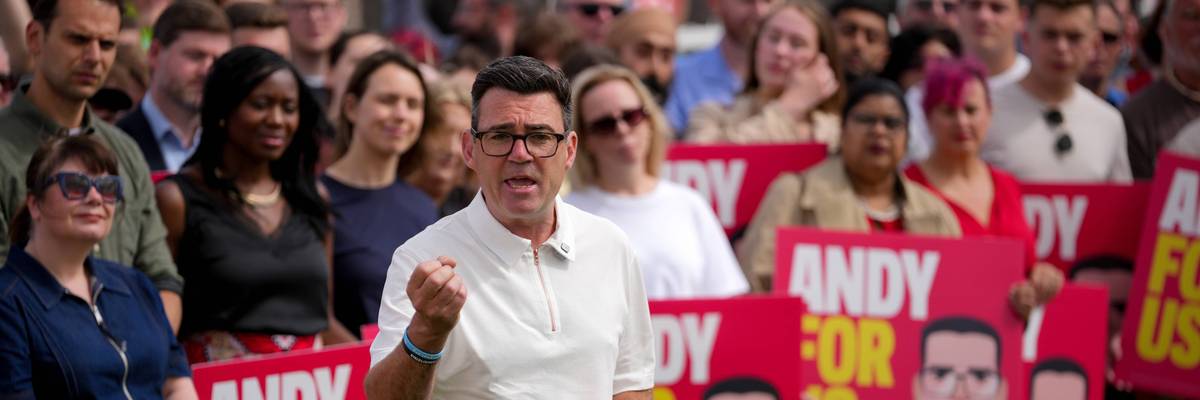
Former Manchester Mayor Andy Burnham speaks as he celebrates his victory in yesterday's Makerfield by-election, at Ashton Town Football Club, on June 19, 2026 in Ashton in Makerfield, England.
Jeremy Corbyn said Andy Burnham would be "accepting too much of the austerity that we've had imposed upon us" and "doesn't appear to be doing anything different internationally."
UK Prime Minister Keir Starmer is expected to announce as soon as Monday that he will resign, according to new reports, as Labour supporters abandon the party.
But many on the left remain skeptical that his likely replacement, Andy Burnham, will truly bring the "change" he promises.
Britain's Observer newspaper reported on Saturday that the prime minister appeared "resigned" to stepping down, well aware that "support isn't there" for his continued leadership amid the party's dismal unpopularity.
Though Starmer swept away nearly a decade and a half of Conservative rule in 2024, his honeymoon has been short-lived. His embrace of austerity in the face of a cost-of-living crisis and his government's ferocious crackdowns on pro-Palestinian speech have left progressive supporters seeking alternatives like the ascendant Green Party.
Meanwhile, his hard-right pivot on immigration has done little to siphon votes from Brexiteer Nigel Farage's far-right Reform UK party, which currently leads in national polls.
The immediate trigger for Starmer's reported resignation was Burnham's victory in Thursday's Makerfield by-election, which marked the former mayor of Greater Manchester's return to Westminster. Burnham comfortably defeated a Reform UK candidate, and The Guardian reported that he was expected to have support from about 200 Labour MPs in a leadership challenge against Starmer.
Burnham emphasized during a victory rally that it was "a last chance to change" Labour as it heads for electoral oblivion.
Responding to what he said were requests from constituents to "do something to make life more affordable," Burnham called for an end to "trickle down economics," with government interventions to bring down utility bills and rail fares, public procurement of businesses, pushes for reindustrialization, and job guarantees for people ages 16 to 18.
But some leaders on the British left have warned that Burnham will do little to deviate from Starmer's failures.
While he has pledged to reverse Starmer's welfare cuts and privatizations of public services, Burnham has also committed to maintaining the party's spending limits, which may make significant changes impossible.
Islington North MP Jeremy Corbyn, who led the Labour Party from 2015-20, said that while he personally likes Burnham, "his basic economic strategy and views... seem to me to be accepting too much of the austerity that we've had imposed upon us."
The ex-leader also said Burnham "doesn't appear to be doing anything different internationally," noting that he has not given a straight answer on whether Britain should conduct an inquiry into the UK government's policy on Gaza and its supply of weapons to Israel.
Burnham has also drawn criticism for saying he would maintain Home Secretary Shabana Mahmood, who has spearheaded hard-line changes to UK asylum policies and has enforced the repressive ban on Palestine Action, which has led to the arrest of thousands of nonviolent protesters, many of whom have been charged with terrorism.
"The architect of Labour’s cruel plans on settled status and persecution of free speech and protest stays in place," said Green Party leader Zack Polanski, who said it was a sign of "more of the same."
Remarking on Burnham's team of economic advisers, who include former chief economists for the Bank of England and Goldman Sachs, Polanski said it "isn’t a team of advisers which looks like challenging wealth and power."
This country and this world are at a monumental crossroads. US voters have an opportunity to beat back the forces of fascism and confront the billionaires who are rigging the economy, our media system, and our democracy, making it increasingly impossible for ordinary people to get by. We’re not just talking about the election. We’re talking about what must be done once these fascist elements are vanquished from power. We need a bolder set of solutions than what either major party has so far been willing to offer and a working-class movement ready to fight like hell for it. Trump didn't emerge from nowhere. The conditions that fueled MAGA authoritarianism were created by decades of radical neoliberal economic policies and a corrupt political system dominated by corporate interests. They slashed taxes on the super-rich, promising that the benefits would trickle down. They said giveaways to the corporate titans would make life more affordable for the rest of us. It was all bullshit. And when a bitter, betrayed populace searches for someone to blame, right-wing demagogues have little trouble finding scapegoats. People know when they're being lied to, but you won't hear any of this from the corporate media. Only independent journalism—powered and funded by people who believe in building a better world—can deliver truly trustworthy daily news. If you share our vision, please contribute whatever you can to sustain our work. |
UK Prime Minister Keir Starmer is expected to announce as soon as Monday that he will resign, according to new reports, as Labour supporters abandon the party.
But many on the left remain skeptical that his likely replacement, Andy Burnham, will truly bring the "change" he promises.
Britain's Observer newspaper reported on Saturday that the prime minister appeared "resigned" to stepping down, well aware that "support isn't there" for his continued leadership amid the party's dismal unpopularity.
Though Starmer swept away nearly a decade and a half of Conservative rule in 2024, his honeymoon has been short-lived. His embrace of austerity in the face of a cost-of-living crisis and his government's ferocious crackdowns on pro-Palestinian speech have left progressive supporters seeking alternatives like the ascendant Green Party.
Meanwhile, his hard-right pivot on immigration has done little to siphon votes from Brexiteer Nigel Farage's far-right Reform UK party, which currently leads in national polls.
The immediate trigger for Starmer's reported resignation was Burnham's victory in Thursday's Makerfield by-election, which marked the former mayor of Greater Manchester's return to Westminster. Burnham comfortably defeated a Reform UK candidate, and The Guardian reported that he was expected to have support from about 200 Labour MPs in a leadership challenge against Starmer.
Burnham emphasized during a victory rally that it was "a last chance to change" Labour as it heads for electoral oblivion.
Responding to what he said were requests from constituents to "do something to make life more affordable," Burnham called for an end to "trickle down economics," with government interventions to bring down utility bills and rail fares, public procurement of businesses, pushes for reindustrialization, and job guarantees for people ages 16 to 18.
But some leaders on the British left have warned that Burnham will do little to deviate from Starmer's failures.
While he has pledged to reverse Starmer's welfare cuts and privatizations of public services, Burnham has also committed to maintaining the party's spending limits, which may make significant changes impossible.
Islington North MP Jeremy Corbyn, who led the Labour Party from 2015-20, said that while he personally likes Burnham, "his basic economic strategy and views... seem to me to be accepting too much of the austerity that we've had imposed upon us."
The ex-leader also said Burnham "doesn't appear to be doing anything different internationally," noting that he has not given a straight answer on whether Britain should conduct an inquiry into the UK government's policy on Gaza and its supply of weapons to Israel.
Burnham has also drawn criticism for saying he would maintain Home Secretary Shabana Mahmood, who has spearheaded hard-line changes to UK asylum policies and has enforced the repressive ban on Palestine Action, which has led to the arrest of thousands of nonviolent protesters, many of whom have been charged with terrorism.
"The architect of Labour’s cruel plans on settled status and persecution of free speech and protest stays in place," said Green Party leader Zack Polanski, who said it was a sign of "more of the same."
Remarking on Burnham's team of economic advisers, who include former chief economists for the Bank of England and Goldman Sachs, Polanski said it "isn’t a team of advisers which looks like challenging wealth and power."