SUBSCRIBE TO OUR FREE NEWSLETTER
Daily news & progressive opinion—funded by the people, not the corporations—delivered straight to your inbox.
5
#000000
#FFFFFF
To donate by check, phone, or other method, see our More Ways to Give page.
Daily news & progressive opinion—funded by the people, not the corporations—delivered straight to your inbox.
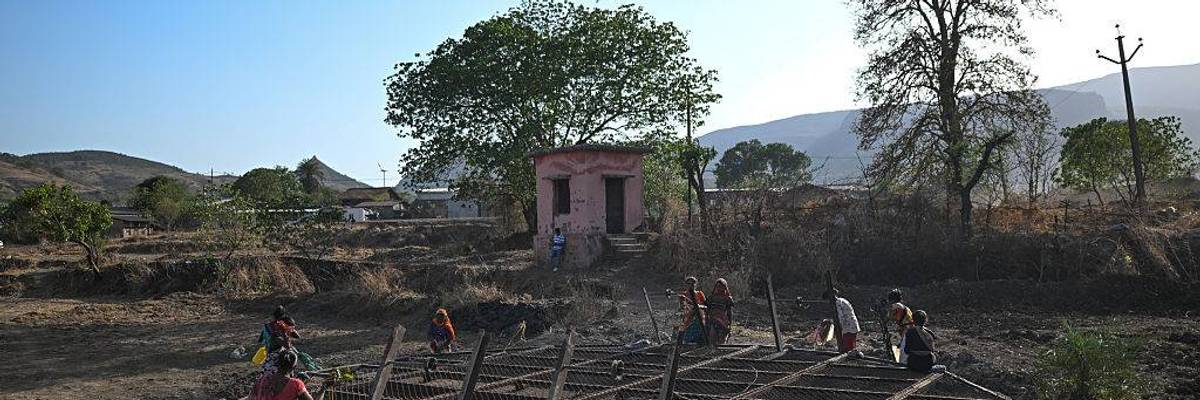
Women collect contaminated and polluted water from a partially dried community well on May 28, 2026 in the outskirts of Nashik, Maharashtra, India.
The lead author of the new report noted that predicted weather patterns could mean the record is shattered as soon as next year.
Global temperatures are likely to hit their highest average level ever within the next four years, according to a report published Thursday by the United Nations' World Meteorological Organization.
Overall, WMO's report projects an 86% chance that the world will experience its warmest year ever between 2026 and 2030, with a 91% chance that "the global mean near-surface temperature will temporarily exceed 1.5°C above the 1850-1900 average levels for at least one year between 2026 and 2030."
Exceeding temperatures from the pre-industrial average by 1.5°C "risks unleashing ever more severe climate change impacts and extreme weather, and decreases adaptation option," the report notes.
Leon Hermanson, lead author of the report, said there's a good chance that 2027 will break all-time temperature records set in 2024 given that meteorologists are predicting an El Niño weather pattern to develop this summer and continue through the end of this year.
One particularly troubling finding in the report is that "Arctic temperatures over the next five extended northern hemisphere winters (November-March) are predicted to be 2.8°C above average temperatures for 1991-2020, an anomaly more than three and half times that of global mean temperature anomaly over the same period."
These higher Arctic temperatures mean likely further reductions in ice in the Barents Sea, Bering Sea, and Sea of Okhotsk, the report warns.
Simon Stiell, executive secretary of the United Nations Framework Convention on Climate Change, said in a Thursday interview with The Guardian that Europe's current heatwave is a preview of what's to come the longer the global climate crisis goes unaddressed.
"Protecting human lives, businesses and economies from extreme heat and the many other soaring costs of climate change is core business for every nation," said Stiell, "and it starts with kicking the fossil fuel addiction much faster."
Dear Common Dreams reader, It’s been nearly 30 years since I co-founded Common Dreams with my late wife, Lina Newhouser. We had the radical notion that journalism should serve the public good, not corporate profits. It was clear to us from the outset what it would take to build such a project. No paid advertisements. No corporate sponsors. No millionaire publisher telling us what to think or do. Many people said we wouldn't last a year, but we proved those doubters wrong. Together with a tremendous team of journalists and dedicated staff, we built an independent media outlet free from the constraints of profits and corporate control. Our mission has always been simple: To inform. To inspire. To ignite change for the common good. Building Common Dreams was not easy. Our survival was never guaranteed. When you take on the most powerful forces—Wall Street greed, fossil fuel industry destruction, Big Tech lobbyists, and uber-rich oligarchs who have spent billions upon billions rigging the economy and democracy in their favor—the only bulwark you have is supporters who believe in your work. But here’s the urgent message from me today. It's never been this bad out there. And it's never been this hard to keep us going. At the very moment Common Dreams is most needed, the threats we face are intensifying. We need your support now more than ever. We don't accept corporate advertising and never will. We don't have a paywall because we don't think people should be blocked from critical news based on their ability to pay. Everything we do is funded by the donations of readers like you. When everyone does the little they can afford, we are strong. But if that support retreats or dries up, so do we. Will you donate now to make sure Common Dreams not only survives but thrives? —Craig Brown, Co-founder |
Global temperatures are likely to hit their highest average level ever within the next four years, according to a report published Thursday by the United Nations' World Meteorological Organization.
Overall, WMO's report projects an 86% chance that the world will experience its warmest year ever between 2026 and 2030, with a 91% chance that "the global mean near-surface temperature will temporarily exceed 1.5°C above the 1850-1900 average levels for at least one year between 2026 and 2030."
Exceeding temperatures from the pre-industrial average by 1.5°C "risks unleashing ever more severe climate change impacts and extreme weather, and decreases adaptation option," the report notes.
Leon Hermanson, lead author of the report, said there's a good chance that 2027 will break all-time temperature records set in 2024 given that meteorologists are predicting an El Niño weather pattern to develop this summer and continue through the end of this year.
One particularly troubling finding in the report is that "Arctic temperatures over the next five extended northern hemisphere winters (November-March) are predicted to be 2.8°C above average temperatures for 1991-2020, an anomaly more than three and half times that of global mean temperature anomaly over the same period."
These higher Arctic temperatures mean likely further reductions in ice in the Barents Sea, Bering Sea, and Sea of Okhotsk, the report warns.
Simon Stiell, executive secretary of the United Nations Framework Convention on Climate Change, said in a Thursday interview with The Guardian that Europe's current heatwave is a preview of what's to come the longer the global climate crisis goes unaddressed.
"Protecting human lives, businesses and economies from extreme heat and the many other soaring costs of climate change is core business for every nation," said Stiell, "and it starts with kicking the fossil fuel addiction much faster."
Global temperatures are likely to hit their highest average level ever within the next four years, according to a report published Thursday by the United Nations' World Meteorological Organization.
Overall, WMO's report projects an 86% chance that the world will experience its warmest year ever between 2026 and 2030, with a 91% chance that "the global mean near-surface temperature will temporarily exceed 1.5°C above the 1850-1900 average levels for at least one year between 2026 and 2030."
Exceeding temperatures from the pre-industrial average by 1.5°C "risks unleashing ever more severe climate change impacts and extreme weather, and decreases adaptation option," the report notes.
Leon Hermanson, lead author of the report, said there's a good chance that 2027 will break all-time temperature records set in 2024 given that meteorologists are predicting an El Niño weather pattern to develop this summer and continue through the end of this year.
One particularly troubling finding in the report is that "Arctic temperatures over the next five extended northern hemisphere winters (November-March) are predicted to be 2.8°C above average temperatures for 1991-2020, an anomaly more than three and half times that of global mean temperature anomaly over the same period."
These higher Arctic temperatures mean likely further reductions in ice in the Barents Sea, Bering Sea, and Sea of Okhotsk, the report warns.
Simon Stiell, executive secretary of the United Nations Framework Convention on Climate Change, said in a Thursday interview with The Guardian that Europe's current heatwave is a preview of what's to come the longer the global climate crisis goes unaddressed.
"Protecting human lives, businesses and economies from extreme heat and the many other soaring costs of climate change is core business for every nation," said Stiell, "and it starts with kicking the fossil fuel addiction much faster."